Non-farm payroll data countdown: Goldilocks or stagflation nightmare? Fed rate cuts may be blocked.
2026-04-03 10:54:43
With the release of the US March non-farm payrolls report on April 3rd imminent, global financial markets are in a highly tense atmosphere. The focus has subtly shifted: people are no longer simply debating whether the labor market data is "overheated" or "overcooled," but rather turning their attention to the unprecedented dilemma facing the Federal Reserve. On the one hand, the labor market is showing signs of cooling; on the other hand, the surge in oil prices triggered by geopolitical conflicts in the Middle East is threatening to reignite inflation. This looming shadow of "stagflation" forces investors to reassess whether the resilience of the US economy in the second quarter of 2026 can be sustained or whether a significant pullback is imminent.

According to market consensus, non-farm payrolls (NFP) in March are expected to see a relatively modest rebound, with the number of new jobs likely falling between 50,000 and 65,000. While this figure represents a recovery from the astonishing low of 92,000 in February, it remains relatively weak historically and falls far short of the robust performance expected during a normal expansion cycle.
Meanwhile, the average hourly wage growth rate is expected to remain in the range of 0.3% to 0.4% month-on-month , indicating that wage levels remain relatively sluggish. This phenomenon of weak employment growth but wages failing to fall quickly is precisely the signal that the market is most wary of.
If the actual data deteriorates further, especially if job growth falls below 50,000 while wage growth exceeds 0.5%, then the narrative of a "stagflation shock" will gain decisive support. This would directly push the Federal Reserve into a predicament where it cannot easily cut interest rates, as any easing measures could be seen as adding fuel to the inflation fire.
Regarding the unemployment rate , the market expects it to remain relatively stable, or rise slightly to the range of 4.4% to 4.5%. While this subtle change may seem mild, it could further reinforce the signal of a cooling labor market, especially given the already significantly weakened hiring intentions of businesses.
From an overall perspective, in the current early stages of the crisis, companies are even reluctant to actively expand their hiring, and this cautious attitude is quietly changing the underlying driving force of the US economy.
Of all the possible outcomes, the most worrying for the market is the "stagflation shock"—that is, significantly weaker-than-expected employment data coupled with unexpectedly strong wage growth. This scenario would be disastrous for the Dow Jones Industrial Average, as it would mean the Federal Reserve would be caught in a dilemma: unable to stimulate economic growth through interest rate cuts, yet forced to confront inflationary pressures from both rising wages and energy prices. Investors generally believe this combination would completely dispel expectations of further easing in the remainder of 2026, triggering a new round of panic selling in the stock market.
In contrast, a "Goldilocks-like" scenario for non-farm payroll data—with new jobs falling between 70,000 and 90,000—would be considered the most welcome outcome for the stock market. This would indicate that the economy is cooling sufficiently to support future easing policies without signaling a complete collapse in consumer demand. In this scenario, the Dow Jones Industrial Average could potentially reclaim the important psychological level of 49,000 points, resuming the upward momentum that was interrupted by geopolitical risks during the previous "AI honeymoon period."
The US Dollar Index (DXY) is currently fluctuating within a wide range of 95.50 to 100.50, mainly due to the continued inflow of safe-haven funds. Its future direction will depend heavily on the final performance of the non-farm payroll data.
If non-farm payrolls unexpectedly strengthen, exceeding 100,000, this would be interpreted as strong evidence that the "wartime economy" still possesses considerable resilience. Traders might quickly rule out the possibility of further rate cuts by the Federal Reserve in the remainder of 2026, thus propelling the dollar index towards the key resistance level of 100.40 to 100.50, and potentially even breaking through it. Conversely, if the data significantly misses expectations, falling below 30,000 jobs, then concerns about a "hard landing" will quickly intensify, and the dollar index may fall back to the support area around 98.00, as the market will be betting that even in the face of an oil price shock, the Federal Reserve will be forced to prioritize policies supporting economic growth.
The Dow Jones Industrial Average has recently entered a clear "spiral downward" trend, experiencing several sharp drops during the day. The "AI honeymoon period" that the market had high hopes for in early 2026 is now facing the harsh reality of geopolitical risks. In the current environment, only moderate and balanced employment data can bring it true salvation. A "Goldilocks-style" result would be the scenario the Dow most desires, as it would send a hopeful signal of a soft landing for the economy, thus providing room for the stock market to recover.
However, once stagflation signals are confirmed—with employment below 50,000 but wage growth exceeding 0.5%—the Dow Jones Industrial Average could face even more intense selling pressure, potentially falling to 48,000 points or lower. This scenario would completely entangle the Federal Reserve, leaving it caught between combating inflation and supporting growth.
From a technical analysis perspective, the market is currently showing clear signs of fatigue. The US dollar index has formed a potential triple top pattern around 100.50, while the Dow Jones Industrial Average is struggling to hold its key psychological support level. With most markets closed on Friday for the Easter holiday, the real market rally is likely to be delayed until Monday's opening. Investors also need to closely monitor the revision of the February non-farm payroll data—if the figure of -92,000 is further revised downwards, the previous narrative of "low hiring, low layoffs" could quickly collapse, triggering deeper concerns about the health of US consumers.
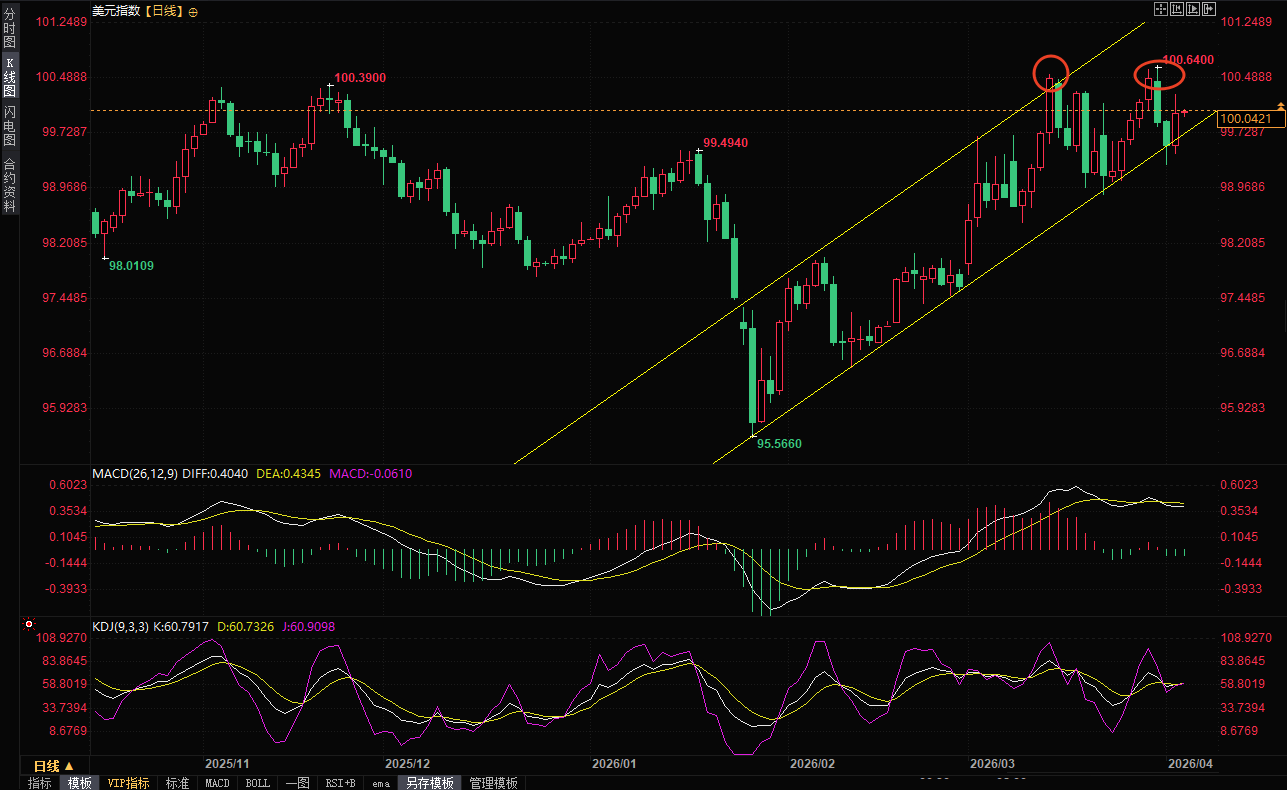
(US Dollar Index Daily Chart, Source: FX678)
Overall, the March non-farm payroll report will be a key watershed moment for the US stock indices (Dow Jones, S&P 500, and Nasdaq 100) in the second quarter of 2026. It will not only test the true resilience of the labor market but also determine the Federal Reserve's difficult choice between an oil shock and an economic slowdown. Regardless of the final data, it will profoundly impact the safe-haven status of the US dollar index and the recovery potential of the Dow Jones index. Market participants must remain highly vigilant and closely monitor data revisions and subsequent reactions on the first trading day after the holiday to gain an advantage in this "stagflation storm."
At 10:53 Beijing time, the US dollar index is currently at 100.04.
Key expectations for the March jobs report: Sticky concerns amid a historically weak rebound.
According to market consensus, non-farm payrolls (NFP) in March are expected to see a relatively modest rebound, with the number of new jobs likely falling between 50,000 and 65,000. While this figure represents a recovery from the astonishing low of 92,000 in February, it remains relatively weak historically and falls far short of the robust performance expected during a normal expansion cycle.
Meanwhile, the average hourly wage growth rate is expected to remain in the range of 0.3% to 0.4% month-on-month , indicating that wage levels remain relatively sluggish. This phenomenon of weak employment growth but wages failing to fall quickly is precisely the signal that the market is most wary of.
If the actual data deteriorates further, especially if job growth falls below 50,000 while wage growth exceeds 0.5%, then the narrative of a "stagflation shock" will gain decisive support. This would directly push the Federal Reserve into a predicament where it cannot easily cut interest rates, as any easing measures could be seen as adding fuel to the inflation fire.
Regarding the unemployment rate , the market expects it to remain relatively stable, or rise slightly to the range of 4.4% to 4.5%. While this subtle change may seem mild, it could further reinforce the signal of a cooling labor market, especially given the already significantly weakened hiring intentions of businesses.
From an overall perspective, in the current early stages of the crisis, companies are even reluctant to actively expand their hiring, and this cautious attitude is quietly changing the underlying driving force of the US economy.
Worst-case scenario for the "stagflation shock": The Fed's path to interest rate cuts is completely blocked.
Of all the possible outcomes, the most worrying for the market is the "stagflation shock"—that is, significantly weaker-than-expected employment data coupled with unexpectedly strong wage growth. This scenario would be disastrous for the Dow Jones Industrial Average, as it would mean the Federal Reserve would be caught in a dilemma: unable to stimulate economic growth through interest rate cuts, yet forced to confront inflationary pressures from both rising wages and energy prices. Investors generally believe this combination would completely dispel expectations of further easing in the remainder of 2026, triggering a new round of panic selling in the stock market.
In contrast, a "Goldilocks-like" scenario for non-farm payroll data—with new jobs falling between 70,000 and 90,000—would be considered the most welcome outcome for the stock market. This would indicate that the economy is cooling sufficiently to support future easing policies without signaling a complete collapse in consumer demand. In this scenario, the Dow Jones Industrial Average could potentially reclaim the important psychological level of 49,000 points, resuming the upward momentum that was interrupted by geopolitical risks during the previous "AI honeymoon period."
Three Scenarios for the US Dollar Index: The Ceiling Test Under Safe-Haven Support
The US Dollar Index (DXY) is currently fluctuating within a wide range of 95.50 to 100.50, mainly due to the continued inflow of safe-haven funds. Its future direction will depend heavily on the final performance of the non-farm payroll data.
If non-farm payrolls unexpectedly strengthen, exceeding 100,000, this would be interpreted as strong evidence that the "wartime economy" still possesses considerable resilience. Traders might quickly rule out the possibility of further rate cuts by the Federal Reserve in the remainder of 2026, thus propelling the dollar index towards the key resistance level of 100.40 to 100.50, and potentially even breaking through it. Conversely, if the data significantly misses expectations, falling below 30,000 jobs, then concerns about a "hard landing" will quickly intensify, and the dollar index may fall back to the support area around 98.00, as the market will be betting that even in the face of an oil price shock, the Federal Reserve will be forced to prioritize policies supporting economic growth.
The fate of the Dow Jones Industrial Average: A chance for "Goldilocks" to save itself after its spiral decline.
The Dow Jones Industrial Average has recently entered a clear "spiral downward" trend, experiencing several sharp drops during the day. The "AI honeymoon period" that the market had high hopes for in early 2026 is now facing the harsh reality of geopolitical risks. In the current environment, only moderate and balanced employment data can bring it true salvation. A "Goldilocks-style" result would be the scenario the Dow most desires, as it would send a hopeful signal of a soft landing for the economy, thus providing room for the stock market to recover.
However, once stagflation signals are confirmed—with employment below 50,000 but wage growth exceeding 0.5%—the Dow Jones Industrial Average could face even more intense selling pressure, potentially falling to 48,000 points or lower. This scenario would completely entangle the Federal Reserve, leaving it caught between combating inflation and supporting growth.
Technical Signals and Market Dynamics: Signs of Exhaustion Have Quietly Emerged
From a technical analysis perspective, the market is currently showing clear signs of fatigue. The US dollar index has formed a potential triple top pattern around 100.50, while the Dow Jones Industrial Average is struggling to hold its key psychological support level. With most markets closed on Friday for the Easter holiday, the real market rally is likely to be delayed until Monday's opening. Investors also need to closely monitor the revision of the February non-farm payroll data—if the figure of -92,000 is further revised downwards, the previous narrative of "low hiring, low layoffs" could quickly collapse, triggering deeper concerns about the health of US consumers.
(US Dollar Index Daily Chart, Source: FX678)
Summary and Outlook: A real storm may be brewing after the holidays.
Overall, the March non-farm payroll report will be a key watershed moment for the US stock indices (Dow Jones, S&P 500, and Nasdaq 100) in the second quarter of 2026. It will not only test the true resilience of the labor market but also determine the Federal Reserve's difficult choice between an oil shock and an economic slowdown. Regardless of the final data, it will profoundly impact the safe-haven status of the US dollar index and the recovery potential of the Dow Jones index. Market participants must remain highly vigilant and closely monitor data revisions and subsequent reactions on the first trading day after the holiday to gain an advantage in this "stagflation storm."
At 10:53 Beijing time, the US dollar index is currently at 100.04.
- Risk Warning and Disclaimer
- The market involves risk, and trading may not be suitable for all investors. This article is for reference only and does not constitute personal investment advice, nor does it take into account certain users’ specific investment objectives, financial situation, or other needs. Any investment decisions made based on this information are at your own risk.