













The escalating tensions in the Middle East have increased demand for the US dollar as a safe haven, while weak Japanese consumption has caused the USD/JPY pair to retest the 160 level.
2026-04-07 10:22:47
On Tuesday during Asian trading hours, USD/JPY touched a one-week high, approaching the 160.00 level but failing to break through effectively, exhibiting an overall volatile but slightly bullish trend. Current exchange rate movements are primarily influenced by divergent fundamentals and the interplay of policy expectations.
From Japan's perspective, weak economic data has continued to put downward pressure on the yen. According to data released by Japan's Ministry of Internal Affairs and Communications, household spending in Japan fell 1.8% year-on-year in February, marking the third consecutive month of decline, indicating that consumer spending momentum remains weak. Although there was a slight rebound month-on-month, the overall performance fell short of expectations, reflecting that the foundation for domestic demand recovery is still not solid. This data reinforced market caution regarding the Japanese economic outlook, thereby weakening the yen's performance.

Meanwhile, continued tensions in the Middle East are further amplifying the pressure on the Japanese economy. Given Japan's heavy reliance on energy imports, particularly crude oil from the Middle East, the risks surrounding the Strait of Hormuz have raised concerns that rising energy costs will hinder Japan's economic recovery. Against this backdrop, market expectations for a near-term interest rate hike by the Bank of Japan have cooled significantly, further weakening the yen.
For the US dollar, safe-haven demand was the main supporting factor. US President Donald Trump's tough stance on the Middle East situation, and Iran's rejection of ceasefire proposals, fueled market concerns about an escalation of the conflict. This not only increased the dollar's safe-haven appeal but also strengthened market expectations of rising inflation, thus supporting the Federal Reserve's continued tight policy stance. The dollar therefore remained strong, providing upward momentum for the USD/JPY exchange rate.
However, it's important to note that the expectation of potential intervention by Japanese authorities is a significant constraint on the exchange rate. Historical experience shows that the probability of policy intervention increases markedly when the exchange rate approaches or breaks through key psychological levels. Therefore, despite the fundamentals favoring a strong dollar, the exchange rate faces strong resistance around 160.
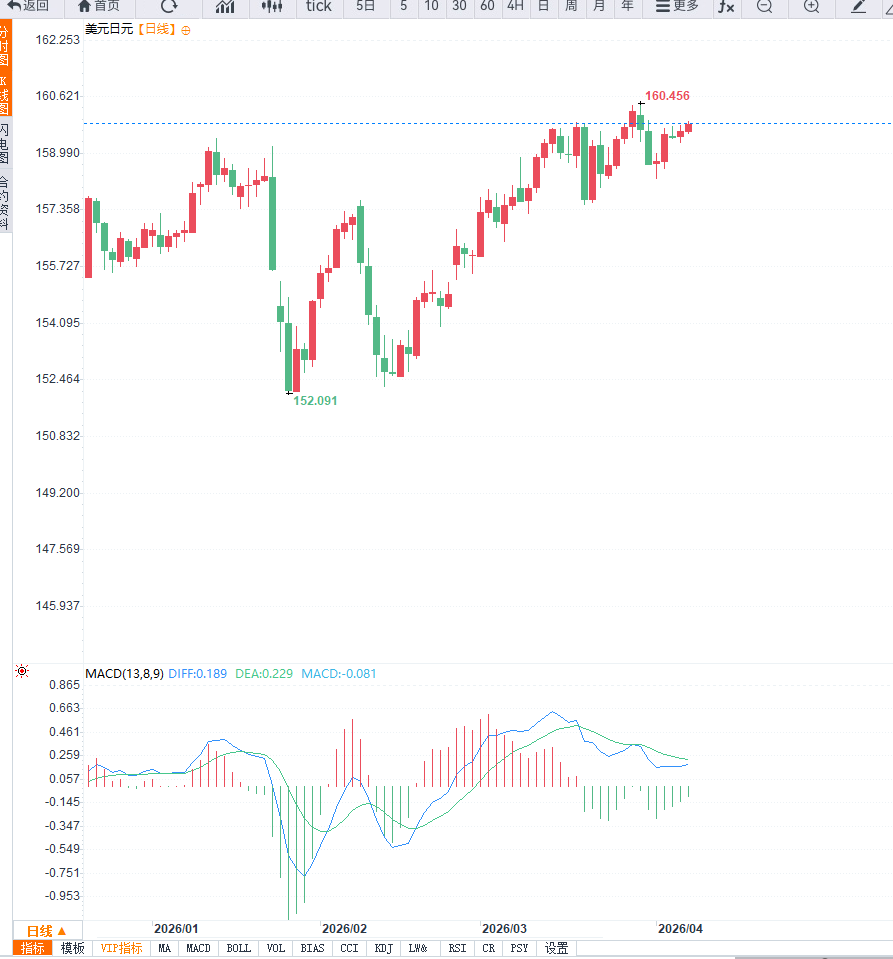
From a technical perspective, on the daily chart, USD/JPY remains within an upward trend channel, having risen steadily since the February lows, with both highs and lows gradually moving higher, forming a complete trend structure. The current price is approaching the previous high area, creating significant technical resistance. Key resistance lies in the 160.00-160.50 range ; a decisive break above this level would open up further upside potential. Support lies at 158.00 , with further support at 156.50 . Momentum indicators suggest that bulls still have the upper hand, but the pace of the upward movement has slowed.
On the 4-hour chart, the exchange rate is showing an upward trend with short-term moving averages maintaining a bullish alignment. However, the price has repeatedly encountered resistance near the 160 level, indicating strong selling pressure above. The RSI is near the high level but has not entered the extreme overbought zone, suggesting that there is still some upward momentum, but the upside potential is limited. A break above 160.50 could trigger an accelerated rise; a break below 158.00 could lead to a short-term correction.
Editor's Summary:
The current USD/JPY exchange rate is driven by a strong dollar and weak yen fundamentals, but is also constrained by expectations of policy intervention. The situation in the Middle East and rising energy prices are putting pressure on the Japanese economy, weakening the yen's performance, while the dollar remains strong due to safe-haven demand and interest rate expectations. Technically, the exchange rate remains in an upward trend, but faces strong resistance near key psychological levels. In the short term, USD/JPY may maintain a high-level consolidation with a slightly bullish bias; whether it breaks through will depend on changes in geopolitical tensions and policy signals.
From Japan's perspective, weak economic data has continued to put downward pressure on the yen. According to data released by Japan's Ministry of Internal Affairs and Communications, household spending in Japan fell 1.8% year-on-year in February, marking the third consecutive month of decline, indicating that consumer spending momentum remains weak. Although there was a slight rebound month-on-month, the overall performance fell short of expectations, reflecting that the foundation for domestic demand recovery is still not solid. This data reinforced market caution regarding the Japanese economic outlook, thereby weakening the yen's performance.
Meanwhile, continued tensions in the Middle East are further amplifying the pressure on the Japanese economy. Given Japan's heavy reliance on energy imports, particularly crude oil from the Middle East, the risks surrounding the Strait of Hormuz have raised concerns that rising energy costs will hinder Japan's economic recovery. Against this backdrop, market expectations for a near-term interest rate hike by the Bank of Japan have cooled significantly, further weakening the yen.
For the US dollar, safe-haven demand was the main supporting factor. US President Donald Trump's tough stance on the Middle East situation, and Iran's rejection of ceasefire proposals, fueled market concerns about an escalation of the conflict. This not only increased the dollar's safe-haven appeal but also strengthened market expectations of rising inflation, thus supporting the Federal Reserve's continued tight policy stance. The dollar therefore remained strong, providing upward momentum for the USD/JPY exchange rate.
However, it's important to note that the expectation of potential intervention by Japanese authorities is a significant constraint on the exchange rate. Historical experience shows that the probability of policy intervention increases markedly when the exchange rate approaches or breaks through key psychological levels. Therefore, despite the fundamentals favoring a strong dollar, the exchange rate faces strong resistance around 160.
From a technical perspective, on the daily chart, USD/JPY remains within an upward trend channel, having risen steadily since the February lows, with both highs and lows gradually moving higher, forming a complete trend structure. The current price is approaching the previous high area, creating significant technical resistance. Key resistance lies in the 160.00-160.50 range ; a decisive break above this level would open up further upside potential. Support lies at 158.00 , with further support at 156.50 . Momentum indicators suggest that bulls still have the upper hand, but the pace of the upward movement has slowed.
On the 4-hour chart, the exchange rate is showing an upward trend with short-term moving averages maintaining a bullish alignment. However, the price has repeatedly encountered resistance near the 160 level, indicating strong selling pressure above. The RSI is near the high level but has not entered the extreme overbought zone, suggesting that there is still some upward momentum, but the upside potential is limited. A break above 160.50 could trigger an accelerated rise; a break below 158.00 could lead to a short-term correction.
Editor's Summary:
The current USD/JPY exchange rate is driven by a strong dollar and weak yen fundamentals, but is also constrained by expectations of policy intervention. The situation in the Middle East and rising energy prices are putting pressure on the Japanese economy, weakening the yen's performance, while the dollar remains strong due to safe-haven demand and interest rate expectations. Technically, the exchange rate remains in an upward trend, but faces strong resistance near key psychological levels. In the short term, USD/JPY may maintain a high-level consolidation with a slightly bullish bias; whether it breaks through will depend on changes in geopolitical tensions and policy signals.
- Risk Warning and Disclaimer
- The market involves risk, and trading may not be suitable for all investors. This article is for reference only and does not constitute personal investment advice, nor does it take into account certain users’ specific investment objectives, financial situation, or other needs. Any investment decisions made based on this information are at your own risk.

