The window of opportunity between the US and Iran is only two weeks, but the war may already be over?
2026-04-08 16:13:18
With Pakistan's mediation, the United States and Iran officially entered into a two-week temporary ceasefire agreement on April 8, and delegations from both sides will begin political negotiations in Islamabad on April 10 (this Friday).
This ceasefire is a key compromise before the "deadline" set by Trump for a large-scale military strike, but Iran has made it clear that "the ceasefire does not mean the end of the war." The core of the negotiations revolves around three major issues: the opening of the Strait of Hormuz, the withdrawal of US troops, and the lifting of sanctions. The regional security landscape is facing the most profound adjustment since the Cold War.
However, this round of negotiations may only be a temporary pause in the US-Iran conflict, because the US is backed by Jewish financial groups, while for Israel and pro-US oil-producing countries in the Middle East, the threat from Iran has not been eliminated.

This ceasefire marks the first strategic pause between the US and Iran after nearly six weeks of conflict.
Since the outbreak of the conflict on February 28, the US and Israel have launched more than 3,000 strikes against Iran, while Iran has launched 1,511 counterattacks against Israel and Gulf countries. Both sides are under tremendous military and economic pressure.
In his ceasefire statement, Trump emphasized that the agreement was based on Iran's "full, immediate, and safe opening of the Strait of Hormuz," otherwise he would restart escalation operations. Iran's Supreme National Security Council stated in its statement that the goal of the negotiations was to "consolidate the gains of the battlefield and establish a new regional security order," and expressed "complete distrust" of the United States.
According to the agreement, Israel will simultaneously suspend its strikes against Iran during the ceasefire period, and the US military has suspended its airstrikes within Iranian territory.
However, Iran has repeatedly emphasized that the ceasefire is only a "tactical pause," and that if the US or Israel "makes a mistake," Iran will immediately resume its full-scale counterattack.
The negotiation period will last a maximum of 15 days, which can be extended with the consent of both parties. The Supreme National Security Council of Iran will lead the negotiation process, with its secretary, Zulqadir, reporting directly to the Supreme Leader to ensure that decisions are in line with Iran's core interests.
The Strait of Hormuz, a vital passage for approximately 20% of global oil trade and 20% of liquefied natural gas transportation, is the absolute core of these negotiations. The two sides hold sharply opposing positions, with Iran's 10-point plan contrasting sharply with the US demands:
US position: Insisting on "freedom of navigation" and refusing to relinquish sovereignty. The Trump administration has always regarded the "free and unimpeded passage" of the Strait of Hormuz as a core national interest, demanding that Iran open it unconditionally and fully, and opposing the use of the strait as a bargaining chip.
The US believes that Iran's control over the Strait of Hormuz directly threatens the stability of global energy supplies and that the normal order of international shipping must be restored. It does not accept any form of "regulated passage" or "fee mechanism".
Iran's proposal: "Regulated passage" to establish dominance. Iran rejected the US demands and put forward a 10-point ceasefire plan, the core of which is "controlled passage coordinated by the Iranian armed forces" and the formulation of a Straits security agreement to ensure Iranian dominance.
Specifically, it includes:
Over the next two weeks, ships will only be allowed to pass through the strait under the coordination and technical restrictions of the Iranian armed forces; there is no commitment to full opening.
They advocate for tiered control over passing vessels (banning from enemy countries, providing green channels for friendly countries, and requiring reporting and review for neutral countries), and plan to jointly collect passage fees with Oman.
They demanded that the Straits control plan be incorporated into a binding UN Security Council resolution, making it a new regional order within the framework of international law.
Iranian Foreign Minister Araqchi explicitly stated that safe navigation through the Strait "must be coordinated with Iranian armed forces," leaving ample room for Iran to independently define the boundaries of its compliance.
Besides control of the Straits, Iran's 10-point plan outlines three rigid conditions that directly target the United States' strategic presence in the Middle East and the foundation of its policy towards Iran:
Full lifting of sanctions: Demands that the United States lift all primary and secondary sanctions, revoke relevant UN Security Council and IAEA resolutions, and unfreeze all frozen Iranian assets overseas;
The US withdrawal demanded that "US combat troops withdraw from all bases and deployment sites in the region," but did not specify the scope of "combat troops," leaving room for further negotiations.
War reparations and ceasefire extension: Demand that the United States fully compensate Iran for its war losses, end its attacks on the "axis of resistance" (including Hezbollah in Lebanon), and cease fighting on all fronts.
Iranian Ambassador to Pakistan, Moghaddam, bluntly warned Gulf states: "The United States will eventually be defeated and withdraw, while you will remain in the region for a long time," implying that Iran will reshape the security order as a regional leader.
Just hours after the ceasefire agreement took effect, intense military clashes erupted in the Gulf region, directly impacting the credibility of the ceasefire.
In the early hours of April 8, the Israeli military reported detecting a ballistic missile attack by Iran, prompting air raid sirens to be sounded in central and northern Israel. The UAE, Saudi Arabia, Kuwait, Bahrain, and Qatar simultaneously activated their air defense systems to intercept the missiles and drones launched by Iran.
This attack exposed three major real dilemmas, with air defense systems on the verge of collapse: the Patriot interceptor stockpiles of several Gulf countries are running low, with the UAE and Kuwait having used up about 75% and Bahrain up to 87%, making them vulnerable to saturation attacks and lacking the ability to defend against Iran's low-cost swarm drones.
Energy infrastructure suffers severe damage: Qatar's Ras Lafan LNG plant suffered a 17% loss in capacity due to an attack, with a recovery period of several years, putting continued pressure on the region's energy supply;
The Gulf states are divided: UAE Presidential Advisor Gargash explicitly opposes a "temporary ceasefire without substantial guarantees," stating that "there is no basis for trust in the current Iranian regime"; Saudi Arabia, Kuwait, and other countries are worried that their security will be compromised after the US withdrawal, leading to strategic anxiety.
As mentioned repeatedly in previous articles, the US and Iran may be negotiating behind the scenes. In this political game, both sides need to gain the trust of their people and will declare victory. However, observing the 2,000-year history of Persia, we can see that without exception, when faced with a powerful enemy, negotiations always end in the end, and even significant concessions are made. Persian wisdom has made this ancient country very good at balancing the power of various parties. They may appear ready to fight to the death, but they never actually fight to the death.
Therefore, Iran definitely hopes to negotiate and will selectively compromise from the 10 draft conditions. If no unexpected problems arise, the war should be able to end.
Iran can compromise on nuclear weapons, maintaining its uranium enrichment technology at a semi-military level, and does not need nuclear weapons in the short term, as the Strait of Hormuz and missile threats to neighboring oil-producing countries are already lethal enough. However, it needs the security of fraternal organizations such as the Houthis in Yemen, the Iraqi militia, Hezbollah in Lebanon, and the Syrian Shiite coalition.
For the US to withdraw gracefully, it will certainly need Iran to make a superficial compromise on nuclear and enriched uranium issues. As for whether there will be a fee for passage through the Strait of Hormuz, according to the US, that is a matter for countries like Europe that need to use the Strait. At the same time, the passage of ships from the pro-US camp, especially those carrying crude oil or other cargo, will likely be charged.
However, this round of negotiations cannot be ruled out as merely a buffer in the Middle East conflict, a way to allow countries to evacuate the "hostage ships" trapped in the Persian Gulf. There is also the possibility of accidental clashes along the way, such as an Israeli offensive, or the US suddenly raising its prices at the negotiating table, making it impossible to reach a substantive agreement. Therefore, the short-term outlook for crude oil transportation remains pessimistic.
Moreover, for countries like Israel, the UAE, and Saudi Arabia, it is difficult for them to believe that the threat from Iran has been eliminated, because Iran and its brother organizations still possess strong military deterrent capabilities, and they hope to retain the United States to continue to contain Iran.
As a result, oil prices may begin a sustained rebound after this one-off adjustment. At the same time, after the release of global risk appetite, funds will remain cautious, because a slowdown in global economic growth is almost an inevitable objective phenomenon in the face of high oil prices.
From a technical perspective, oil prices have held above the 0.618 Fibonacci retracement level. The next level to watch is the resistance at 97 and 102. If these levels are reached, oil prices could continue to rebound.
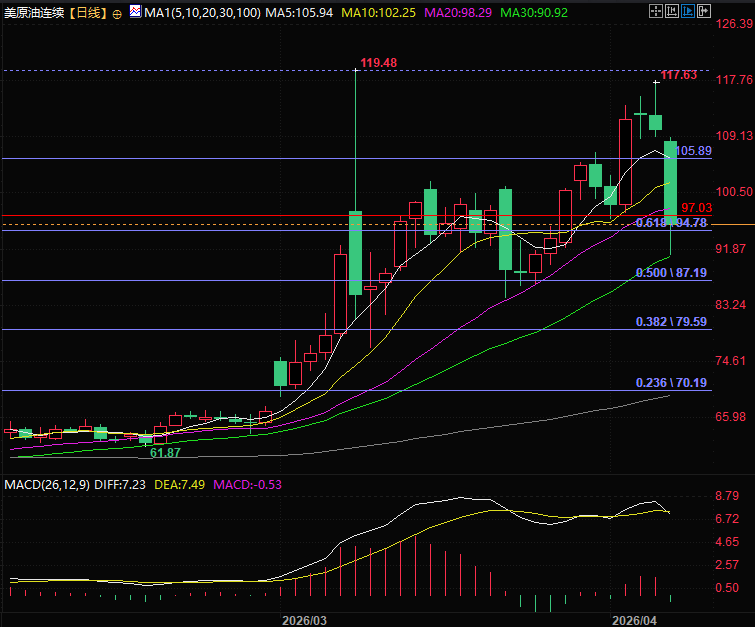
(WTI crude oil futures contract daily chart, source: EasyForex)
At 15:54 Beijing time, WTI crude oil futures were trading at $95.79 per barrel.
This ceasefire is a key compromise before the "deadline" set by Trump for a large-scale military strike, but Iran has made it clear that "the ceasefire does not mean the end of the war." The core of the negotiations revolves around three major issues: the opening of the Strait of Hormuz, the withdrawal of US troops, and the lifting of sanctions. The regional security landscape is facing the most profound adjustment since the Cold War.
However, this round of negotiations may only be a temporary pause in the US-Iran conflict, because the US is backed by Jewish financial groups, while for Israel and pro-US oil-producing countries in the Middle East, the threat from Iran has not been eliminated.
Ceasefire and Negotiations: A Fragile Window of Opportunity, a Firm Bottom Line
This ceasefire marks the first strategic pause between the US and Iran after nearly six weeks of conflict.
Since the outbreak of the conflict on February 28, the US and Israel have launched more than 3,000 strikes against Iran, while Iran has launched 1,511 counterattacks against Israel and Gulf countries. Both sides are under tremendous military and economic pressure.
In his ceasefire statement, Trump emphasized that the agreement was based on Iran's "full, immediate, and safe opening of the Strait of Hormuz," otherwise he would restart escalation operations. Iran's Supreme National Security Council stated in its statement that the goal of the negotiations was to "consolidate the gains of the battlefield and establish a new regional security order," and expressed "complete distrust" of the United States.
According to the agreement, Israel will simultaneously suspend its strikes against Iran during the ceasefire period, and the US military has suspended its airstrikes within Iranian territory.
However, Iran has repeatedly emphasized that the ceasefire is only a "tactical pause," and that if the US or Israel "makes a mistake," Iran will immediately resume its full-scale counterattack.
The negotiation period will last a maximum of 15 days, which can be extended with the consent of both parties. The Supreme National Security Council of Iran will lead the negotiation process, with its secretary, Zulqadir, reporting directly to the Supreme Leader to ensure that decisions are in line with Iran's core interests.
The Strait of Hormuz: A Battle for Control of the Global Energy Throat
The Strait of Hormuz, a vital passage for approximately 20% of global oil trade and 20% of liquefied natural gas transportation, is the absolute core of these negotiations. The two sides hold sharply opposing positions, with Iran's 10-point plan contrasting sharply with the US demands:
US position: Insisting on "freedom of navigation" and refusing to relinquish sovereignty. The Trump administration has always regarded the "free and unimpeded passage" of the Strait of Hormuz as a core national interest, demanding that Iran open it unconditionally and fully, and opposing the use of the strait as a bargaining chip.
The US believes that Iran's control over the Strait of Hormuz directly threatens the stability of global energy supplies and that the normal order of international shipping must be restored. It does not accept any form of "regulated passage" or "fee mechanism".
Iran's proposal: "Regulated passage" to establish dominance. Iran rejected the US demands and put forward a 10-point ceasefire plan, the core of which is "controlled passage coordinated by the Iranian armed forces" and the formulation of a Straits security agreement to ensure Iranian dominance.
Specifically, it includes:
Over the next two weeks, ships will only be allowed to pass through the strait under the coordination and technical restrictions of the Iranian armed forces; there is no commitment to full opening.
They advocate for tiered control over passing vessels (banning from enemy countries, providing green channels for friendly countries, and requiring reporting and review for neutral countries), and plan to jointly collect passage fees with Oman.
They demanded that the Straits control plan be incorporated into a binding UN Security Council resolution, making it a new regional order within the framework of international law.
Iranian Foreign Minister Araqchi explicitly stated that safe navigation through the Strait "must be coordinated with Iranian armed forces," leaving ample room for Iran to independently define the boundaries of its compliance.
Iran's core demands: troop withdrawal, sanctions, and reparations, aiming to comprehensively reshape the regional landscape.
Besides control of the Straits, Iran's 10-point plan outlines three rigid conditions that directly target the United States' strategic presence in the Middle East and the foundation of its policy towards Iran:
Full lifting of sanctions: Demands that the United States lift all primary and secondary sanctions, revoke relevant UN Security Council and IAEA resolutions, and unfreeze all frozen Iranian assets overseas;
The US withdrawal demanded that "US combat troops withdraw from all bases and deployment sites in the region," but did not specify the scope of "combat troops," leaving room for further negotiations.
War reparations and ceasefire extension: Demand that the United States fully compensate Iran for its war losses, end its attacks on the "axis of resistance" (including Hezbollah in Lebanon), and cease fighting on all fronts.
Iranian Ambassador to Pakistan, Moghaddam, bluntly warned Gulf states: "The United States will eventually be defeated and withdraw, while you will remain in the region for a long time," implying that Iran will reshape the security order as a regional leader.
Ceasefire Takes Effect Immediately, Attacks Imminent: Regional Security Crisis Under a Fragile Balance
Just hours after the ceasefire agreement took effect, intense military clashes erupted in the Gulf region, directly impacting the credibility of the ceasefire.
In the early hours of April 8, the Israeli military reported detecting a ballistic missile attack by Iran, prompting air raid sirens to be sounded in central and northern Israel. The UAE, Saudi Arabia, Kuwait, Bahrain, and Qatar simultaneously activated their air defense systems to intercept the missiles and drones launched by Iran.
This attack exposed three major real dilemmas, with air defense systems on the verge of collapse: the Patriot interceptor stockpiles of several Gulf countries are running low, with the UAE and Kuwait having used up about 75% and Bahrain up to 87%, making them vulnerable to saturation attacks and lacking the ability to defend against Iran's low-cost swarm drones.
Energy infrastructure suffers severe damage: Qatar's Ras Lafan LNG plant suffered a 17% loss in capacity due to an attack, with a recovery period of several years, putting continued pressure on the region's energy supply;
The Gulf states are divided: UAE Presidential Advisor Gargash explicitly opposes a "temporary ceasefire without substantial guarantees," stating that "there is no basis for trust in the current Iranian regime"; Saudi Arabia, Kuwait, and other countries are worried that their security will be compromised after the US withdrawal, leading to strategic anxiety.
Future Outlook: Tactical Pause or Landscape Restructuring?
As mentioned repeatedly in previous articles, the US and Iran may be negotiating behind the scenes. In this political game, both sides need to gain the trust of their people and will declare victory. However, observing the 2,000-year history of Persia, we can see that without exception, when faced with a powerful enemy, negotiations always end in the end, and even significant concessions are made. Persian wisdom has made this ancient country very good at balancing the power of various parties. They may appear ready to fight to the death, but they never actually fight to the death.
Therefore, Iran definitely hopes to negotiate and will selectively compromise from the 10 draft conditions. If no unexpected problems arise, the war should be able to end.
Iran can compromise on nuclear weapons, maintaining its uranium enrichment technology at a semi-military level, and does not need nuclear weapons in the short term, as the Strait of Hormuz and missile threats to neighboring oil-producing countries are already lethal enough. However, it needs the security of fraternal organizations such as the Houthis in Yemen, the Iraqi militia, Hezbollah in Lebanon, and the Syrian Shiite coalition.
For the US to withdraw gracefully, it will certainly need Iran to make a superficial compromise on nuclear and enriched uranium issues. As for whether there will be a fee for passage through the Strait of Hormuz, according to the US, that is a matter for countries like Europe that need to use the Strait. At the same time, the passage of ships from the pro-US camp, especially those carrying crude oil or other cargo, will likely be charged.
However, this round of negotiations cannot be ruled out as merely a buffer in the Middle East conflict, a way to allow countries to evacuate the "hostage ships" trapped in the Persian Gulf. There is also the possibility of accidental clashes along the way, such as an Israeli offensive, or the US suddenly raising its prices at the negotiating table, making it impossible to reach a substantive agreement. Therefore, the short-term outlook for crude oil transportation remains pessimistic.
Moreover, for countries like Israel, the UAE, and Saudi Arabia, it is difficult for them to believe that the threat from Iran has been eliminated, because Iran and its brother organizations still possess strong military deterrent capabilities, and they hope to retain the United States to continue to contain Iran.
As a result, oil prices may begin a sustained rebound after this one-off adjustment. At the same time, after the release of global risk appetite, funds will remain cautious, because a slowdown in global economic growth is almost an inevitable objective phenomenon in the face of high oil prices.
From a technical perspective, oil prices have held above the 0.618 Fibonacci retracement level. The next level to watch is the resistance at 97 and 102. If these levels are reached, oil prices could continue to rebound.
(WTI crude oil futures contract daily chart, source: EasyForex)
At 15:54 Beijing time, WTI crude oil futures were trading at $95.79 per barrel.
- Risk Warning and Disclaimer
- The market involves risk, and trading may not be suitable for all investors. This article is for reference only and does not constitute personal investment advice, nor does it take into account certain users’ specific investment objectives, financial situation, or other needs. Any investment decisions made based on this information are at your own risk.