Dalio warns: The US-Iran conflict is just the beginning; gold remains the safe haven.
2026-04-08 18:04:26
In his latest analysis, Bridgewater Associates founder Ray Dalio stated that the current conflict between the US, Israel, and Iran is by no means an accidental local confrontation, but rather an inevitable product of the global "great cycle" entering a disordered phase.
This macro investment master, with over 50 years of experience, pointed out through his research on the evolution of war and order over the past five centuries that the world is currently in the early stages of a world war with "no clear declaration of war and multiple intertwined fronts," with the US-Iran war being only the most closely watched component.
Dalio emphasizes that most people and markets have fallen into a short-sighted trap—they focus excessively on short-term issues such as the opening of the Strait of Hormuz, oil price fluctuations, and the deployment of US troops, while ignoring the deeper logic behind the conflicts: the world has formed a pattern of multiple hot and non-hot wars intertwined, including the Russia-Ukraine-Europe-US conflict, the multi-country conflict in the Middle East, proxy wars in Asia and Africa, and comprehensive confrontations covering trade, technology, capital, and geopolitical influence.

These conflicts are interconnected and mutually reinforcing, forming a classic dynamic highly similar to the "world wars" in history. Moreover, they involve multiple nuclear powers, and the risk transmission effect far exceeds that of conventional local wars.
More importantly, the market's prevailing pricing logic that "the war will end soon and everything will return to normal" is seriously flawed. Dalio warns that this world war "will not end in the short term," and is currently only in its initial stage. Escalation of the conflict is an inevitable trend within a larger cycle, not a random variable.
Using objective indicators such as UN voting records, bilateral treaties, economic ties, and actual actions, Dalio clearly outlines the global camp divisions: he believes that China and Russia are deeply allied, and in turn, they are forming a strategic alliance with countries such as Iran, North Korea, and Cuba.
The United States, on the other hand, has formed an opposing camp with several European countries, Israel, the Gulf Cooperation Council countries, Japan, and Australia.
This situation is not a temporary arrangement, but an inevitable result of long-term power balance and interest game, and it is profoundly influencing the course of the US-Iran conflict.
In the power struggle between factions, the strategic advantages and disadvantages of each side are immediately apparent:
The China-Russia camp: With the deep energy cooperation between China and Iran (China absorbs 80%-90% of Iran's oil exports), the energy complementarity between China and Russia, and China's ample coal and solar energy reserves and 90-120 days of oil inventory, it has effectively offset the risk of the Strait of Hormuz being blocked, and has become the "relative beneficiary" of the conflict.
The US camp: Although it has the natural advantage of being an energy exporter, the overexpansion of 750-800 military bases around the world, the strategic dilemma of fighting on multiple fronts, and the anti-war public opinion before the midterm elections have raised serious questions about its long-term combat capabilities.
Dalio specifically points out that the United States is the "most powerful but also the most vulnerable" major power—its excessive military and financial expansion makes it difficult to withstand the drain of a protracted war.
It is worth noting that Dalio refuted the view that "blocking the Strait of Hormuz would severely damage China."
He emphasized that the mutual support systems between China and Iran, and between China and Russia, have ensured the stability of energy supplies, while the United States' attempt to deprive Iran of control of the Straits of Hormuz by military means faces the real dilemma of "requiring huge costs but being difficult to sustain."
Dalio's core analysis has always been rooted in historical patterns.
He pointed out that the current global situation is highly similar to that of 1913-1914 and 1938-1939, and is at a critical juncture in the transition from "pre-war confrontation" to "actual combat stage", corresponding to the ninth stage of its "external order and disorder cycle" - soaring fiscal pressure, weaponization of trade routes, and simultaneous outbreak of conflicts in multiple regions.
The typical characteristics of this cycle have been fully revealed: as the dominant country in the post-war world order, the United States has been declining in strength relative to emerging powers, yet it still tries to maintain its hegemony through military means, thus falling into the historical fate of an "over-expansion empire".
Major countries around the world have formed ideological and military alliances, proxy wars have occurred frequently, and trade sanctions and supply chain controls have become the norm.
Even more dangerous is the decline in confidence among some countries in the U.S. defense commitment, which has fueled a weapons development race involving nuclear weapons, missiles, and other technologies, further amplifying the risk of conflict.
Dalio specifically warned that overextended great powers cannot win multiple wars simultaneously.
The United States’ deep involvement in the Middle East makes it difficult to deal with potential new conflicts in Asia and Europe. This “strategic distraction” will lead allies to question its commitments, thereby accelerating the restructuring of the global order.
Historically, similar "overdraft of hegemony" has led to the decline of many empires, and the United States is now facing the same historical test.
Based on the laws of long-term cycles and the current situation, Dalio has given five core predictions, pointing directly to the inevitable trend of future global development:
The conflict will continue to escalate, and the ceasefire is merely a "mid-game break": the core contradictions between the US and Iran—Iran's nuclear capabilities, control of the Straits, and US hegemony in the Middle East—are a zero-sum game that cannot be resolved through negotiations.
Any ceasefire agreement is unlikely to resolve the fundamental differences, and the risk of escalation or spillover of the conflict is far greater than the market expects.
The world order has completely shifted to "might makes right": the multilateral rules system dominated by the United States after World War II has collapsed completely, and the world has entered an era of disorder without a single dominant power.
The binding force of international law and multilateral organizations continues to weaken, geopolitical competition will become the long-term norm in the future, and more countries will be forced to "choose sides" between the two camps, significantly shrinking the space for neutrality.
The key to victory or defeat in war lies in "resilience under pressure," rather than short-term strength: Dalio overturns the traditional perception that "strength guarantees victory."
He emphasized that history has proven that the core indicator of victory or defeat in war is "the endurance to suffer".
Although the United States has a superior military strength, it suffers from domestic divisions, a high fiscal deficit, and weak long-term resilience; while Iran and its Chinese allies have greater strategic resilience for "long-term attrition".
The logic of global asset allocation is being restructured, with hedging and hard assets becoming the core: Energy prices will form a "permanent risk premium," and even if the conflict cools down in the short term, the central oil price will be difficult to return to pre-war levels.
Gold, as a "hard currency in turbulent times," should be a core component of an investment portfolio, while dollar assets and bonds face the dual pressures of declining hegemony and rising inflation. With globalization coming to a complete end, supply chains will be restructured with "geosecurity" at their core, and camp-based and regionalization will become the mainstream.
The probability of a major conflict within five years exceeds 50%: Dalio's quantitative analysis shows that within the next five years, there is a greater than 50% probability of at least one of the following risk events: escalation of the US-Iran conflict, spillover effects of the Russia-Ukraine war, and outbreak of conflict in the South China Sea.
Dalio concluded by emphasizing that his assessment was not a "hopeful scenario," but rather a rational deduction based on historical patterns and objective indicators.
He urged countries, businesses, and investors to abandon any illusions about a "return to normalcy" and face the reality that "a world war has begun."
For the nation, it is necessary to strengthen strategic autonomy and risk hedging, and reduce dependence on a single camp;
For businesses, supply chain layout should prioritize geopolitical security rather than maximizing efficiency.
For investors, it is necessary to overweight hard assets such as gold and underweight the US dollar and credit assets, and be wary of the dual pressures of rising inflation and tightening monetary policy.
Ultimately, all of Dalio's assessments point to one core conclusion: the world has entered a major cycle of conflict and order reconstruction, and the US-Iran conflict is merely the "prelude" to this historic transformation.
Regardless of how the situation ultimately evolves, the old order that emerged after World War II is irreversibly coming to an end, and a "new world" full of uncertainty but with clear logic is on the horizon.
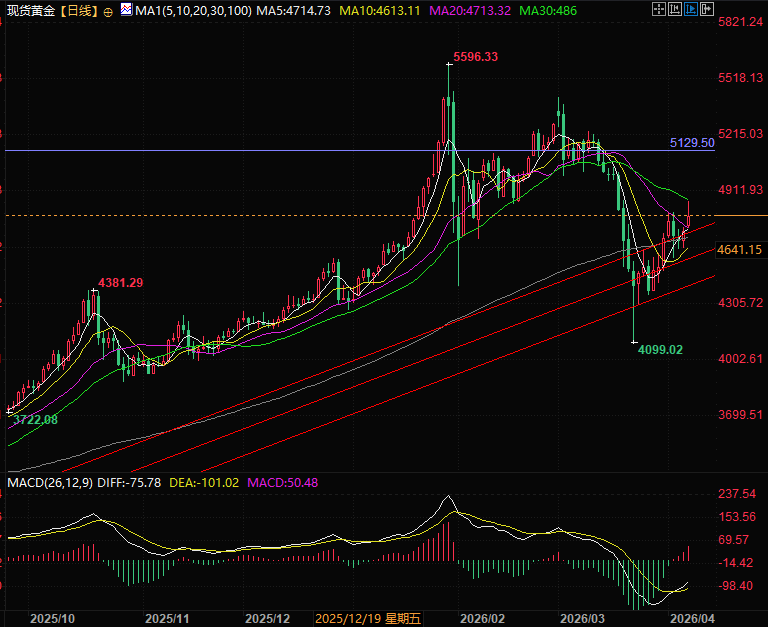
(Spot gold daily chart, source: FX678)
As of 18:01 Beijing time, spot gold is trading at $4787.90 per ounce.
This macro investment master, with over 50 years of experience, pointed out through his research on the evolution of war and order over the past five centuries that the world is currently in the early stages of a world war with "no clear declaration of war and multiple intertwined fronts," with the US-Iran war being only the most closely watched component.
Dalio emphasizes that most people and markets have fallen into a short-sighted trap—they focus excessively on short-term issues such as the opening of the Strait of Hormuz, oil price fluctuations, and the deployment of US troops, while ignoring the deeper logic behind the conflicts: the world has formed a pattern of multiple hot and non-hot wars intertwined, including the Russia-Ukraine-Europe-US conflict, the multi-country conflict in the Middle East, proxy wars in Asia and Africa, and comprehensive confrontations covering trade, technology, capital, and geopolitical influence.
These conflicts are interconnected and mutually reinforcing, forming a classic dynamic highly similar to the "world wars" in history. Moreover, they involve multiple nuclear powers, and the risk transmission effect far exceeds that of conventional local wars.
More importantly, the market's prevailing pricing logic that "the war will end soon and everything will return to normal" is seriously flawed. Dalio warns that this world war "will not end in the short term," and is currently only in its initial stage. Escalation of the conflict is an inevitable trend within a larger cycle, not a random variable.
Factional Structure: Two opposing camps have emerged, with China, the US, Russia, and Europe each possessing strategic advantages and disadvantages.
Using objective indicators such as UN voting records, bilateral treaties, economic ties, and actual actions, Dalio clearly outlines the global camp divisions: he believes that China and Russia are deeply allied, and in turn, they are forming a strategic alliance with countries such as Iran, North Korea, and Cuba.
The United States, on the other hand, has formed an opposing camp with several European countries, Israel, the Gulf Cooperation Council countries, Japan, and Australia.
This situation is not a temporary arrangement, but an inevitable result of long-term power balance and interest game, and it is profoundly influencing the course of the US-Iran conflict.
In the power struggle between factions, the strategic advantages and disadvantages of each side are immediately apparent:
The China-Russia camp: With the deep energy cooperation between China and Iran (China absorbs 80%-90% of Iran's oil exports), the energy complementarity between China and Russia, and China's ample coal and solar energy reserves and 90-120 days of oil inventory, it has effectively offset the risk of the Strait of Hormuz being blocked, and has become the "relative beneficiary" of the conflict.
The US camp: Although it has the natural advantage of being an energy exporter, the overexpansion of 750-800 military bases around the world, the strategic dilemma of fighting on multiple fronts, and the anti-war public opinion before the midterm elections have raised serious questions about its long-term combat capabilities.
Dalio specifically points out that the United States is the "most powerful but also the most vulnerable" major power—its excessive military and financial expansion makes it difficult to withstand the drain of a protracted war.
It is worth noting that Dalio refuted the view that "blocking the Strait of Hormuz would severely damage China."
He emphasized that the mutual support systems between China and Iran, and between China and Russia, have ensured the stability of energy supplies, while the United States' attempt to deprive Iran of control of the Straits of Hormuz by military means faces the real dilemma of "requiring huge costs but being difficult to sustain."
Historical analogy: The current situation is comparable to 1913-1914, and has entered a cycle of conflict escalation.
Dalio's core analysis has always been rooted in historical patterns.
He pointed out that the current global situation is highly similar to that of 1913-1914 and 1938-1939, and is at a critical juncture in the transition from "pre-war confrontation" to "actual combat stage", corresponding to the ninth stage of its "external order and disorder cycle" - soaring fiscal pressure, weaponization of trade routes, and simultaneous outbreak of conflicts in multiple regions.
The typical characteristics of this cycle have been fully revealed: as the dominant country in the post-war world order, the United States has been declining in strength relative to emerging powers, yet it still tries to maintain its hegemony through military means, thus falling into the historical fate of an "over-expansion empire".
Major countries around the world have formed ideological and military alliances, proxy wars have occurred frequently, and trade sanctions and supply chain controls have become the norm.
Even more dangerous is the decline in confidence among some countries in the U.S. defense commitment, which has fueled a weapons development race involving nuclear weapons, missiles, and other technologies, further amplifying the risk of conflict.
Dalio specifically warned that overextended great powers cannot win multiple wars simultaneously.
The United States’ deep involvement in the Middle East makes it difficult to deal with potential new conflicts in Asia and Europe. This “strategic distraction” will lead allies to question its commitments, thereby accelerating the restructuring of the global order.
Historically, similar "overdraft of hegemony" has led to the decline of many empires, and the United States is now facing the same historical test.
Subsequent Trends: Five Irreversible Trends, Probability of Major Conflict Exceeds 50% Within Five Years
Based on the laws of long-term cycles and the current situation, Dalio has given five core predictions, pointing directly to the inevitable trend of future global development:
The conflict will continue to escalate, and the ceasefire is merely a "mid-game break": the core contradictions between the US and Iran—Iran's nuclear capabilities, control of the Straits, and US hegemony in the Middle East—are a zero-sum game that cannot be resolved through negotiations.
Any ceasefire agreement is unlikely to resolve the fundamental differences, and the risk of escalation or spillover of the conflict is far greater than the market expects.
The world order has completely shifted to "might makes right": the multilateral rules system dominated by the United States after World War II has collapsed completely, and the world has entered an era of disorder without a single dominant power.
The binding force of international law and multilateral organizations continues to weaken, geopolitical competition will become the long-term norm in the future, and more countries will be forced to "choose sides" between the two camps, significantly shrinking the space for neutrality.
The key to victory or defeat in war lies in "resilience under pressure," rather than short-term strength: Dalio overturns the traditional perception that "strength guarantees victory."
He emphasized that history has proven that the core indicator of victory or defeat in war is "the endurance to suffer".
Although the United States has a superior military strength, it suffers from domestic divisions, a high fiscal deficit, and weak long-term resilience; while Iran and its Chinese allies have greater strategic resilience for "long-term attrition".
The logic of global asset allocation is being restructured, with hedging and hard assets becoming the core: Energy prices will form a "permanent risk premium," and even if the conflict cools down in the short term, the central oil price will be difficult to return to pre-war levels.
Gold, as a "hard currency in turbulent times," should be a core component of an investment portfolio, while dollar assets and bonds face the dual pressures of declining hegemony and rising inflation. With globalization coming to a complete end, supply chains will be restructured with "geosecurity" at their core, and camp-based and regionalization will become the mainstream.
The probability of a major conflict within five years exceeds 50%: Dalio's quantitative analysis shows that within the next five years, there is a greater than 50% probability of at least one of the following risk events: escalation of the US-Iran conflict, spillover effects of the Russia-Ukraine war, and outbreak of conflict in the South China Sea.
Key takeaway: Everyone must adapt to the "logic of chaotic times".
Dalio concluded by emphasizing that his assessment was not a "hopeful scenario," but rather a rational deduction based on historical patterns and objective indicators.
He urged countries, businesses, and investors to abandon any illusions about a "return to normalcy" and face the reality that "a world war has begun."
For the nation, it is necessary to strengthen strategic autonomy and risk hedging, and reduce dependence on a single camp;
For businesses, supply chain layout should prioritize geopolitical security rather than maximizing efficiency.
For investors, it is necessary to overweight hard assets such as gold and underweight the US dollar and credit assets, and be wary of the dual pressures of rising inflation and tightening monetary policy.
Ultimately, all of Dalio's assessments point to one core conclusion: the world has entered a major cycle of conflict and order reconstruction, and the US-Iran conflict is merely the "prelude" to this historic transformation.
Regardless of how the situation ultimately evolves, the old order that emerged after World War II is irreversibly coming to an end, and a "new world" full of uncertainty but with clear logic is on the horizon.
(Spot gold daily chart, source: FX678)
As of 18:01 Beijing time, spot gold is trading at $4787.90 per ounce.
- Risk Warning and Disclaimer
- The market involves risk, and trading may not be suitable for all investors. This article is for reference only and does not constitute personal investment advice, nor does it take into account certain users’ specific investment objectives, financial situation, or other needs. Any investment decisions made based on this information are at your own risk.