Gold Trading Alert: A rollercoaster ride of price swings! The US-Iran ceasefire triggers a gold price rollercoaster, but a bigger threat lurks beneath the surface.
2026-04-09 07:30:01
On Wednesday (April 8), spot gold surged more than 3% after the US and Iran reached a two-week ceasefire agreement, reaching a high of $4,856.93 per ounce. The ceasefire news pushed oil prices down below $100 per barrel, the dollar index declined, significantly easing inflation concerns and reigniting expectations of a Federal Reserve rate cut, providing short-term benefits for gold.
However, on the first day of the ceasefire, Israel launched a large-scale airstrike on Lebanon, and Iran re-blocked the Strait of Hormuz, causing renewed tensions. Gold prices gave back much of their gains in late trading, closing up only 0.3% at around $4,719. Analysts believe the current rebound is more of a "relief rally," and that negotiations still face multiple obstacles, with the reopening of the Strait of Hormuz being crucial.
Gold prices fluctuated slightly lower in early Asian trading on Thursday (April 9), currently trading around $4710 per ounce. Analysts pointed out that gold may remain volatile in the short term, but in the medium to long term, it still has investment value given geopolitical uncertainties and potential interest rate cuts. Investors should closely monitor this week's US inflation data and the progress of US-Iran peace talks in Pakistan.
On Wednesday, the gold market witnessed a breathtaking price action. Following news that the US and Iran had agreed to a two-week ceasefire, spot gold prices surged by over 3%, reaching a high of $4,856.93 per ounce, a near three-week high since March 19th. Although prices retraced most of their gains towards the end of the session, ultimately closing up only 0.3% at $4,719, this dramatic intraday surge clearly reflects the market's extreme sensitivity to ceasefire news.
The core logic behind this surge in gold prices is not complicated. The ceasefire agreement directly pushed oil prices below the $100 per barrel mark, while the dollar also fell to its lowest level in a month against a basket of major currencies. For gold, a weaker dollar means that dollar-denominated gold becomes cheaper for investors holding other currencies, which in itself stimulates buying demand. More importantly, the plunge in oil prices significantly alleviated market concerns about continued worsening inflation, a concern that had been a major factor suppressing gold's performance in previous weeks.
Marex analyst Edward Meir offered a clear interpretation. He pointed out that the ceasefire is calming the market and easing pressure, which helps reduce some inflationary pressures and may even reopen the door for the Federal Reserve to cut interest rates, which is undoubtedly a clear positive factor for gold.
Judging from the performance of the interest rate futures market, investor expectations are indeed shifting in this direction. After the ceasefire news broke, the market's expectation of the probability of the Federal Reserve cutting interest rates at least once before the end of this year once climbed to around 65%, which is in stark contrast to the pessimistic sentiment before the ceasefire, when the market did not believe that the Fed would cut interest rates at all and even began to bet on interest rate hikes.
However, the bullish euphoria in the gold market did not last long. As more details emerged, investors gradually realized that the foundation of this ceasefire agreement was far more fragile than imagined, and gold prices subsequently fell sharply from their intraday highs.
The crux of the issue is that the so-called US-Iran ceasefire does not equate to a genuine easing of tensions in the Middle East. On the very day the US and Iran agreed to suspend direct combat, Israel escalated its military operations in Lebanon, launching its largest airstrike against Hezbollah since the start of the conflict. Iran immediately responded strongly, accusing Israel of violating the ceasefire agreement, not only re-closing the Strait of Hormuz but also threatening deterrent action against Israeli military targets. Even more problematic is that Iranian Parliament Speaker Ghalibaf explicitly stated that three key clauses of Tehran's ten-point ceasefire proposal had been violated, undermining the foundation for negotiations.
What does this fragile ceasefire mean? It means that all the optimistic pricing previously made by the market based on expectations of peace may face revision. The Strait of Hormuz remains closed, and about 20 percent of global oil shipments are still blocked. Although oil prices have fallen from their peak, they are still about 30 percent higher than pre-war levels. Inflationary pressures have not truly subsided; they have only been temporarily masked by the ceasefire news.
This is why gold prices quickly gave back their gains after hitting a near three-week high. The market began to reassess the sustainability of the ceasefire agreement and its real impact on the Federal Reserve's monetary policy path. Investors realized that, against the backdrop of Israel's continued attacks on Lebanon and Iran's re-blockade of the Strait of Hormuz, the so-called easing of inflation may be short-lived.
The current uncertainty in the gold market largely stems from the high degree of uncertainty surrounding the Federal Reserve's monetary policy outlook. The minutes of the Fed's March meeting, released on Wednesday, revealed growing divisions among policymakers, and this situation has a complex and two-way impact on gold.
The meeting minutes revealed that a growing number of Federal Reserve policymakers believed that, given the impact of the Iran war on inflation, raising interest rates might be necessary to address persistently high inflation exceeding the 2% target. Some participants explicitly stated that the post-meeting statement should retain a two-way description for future interest rate decisions, including both the possibility of rate cuts and hikes, to reflect that raising the target range for the federal funds rate might be appropriate if inflation remains above target.
This contrasts sharply with pre-war market expectations. Before the war broke out on February 28, the market had anticipated approximately two US interest rate cuts this year. The war-induced surge in oil prices completely disrupted these expectations, forcing investors to reprice the Federal Reserve's interest rate path.
Interestingly, the meeting minutes also revealed another layer of information. Most participants judged that if the Middle East conflict dragged on, it would cause sufficient damage to economic growth, necessitating further interest rate cuts to support the economy. A sharp rise in oil prices would reduce household purchasing power, tighten financial conditions, and drag down overseas economic growth; these factors combined might force the Federal Reserve to shift to an easing stance before inflation is fully under control.
This dilemma has left the gold market in a state of flux. If the Federal Reserve raises interest rates due to high inflation, the opportunity cost of holding gold increases, putting downward pressure on prices. However, if the Fed cuts rates due to economic damage, a weaker dollar and looser liquidity will support higher gold prices. The current sharp fluctuations in gold prices are a result of the market oscillating between these two possibilities.
From a broader perspective, the current developments in the Middle East actually create a relatively favorable environment for gold. This is not because of the ceasefire itself, but precisely because the ceasefire is too fragile and the prospects for peace are too bleak.
While the United States has reached a temporary ceasefire with Iran, the Trump administration is also considering punishing NATO members that did not provide sufficient support during the war with Iran, planning to withdraw US troops from these countries and redeploy them to countries with stronger support. This policy orientation will only exacerbate the rift between the United States and its traditional allies, further undermining the stability of the global geopolitical landscape.
While Iran agreed to a ceasefire, it made it clear that the foundation for negotiations had been undermined. The US and Iran disagree on the ten-point plan that forms the basis of the negotiations. Whether the US-proposed fifteen-point plan can be aligned with Iran's ceasefire terms, and whether Israel can make changes on the Lebanon issue, are all key variables affecting the peace process. Whether the first round of US-Iran talks, originally scheduled for this Saturday in Islamabad, Pakistan, will proceed as planned remains highly uncertain.
This highly uncertain geopolitical environment is precisely the ideal environment for gold to function as a safe-haven asset. Whenever a ceasefire agreement falters, or whenever negotiations encounter obstacles, investors flock back to the gold market for protection. Even during periods of heightened risk appetite triggered by ceasefire news, gold merely retreated from its highs rather than completely reversed course, ultimately closing higher. This in itself demonstrates that the market's demand for safe-haven assets has never truly subsided.
Looking ahead to the next few trading days, the gold market will face another important catalyst: the release of US inflation data. Both the Personal Consumption Expenditures Price Index and the Consumer Price Index, two key inflation indicators, will be released later this week.
The importance of this data lies in the fact that it will provide the Federal Reserve with the latest information for its interest rate decisions. If the data shows that inflationary pressures remain stubborn or even rise further, then the possibility of an interest rate hike mentioned in the meeting minutes will become more realistic, which is clearly not good news for gold. Conversely, if inflation shows signs of cooling, market expectations for a Fed rate cut may rise again, thus providing upward momentum for gold prices.
Looking at the performance of the inflation-protected bond market, the market currently expects an average annual inflation rate of about 2.3 percent over the next ten years. While this level is higher than the Federal Reserve's target, it is not out of control. The key issue is that developments in the Middle East will largely determine how far the actual inflation path will deviate from this expectation.
It's worth noting that even if the ceasefire agreement holds, it will take time for the decline in oil prices to be transmitted to end-consumer prices. Moreover, the current ceasefire is so fragile, and the Strait of Hormuz could easily become a focal point of geopolitical competition again. Against this backdrop, investors will inevitably remain highly vigilant about the inflation outlook, and this vigilance itself will support the safe-haven demand for gold.
In summary, the gold market is currently at a critical crossroads. On the one hand, the temporary ceasefire between the US and Iran has indeed mitigated the most extreme tail risks, driving a relief rally in risk assets, which has diverted some funds that might have flowed into the gold market in the short term. On the other hand, the foundation of this ceasefire agreement is extremely fragile. Israel's military action in Lebanon, Iran's re-blockade of the Strait of Hormuz, and the serious differences between the US and Iran on negotiating terms—all these factors mean that the situation could escalate again at any time.
For gold investors, the most important thing right now is not speculating on whether the ceasefire will last, but recognizing a fundamental reality: geopolitical risks in the Middle East have not disappeared, the global inflation outlook remains highly uncertain, and the Federal Reserve's monetary policy path remains shrouded in mystery. In this environment, gold's value as a safe-haven asset and inflation hedge has not been weakened; on the contrary, it has become even more prominent due to the interplay of various uncertainties.
In the short term, gold prices may continue to fluctuate wildly as ceasefire negotiations progress and inflation data are released. However, from a longer-term perspective, as long as the situation in the Middle East does not truly move towards lasting peace, and as long as the fragility of global supply chains does not fundamentally improve, gold will always remain an indispensable ballast in investors' asset allocation.
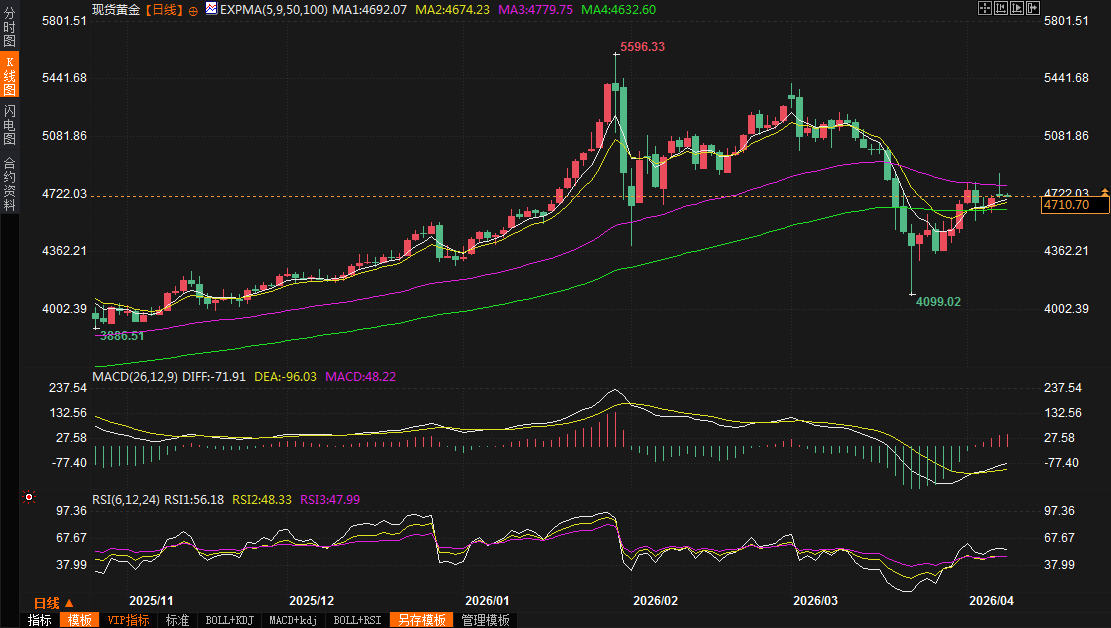
(Spot gold daily chart, source: FX678)
At 07:27 Beijing time, spot gold was trading at $4711.07 per ounce.
However, on the first day of the ceasefire, Israel launched a large-scale airstrike on Lebanon, and Iran re-blocked the Strait of Hormuz, causing renewed tensions. Gold prices gave back much of their gains in late trading, closing up only 0.3% at around $4,719. Analysts believe the current rebound is more of a "relief rally," and that negotiations still face multiple obstacles, with the reopening of the Strait of Hormuz being crucial.
Gold prices fluctuated slightly lower in early Asian trading on Thursday (April 9), currently trading around $4710 per ounce. Analysts pointed out that gold may remain volatile in the short term, but in the medium to long term, it still has investment value given geopolitical uncertainties and potential interest rate cuts. Investors should closely monitor this week's US inflation data and the progress of US-Iran peace talks in Pakistan.
The ceasefire triggered a relief rally, with gold prices surging at one point.
On Wednesday, the gold market witnessed a breathtaking price action. Following news that the US and Iran had agreed to a two-week ceasefire, spot gold prices surged by over 3%, reaching a high of $4,856.93 per ounce, a near three-week high since March 19th. Although prices retraced most of their gains towards the end of the session, ultimately closing up only 0.3% at $4,719, this dramatic intraday surge clearly reflects the market's extreme sensitivity to ceasefire news.
The core logic behind this surge in gold prices is not complicated. The ceasefire agreement directly pushed oil prices below the $100 per barrel mark, while the dollar also fell to its lowest level in a month against a basket of major currencies. For gold, a weaker dollar means that dollar-denominated gold becomes cheaper for investors holding other currencies, which in itself stimulates buying demand. More importantly, the plunge in oil prices significantly alleviated market concerns about continued worsening inflation, a concern that had been a major factor suppressing gold's performance in previous weeks.
Marex analyst Edward Meir offered a clear interpretation. He pointed out that the ceasefire is calming the market and easing pressure, which helps reduce some inflationary pressures and may even reopen the door for the Federal Reserve to cut interest rates, which is undoubtedly a clear positive factor for gold.
Judging from the performance of the interest rate futures market, investor expectations are indeed shifting in this direction. After the ceasefire news broke, the market's expectation of the probability of the Federal Reserve cutting interest rates at least once before the end of this year once climbed to around 65%, which is in stark contrast to the pessimistic sentiment before the ceasefire, when the market did not believe that the Fed would cut interest rates at all and even began to bet on interest rate hikes.
Optimism quickly crumbled, and gold prices plummeted from their highs.
However, the bullish euphoria in the gold market did not last long. As more details emerged, investors gradually realized that the foundation of this ceasefire agreement was far more fragile than imagined, and gold prices subsequently fell sharply from their intraday highs.
The crux of the issue is that the so-called US-Iran ceasefire does not equate to a genuine easing of tensions in the Middle East. On the very day the US and Iran agreed to suspend direct combat, Israel escalated its military operations in Lebanon, launching its largest airstrike against Hezbollah since the start of the conflict. Iran immediately responded strongly, accusing Israel of violating the ceasefire agreement, not only re-closing the Strait of Hormuz but also threatening deterrent action against Israeli military targets. Even more problematic is that Iranian Parliament Speaker Ghalibaf explicitly stated that three key clauses of Tehran's ten-point ceasefire proposal had been violated, undermining the foundation for negotiations.
What does this fragile ceasefire mean? It means that all the optimistic pricing previously made by the market based on expectations of peace may face revision. The Strait of Hormuz remains closed, and about 20 percent of global oil shipments are still blocked. Although oil prices have fallen from their peak, they are still about 30 percent higher than pre-war levels. Inflationary pressures have not truly subsided; they have only been temporarily masked by the ceasefire news.
This is why gold prices quickly gave back their gains after hitting a near three-week high. The market began to reassess the sustainability of the ceasefire agreement and its real impact on the Federal Reserve's monetary policy path. Investors realized that, against the backdrop of Israel's continued attacks on Lebanon and Iran's re-blockade of the Strait of Hormuz, the so-called easing of inflation may be short-lived.
The Federal Reserve is in a dilemma; the threat of interest rate hikes has not gone away.
The current uncertainty in the gold market largely stems from the high degree of uncertainty surrounding the Federal Reserve's monetary policy outlook. The minutes of the Fed's March meeting, released on Wednesday, revealed growing divisions among policymakers, and this situation has a complex and two-way impact on gold.
The meeting minutes revealed that a growing number of Federal Reserve policymakers believed that, given the impact of the Iran war on inflation, raising interest rates might be necessary to address persistently high inflation exceeding the 2% target. Some participants explicitly stated that the post-meeting statement should retain a two-way description for future interest rate decisions, including both the possibility of rate cuts and hikes, to reflect that raising the target range for the federal funds rate might be appropriate if inflation remains above target.
This contrasts sharply with pre-war market expectations. Before the war broke out on February 28, the market had anticipated approximately two US interest rate cuts this year. The war-induced surge in oil prices completely disrupted these expectations, forcing investors to reprice the Federal Reserve's interest rate path.
Interestingly, the meeting minutes also revealed another layer of information. Most participants judged that if the Middle East conflict dragged on, it would cause sufficient damage to economic growth, necessitating further interest rate cuts to support the economy. A sharp rise in oil prices would reduce household purchasing power, tighten financial conditions, and drag down overseas economic growth; these factors combined might force the Federal Reserve to shift to an easing stance before inflation is fully under control.
This dilemma has left the gold market in a state of flux. If the Federal Reserve raises interest rates due to high inflation, the opportunity cost of holding gold increases, putting downward pressure on prices. However, if the Fed cuts rates due to economic damage, a weaker dollar and looser liquidity will support higher gold prices. The current sharp fluctuations in gold prices are a result of the market oscillating between these two possibilities.
Geopolitical uncertainty is the strongest support for gold.
From a broader perspective, the current developments in the Middle East actually create a relatively favorable environment for gold. This is not because of the ceasefire itself, but precisely because the ceasefire is too fragile and the prospects for peace are too bleak.
While the United States has reached a temporary ceasefire with Iran, the Trump administration is also considering punishing NATO members that did not provide sufficient support during the war with Iran, planning to withdraw US troops from these countries and redeploy them to countries with stronger support. This policy orientation will only exacerbate the rift between the United States and its traditional allies, further undermining the stability of the global geopolitical landscape.
While Iran agreed to a ceasefire, it made it clear that the foundation for negotiations had been undermined. The US and Iran disagree on the ten-point plan that forms the basis of the negotiations. Whether the US-proposed fifteen-point plan can be aligned with Iran's ceasefire terms, and whether Israel can make changes on the Lebanon issue, are all key variables affecting the peace process. Whether the first round of US-Iran talks, originally scheduled for this Saturday in Islamabad, Pakistan, will proceed as planned remains highly uncertain.
This highly uncertain geopolitical environment is precisely the ideal environment for gold to function as a safe-haven asset. Whenever a ceasefire agreement falters, or whenever negotiations encounter obstacles, investors flock back to the gold market for protection. Even during periods of heightened risk appetite triggered by ceasefire news, gold merely retreated from its highs rather than completely reversed course, ultimately closing higher. This in itself demonstrates that the market's demand for safe-haven assets has never truly subsided.
With inflation data about to be released, gold faces a new test.
Looking ahead to the next few trading days, the gold market will face another important catalyst: the release of US inflation data. Both the Personal Consumption Expenditures Price Index and the Consumer Price Index, two key inflation indicators, will be released later this week.
The importance of this data lies in the fact that it will provide the Federal Reserve with the latest information for its interest rate decisions. If the data shows that inflationary pressures remain stubborn or even rise further, then the possibility of an interest rate hike mentioned in the meeting minutes will become more realistic, which is clearly not good news for gold. Conversely, if inflation shows signs of cooling, market expectations for a Fed rate cut may rise again, thus providing upward momentum for gold prices.
Looking at the performance of the inflation-protected bond market, the market currently expects an average annual inflation rate of about 2.3 percent over the next ten years. While this level is higher than the Federal Reserve's target, it is not out of control. The key issue is that developments in the Middle East will largely determine how far the actual inflation path will deviate from this expectation.
It's worth noting that even if the ceasefire agreement holds, it will take time for the decline in oil prices to be transmitted to end-consumer prices. Moreover, the current ceasefire is so fragile, and the Strait of Hormuz could easily become a focal point of geopolitical competition again. Against this backdrop, investors will inevitably remain highly vigilant about the inflation outlook, and this vigilance itself will support the safe-haven demand for gold.
Conclusion: The Golden Crossroads
In summary, the gold market is currently at a critical crossroads. On the one hand, the temporary ceasefire between the US and Iran has indeed mitigated the most extreme tail risks, driving a relief rally in risk assets, which has diverted some funds that might have flowed into the gold market in the short term. On the other hand, the foundation of this ceasefire agreement is extremely fragile. Israel's military action in Lebanon, Iran's re-blockade of the Strait of Hormuz, and the serious differences between the US and Iran on negotiating terms—all these factors mean that the situation could escalate again at any time.
For gold investors, the most important thing right now is not speculating on whether the ceasefire will last, but recognizing a fundamental reality: geopolitical risks in the Middle East have not disappeared, the global inflation outlook remains highly uncertain, and the Federal Reserve's monetary policy path remains shrouded in mystery. In this environment, gold's value as a safe-haven asset and inflation hedge has not been weakened; on the contrary, it has become even more prominent due to the interplay of various uncertainties.
In the short term, gold prices may continue to fluctuate wildly as ceasefire negotiations progress and inflation data are released. However, from a longer-term perspective, as long as the situation in the Middle East does not truly move towards lasting peace, and as long as the fragility of global supply chains does not fundamentally improve, gold will always remain an indispensable ballast in investors' asset allocation.
(Spot gold daily chart, source: FX678)
At 07:27 Beijing time, spot gold was trading at $4711.07 per ounce.
- Risk Warning and Disclaimer
- The market involves risk, and trading may not be suitable for all investors. This article is for reference only and does not constitute personal investment advice, nor does it take into account certain users’ specific investment objectives, financial situation, or other needs. Any investment decisions made based on this information are at your own risk.