Uncertainty surrounding Middle East negotiations, coupled with downward pressure from interest rate expectations, caused silver prices to rise and then fall.
2026-04-09 14:24:34
Silver prices remained range-bound during the Asian session, currently trading around $74. Overall, the market lacks a clear direction, with prices fluctuating within a range, but the short-term structure remains weak.
From a fundamental perspective, uncertainty remains in the Middle East. Although the US and Iran plan to hold a new round of negotiations on a long-term ceasefire, significant differences exist between the two sides. Iran has pointed out that the terms of the agreement have been violated, particularly regarding the conflict in Lebanon, further undermining market confidence in the ceasefire's prospects. This uncertainty keeps market sentiment cautious; while silver, as a safe-haven asset, has received some support, it has not generated significant upward momentum.
Meanwhile, changes in the energy market indirectly impacted silver. Previously, the disruption of the Strait of Hormuz had caused a sharp rise in oil prices, pushing up global inflation expectations and reinforcing market expectations that major central banks would maintain tight monetary policies. Although recent ceasefire news has somewhat eased the oil price surge, overall inflation remains high, and the policy environment remains tight.
From a monetary policy perspective, the expectation that the Federal Reserve will maintain high interest rates continues to exert downward pressure on silver. According to market pricing, the probability of the Fed keeping interest rates unchanged is currently around 76.4%. This expectation implies that real interest rates may remain relatively high, thus reducing the attractiveness of non-interest-bearing assets like silver. This is one of the key reasons why silver prices have been under sustained pressure recently.
From a market sentiment perspective, investors are currently leaning towards a wait-and-see approach. On the one hand, the geopolitical situation still carries the risk of recurring fluctuations; on the other hand, the policy path remains unclear, leaving funds without a clear direction. Against this backdrop, silver prices are more likely to exhibit range-bound trading.
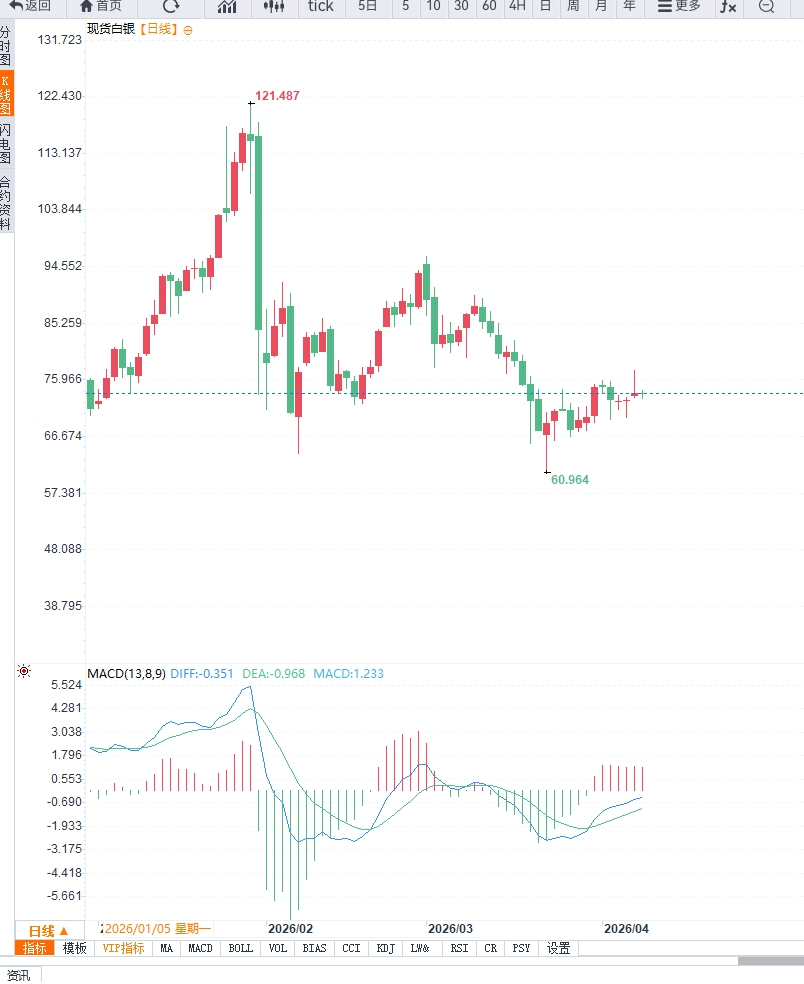
From a technical perspective, the daily chart shows that silver has entered a consolidation phase after falling from its highs, with the overall trend showing signs of weakening. The price continues to trade below short-term moving averages, indicating that bears are in control. The current level around 74.89 forms a key resistance, coinciding with the 20-day moving average; failure to break through this level will likely result in continued short-term pressure. Further resistance is expected around 81.13, a previous high.
From a momentum perspective, the RSI is in the neutral to weak zone (around 46), indicating insufficient bullish momentum. Meanwhile, the MACD remains weak, suggesting limited upside potential. On the 4-hour chart, the price is trading in a low-level consolidation range, with short-term moving averages in a bearish alignment. If it fails to break above 75, the rebound is likely just a technical correction.
Looking at the downside, the 70.00 level forms a key support, which has strong psychological significance. A break below this level could trigger further declines. Further support lies in the 66.70 area, which is the previous low.
Editor's Summary:
The current silver price trend exhibits a typical weak and volatile pattern. While geopolitical uncertainties provide some support, they are insufficient to offset the suppressive effect of the high-interest-rate environment. With market expectations rising that the Federal Reserve will maintain its tightening policy, silver lacks sustained upward momentum in the short term. Future price movements will depend on two key factors: whether the situation in the Middle East escalates further, and changes in the path of US inflation and interest rates. Until then, silver is likely to maintain a weak and volatile trend.
From a fundamental perspective, uncertainty remains in the Middle East. Although the US and Iran plan to hold a new round of negotiations on a long-term ceasefire, significant differences exist between the two sides. Iran has pointed out that the terms of the agreement have been violated, particularly regarding the conflict in Lebanon, further undermining market confidence in the ceasefire's prospects. This uncertainty keeps market sentiment cautious; while silver, as a safe-haven asset, has received some support, it has not generated significant upward momentum.
Meanwhile, changes in the energy market indirectly impacted silver. Previously, the disruption of the Strait of Hormuz had caused a sharp rise in oil prices, pushing up global inflation expectations and reinforcing market expectations that major central banks would maintain tight monetary policies. Although recent ceasefire news has somewhat eased the oil price surge, overall inflation remains high, and the policy environment remains tight.
From a monetary policy perspective, the expectation that the Federal Reserve will maintain high interest rates continues to exert downward pressure on silver. According to market pricing, the probability of the Fed keeping interest rates unchanged is currently around 76.4%. This expectation implies that real interest rates may remain relatively high, thus reducing the attractiveness of non-interest-bearing assets like silver. This is one of the key reasons why silver prices have been under sustained pressure recently.
From a market sentiment perspective, investors are currently leaning towards a wait-and-see approach. On the one hand, the geopolitical situation still carries the risk of recurring fluctuations; on the other hand, the policy path remains unclear, leaving funds without a clear direction. Against this backdrop, silver prices are more likely to exhibit range-bound trading.
From a technical perspective, the daily chart shows that silver has entered a consolidation phase after falling from its highs, with the overall trend showing signs of weakening. The price continues to trade below short-term moving averages, indicating that bears are in control. The current level around 74.89 forms a key resistance, coinciding with the 20-day moving average; failure to break through this level will likely result in continued short-term pressure. Further resistance is expected around 81.13, a previous high.
From a momentum perspective, the RSI is in the neutral to weak zone (around 46), indicating insufficient bullish momentum. Meanwhile, the MACD remains weak, suggesting limited upside potential. On the 4-hour chart, the price is trading in a low-level consolidation range, with short-term moving averages in a bearish alignment. If it fails to break above 75, the rebound is likely just a technical correction.
Looking at the downside, the 70.00 level forms a key support, which has strong psychological significance. A break below this level could trigger further declines. Further support lies in the 66.70 area, which is the previous low.
Editor's Summary:
The current silver price trend exhibits a typical weak and volatile pattern. While geopolitical uncertainties provide some support, they are insufficient to offset the suppressive effect of the high-interest-rate environment. With market expectations rising that the Federal Reserve will maintain its tightening policy, silver lacks sustained upward momentum in the short term. Future price movements will depend on two key factors: whether the situation in the Middle East escalates further, and changes in the path of US inflation and interest rates. Until then, silver is likely to maintain a weak and volatile trend.
- Risk Warning and Disclaimer
- The market involves risk, and trading may not be suitable for all investors. This article is for reference only and does not constitute personal investment advice, nor does it take into account certain users’ specific investment objectives, financial situation, or other needs. Any investment decisions made based on this information are at your own risk.