April 10th Financial Breakfast: Gold prices await CPI test at the $4760 mark; Iran vows no dialogue before peace in Lebanon; crude oil may test the $100 mark again.
2026-04-10 07:26:15
On Friday (April 10, Beijing time) in early Asian trading, spot gold was trading around $4,760 per ounce. Gold prices rose on Thursday, supported by a weaker dollar, as investors assessed the sustainability of the fragile ceasefire agreement between the US and Iran and awaited the release of US March CPI data on Friday. US crude oil was trading around $98.43 per barrel. Although the Israeli prime minister stated that he would begin direct negotiations with Lebanon as soon as possible after the attack on Lebanon, Iran indicated that it was prepared for all eventualities, and oil prices may retest the $100 per barrel mark. In addition, sources said that Iran had informed Pakistan, the mediator in the negotiations, that its delegation would not participate in peace talks with the United States until a ceasefire was achieved in Lebanon.

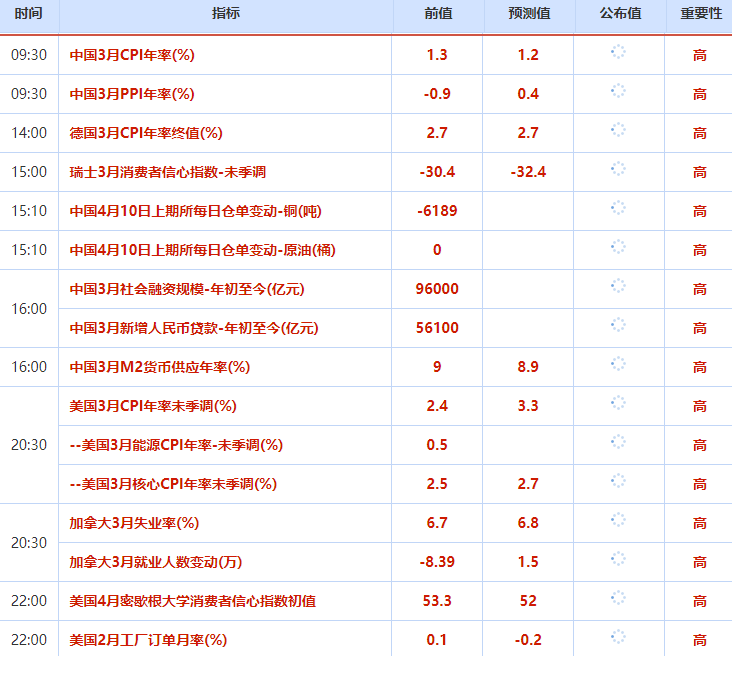
U.S. stocks closed higher across the board on Thursday, with the Dow Jones Industrial Average up 0.58%, the S&P 500 up 0.62%, and the Nasdaq Composite up 0.83%, mainly boosted by progress in Middle East peace talks, which eased market concerns about the fragile ceasefire agreement between the U.S. and Iran.
The S&P 500 index has climbed back above the key technical levels of the 100-day and 200-day moving averages, while the volatility index, known as the "fear index," has fallen to its lowest level since the outbreak of the war.
On the economic data front, fourth-quarter GDP growth was lower than expected, but PCE inflation met expectations. Federal Reserve meeting minutes showed that policymakers were increasingly concerned about potential interest rate hikes to address the inflationary impact of the war.
Among the sectors, the energy sector saw the largest decline, while the consumer discretionary sector saw the largest increase. In terms of individual stocks, Amazon rose 5.6% after its CEO disclosed that its AI services annualized revenue exceeded $15 billion, Constellation Brands surged 8.5% as its quarterly sales decline narrowed, while Applied Digital fell 8% due to widening losses.
Gold prices rose more than 1% on Thursday, with spot gold closing up 1.6% at $4,789.67 per ounce and U.S. gold futures rising 0.9% to $4,818.00, mainly supported by a weaker dollar, as investors assessed the durability of the fragile ceasefire agreement between the U.S. and Iran and awaited the release of U.S. March CPI data on Friday.
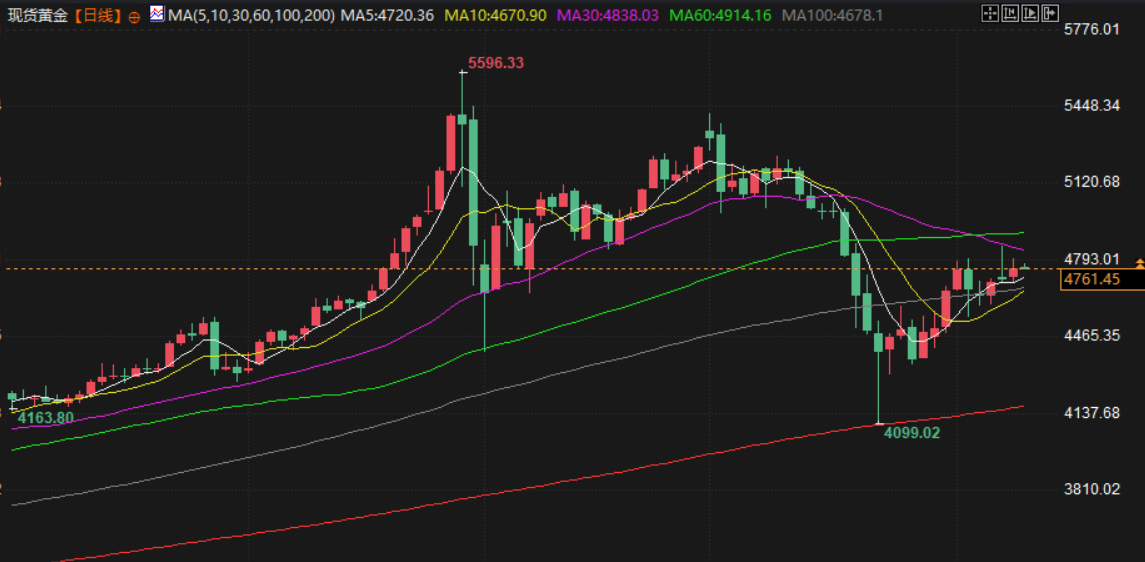
Despite Israel's bombing of more targets in Lebanon, Iran's demand to include Lebanon in the ceasefire, and no signs of the Strait of Hormuz blockade being lifted, geopolitical risks remain, but the market is cautiously interpreting the ceasefire prospects.
RJO Futures strategists said a weaker dollar helped stabilize gold, while Morgan Stanley expects gold prices to remain stable in the second quarter and rebound in the second half of the year. They also noted that if the Federal Reserve avoids raising interest rates or the conflict is resolved, it may refocus on the issue of fiat currency devaluation.
In other precious metals, spot silver rose 2.9% to $76.24, platinum rose 3.8% to $2106.01, and palladium rose slightly by 0.3% to $1558.75.
International oil prices closed higher in volatile trading on Thursday, but Brent crude settled below $100 a barrel for the second consecutive session, with gains narrowing to 1.2% at $95.92 a barrel (it reached a high of $99.50 during the session). WTI crude futures rose 3.7% to $97.87 a barrel (it reached a high of $102.70 during the session). In early trading, oil prices rose more than 5% due to market doubts about the sustainability of the two-week ceasefire agreement between the US and Iran and concerns about continued disruptions to energy transport through the Strait of Hormuz. However, gains narrowed after the Israeli prime minister stated that he would begin direct negotiations with Lebanon as soon as possible, including discussions on disarming Hezbollah.
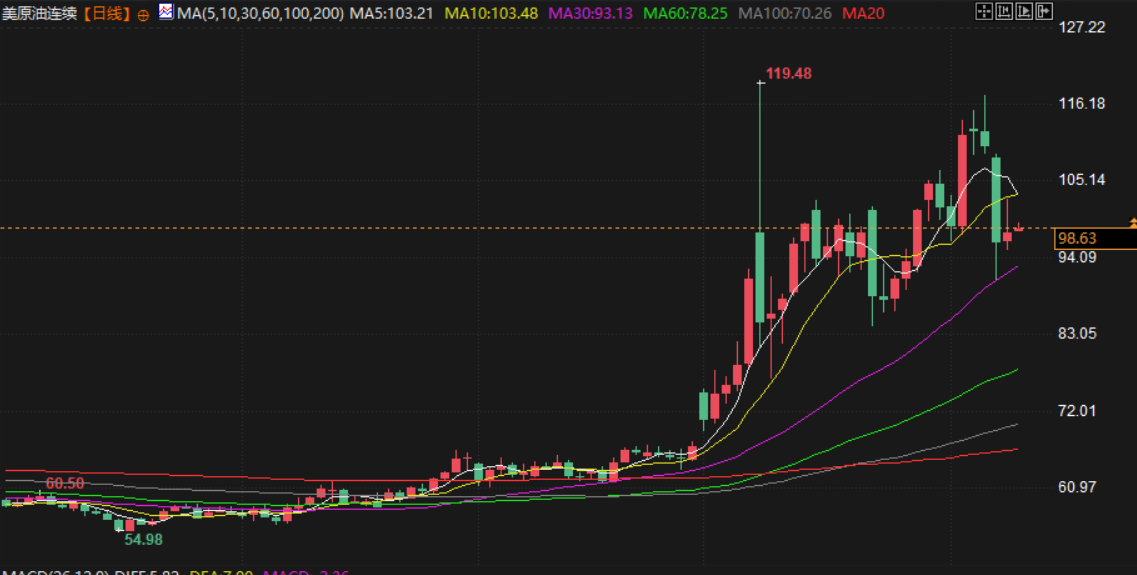
Despite the ceasefire, ship traffic through the Strait of Hormuz remained well below 10% of normal levels on Thursday, with Iran warning vessels to navigate within its territorial waters to demonstrate control.
In addition, the Saudi Press Agency reported that the attacks have reduced the country's crude oil production by about 600,000 barrels per day and the volume of oil transported by the east-west pipeline by about 700,000 barrels per day. After settlement, the increases in both indicators exceeded $1.
Traders pointed out that even if the Straits reopen, Saudi Arabia's export flexibility will remain compromised in the short term, and Israel's strikes on more targets in Lebanon jeopardize the ceasefire agreement; analysts said tankers may navigate in mine-torn waters and environments with a heightened military presence, keeping insurance and freight costs high.
The dollar's rebound faltered on Thursday as markets closely watched whether the US-Iran ceasefire agreement could be maintained. The agreement was jeopardized by Israel's continued bombing of Lebanon and Iran's failure to lift its blockade of the Strait of Hormuz. Although Iranian negotiators departed for Pakistan for the first round of talks, Tehran stated that no agreement would be reached as long as Israel continued its bombing of Lebanon. Meanwhile, the Israeli prime minister sought direct talks with Beirut to disarm Hezbollah, and US President Trump stated that US troops would remain deployed in and around Iran until the agreement was fully implemented.
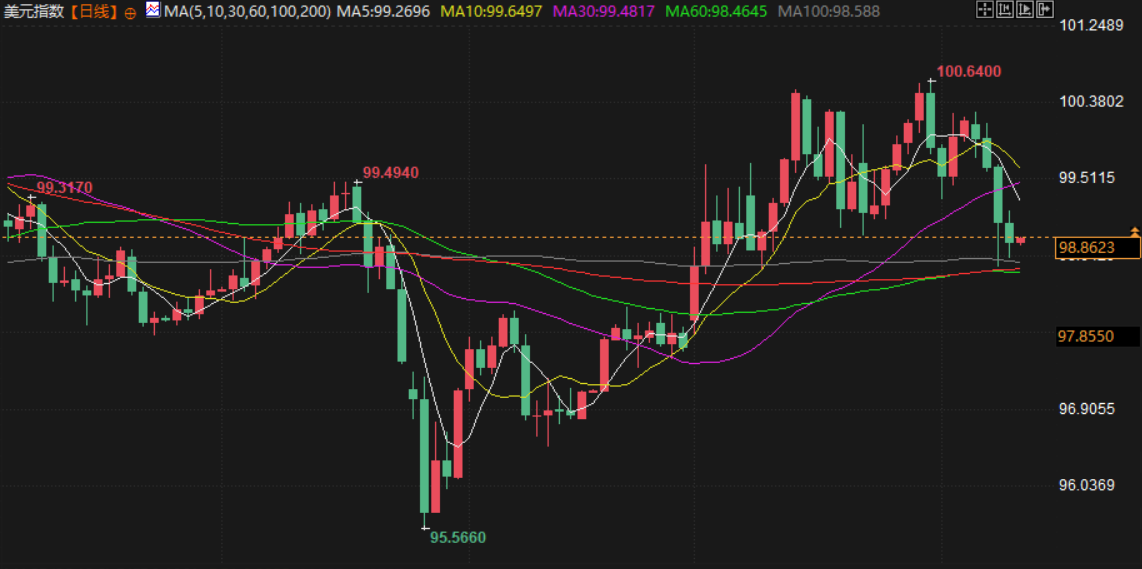
In the currency markets, the euro rose 0.3% against the dollar to $1.1698, after earlier hitting a one-month high of $1.1721; the pound rose 0.27% against the dollar to $1.343; the yen weakened, with the dollar rising 0.27% against the yen to 159.02 yen; the Australian dollar and the New Zealand dollar rose 0.49% and 0.57% respectively.
On the economic data front, the US PCE price index rose 0.4% month-on-month in February, in line with expectations. However, given the backdrop of the Iran war, inflation may rise further in March, and the Federal Reserve is expected to be reluctant to cut interest rates for some time. In Japan, consumer confidence deteriorated for the first time in three months in March, complicating the Bank of Japan's decision to raise interest rates. Governor Kazuo Ueda stated that real interest rates are clearly negative, maintaining an accommodative environment.
The probability of the Federal Reserve keeping interest rates unchanged in April is 98.4%, while the expectation of a rate cut this year has risen to 35.2%.
According to CME's "FedWatch": The probability of the Fed raising interest rates by 25 basis points in April is 1.6%, and the probability of keeping rates unchanged is 98.4%. By June, the probability of a cumulative 25 basis point rate cut by the Fed is 2.1%, the probability of keeping rates unchanged is 96.3%, and the probability of a cumulative 25 basis point rate hike is 1.5%. By December, the probability of a cumulative 25 basis point rate cut by the Fed has risen to 35.2% (from 22.3% the previous day), the probability of keeping rates unchanged is 59% (from 74% the previous day), and the probability of a cumulative 25 basis point rate hike is 5.8% (from 3.7% the previous day).
Iran says control of the Strait of Hormuz has entered a new phase.
The Iranian Islamic Revolutionary Guard Corps Navy Command issued a statement early on April 10th local time, declaring that control over the Strait of Hormuz had entered a "new phase." The statement did not specify the concrete control measures for this new phase. Earlier, Iran's Supreme Leader Mojtaba Khamenei stated that Iran would not let any aggressor go unpunished and would pursue reparations for war losses and the blood debts of fallen soldiers. The control of the Strait of Hormuz is also entering a new phase. (CCTV International News)
Iranian Parliament Speaker: Iranian people and armed forces are prepared for all eventualities.
On September 9, the 40th anniversary of the death of former Supreme Leader Ali Khamenei, Iranian Parliament Speaker Mohammad Ghalibaf stated in a address that despite continued external pressure, Iran's defense forces and society remain robust, and public cohesion remains high. He added that if the United States honors its commitments, Iran and the US may initiate negotiations; otherwise, Iran will consider resuming operations, and the Iranian people and armed forces are prepared for all eventualities. Ghalibaf emphasized that Iran adheres to a combination of military and diplomatic means and is confident of achieving ultimate victory in the war. He stated that the US acceptance of Iran's proposed negotiation principles is a significant achievement for Iran. At the same time, Ghalibaf stressed Iran's important achievements in defense and regional strategy, noting that Iran has achieved defensive independence by relying on youth development and indigenous technology in developing missile and drone capabilities. He stated that Iranian missiles and drones can penetrate advanced defense systems at extremely low cost and transform the potential influence of the Strait of Hormuz into a significant deterrent to the US economy, effectively enhancing the country's independent defense capabilities. (Xinhua)
The Israeli Prime Minister stated that fighting in Lebanon will not cease until Hezbollah is disarmed.
On the evening of April 9th local time, Israeli Prime Minister Benjamin Netanyahu stated that Israel would not cease its fighting in Lebanon until the safety of residents in the northern region was restored and Hezbollah was disarmed. Netanyahu said he had ordered direct negotiations with Lebanon aimed at disarming Hezbollah and pushing for a historic and sustainable peace agreement between Israel and Lebanon. Netanyahu stated that Israel's actions against Iran and the "resistance front" have achieved significant success, historically changing Israel's position in the Middle East. Israel is stronger than ever before, while Iran is weaker than ever before. Netanyahu also stated that Israel has reached four peace agreements with Arab countries and intends to pursue genuine peace based on its strength and position. (CCTV News)
Iran's Supreme Leader emphasizes victory through unity.
On the evening of April 9th local time, Iranian state television read a statement from Supreme Leader Mojtaba Khamenei, emphasizing that Iran does not seek war, but will not relinquish its rights. This latest statement from Mojtaba was released on the 40th anniversary of the assassination of his father, the late Supreme Leader Ali Khamenei. The statement reviewed Khamenei's life and stressed that Iran's victory in the war was due to the unity of the government, the army, and the people. The statement indicated that Iran will pursue war reparations and advance its administration of the Strait of Hormuz to "a new phase," while considering the "resistance front" as a unified whole. The statement also called on Iran's southern Gulf neighbors (the Gulf Arab states) to stand on the "right side," stating that Iran will extend goodwill to these countries, but only if they distance themselves from "arrogant hegemons." (CCTV International News)
Netanyahu orders direct talks with Lebanon; US media reports first talks to be held next week in the US.
The Israeli Prime Minister's Office issued a statement on August 9th, saying that Prime Minister Netanyahu had instructed the Israeli government the previous day to begin direct negotiations with Lebanon as soon as possible. US media reported that the first round of talks will be held in the US next week. The statement from the Prime Minister's Office said the focus of the negotiations is the disarmament of Hezbollah and the "establishment of peaceful relations between Israel and Lebanon." The statement said this move was made against the backdrop of "Lebanon's repeated requests to begin direct negotiations with Israel." Netanyahu stated that Lebanese Prime Minister Salam called him on August 9th, seeking "demilitarization of Beirut." Israel and Lebanon do not have diplomatic relations. According to a report on August 9th by the US news website Axios, a senior Israeli official said the first round of direct negotiations between Israel and Lebanon will be held next week at the US State Department in Washington, D.C. The Israeli delegation will be represented by its ambassador to the US, Yehir Light, while the Lebanese delegation will be represented by its ambassador to the US, Nada Hamad Muawad. The US delegation will be led by US Ambassador to Lebanon, Michel Issa. (Xinhua)
The whereabouts of Iran's enriched uranium have long been shrouded in mystery, and this is expected to become a major bargaining chip for Tehran in peace negotiations.
The United States claims to have located the sites of Iran's most sensitive nuclear materials and knows how to access them. However, international inspectors who last saw the enriched uranium say the situation is far less clear. Over the past 48 hours, much of the world's attention has been focused on the Strait of Hormuz and the fragile ceasefire, highlighting a shift in Washington's priorities in the war it initiated: currently, no one can verify the location and condition of Iran's entire stockpile of highly enriched uranium. These materials, if further processed, could be used to manufacture weapons within days.
Ukraine follows Orthodox Easter ceasefire
According to a statement released by the Kremlin on the evening of April 9th local time, Russian President Vladimir Putin announced that Russia would soon implement a ceasefire during the Orthodox Easter holiday. The ceasefire will run from 4 PM Moscow time on April 11th to midnight on April 12th (9 PM Beijing time on April 11th to 5 AM on April 13th). He hoped that Ukraine would follow suit. Ukrainian President Volodymyr Zelenskyy immediately stated, "Ukraine has repeatedly stated that we are ready to take reciprocal measures. We have proposed a ceasefire during this year's (Orthodox) Easter holiday and will act accordingly." (CCTV International News)
my country's first 500,000-ton-scale biomass green alcohol oil demonstration project has commenced construction.
China Energy Engineering Corporation (CEEC) announced the official commencement of my country's first 500,000-ton-scale biomass-based green alcohol oil demonstration project—the Shenyang 500,000-ton-scale wind-solar-hydrogen integrated biomass-based green alcohol oil demonstration project in Liaoning Province. The project's launch marks a significant step forward for my country's hydrogen-based liquid fuel industry, moving from the demonstration phase to large-scale construction and development. The demonstration project represents a total investment of 32 billion yuan. Leveraging the unique local resources of wind power and biomass, the project will produce 500,000 tons of biomass-based green alcohol oil annually, complemented by a 2-gigawatt centralized wind power system, with an estimated annual biomass demand of approximately 3 million tons. Previously, wind-solar-hydrogen production and biomass gasification synthesis were often conducted independently; this project marks the first time a 500,000-ton-scale system has been integrated, achieving a shift in raw material utilization through a three-in-one approach of "green electricity—green hydrogen—biomass." Furthermore, the project is simultaneously planning and constructing a green computing center, actively exploring a new model of synergistic development between "green electricity" and "computing power." (CCTV News)
Key Focus Today
stock market
U.S. stocks closed higher across the board on Thursday, with the Dow Jones Industrial Average up 0.58%, the S&P 500 up 0.62%, and the Nasdaq Composite up 0.83%, mainly boosted by progress in Middle East peace talks, which eased market concerns about the fragile ceasefire agreement between the U.S. and Iran.
The S&P 500 index has climbed back above the key technical levels of the 100-day and 200-day moving averages, while the volatility index, known as the "fear index," has fallen to its lowest level since the outbreak of the war.
On the economic data front, fourth-quarter GDP growth was lower than expected, but PCE inflation met expectations. Federal Reserve meeting minutes showed that policymakers were increasingly concerned about potential interest rate hikes to address the inflationary impact of the war.
Among the sectors, the energy sector saw the largest decline, while the consumer discretionary sector saw the largest increase. In terms of individual stocks, Amazon rose 5.6% after its CEO disclosed that its AI services annualized revenue exceeded $15 billion, Constellation Brands surged 8.5% as its quarterly sales decline narrowed, while Applied Digital fell 8% due to widening losses.
Gold Market
Gold prices rose more than 1% on Thursday, with spot gold closing up 1.6% at $4,789.67 per ounce and U.S. gold futures rising 0.9% to $4,818.00, mainly supported by a weaker dollar, as investors assessed the durability of the fragile ceasefire agreement between the U.S. and Iran and awaited the release of U.S. March CPI data on Friday.
Despite Israel's bombing of more targets in Lebanon, Iran's demand to include Lebanon in the ceasefire, and no signs of the Strait of Hormuz blockade being lifted, geopolitical risks remain, but the market is cautiously interpreting the ceasefire prospects.
RJO Futures strategists said a weaker dollar helped stabilize gold, while Morgan Stanley expects gold prices to remain stable in the second quarter and rebound in the second half of the year. They also noted that if the Federal Reserve avoids raising interest rates or the conflict is resolved, it may refocus on the issue of fiat currency devaluation.
In other precious metals, spot silver rose 2.9% to $76.24, platinum rose 3.8% to $2106.01, and palladium rose slightly by 0.3% to $1558.75.
oil market
International oil prices closed higher in volatile trading on Thursday, but Brent crude settled below $100 a barrel for the second consecutive session, with gains narrowing to 1.2% at $95.92 a barrel (it reached a high of $99.50 during the session). WTI crude futures rose 3.7% to $97.87 a barrel (it reached a high of $102.70 during the session). In early trading, oil prices rose more than 5% due to market doubts about the sustainability of the two-week ceasefire agreement between the US and Iran and concerns about continued disruptions to energy transport through the Strait of Hormuz. However, gains narrowed after the Israeli prime minister stated that he would begin direct negotiations with Lebanon as soon as possible, including discussions on disarming Hezbollah.
Despite the ceasefire, ship traffic through the Strait of Hormuz remained well below 10% of normal levels on Thursday, with Iran warning vessels to navigate within its territorial waters to demonstrate control.
In addition, the Saudi Press Agency reported that the attacks have reduced the country's crude oil production by about 600,000 barrels per day and the volume of oil transported by the east-west pipeline by about 700,000 barrels per day. After settlement, the increases in both indicators exceeded $1.
Traders pointed out that even if the Straits reopen, Saudi Arabia's export flexibility will remain compromised in the short term, and Israel's strikes on more targets in Lebanon jeopardize the ceasefire agreement; analysts said tankers may navigate in mine-torn waters and environments with a heightened military presence, keeping insurance and freight costs high.
Foreign exchange market
The dollar's rebound faltered on Thursday as markets closely watched whether the US-Iran ceasefire agreement could be maintained. The agreement was jeopardized by Israel's continued bombing of Lebanon and Iran's failure to lift its blockade of the Strait of Hormuz. Although Iranian negotiators departed for Pakistan for the first round of talks, Tehran stated that no agreement would be reached as long as Israel continued its bombing of Lebanon. Meanwhile, the Israeli prime minister sought direct talks with Beirut to disarm Hezbollah, and US President Trump stated that US troops would remain deployed in and around Iran until the agreement was fully implemented.
In the currency markets, the euro rose 0.3% against the dollar to $1.1698, after earlier hitting a one-month high of $1.1721; the pound rose 0.27% against the dollar to $1.343; the yen weakened, with the dollar rising 0.27% against the yen to 159.02 yen; the Australian dollar and the New Zealand dollar rose 0.49% and 0.57% respectively.
On the economic data front, the US PCE price index rose 0.4% month-on-month in February, in line with expectations. However, given the backdrop of the Iran war, inflation may rise further in March, and the Federal Reserve is expected to be reluctant to cut interest rates for some time. In Japan, consumer confidence deteriorated for the first time in three months in March, complicating the Bank of Japan's decision to raise interest rates. Governor Kazuo Ueda stated that real interest rates are clearly negative, maintaining an accommodative environment.
International News
The probability of the Federal Reserve keeping interest rates unchanged in April is 98.4%, while the expectation of a rate cut this year has risen to 35.2%.
According to CME's "FedWatch": The probability of the Fed raising interest rates by 25 basis points in April is 1.6%, and the probability of keeping rates unchanged is 98.4%. By June, the probability of a cumulative 25 basis point rate cut by the Fed is 2.1%, the probability of keeping rates unchanged is 96.3%, and the probability of a cumulative 25 basis point rate hike is 1.5%. By December, the probability of a cumulative 25 basis point rate cut by the Fed has risen to 35.2% (from 22.3% the previous day), the probability of keeping rates unchanged is 59% (from 74% the previous day), and the probability of a cumulative 25 basis point rate hike is 5.8% (from 3.7% the previous day).
Iran says control of the Strait of Hormuz has entered a new phase.
The Iranian Islamic Revolutionary Guard Corps Navy Command issued a statement early on April 10th local time, declaring that control over the Strait of Hormuz had entered a "new phase." The statement did not specify the concrete control measures for this new phase. Earlier, Iran's Supreme Leader Mojtaba Khamenei stated that Iran would not let any aggressor go unpunished and would pursue reparations for war losses and the blood debts of fallen soldiers. The control of the Strait of Hormuz is also entering a new phase. (CCTV International News)
Iranian Parliament Speaker: Iranian people and armed forces are prepared for all eventualities.
On September 9, the 40th anniversary of the death of former Supreme Leader Ali Khamenei, Iranian Parliament Speaker Mohammad Ghalibaf stated in a address that despite continued external pressure, Iran's defense forces and society remain robust, and public cohesion remains high. He added that if the United States honors its commitments, Iran and the US may initiate negotiations; otherwise, Iran will consider resuming operations, and the Iranian people and armed forces are prepared for all eventualities. Ghalibaf emphasized that Iran adheres to a combination of military and diplomatic means and is confident of achieving ultimate victory in the war. He stated that the US acceptance of Iran's proposed negotiation principles is a significant achievement for Iran. At the same time, Ghalibaf stressed Iran's important achievements in defense and regional strategy, noting that Iran has achieved defensive independence by relying on youth development and indigenous technology in developing missile and drone capabilities. He stated that Iranian missiles and drones can penetrate advanced defense systems at extremely low cost and transform the potential influence of the Strait of Hormuz into a significant deterrent to the US economy, effectively enhancing the country's independent defense capabilities. (Xinhua)
The Israeli Prime Minister stated that fighting in Lebanon will not cease until Hezbollah is disarmed.
On the evening of April 9th local time, Israeli Prime Minister Benjamin Netanyahu stated that Israel would not cease its fighting in Lebanon until the safety of residents in the northern region was restored and Hezbollah was disarmed. Netanyahu said he had ordered direct negotiations with Lebanon aimed at disarming Hezbollah and pushing for a historic and sustainable peace agreement between Israel and Lebanon. Netanyahu stated that Israel's actions against Iran and the "resistance front" have achieved significant success, historically changing Israel's position in the Middle East. Israel is stronger than ever before, while Iran is weaker than ever before. Netanyahu also stated that Israel has reached four peace agreements with Arab countries and intends to pursue genuine peace based on its strength and position. (CCTV News)
Iran's Supreme Leader emphasizes victory through unity.
On the evening of April 9th local time, Iranian state television read a statement from Supreme Leader Mojtaba Khamenei, emphasizing that Iran does not seek war, but will not relinquish its rights. This latest statement from Mojtaba was released on the 40th anniversary of the assassination of his father, the late Supreme Leader Ali Khamenei. The statement reviewed Khamenei's life and stressed that Iran's victory in the war was due to the unity of the government, the army, and the people. The statement indicated that Iran will pursue war reparations and advance its administration of the Strait of Hormuz to "a new phase," while considering the "resistance front" as a unified whole. The statement also called on Iran's southern Gulf neighbors (the Gulf Arab states) to stand on the "right side," stating that Iran will extend goodwill to these countries, but only if they distance themselves from "arrogant hegemons." (CCTV International News)
Netanyahu orders direct talks with Lebanon; US media reports first talks to be held next week in the US.
The Israeli Prime Minister's Office issued a statement on August 9th, saying that Prime Minister Netanyahu had instructed the Israeli government the previous day to begin direct negotiations with Lebanon as soon as possible. US media reported that the first round of talks will be held in the US next week. The statement from the Prime Minister's Office said the focus of the negotiations is the disarmament of Hezbollah and the "establishment of peaceful relations between Israel and Lebanon." The statement said this move was made against the backdrop of "Lebanon's repeated requests to begin direct negotiations with Israel." Netanyahu stated that Lebanese Prime Minister Salam called him on August 9th, seeking "demilitarization of Beirut." Israel and Lebanon do not have diplomatic relations. According to a report on August 9th by the US news website Axios, a senior Israeli official said the first round of direct negotiations between Israel and Lebanon will be held next week at the US State Department in Washington, D.C. The Israeli delegation will be represented by its ambassador to the US, Yehir Light, while the Lebanese delegation will be represented by its ambassador to the US, Nada Hamad Muawad. The US delegation will be led by US Ambassador to Lebanon, Michel Issa. (Xinhua)
The whereabouts of Iran's enriched uranium have long been shrouded in mystery, and this is expected to become a major bargaining chip for Tehran in peace negotiations.
The United States claims to have located the sites of Iran's most sensitive nuclear materials and knows how to access them. However, international inspectors who last saw the enriched uranium say the situation is far less clear. Over the past 48 hours, much of the world's attention has been focused on the Strait of Hormuz and the fragile ceasefire, highlighting a shift in Washington's priorities in the war it initiated: currently, no one can verify the location and condition of Iran's entire stockpile of highly enriched uranium. These materials, if further processed, could be used to manufacture weapons within days.
Ukraine follows Orthodox Easter ceasefire
According to a statement released by the Kremlin on the evening of April 9th local time, Russian President Vladimir Putin announced that Russia would soon implement a ceasefire during the Orthodox Easter holiday. The ceasefire will run from 4 PM Moscow time on April 11th to midnight on April 12th (9 PM Beijing time on April 11th to 5 AM on April 13th). He hoped that Ukraine would follow suit. Ukrainian President Volodymyr Zelenskyy immediately stated, "Ukraine has repeatedly stated that we are ready to take reciprocal measures. We have proposed a ceasefire during this year's (Orthodox) Easter holiday and will act accordingly." (CCTV International News)
Domestic News
my country's first 500,000-ton-scale biomass green alcohol oil demonstration project has commenced construction.
China Energy Engineering Corporation (CEEC) announced the official commencement of my country's first 500,000-ton-scale biomass-based green alcohol oil demonstration project—the Shenyang 500,000-ton-scale wind-solar-hydrogen integrated biomass-based green alcohol oil demonstration project in Liaoning Province. The project's launch marks a significant step forward for my country's hydrogen-based liquid fuel industry, moving from the demonstration phase to large-scale construction and development. The demonstration project represents a total investment of 32 billion yuan. Leveraging the unique local resources of wind power and biomass, the project will produce 500,000 tons of biomass-based green alcohol oil annually, complemented by a 2-gigawatt centralized wind power system, with an estimated annual biomass demand of approximately 3 million tons. Previously, wind-solar-hydrogen production and biomass gasification synthesis were often conducted independently; this project marks the first time a 500,000-ton-scale system has been integrated, achieving a shift in raw material utilization through a three-in-one approach of "green electricity—green hydrogen—biomass." Furthermore, the project is simultaneously planning and constructing a green computing center, actively exploring a new model of synergistic development between "green electricity" and "computing power." (CCTV News)
- Risk Warning and Disclaimer
- The market involves risk, and trading may not be suitable for all investors. This article is for reference only and does not constitute personal investment advice, nor does it take into account certain users’ specific investment objectives, financial situation, or other needs. Any investment decisions made based on this information are at your own risk.