Gold Trading Alert: The US-Iran ceasefire agreement is on the verge of collapse; gold prices rise slightly; CPI data may be a turning point.
2026-04-10 07:23:18
Amidst volatile geopolitical tensions, the fragility of the Middle East ceasefire agreement and the impending release of US inflation data fueled a roughly 1% rebound in gold prices on Thursday (April 9). Spot gold briefly touched $4,801 per ounce before closing up 1% at around $4,765, while US gold futures also settled up 0.9% at $4,818. This movement not only reflects the market's continued thirst for safe-haven assets but also highlights how the current international uncertainty is profoundly impacting commodity pricing logic. In early Asian trading on Friday (April 10), spot gold traded in a narrow range, currently hovering around $4,760 per ounce.

The situation in the Middle East is one of the core drivers of this gold price surge. The ceasefire agreement brokered by the Trump administration between the US and Iran appeared to have brought an end to the six-week conflict, but cracks have quickly emerged. Israel's large-scale airstrikes on targets in Lebanon, which killed more than 300 people, directly threaten the agreement's sustainability. Iran has made it clear that a ceasefire must include Lebanon and emphasized that it will not tolerate any attacks; further, strong statements from Iran's Supreme Leader have exacerbated market tensions.
The strait's blockade is particularly critical. This strait carries approximately one-fifth of the world's oil and liquefied natural gas shipments; however, in the initial 24 hours after the ceasefire, only a small number of ships passed through, far below the pre-war average of 140 ships per day. Iran's assertion of control by warning ships against entering its territorial waters has resulted in the most severe disruption to global energy supplies in history. High oil prices followed; although they fell sharply on Tuesday, they rebounded on Wednesday, with US crude briefly reaching $102.70 per barrel and Brent crude nearing $100. This energy supply risk has not only fueled inflation expectations but also strengthened the appeal of gold as a safe-haven asset.
Israeli Prime Minister Benjamin Netanyahu is seeking direct dialogue with Lebanon, focusing on disarming Hezbollah and establishing peace relations, while Lebanon is pushing for a temporary ceasefire to initiate broader negotiations. Pakistan is preparing for the first round of US-Iran talks, but significant differences exist: the US and Israel insist Lebanon is not included in the ceasefire agreement, while Iran holds the opposite view. Hezbollah lawmakers' public refusal to negotiate directly with Israel further adds to the uncertainty. Market participants generally believe that the ceasefire news initially boosted gold prices, but as cracks appeared, gold prices retreated from their recent high of $4,856, only to quickly stabilize with support from a weaker dollar.
This geopolitical risk premium is a typical catalyst for the long-term bull market in gold. Historical experience shows that when conflicts escalate or energy routes are blocked, investors often turn to gold to hedge against uncertainty, even if short-term inflationary pressures from oil prices may temporarily suppress its gains.
The dollar index extended its decline on Thursday, closing down 0.22% at around 98.81. The weakening dollar provided significant technical support for gold. Buyers using other currencies found it easier to purchase gold when the dollar was weak, directly driving the rebound in spot gold prices. Bob Haberkorn, senior market strategist at RJO Futures, noted that the weaker dollar helped gold regain its footing, but the market is still cautiously assessing the true meaning of the ceasefire.
Meanwhile, US economic data released mixed signals. The US Personal Consumption Expenditures (PCE) inflation gauge rose 0.4% month-over-month in February, reaching 2.8% year-over-year, in line with market expectations. However, March's CPI data will be released on Friday, and the market widely expects inflation to rise further. High oil prices have become a major threat to inflation, not only squeezing economic growth but also limiting the Federal Reserve's room for interest rate cuts. Fed meeting minutes show that policymakers are increasingly concerned about inflation risks and are even considering raising interest rates if necessary to address the pressure.
U.S. Treasury yields edged lower after the data release, with the 10-year yield at 4.285% and the two-year yield falling to 3.775%. The yield curve shows a positive slope, reflecting the market's weighing of short-term economic slowdown against long-term inflationary pressures. Rising initial jobless claims and a downward revision of GDP growth to 0.5%, signals that should have supported expectations of interest rate cuts, were offset by rising energy prices. The CME FedWatch tool shows that while the probability of a 25-basis-point rate cut at the December meeting has increased somewhat, it is still significantly lower than a month ago.
Morgan Stanley analysts believe that gold prices are likely to remain stable in the second quarter of 2026, with a potential rebound in the second half of the year. Gold will be supported if the Federal Reserve avoids raising interest rates; meanwhile, the gradual resolution of conflicts will also refocus the market on the issue of fiat currency devaluation. As a non-interest-bearing asset, gold is typically under pressure in a high-interest-rate environment, but current geopolitical risks and inflationary uncertainties are giving it unique defensive value.
From a broader perspective, gold's recent performance is not an isolated event. Since 2025, gold prices have risen significantly, breaking historical highs multiple times, and some analysts predict that in 2026, they may further challenge $5,000 or even higher levels. Continued gold purchases by central banks, ETF inflows, and global trade and geopolitical uncertainties are all structural factors supporting the long-term strength of gold.
Although concerns about "stagflation" triggered by oil prices briefly caused gold prices to pull back from their early March highs, Thursday's rebound indicates a return of market confidence in safe-haven demand. Saudi Arabia's oil production was reduced by 600,000 barrels per day due to the attacks, further highlighting supply fragility, which will continue to push up energy costs and indirectly benefit gold's hedging properties.
The volatility in the international oil market echoed the price movements of gold. While Brent crude oil's gains narrowed to around 1%, it had surged by over 5% at one point during the session, reflecting investor concerns about the reopening of the Straits. Even if negotiations progress, the risks won't disappear overnight: insurance and freight costs remain high, and physical crude oil prices have already reached record highs.
In summary, the gold market is currently at a crossroads between geopolitical risks and macroeconomic data. Friday's release of the US March CPI data will be a key catalyst. If inflation rises higher than expected, further dimming the prospect of a Fed rate cut, the dollar may rebound and put short-term downward pressure on gold prices; conversely, if the data is moderate, or if there are signs of substantial easing in the Middle East situation, gold is expected to regain upward momentum.
Overall, gold's appeal lies in its multiple roles: a safe-haven asset, an inflation hedge, and a choice to hedge against fiat currency devaluation. Given the fragile balance of the US-Iran ceasefire agreement, any new escalation of conflict or news of energy disruptions could reignite enthusiasm for rising gold prices. In the long term, structural demand amid global uncertainty supports gold's continued upward trend within a high-level range.
Investors need to remain vigilant and closely monitor progress in Middle East negotiations, the resumption of shipping in the Strait of Hormuz, and policy signals from the Federal Reserve. Regardless of short-term fluctuations, gold's status as a "crisis currency" will continue to shine with unique value in the turbulent world of 2026.
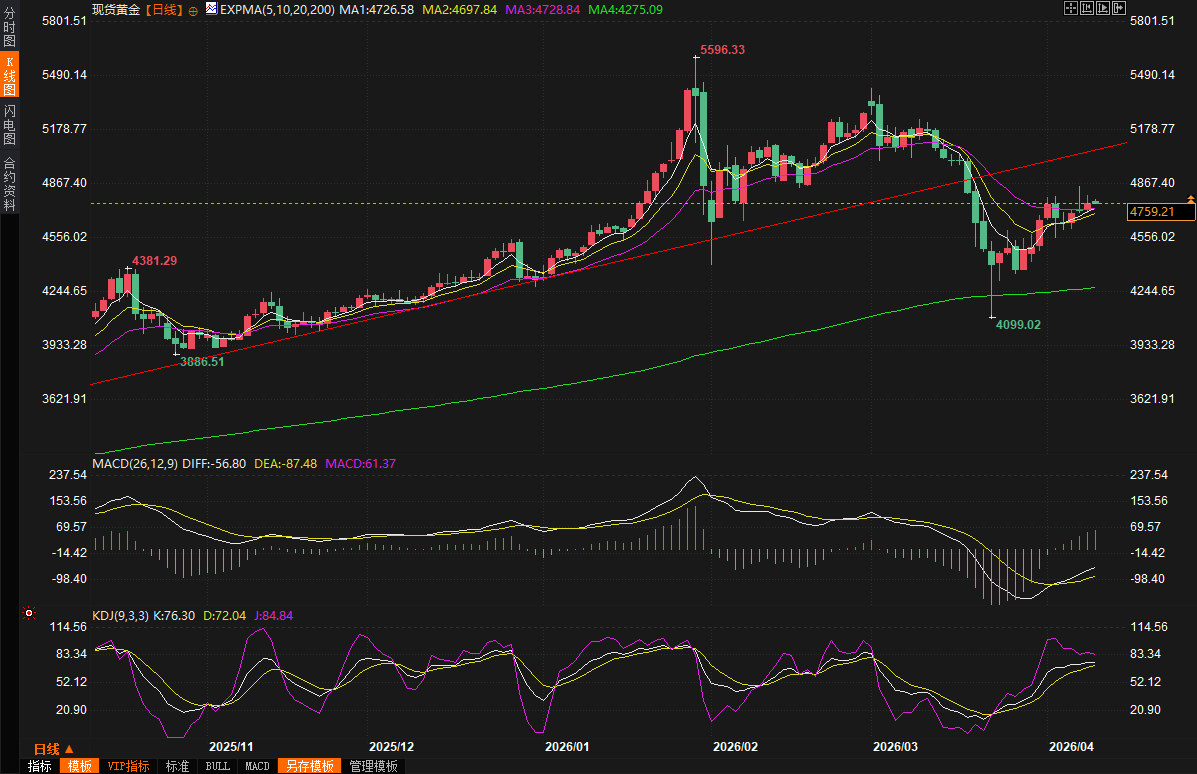
(Spot gold daily chart, source: FX678)
At 07:21 Beijing time, spot gold was trading at $4759.20 per ounce.
Geopolitical clouds loom: The fragile balance of the ceasefire agreement.
The situation in the Middle East is one of the core drivers of this gold price surge. The ceasefire agreement brokered by the Trump administration between the US and Iran appeared to have brought an end to the six-week conflict, but cracks have quickly emerged. Israel's large-scale airstrikes on targets in Lebanon, which killed more than 300 people, directly threaten the agreement's sustainability. Iran has made it clear that a ceasefire must include Lebanon and emphasized that it will not tolerate any attacks; further, strong statements from Iran's Supreme Leader have exacerbated market tensions.
The strait's blockade is particularly critical. This strait carries approximately one-fifth of the world's oil and liquefied natural gas shipments; however, in the initial 24 hours after the ceasefire, only a small number of ships passed through, far below the pre-war average of 140 ships per day. Iran's assertion of control by warning ships against entering its territorial waters has resulted in the most severe disruption to global energy supplies in history. High oil prices followed; although they fell sharply on Tuesday, they rebounded on Wednesday, with US crude briefly reaching $102.70 per barrel and Brent crude nearing $100. This energy supply risk has not only fueled inflation expectations but also strengthened the appeal of gold as a safe-haven asset.
Israeli Prime Minister Benjamin Netanyahu is seeking direct dialogue with Lebanon, focusing on disarming Hezbollah and establishing peace relations, while Lebanon is pushing for a temporary ceasefire to initiate broader negotiations. Pakistan is preparing for the first round of US-Iran talks, but significant differences exist: the US and Israel insist Lebanon is not included in the ceasefire agreement, while Iran holds the opposite view. Hezbollah lawmakers' public refusal to negotiate directly with Israel further adds to the uncertainty. Market participants generally believe that the ceasefire news initially boosted gold prices, but as cracks appeared, gold prices retreated from their recent high of $4,856, only to quickly stabilize with support from a weaker dollar.
This geopolitical risk premium is a typical catalyst for the long-term bull market in gold. Historical experience shows that when conflicts escalate or energy routes are blocked, investors often turn to gold to hedge against uncertainty, even if short-term inflationary pressures from oil prices may temporarily suppress its gains.
A Weak Dollar and Inflation Expectations: Gold's Resilience Supported by Two Factors
The dollar index extended its decline on Thursday, closing down 0.22% at around 98.81. The weakening dollar provided significant technical support for gold. Buyers using other currencies found it easier to purchase gold when the dollar was weak, directly driving the rebound in spot gold prices. Bob Haberkorn, senior market strategist at RJO Futures, noted that the weaker dollar helped gold regain its footing, but the market is still cautiously assessing the true meaning of the ceasefire.
Meanwhile, US economic data released mixed signals. The US Personal Consumption Expenditures (PCE) inflation gauge rose 0.4% month-over-month in February, reaching 2.8% year-over-year, in line with market expectations. However, March's CPI data will be released on Friday, and the market widely expects inflation to rise further. High oil prices have become a major threat to inflation, not only squeezing economic growth but also limiting the Federal Reserve's room for interest rate cuts. Fed meeting minutes show that policymakers are increasingly concerned about inflation risks and are even considering raising interest rates if necessary to address the pressure.
U.S. Treasury yields edged lower after the data release, with the 10-year yield at 4.285% and the two-year yield falling to 3.775%. The yield curve shows a positive slope, reflecting the market's weighing of short-term economic slowdown against long-term inflationary pressures. Rising initial jobless claims and a downward revision of GDP growth to 0.5%, signals that should have supported expectations of interest rate cuts, were offset by rising energy prices. The CME FedWatch tool shows that while the probability of a 25-basis-point rate cut at the December meeting has increased somewhat, it is still significantly lower than a month ago.
Morgan Stanley analysts believe that gold prices are likely to remain stable in the second quarter of 2026, with a potential rebound in the second half of the year. Gold will be supported if the Federal Reserve avoids raising interest rates; meanwhile, the gradual resolution of conflicts will also refocus the market on the issue of fiat currency devaluation. As a non-interest-bearing asset, gold is typically under pressure in a high-interest-rate environment, but current geopolitical risks and inflationary uncertainties are giving it unique defensive value.
Market Sentiment and Institutional Outlook: The Structural Bull Market Logic for Gold
From a broader perspective, gold's recent performance is not an isolated event. Since 2025, gold prices have risen significantly, breaking historical highs multiple times, and some analysts predict that in 2026, they may further challenge $5,000 or even higher levels. Continued gold purchases by central banks, ETF inflows, and global trade and geopolitical uncertainties are all structural factors supporting the long-term strength of gold.
Although concerns about "stagflation" triggered by oil prices briefly caused gold prices to pull back from their early March highs, Thursday's rebound indicates a return of market confidence in safe-haven demand. Saudi Arabia's oil production was reduced by 600,000 barrels per day due to the attacks, further highlighting supply fragility, which will continue to push up energy costs and indirectly benefit gold's hedging properties.
The volatility in the international oil market echoed the price movements of gold. While Brent crude oil's gains narrowed to around 1%, it had surged by over 5% at one point during the session, reflecting investor concerns about the reopening of the Straits. Even if negotiations progress, the risks won't disappear overnight: insurance and freight costs remain high, and physical crude oil prices have already reached record highs.
Looking ahead: Can gold maintain its strong performance?
In summary, the gold market is currently at a crossroads between geopolitical risks and macroeconomic data. Friday's release of the US March CPI data will be a key catalyst. If inflation rises higher than expected, further dimming the prospect of a Fed rate cut, the dollar may rebound and put short-term downward pressure on gold prices; conversely, if the data is moderate, or if there are signs of substantial easing in the Middle East situation, gold is expected to regain upward momentum.
Overall, gold's appeal lies in its multiple roles: a safe-haven asset, an inflation hedge, and a choice to hedge against fiat currency devaluation. Given the fragile balance of the US-Iran ceasefire agreement, any new escalation of conflict or news of energy disruptions could reignite enthusiasm for rising gold prices. In the long term, structural demand amid global uncertainty supports gold's continued upward trend within a high-level range.
Investors need to remain vigilant and closely monitor progress in Middle East negotiations, the resumption of shipping in the Strait of Hormuz, and policy signals from the Federal Reserve. Regardless of short-term fluctuations, gold's status as a "crisis currency" will continue to shine with unique value in the turbulent world of 2026.
(Spot gold daily chart, source: FX678)
At 07:21 Beijing time, spot gold was trading at $4759.20 per ounce.
- Risk Warning and Disclaimer
- The market involves risk, and trading may not be suitable for all investors. This article is for reference only and does not constitute personal investment advice, nor does it take into account certain users’ specific investment objectives, financial situation, or other needs. Any investment decisions made based on this information are at your own risk.