Tensions between the US and Iran have been fluctuating, causing the US dollar to gap up against the Japanese yen and once again approach the 160 level.
2026-04-13 10:55:12
On Monday during Asian trading hours, the USD/JPY pair continued its upward momentum, opening higher and reaching around 159.85 , indicating that bullish sentiment still dominates the market. This rise was mainly driven by both escalating geopolitical risks and changing macroeconomic expectations, allowing the exchange rate to maintain its strength near key levels.

In the context of this event, tensions between the United States and Iran have escalated again. The approximately 21 hours of negotiations over the weekend failed to yield a breakthrough, rapidly cooling market expectations for a de-escalation. This was followed by the US announcement of measures to block key shipping routes, triggering a rise in risk aversion in global markets. Against this backdrop, the US dollar, as the world's primary reserve currency, has strengthened its safe-haven appeal, driving capital inflows.
Meanwhile, the sharp rise in crude oil prices further exacerbated market volatility. WTI crude oil gapped up and remained near $100 per barrel , reinforcing market expectations of rising inflation. The continued rise in energy prices further strengthened investors' expectations that the Federal Reserve would maintain its high-interest-rate policy, thus providing fundamental support for the US dollar.
In contrast, the yen has been relatively weak. The Japanese economy is highly dependent on energy imports, and rising oil prices will directly increase import costs, putting pressure on the economy. This "imported inflation" diminishes the yen's attractiveness, keeping it under continued pressure in the current environment.
However, market expectations of potential intervention by Japanese authorities have become a significant factor limiting further appreciation of the exchange rate. As the USD/JPY pair approaches the 160 level , investors' vigilance regarding policy intervention has noticeably increased, which has also dampened the willingness of bulls to continue significantly increasing their positions.
From a global market perspective, the current situation presents a typical structure of "a stronger US dollar and a pressured Japanese yen." On the one hand, safe-haven funds are flowing into the US dollar; on the other hand, Japan's economic fundamentals are affected by energy shocks, creating a two-way driving force that keeps the exchange rate on an upward trend.
In terms of market sentiment, investors are weighing two main factors: the upward momentum driven by geopolitical risks and inflation expectations, and the risk of a pullback due to potential policy intervention. This interplay is causing the exchange rate to fluctuate within a high-level range.
The key variables currently attracting investor attention include: whether the situation in the Middle East will escalate further, whether oil prices will remain high, and whether the Japanese authorities will take actual intervention measures. These factors will directly determine whether the exchange rate can effectively break through the 160 mark.
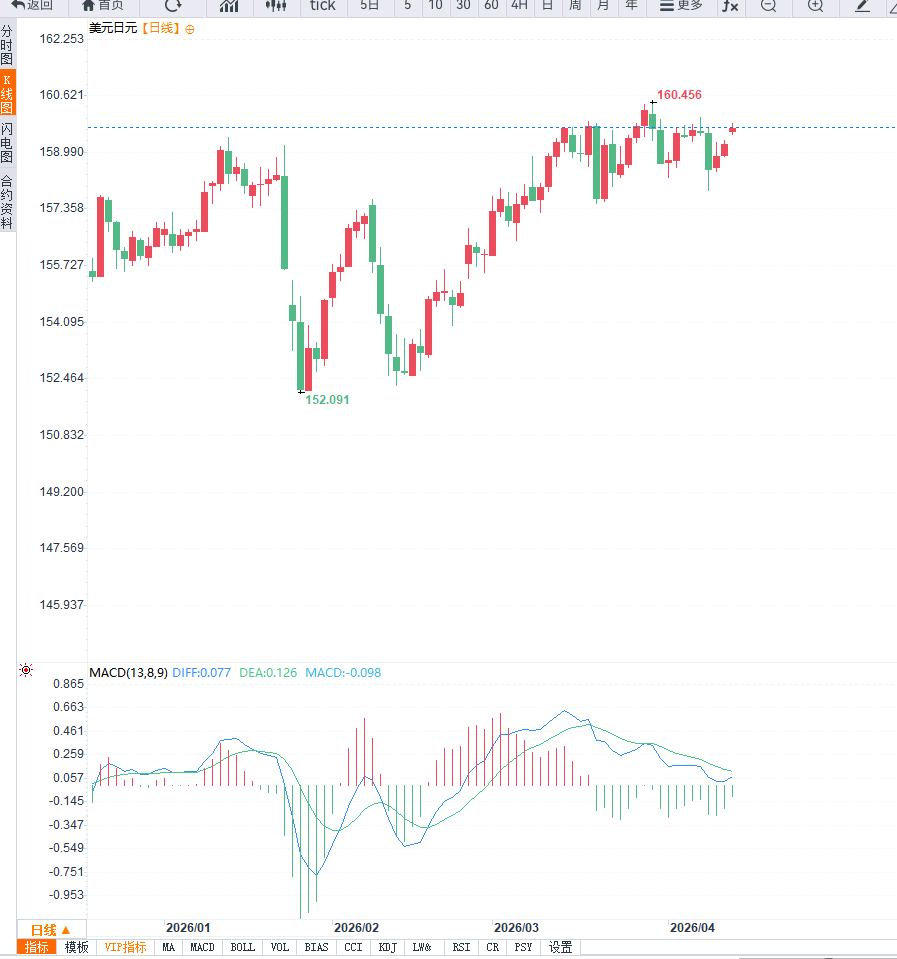
From a technical perspective, the daily chart shows that USD/JPY maintains an overall upward trend. After finding support in the 158.20-158.25 area, it rebounded, confirming this area as a key support zone. Currently, the exchange rate is firmly trading above the 200-period moving average, indicating a continued bullish medium-term trend. In terms of momentum indicators, the MACD continues to diverge upwards, and the RSI is around 63 , showing that upward momentum still exists but has not yet entered extreme overbought territory.
From a 4-hour chart perspective, the exchange rate is showing a short-term upward trend with fluctuations, and the gap indicates strong bullish momentum. If the price can effectively break through and hold above the 160 level , it is expected to further open up upward space and test the 161.50 area; conversely, if the upward movement is resisted and falls below the 158.60 support, it may retreat to the 158.20 or even 158.00 area for consolidation. Overall, the short-term trend remains bullish, but the risk of high-level volatility is increasing.
Editor's Summary <br/>Overall, the current rise in USD/JPY is mainly driven by safe-haven demand, inflation expectations, and interest rate policy expectations. Rising oil prices have intensified inflationary pressures, fueling market expectations that the Federal Reserve will maintain high interest rates, thus supporting the dollar's performance. Meanwhile, the Japanese economy is affected by the energy shock, putting continued pressure on the yen. However, as the exchange rate approaches the key psychological level of 160, expectations of intervention by Japanese authorities have significantly increased, which will be a crucial variable limiting further gains. Future trends will depend on the combined effects of geopolitical tensions, oil price changes, and policy signals. Against this backdrop, USD/JPY may maintain a high-level consolidation pattern in the short term, with bulls and bears battling around key levels, and market volatility is expected to increase further.
In the context of this event, tensions between the United States and Iran have escalated again. The approximately 21 hours of negotiations over the weekend failed to yield a breakthrough, rapidly cooling market expectations for a de-escalation. This was followed by the US announcement of measures to block key shipping routes, triggering a rise in risk aversion in global markets. Against this backdrop, the US dollar, as the world's primary reserve currency, has strengthened its safe-haven appeal, driving capital inflows.
Meanwhile, the sharp rise in crude oil prices further exacerbated market volatility. WTI crude oil gapped up and remained near $100 per barrel , reinforcing market expectations of rising inflation. The continued rise in energy prices further strengthened investors' expectations that the Federal Reserve would maintain its high-interest-rate policy, thus providing fundamental support for the US dollar.
In contrast, the yen has been relatively weak. The Japanese economy is highly dependent on energy imports, and rising oil prices will directly increase import costs, putting pressure on the economy. This "imported inflation" diminishes the yen's attractiveness, keeping it under continued pressure in the current environment.
However, market expectations of potential intervention by Japanese authorities have become a significant factor limiting further appreciation of the exchange rate. As the USD/JPY pair approaches the 160 level , investors' vigilance regarding policy intervention has noticeably increased, which has also dampened the willingness of bulls to continue significantly increasing their positions.
From a global market perspective, the current situation presents a typical structure of "a stronger US dollar and a pressured Japanese yen." On the one hand, safe-haven funds are flowing into the US dollar; on the other hand, Japan's economic fundamentals are affected by energy shocks, creating a two-way driving force that keeps the exchange rate on an upward trend.
In terms of market sentiment, investors are weighing two main factors: the upward momentum driven by geopolitical risks and inflation expectations, and the risk of a pullback due to potential policy intervention. This interplay is causing the exchange rate to fluctuate within a high-level range.
The key variables currently attracting investor attention include: whether the situation in the Middle East will escalate further, whether oil prices will remain high, and whether the Japanese authorities will take actual intervention measures. These factors will directly determine whether the exchange rate can effectively break through the 160 mark.
From a technical perspective, the daily chart shows that USD/JPY maintains an overall upward trend. After finding support in the 158.20-158.25 area, it rebounded, confirming this area as a key support zone. Currently, the exchange rate is firmly trading above the 200-period moving average, indicating a continued bullish medium-term trend. In terms of momentum indicators, the MACD continues to diverge upwards, and the RSI is around 63 , showing that upward momentum still exists but has not yet entered extreme overbought territory.
From a 4-hour chart perspective, the exchange rate is showing a short-term upward trend with fluctuations, and the gap indicates strong bullish momentum. If the price can effectively break through and hold above the 160 level , it is expected to further open up upward space and test the 161.50 area; conversely, if the upward movement is resisted and falls below the 158.60 support, it may retreat to the 158.20 or even 158.00 area for consolidation. Overall, the short-term trend remains bullish, but the risk of high-level volatility is increasing.
Editor's Summary <br/>Overall, the current rise in USD/JPY is mainly driven by safe-haven demand, inflation expectations, and interest rate policy expectations. Rising oil prices have intensified inflationary pressures, fueling market expectations that the Federal Reserve will maintain high interest rates, thus supporting the dollar's performance. Meanwhile, the Japanese economy is affected by the energy shock, putting continued pressure on the yen. However, as the exchange rate approaches the key psychological level of 160, expectations of intervention by Japanese authorities have significantly increased, which will be a crucial variable limiting further gains. Future trends will depend on the combined effects of geopolitical tensions, oil price changes, and policy signals. Against this backdrop, USD/JPY may maintain a high-level consolidation pattern in the short term, with bulls and bears battling around key levels, and market volatility is expected to increase further.
- Risk Warning and Disclaimer
- The market involves risk, and trading may not be suitable for all investors. This article is for reference only and does not constitute personal investment advice, nor does it take into account certain users’ specific investment objectives, financial situation, or other needs. Any investment decisions made based on this information are at your own risk.