The US-EU chessboard has taken a turn! The Hungarian election shattered Trump's European strategy, and the dollar's safe-haven logic collapsed, facing a double blow.
2026-04-13 21:40:07
On Monday (April 13), during the Asian and European sessions, the US dollar rose and then fell back. In addition to digesting Trump's remarks about softening the blockade of the Strait of Hormuz, the market received another piece of bad news for the United States.
The upset result of the Hungarian prime ministerial election marks a significant setback for the Trump administration's European strategy.
On April 7, before the election, Vice President Vance's unusual diplomatic move of visiting Hungary was essentially a desperate gamble by the Trump administration to achieve its three strategic goals, but it ultimately ended in complete failure.
Vance's core objective for this trip was, first and foremost, to support his political ally, Orban. Orban, seen by the Trump administration as a "standard-bearer" and role model of right-wing populism in Europe, was in dire need of US endorsement when facing a poll crisis. Vance attempted to portray him as a hero who resisted the power of EU bureaucracy through a high-profile visit, thereby winning the support of swing voters.
Secondly, the United States intends to make Hungary a "strategic testing ground" for conservative governance, and by supporting Orban, to build a bridgehead within the EU to check and balance the mainstream factions and divide the European integration process.
Finally, during his visit to Hungary, Vance publicly criticized the EU for "interfering in the Hungarian election," but in reality, he was using the guise of "anti-interference" to "help the election" and attempting to directly influence the election's outcome through American influence.
But the election results delivered a resounding slap to this meticulously planned diplomatic campaign: Magal's victory not only ended Orban's long-term rule, but also completely shattered the Trump administration's strategic vision.
The United States' overt intervention not only failed to salvage Orban's defeat, but also fueled resentment among Hungarian voters towards external interference in their domestic affairs, indirectly boosting the opposition's support.
This "more harm than good" outcome highlights the Trump administration's serious misjudgment of European geopolitics and exposes the incompatibility of its "ideologically-based" diplomatic model in Europe.
For the Trump administration, the defeat in the Hungarian election was not merely a political change in a single country, but rather the collapse of a core pillar of its European strategy.
For a long time, the United States has regarded Hungary, led by Orban, as a key tool to contain the European Union and promote a conservative agenda, hoping to use this "model" to radiate influence and divide the consistency of European policies toward the United States.
However, after his election victory, Magalh clearly stated that he would "deepen cooperation with the EU and NATO" and emphasized that Hungary "firmly embraces its European national identity," which means that the "anti-European bridgehead" carefully cultivated by the United States has completely collapsed.
More seriously, this diplomatic setback will undermine the United States' credibility in Central and Eastern Europe.
The Trump administration's open interference in the internal affairs of other countries has not only provoked resentment in Hungary, but has also alerted other European countries to the US's "ideological export" and interventionism. The mainstream factions in the EU will be more inclined to unite to deal with the US's divisive strategy, and the linkage between the US and right-wing populist forces in Europe has been greatly weakened.
Furthermore, the United States' inaction in investing diplomatic resources in the Hungarian elections while the war with Iran was raging also distracted it from its core geopolitical conflicts, further exposing the misallocation of resources and confusion of priorities in its global strategy.
For Hungary, Magal's victory has ushered in a new era of transformation in the "post-Orban era," a time of both opportunities and challenges.
On a positive note, Magal's "de-Orbanization" stance has cleared the way for Hungary to repair its relations with the EU. Previously, Orban's actions, such as manipulating the democratic system and vetoing a €90 billion loan to Ukraine, had led to a continuous escalation of tensions between Hungary and the EU. Magal's commitment to deepening cooperation with the EU is expected to unlock various types of frozen funding from the EU and alleviate domestic economic pressure.
At the same time, Magal advocates for diversifying the energy structure and plans to introduce diversified oil and gas supply channels to landlocked Hungary through new agreements and infrastructure construction, thereby reducing its dependence on a single energy source and mitigating the impact of geopolitical conflicts on the domestic economy.
However, the challenges are equally undeniable. Although Magal comes from a right-wing background, he has distanced himself from Orban's hardline approach. His policy shift requires balancing domestic conservative forces with the mainstream demands of the EU, especially on sensitive issues such as Ukraine and sanctions against Russia. Magal has stated that he hopes the EU will lift sanctions against Russia after the conflict ends. This position differs from the EU's current policy toward Russia and may trigger new power struggles in the future.
In addition, Hungary needs to maintain communication with the United States while rebuilding mutual trust with the European Union, seeking a neutral position in the strategic game between the US and the EU, and avoiding falling into the dilemma of "choosing sides" again.
Magal, shortly after taking office, expressed his hope that the EU would lift sanctions against Russia after the conflict ended.
The geopolitical restructuring in Europe triggered by the Hungarian elections ultimately transmitted to the US dollar index through market expectations, creating a significant chain reaction.
Previously, during the administration of Viktor Orbán, supported by the Trump administration, the ongoing conflict between Hungary and the EU, along with the rise of populism in Europe, provided stable safe-haven demand for the US dollar. The risk of division within Europe led funds to flow into dollar assets, which, combined with the relative advantage of US energy self-sufficiency, strengthened the dollar's dominance.
However, after Magalhães' victory, the European political landscape has shown a trend of "de-dividing": Hungary has re-embraced its European identity, policy coordination within the EU is expected to improve, the European geopolitical risk premium has rapidly subsided, and the safe-haven logic that previously supported the US dollar has significantly weakened.
More importantly, the Trump administration’s diplomatic setbacks exposed the marginal decline of its global influence, shaking market confidence in the US-led geopolitical order. Coupled with inflationary pressures on the US economy and expectations of interest rate cuts by the Federal Reserve, funds began to flow back from dollar assets to European markets.
In the short term, the weak and volatile trend of the US dollar index around the 99 level will be further consolidated.
The decrease in political uncertainty in Europe has led markets to gradually abandon geopolitical safe-haven trading and return to the traditional narrative of "weak dollar + Fed rate cuts." Meanwhile, the Magal government's push for Hungary's energy diversification and deepening cooperation with the EU may boost expectations for a Eurozone economic recovery, indirectly suppressing the relative attractiveness of the dollar.
The subsequent fluctuations in the US dollar index will continue to reflect the degree of fading of geopolitical risks in Europe and the pace of adjustments in the Federal Reserve's policies. The changes in the strategic landscape between the US and Europe triggered by the Hungarian elections have become a key fulcrum for leveraging this logic.
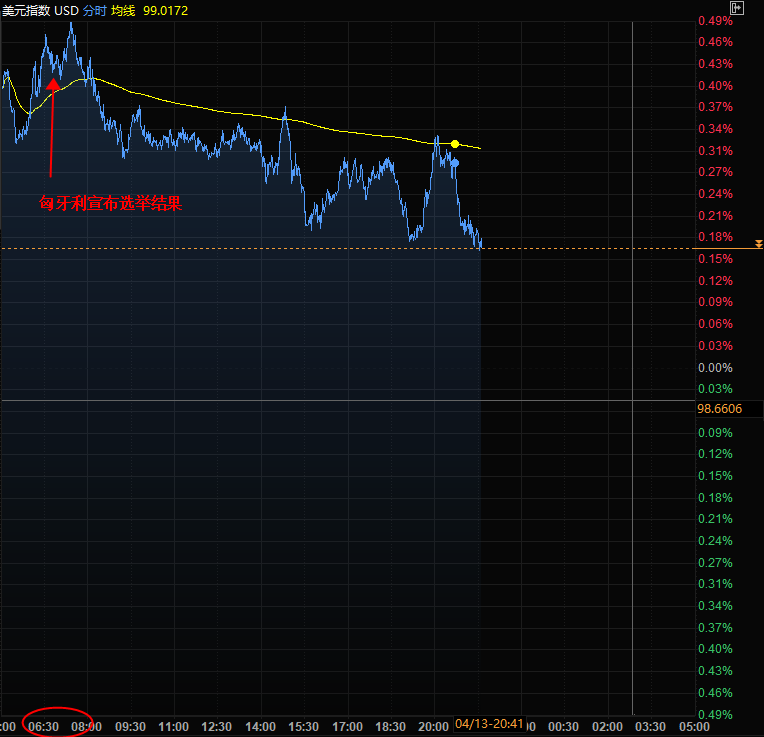
(US Dollar Index intraday chart, source: EasyForex subsidiary)
At 21:39 Beijing time, the US dollar index is currently at 98.86.
The Trump administration's diplomatic setbacks: all three high-stakes gambles fail.
The upset result of the Hungarian prime ministerial election marks a significant setback for the Trump administration's European strategy.
On April 7, before the election, Vice President Vance's unusual diplomatic move of visiting Hungary was essentially a desperate gamble by the Trump administration to achieve its three strategic goals, but it ultimately ended in complete failure.
Vance's core objective for this trip was, first and foremost, to support his political ally, Orban. Orban, seen by the Trump administration as a "standard-bearer" and role model of right-wing populism in Europe, was in dire need of US endorsement when facing a poll crisis. Vance attempted to portray him as a hero who resisted the power of EU bureaucracy through a high-profile visit, thereby winning the support of swing voters.
Secondly, the United States intends to make Hungary a "strategic testing ground" for conservative governance, and by supporting Orban, to build a bridgehead within the EU to check and balance the mainstream factions and divide the European integration process.
Finally, during his visit to Hungary, Vance publicly criticized the EU for "interfering in the Hungarian election," but in reality, he was using the guise of "anti-interference" to "help the election" and attempting to directly influence the election's outcome through American influence.
But the election results delivered a resounding slap to this meticulously planned diplomatic campaign: Magal's victory not only ended Orban's long-term rule, but also completely shattered the Trump administration's strategic vision.
The United States' overt intervention not only failed to salvage Orban's defeat, but also fueled resentment among Hungarian voters towards external interference in their domestic affairs, indirectly boosting the opposition's support.
This "more harm than good" outcome highlights the Trump administration's serious misjudgment of European geopolitics and exposes the incompatibility of its "ideologically-based" diplomatic model in Europe.
The profound impact of the election results on the United States: the collapse of strategic pivots and the shattering of the alliance system.
For the Trump administration, the defeat in the Hungarian election was not merely a political change in a single country, but rather the collapse of a core pillar of its European strategy.
For a long time, the United States has regarded Hungary, led by Orban, as a key tool to contain the European Union and promote a conservative agenda, hoping to use this "model" to radiate influence and divide the consistency of European policies toward the United States.
However, after his election victory, Magalh clearly stated that he would "deepen cooperation with the EU and NATO" and emphasized that Hungary "firmly embraces its European national identity," which means that the "anti-European bridgehead" carefully cultivated by the United States has completely collapsed.
More seriously, this diplomatic setback will undermine the United States' credibility in Central and Eastern Europe.
The Trump administration's open interference in the internal affairs of other countries has not only provoked resentment in Hungary, but has also alerted other European countries to the US's "ideological export" and interventionism. The mainstream factions in the EU will be more inclined to unite to deal with the US's divisive strategy, and the linkage between the US and right-wing populist forces in Europe has been greatly weakened.
Furthermore, the United States' inaction in investing diplomatic resources in the Hungarian elections while the war with Iran was raging also distracted it from its core geopolitical conflicts, further exposing the misallocation of resources and confusion of priorities in its global strategy.
Opportunities and Challenges for Hungary's Transition Based on Election Results
For Hungary, Magal's victory has ushered in a new era of transformation in the "post-Orban era," a time of both opportunities and challenges.
On a positive note, Magal's "de-Orbanization" stance has cleared the way for Hungary to repair its relations with the EU. Previously, Orban's actions, such as manipulating the democratic system and vetoing a €90 billion loan to Ukraine, had led to a continuous escalation of tensions between Hungary and the EU. Magal's commitment to deepening cooperation with the EU is expected to unlock various types of frozen funding from the EU and alleviate domestic economic pressure.
At the same time, Magal advocates for diversifying the energy structure and plans to introduce diversified oil and gas supply channels to landlocked Hungary through new agreements and infrastructure construction, thereby reducing its dependence on a single energy source and mitigating the impact of geopolitical conflicts on the domestic economy.
However, the challenges are equally undeniable. Although Magal comes from a right-wing background, he has distanced himself from Orban's hardline approach. His policy shift requires balancing domestic conservative forces with the mainstream demands of the EU, especially on sensitive issues such as Ukraine and sanctions against Russia. Magal has stated that he hopes the EU will lift sanctions against Russia after the conflict ends. This position differs from the EU's current policy toward Russia and may trigger new power struggles in the future.
In addition, Hungary needs to maintain communication with the United States while rebuilding mutual trust with the European Union, seeking a neutral position in the strategic game between the US and the EU, and avoiding falling into the dilemma of "choosing sides" again.
The US Dollar Index Amid Geopolitical Shifts: Weakening Safe-Haven Logic and Fundamental Regression
Magal, shortly after taking office, expressed his hope that the EU would lift sanctions against Russia after the conflict ended.
The geopolitical restructuring in Europe triggered by the Hungarian elections ultimately transmitted to the US dollar index through market expectations, creating a significant chain reaction.
Previously, during the administration of Viktor Orbán, supported by the Trump administration, the ongoing conflict between Hungary and the EU, along with the rise of populism in Europe, provided stable safe-haven demand for the US dollar. The risk of division within Europe led funds to flow into dollar assets, which, combined with the relative advantage of US energy self-sufficiency, strengthened the dollar's dominance.
However, after Magalhães' victory, the European political landscape has shown a trend of "de-dividing": Hungary has re-embraced its European identity, policy coordination within the EU is expected to improve, the European geopolitical risk premium has rapidly subsided, and the safe-haven logic that previously supported the US dollar has significantly weakened.
More importantly, the Trump administration’s diplomatic setbacks exposed the marginal decline of its global influence, shaking market confidence in the US-led geopolitical order. Coupled with inflationary pressures on the US economy and expectations of interest rate cuts by the Federal Reserve, funds began to flow back from dollar assets to European markets.
In the short term, the weak and volatile trend of the US dollar index around the 99 level will be further consolidated.
The decrease in political uncertainty in Europe has led markets to gradually abandon geopolitical safe-haven trading and return to the traditional narrative of "weak dollar + Fed rate cuts." Meanwhile, the Magal government's push for Hungary's energy diversification and deepening cooperation with the EU may boost expectations for a Eurozone economic recovery, indirectly suppressing the relative attractiveness of the dollar.
The subsequent fluctuations in the US dollar index will continue to reflect the degree of fading of geopolitical risks in Europe and the pace of adjustments in the Federal Reserve's policies. The changes in the strategic landscape between the US and Europe triggered by the Hungarian elections have become a key fulcrum for leveraging this logic.
(US Dollar Index intraday chart, source: EasyForex subsidiary)
At 21:39 Beijing time, the US dollar index is currently at 98.86.
- Risk Warning and Disclaimer
- The market involves risk, and trading may not be suitable for all investors. This article is for reference only and does not constitute personal investment advice, nor does it take into account certain users’ specific investment objectives, financial situation, or other needs. Any investment decisions made based on this information are at your own risk.