The lockdown declaration was met with a market sell-off, with gold and risk assets rebounding in tandem.
2026-04-13 21:07:35
On Monday (April 13), during the Asian and European sessions, the US dollar index rose and then fell, causing gold and global risk assets to open lower, test the bottom, and then rebound throughout the day.
The conflict between the US and Iran is escalating around the Strait of Hormuz, a vital global energy artery. The US blockade measures not only impose additional costs on the global economy but also stir up sensitive nerves in international markets.

For weeks, the global economy has been in a highly sensitive state, with the core demand focused on the resumption of navigation in the Strait of Hormuz—this narrow waterway carries about one-fifth of the world's oil and gas transport and is an irreplaceable strategic energy corridor.
Previously, Iran had effectively closed the strait in response to its war with Israel and the United States;
Although some ships were allowed to pass through during the war, they were all required to comply with rules set by Iran, including conditions such as allegedly paying a security passage fee.
Allowing all shipping vehicles to resume navigation was the core clause of the two-week ceasefire agreement reached last week. However, the marathon negotiations between the US and Iran over the weekend ultimately failed, and US President Donald Trump then announced a major escalation of the situation through a "real social media" platform: "Effective immediately, the world's leading US Navy will initiate a full blockade procedure to prohibit all ships attempting to enter or leave the Strait of Hormuz."
Although no agreement was reached in the negotiations, the blockade details subsequently released by the U.S. Central Command on Monday morning were more restrained than Trump’s initial statement on Saturday, but also expanded the actual scope of coverage: the blockade applies to all ships of all countries entering and leaving Iranian ports and coastal areas of the country.
It covers all Iranian ports in the Persian Gulf and the Gulf of Oman, but ships traveling to and from non-Iranian ports and passing through the Strait of Hormuz will not be affected.
This adjustment means that Iranian ports located outside the Strait of Hormuz and along the Gulf of Oman are also included in the blockade, directly causing a slight reversal in the market in the early morning, with the US dollar index fluctuating lower and gold starting to rebound.
The U.S. military has made it clear that the blockade will officially begin at 10:00 a.m. Eastern Time on April 13. The core objective is to exert extreme pressure on Iran's economy by blocking its export routes, forcing the country to open up full air travel.
However, as a major global oil and gas exporter, Iran has warned that the global economy will pay a heavy price for this blockade.
From the perspective of the blockade implementation mechanism, 11 major Iranian ports will be directly under pressure: 8 of them are located in the southern Arabian Gulf and the Gulf of Oman, and 3 are located in the northern Caspian Sea (mainly serving regional trade). These ports are all included in the targeted blockade, especially the Hag Island port, which handles 90% of the country's crude oil exports and will face the most direct impact.
Iran's economy is extremely dependent on oil and gas resources, making it a key target of the US blockade strategy.
According to statistics from the International Energy Agency (IEA), Iran's daily crude oil production reached 3.59 million barrels in February 2026 (before the outbreak of war).
Global daily crude oil demand is projected to be around 105 million barrels by 2025, meaning that Iran's production will account for 3.5% of global demand, which is enough to have a substantial impact on the global oil market landscape.
In 2024, crude oil exports contributed 57% of Iran's total export revenue, with China being the core buyer, absorbing 90% of Iran's oil exports. Syria (3.3%) and the UAE (2%) followed closely behind, while Iraq, Turkey, Malaysia, and Oman each accounted for less than 1% of imports. In addition to crude oil, Iran also exports petrochemical products such as methanol, urea, polyethylene, and ammonia, occupying an important position in the global related industrial chain.
The market impact has begun to emerge: stimulated by news of the blockade, international oil prices have rebounded again, whereas they had experienced a temporary decline when the ceasefire agreement was announced last week.
Although Trump has made it clear that he does not plan to implement a permanent blockade, mentioning in his statement that "we will eventually achieve full two-way traffic, but Iran is currently refusing to cooperate... Any vessel that pays illegal passage fees has no right to safe passage on the high seas," the market still finds it difficult to predict the duration of the blockade, its actual effectiveness, and the depth and breadth of the impact on the shipping industry.
As the largest importer of Iranian crude oil, China will be the first to be impacted, and the ripple effect may trigger a structural shortage in global crude oil supply, further pushing up international oil prices.
In addition, several Gulf countries will also face a chain reaction. The UAE, Oman, Qatar and other countries have long imported key materials such as mineral fuels, steel, building materials, petrochemical products, agricultural products and fruits from Iran. In 2022, the UAE imported core commodities such as mineral fuels, oil and distilled products, organic chemicals, steel, copper and fertilizers from Iran. The blockade will directly disrupt the stability of the supply chains of these countries.
Risks in the agricultural sector are equally significant, with the supply of urea, a core fertilizer, being particularly prominent. Iran is a major urea producer and the largest urea exporter in the Gulf region, and the current conflict has put pressure on the global fertilizer supply chain, putting farmers in various countries under pressure from rising production costs.
Even if countries like Brazil, India, and Australia do not directly import urea from Iran, they may still face imported cost pressures due to the ripple effect of the fertilizer supply chain disruption.
After peace talks broke down, Trump characterized the blockade as a form of “global blackmail” against Iran, primarily targeting Iran’s practice of charging fees for ships passing through the Strait of Hormuz.
However, objectively speaking, the chain reaction triggered by the US blockade measures has brought significant new costs to the global economy, and geopolitical uncertainties have further highlighted the strategic necessity for countries to promote the diversification of crude oil import sources and the upgrading of domestic refining capacity.
From a long-term perspective, expanding the application of renewable energy and promoting the electrification of transportation, manufacturing and logistics systems remain the core paths for countries to reduce their dependence on oil and enhance energy security.
The geopolitical conflict in this region has always been closely linked to the US dollar. The earliest exposure of the war risk boosted the safe-haven status of the US dollar, and the subsequent rise in oil prices further boosted the US dollar due to increased demand for the US dollar as the main settlement currency.
However, the recent weakening of the US dollar index is also due to the aforementioned reasons. Although rising oil prices are still beneficial to the US dollar as a settlement currency, countries such as Saudi Arabia have begun to use multiple currencies for oil trade settlement. At the same time, the window and prospects for negotiations still exist. Finally, Trump's softened explanation on Monday caused the US dollar to rise and fall directly, forcing gold and global risk assets to rebound together.
From a technical perspective, after the US dollar broke below 100, it has been fluctuating around 99 at the bottom of the trading range. Currently, the trend is weak. With the impact of the war waning, the market may begin to return to a weak dollar and the traditional narrative of the Federal Reserve cutting interest rates.
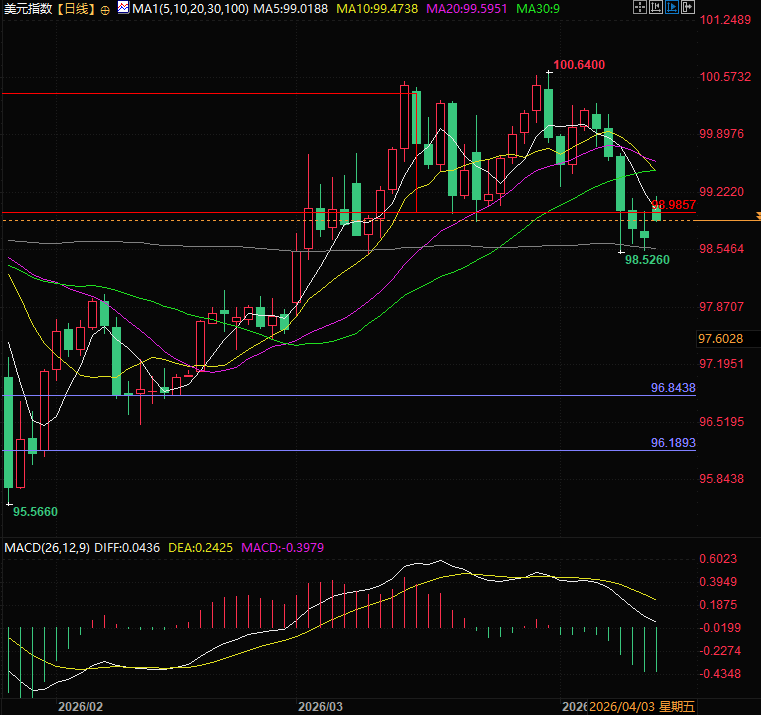
(US Dollar Index Daily Chart, Source: EasyForex)
At 21:05 Beijing time, the US dollar index is currently at 98.89.
The conflict between the US and Iran is escalating around the Strait of Hormuz, a vital global energy artery. The US blockade measures not only impose additional costs on the global economy but also stir up sensitive nerves in international markets.
Conflict Escalates: Ceasefire Talks Break Down, Blockade Declaration Triggers Turmoil
For weeks, the global economy has been in a highly sensitive state, with the core demand focused on the resumption of navigation in the Strait of Hormuz—this narrow waterway carries about one-fifth of the world's oil and gas transport and is an irreplaceable strategic energy corridor.
Previously, Iran had effectively closed the strait in response to its war with Israel and the United States;
Although some ships were allowed to pass through during the war, they were all required to comply with rules set by Iran, including conditions such as allegedly paying a security passage fee.
Allowing all shipping vehicles to resume navigation was the core clause of the two-week ceasefire agreement reached last week. However, the marathon negotiations between the US and Iran over the weekend ultimately failed, and US President Donald Trump then announced a major escalation of the situation through a "real social media" platform: "Effective immediately, the world's leading US Navy will initiate a full blockade procedure to prohibit all ships attempting to enter or leave the Strait of Hormuz."
Lockdown details: Restraint and expansion coexist, market shows slight reversal.
Although no agreement was reached in the negotiations, the blockade details subsequently released by the U.S. Central Command on Monday morning were more restrained than Trump’s initial statement on Saturday, but also expanded the actual scope of coverage: the blockade applies to all ships of all countries entering and leaving Iranian ports and coastal areas of the country.
It covers all Iranian ports in the Persian Gulf and the Gulf of Oman, but ships traveling to and from non-Iranian ports and passing through the Strait of Hormuz will not be affected.
This adjustment means that Iranian ports located outside the Strait of Hormuz and along the Gulf of Oman are also included in the blockade, directly causing a slight reversal in the market in the early morning, with the US dollar index fluctuating lower and gold starting to rebound.
The U.S. military has made it clear that the blockade will officially begin at 10:00 a.m. Eastern Time on April 13. The core objective is to exert extreme pressure on Iran's economy by blocking its export routes, forcing the country to open up full air travel.
However, as a major global oil and gas exporter, Iran has warned that the global economy will pay a heavy price for this blockade.
Key target: Iran's extreme economic dependence on oil and gas
From the perspective of the blockade implementation mechanism, 11 major Iranian ports will be directly under pressure: 8 of them are located in the southern Arabian Gulf and the Gulf of Oman, and 3 are located in the northern Caspian Sea (mainly serving regional trade). These ports are all included in the targeted blockade, especially the Hag Island port, which handles 90% of the country's crude oil exports and will face the most direct impact.
Iran's economy is extremely dependent on oil and gas resources, making it a key target of the US blockade strategy.
According to statistics from the International Energy Agency (IEA), Iran's daily crude oil production reached 3.59 million barrels in February 2026 (before the outbreak of war).
Global daily crude oil demand is projected to be around 105 million barrels by 2025, meaning that Iran's production will account for 3.5% of global demand, which is enough to have a substantial impact on the global oil market landscape.
In 2024, crude oil exports contributed 57% of Iran's total export revenue, with China being the core buyer, absorbing 90% of Iran's oil exports. Syria (3.3%) and the UAE (2%) followed closely behind, while Iraq, Turkey, Malaysia, and Oman each accounted for less than 1% of imports. In addition to crude oil, Iran also exports petrochemical products such as methanol, urea, polyethylene, and ammonia, occupying an important position in the global related industrial chain.
Initial market reaction: Oil prices rebound, uncertainty dominates expectations.
The market impact has begun to emerge: stimulated by news of the blockade, international oil prices have rebounded again, whereas they had experienced a temporary decline when the ceasefire agreement was announced last week.
Although Trump has made it clear that he does not plan to implement a permanent blockade, mentioning in his statement that "we will eventually achieve full two-way traffic, but Iran is currently refusing to cooperate... Any vessel that pays illegal passage fees has no right to safe passage on the high seas," the market still finds it difficult to predict the duration of the blockade, its actual effectiveness, and the depth and breadth of the impact on the shipping industry.
Chain Reaction: Risks Become More Prominent in Energy, Supply Chains, and Agriculture
As the largest importer of Iranian crude oil, China will be the first to be impacted, and the ripple effect may trigger a structural shortage in global crude oil supply, further pushing up international oil prices.
In addition, several Gulf countries will also face a chain reaction. The UAE, Oman, Qatar and other countries have long imported key materials such as mineral fuels, steel, building materials, petrochemical products, agricultural products and fruits from Iran. In 2022, the UAE imported core commodities such as mineral fuels, oil and distilled products, organic chemicals, steel, copper and fertilizers from Iran. The blockade will directly disrupt the stability of the supply chains of these countries.
Risks in the agricultural sector are equally significant, with the supply of urea, a core fertilizer, being particularly prominent. Iran is a major urea producer and the largest urea exporter in the Gulf region, and the current conflict has put pressure on the global fertilizer supply chain, putting farmers in various countries under pressure from rising production costs.
Even if countries like Brazil, India, and Australia do not directly import urea from Iran, they may still face imported cost pressures due to the ripple effect of the fertilizer supply chain disruption.
Long-term implications: Energy security and diversified transformation are inevitable.
After peace talks broke down, Trump characterized the blockade as a form of “global blackmail” against Iran, primarily targeting Iran’s practice of charging fees for ships passing through the Strait of Hormuz.
However, objectively speaking, the chain reaction triggered by the US blockade measures has brought significant new costs to the global economy, and geopolitical uncertainties have further highlighted the strategic necessity for countries to promote the diversification of crude oil import sources and the upgrading of domestic refining capacity.
From a long-term perspective, expanding the application of renewable energy and promoting the electrification of transportation, manufacturing and logistics systems remain the core paths for countries to reduce their dependence on oil and enhance energy security.
Summary and Technical Analysis:
The geopolitical conflict in this region has always been closely linked to the US dollar. The earliest exposure of the war risk boosted the safe-haven status of the US dollar, and the subsequent rise in oil prices further boosted the US dollar due to increased demand for the US dollar as the main settlement currency.
However, the recent weakening of the US dollar index is also due to the aforementioned reasons. Although rising oil prices are still beneficial to the US dollar as a settlement currency, countries such as Saudi Arabia have begun to use multiple currencies for oil trade settlement. At the same time, the window and prospects for negotiations still exist. Finally, Trump's softened explanation on Monday caused the US dollar to rise and fall directly, forcing gold and global risk assets to rebound together.
From a technical perspective, after the US dollar broke below 100, it has been fluctuating around 99 at the bottom of the trading range. Currently, the trend is weak. With the impact of the war waning, the market may begin to return to a weak dollar and the traditional narrative of the Federal Reserve cutting interest rates.
(US Dollar Index Daily Chart, Source: EasyForex)
At 21:05 Beijing time, the US dollar index is currently at 98.89.
- Risk Warning and Disclaimer
- The market involves risk, and trading may not be suitable for all investors. This article is for reference only and does not constitute personal investment advice, nor does it take into account certain users’ specific investment objectives, financial situation, or other needs. Any investment decisions made based on this information are at your own risk.