The US blockade of Iranian ports has escalated tensions, with Trump stating that Iran wants a deal, causing oil prices to fall again.
2026-04-14 14:30:24
Tensions in the Middle East have escalated again following the US blockade of Iranian ports. Despite strong discontent from Tehran and the added uncertainty to the Strait of Hormuz, market expectations for a dialogue-based resolution remain , which boosted international oil prices, causing them to fall below the key $100 per barrel mark on Tuesday (April 14).
The U.S. military has officially begun blockading Iranian ports, a move that has directly angered Iran and further escalated tensions around the Strait of Hormuz.
The U.S. Central Command has made it clear that the blockade will be carried out on all vessels entering and leaving Iranian ports in the Persian Gulf and the Gulf of Oman equally, but will not affect the normal transit passage of neutral vessels to or from non-Iranian destinations through the Strait of Hormuz.
US President Trump made a strong statement on social media, saying that the US military will intercept any Iranian vessels, as well as any vessels paying passage fees to Iran in the Strait of Hormuz. He warned that any Iranian "fast attack craft" approaching the blockade would be immediately destroyed, emphasizing that the same rapid and powerful system used in combating maritime drug traffickers would be employed.
Trump added that the Iranian navy had been "completely wiped out" in the conflict, with only a small number of "fast attack craft" remaining. He stated, "If any of these vessels approach our blockade line, we will destroy them immediately."
Iran responded swiftly. An Iranian military spokesman described the US restrictions on international shipping as "piracy" and warned that if Iranian ports were threatened, no port in the Persian Gulf or the Gulf of Oman would be safe. The Iranian Revolutionary Guard also stated that any warship approaching the strait would violate the ceasefire agreement and threatened to attack warships passing through the strait, while also retaliating against ports of neighboring Gulf states.
Despite the blockade being implemented, the United States has stated that it remains in contact with Iran and continues to advance negotiations on an agreement. Trump said that Iran contacted the U.S. on Monday and expressed its desire to reach an agreement , but he made it clear that he would not approve any agreement that would allow Iran to possess nuclear weapons.
U.S. Vice President Vance, who led the U.S. delegation, pointed out that the United States has made significant progress in negotiations with Iran. He stated that Trump insists that all enriched nuclear material must be removed from Iran and a credible mechanism must be established to verify that Iran has not developed nuclear weapons. Vance added that the future direction of the negotiations still depends on Iran's attitude.
Pakistani Prime Minister Shehbaz Sharif also stated that efforts to resolve the current conflict are ongoing. Although US-Iran talks broke down on Sunday, contact between the two sides has not been completely severed, providing some relief to the market.
Shipping data shows that despite the US blockade of the Strait of Hormuz, the Rich Starry, an oil tanker belonging to a US-sanctioned Asian power, successfully passed through the strait on Tuesday, becoming the first oil tanker to leave the Persian Gulf since the blockade began. The tanker, owned by an Asian company, undoubtedly poses a challenge to the effectiveness of the US blockade.
NATO allies, including the UK and France, have made it clear that they will not participate in the US blockade to avoid being drawn into the conflict. These countries also emphasized that reopening the Strait of Hormuz is crucial for global energy security.
The fragile ceasefire agreement between the US and Iran is currently facing a major test, with only one week left before it expires.
Israel continued its bombing campaign against Lebanon, launching an attack on Monday against the Iranian-backed Hezbollah, aiming to seize a key town in southern Lebanon. Both the United States and Israel have stated that such actions against Hezbollah are not covered by the ceasefire agreement, while Iran insists that these actions should be included within its framework.
Despite the increased market concerns about disruptions to shipping in the Strait of Hormuz due to the blockade, investors' hopes for a resolution through dialogue remain, causing benchmark oil prices to fall below $100 on Tuesday. Analysts believe that short-term oil price movements will depend on the outcome of the interplay between the strength of the blockade and the progress of negotiations.
Overall , the US blockade of Iranian ports marks a new phase of tension in US-Iran relations. On the one hand, military pressure continues; on the other hand, dialogue channels have not been completely closed. Whether the ceasefire agreement can be extended for the remainder of the term, and whether the safety of shipping in the Strait of Hormuz can be guaranteed, will remain key variables influencing the situation in the Middle East and the trajectory of global energy markets.
The developments over the next week warrant close monitoring.
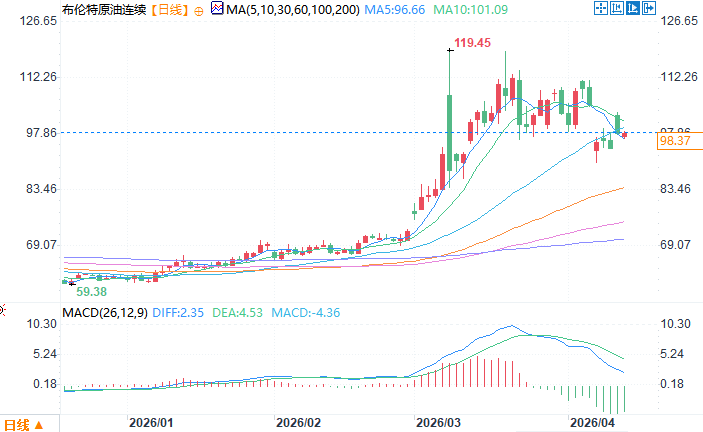
Brent crude oil daily chart source: EasyForex
At 14:29 Beijing time on April 14, Brent crude oil futures were trading at $98.44 per barrel.
Blockade Initiated: US Intensifies Pressure on Iran
The U.S. military has officially begun blockading Iranian ports, a move that has directly angered Iran and further escalated tensions around the Strait of Hormuz.
The U.S. Central Command has made it clear that the blockade will be carried out on all vessels entering and leaving Iranian ports in the Persian Gulf and the Gulf of Oman equally, but will not affect the normal transit passage of neutral vessels to or from non-Iranian destinations through the Strait of Hormuz.
US President Trump made a strong statement on social media, saying that the US military will intercept any Iranian vessels, as well as any vessels paying passage fees to Iran in the Strait of Hormuz. He warned that any Iranian "fast attack craft" approaching the blockade would be immediately destroyed, emphasizing that the same rapid and powerful system used in combating maritime drug traffickers would be employed.
Trump added that the Iranian navy had been "completely wiped out" in the conflict, with only a small number of "fast attack craft" remaining. He stated, "If any of these vessels approach our blockade line, we will destroy them immediately."
Iran responded swiftly. An Iranian military spokesman described the US restrictions on international shipping as "piracy" and warned that if Iranian ports were threatened, no port in the Persian Gulf or the Gulf of Oman would be safe. The Iranian Revolutionary Guard also stated that any warship approaching the strait would violate the ceasefire agreement and threatened to attack warships passing through the strait, while also retaliating against ports of neighboring Gulf states.
Hope for dialogue remains: Trump and Vance send positive signals
Despite the blockade being implemented, the United States has stated that it remains in contact with Iran and continues to advance negotiations on an agreement. Trump said that Iran contacted the U.S. on Monday and expressed its desire to reach an agreement , but he made it clear that he would not approve any agreement that would allow Iran to possess nuclear weapons.
U.S. Vice President Vance, who led the U.S. delegation, pointed out that the United States has made significant progress in negotiations with Iran. He stated that Trump insists that all enriched nuclear material must be removed from Iran and a credible mechanism must be established to verify that Iran has not developed nuclear weapons. Vance added that the future direction of the negotiations still depends on Iran's attitude.
Pakistani Prime Minister Shehbaz Sharif also stated that efforts to resolve the current conflict are ongoing. Although US-Iran talks broke down on Sunday, contact between the two sides has not been completely severed, providing some relief to the market.
Asian giant's oil tankers test blockade: First vessel successfully leaves the Gulf
Shipping data shows that despite the US blockade of the Strait of Hormuz, the Rich Starry, an oil tanker belonging to a US-sanctioned Asian power, successfully passed through the strait on Tuesday, becoming the first oil tanker to leave the Persian Gulf since the blockade began. The tanker, owned by an Asian company, undoubtedly poses a challenge to the effectiveness of the US blockade.
NATO allies have made their stance clear: they refuse to get involved in the conflict.
NATO allies, including the UK and France, have made it clear that they will not participate in the US blockade to avoid being drawn into the conflict. These countries also emphasized that reopening the Strait of Hormuz is crucial for global energy security.
The ceasefire agreement faces a severe test.
The fragile ceasefire agreement between the US and Iran is currently facing a major test, with only one week left before it expires.
Israel continued its bombing campaign against Lebanon, launching an attack on Monday against the Iranian-backed Hezbollah, aiming to seize a key town in southern Lebanon. Both the United States and Israel have stated that such actions against Hezbollah are not covered by the ceasefire agreement, while Iran insists that these actions should be included within its framework.
Oil price trends: Lockdown pressures and expectations of dialogue pull each other in opposite directions.
Despite the increased market concerns about disruptions to shipping in the Strait of Hormuz due to the blockade, investors' hopes for a resolution through dialogue remain, causing benchmark oil prices to fall below $100 on Tuesday. Analysts believe that short-term oil price movements will depend on the outcome of the interplay between the strength of the blockade and the progress of negotiations.
Overall , the US blockade of Iranian ports marks a new phase of tension in US-Iran relations. On the one hand, military pressure continues; on the other hand, dialogue channels have not been completely closed. Whether the ceasefire agreement can be extended for the remainder of the term, and whether the safety of shipping in the Strait of Hormuz can be guaranteed, will remain key variables influencing the situation in the Middle East and the trajectory of global energy markets.
The developments over the next week warrant close monitoring.
Brent crude oil daily chart source: EasyForex
At 14:29 Beijing time on April 14, Brent crude oil futures were trading at $98.44 per barrel.
- Risk Warning and Disclaimer
- The market involves risk, and trading may not be suitable for all investors. This article is for reference only and does not constitute personal investment advice, nor does it take into account certain users’ specific investment objectives, financial situation, or other needs. Any investment decisions made based on this information are at your own risk.