One chart: The Baltic Dry Index rises to a four-month high, with all shipping sectors reporting profits.
2026-04-14 23:58:39
Latest data shows that on April 14, 2026, the Baltic Dry Index (BDI) reached 2354 points, a new high since December 10, 2025, up 4.62% month-on-month, the largest increase since February 12, 2026, and marking the 8th consecutive day of increase (including zero growth). Looking at the short-term charts, the recent 11 BDI data points show: 9 positive increases, 2 negative increases, and 0 zero increases. Specifically, the Panamax Freight Index (BPI) reached 1900 points, up 2.04% from the previous value; the Capesize Freight Index (BCI) reached 3671 points, up 6.81%; and the Supramax Freight Index (BSI) reached 1344 points, up 1.82%. For detailed 720-day and 10-year trend charts of the Baltic Dry Index and its three main sub-indices, please refer to the specially designed charts.
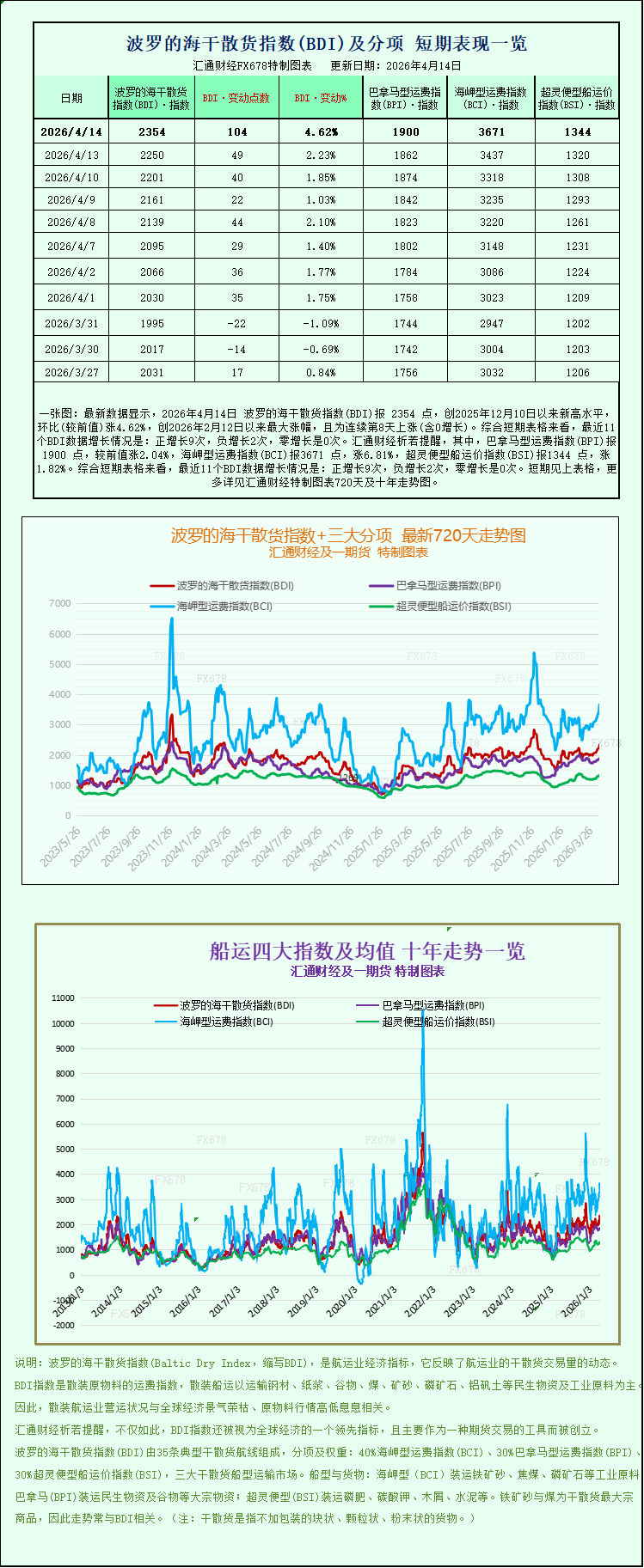
The Baltic Dry Index (BDI) saw a significant surge on Tuesday, breaking through its previous trading range and reaching its highest level in over four months. Simultaneously, all shipping sub-sectors that make up the index also rose, indicating a phase of recovery in the global dry bulk shipping market and a continued improvement in industry sentiment. The BDI, a core indicator of the global dry bulk shipping market, primarily monitors changes in freight rates for ships transporting dry bulk commodities such as iron ore, coal, and grains worldwide. Its trend directly reflects the activity of global commodity trade and the supply and demand relationship in the shipping market.
Specifically, the Baltic Dry Index (BDI), which tracks freight rates for the three core vessel types—Capesize, Panamax, and Supramax—rose 104 points, or 4.6%, to close at 2,354 points. This figure represents the highest level since December 10th of last year, ending months of consolidation and demonstrating a clear upward trend. This significant increase is driven by a combination of factors, including marginal improvements in global commodity trade demand and tight capacity on major shipping routes, suggesting that the dry bulk shipping market is poised for a new upward cycle.
As the "giant" of the dry bulk shipping market, the Capesize sector performed particularly well. The Capesize Index (BCI) surged 234 points, or approximately 6.8%, to close at 3,671 points, its highest point since December 18th of last year, becoming the core driver of the overall index's rise. Capesize vessels are primarily used to transport large dry bulk cargoes, typically carrying up to 150,000 tons of cargo per voyage. Core cargo categories include basic industrial raw materials such as iron ore and coal, and their freight rates are closely linked to global steel industry and energy demand. Along with the index's rise, the average daily earnings of Capesize vessels also increased, rising by $2,125 on the day to reach $29,792, significantly improving shipowner profitability.
It's worth noting that while Capesize shipping rates rose, iron ore futures prices fluctuated in the opposite direction. This is mainly because China's national iron ore purchasing agency recently lifted its ban on iron ore imports from Australian mining company BHP Billiton. This policy adjustment directly increased the total supply available for domestic steel mills, alleviating the previous tight iron ore supply situation, which in turn led to a temporary decline in iron ore futures prices. However, despite the decline in iron ore prices, the production demand of the domestic steel industry remains stable, and the long-term demand for iron ore has not decreased, providing solid support for the transportation demand for Capesize vessels.
Besides the Capesize sector, the Panamax sector also showed a steady upward trend. The Panamax Index (BPI) rose 38 points, or approximately 2%, to close at 1,900 points, continuing its recent moderate upward trend. Panamax vessels are medium-sized dry bulk carriers, typically with a deadweight tonnage of 60,000 to 70,000 tons, primarily transporting bulk commodities such as coal and grain. Their shipping routes are mainly concentrated on transoceanic and regional routes, and are significantly affected by global food trade and energy transportation demand. With the approaching peak season for global food exports and the steady release of coal transportation demand, the average daily revenue of Panamax vessels has also increased, rising by $344 to $17,101 on that day, indicating a steady improvement in profitability.
The Very Large Crude Carrier (VLCC) sector also performed well, with the VLCC index rising 24 points, or 1.8%, to close at 1344 points, achieving a slight increase. As a crucial component of the dry bulk shipping market, VLCCs primarily handle long-distance transport of large dry bulk cargoes, and their freight rates are closely linked to the global demand for transoceanic transport of bulk commodities. This rise in the sector further confirms the overall recovery of the global dry bulk shipping market, with freight rates and profitability improving across large, medium, and small dry bulk carriers, indicating a healthy development trend for the industry as a whole.
Overall, the Baltic Dry Index's rise to a four-month high, with all shipping sectors recording gains, is the result of multiple factors, including a recovery in global commodity trade demand and an improved supply-demand balance in shipping capacity. Going forward, with the gradual recovery of the global economy and continued activity in commodity trade such as iron ore, coal, and grains, the dry bulk shipping market is expected to maintain its upward trend, further enhancing the profitability of shipowners and providing strong support for the stable operation of the global supply chain.
The Baltic Dry Index (BDI) saw a significant surge on Tuesday, breaking through its previous trading range and reaching its highest level in over four months. Simultaneously, all shipping sub-sectors that make up the index also rose, indicating a phase of recovery in the global dry bulk shipping market and a continued improvement in industry sentiment. The BDI, a core indicator of the global dry bulk shipping market, primarily monitors changes in freight rates for ships transporting dry bulk commodities such as iron ore, coal, and grains worldwide. Its trend directly reflects the activity of global commodity trade and the supply and demand relationship in the shipping market.
Specifically, the Baltic Dry Index (BDI), which tracks freight rates for the three core vessel types—Capesize, Panamax, and Supramax—rose 104 points, or 4.6%, to close at 2,354 points. This figure represents the highest level since December 10th of last year, ending months of consolidation and demonstrating a clear upward trend. This significant increase is driven by a combination of factors, including marginal improvements in global commodity trade demand and tight capacity on major shipping routes, suggesting that the dry bulk shipping market is poised for a new upward cycle.
As the "giant" of the dry bulk shipping market, the Capesize sector performed particularly well. The Capesize Index (BCI) surged 234 points, or approximately 6.8%, to close at 3,671 points, its highest point since December 18th of last year, becoming the core driver of the overall index's rise. Capesize vessels are primarily used to transport large dry bulk cargoes, typically carrying up to 150,000 tons of cargo per voyage. Core cargo categories include basic industrial raw materials such as iron ore and coal, and their freight rates are closely linked to global steel industry and energy demand. Along with the index's rise, the average daily earnings of Capesize vessels also increased, rising by $2,125 on the day to reach $29,792, significantly improving shipowner profitability.
It's worth noting that while Capesize shipping rates rose, iron ore futures prices fluctuated in the opposite direction. This is mainly because China's national iron ore purchasing agency recently lifted its ban on iron ore imports from Australian mining company BHP Billiton. This policy adjustment directly increased the total supply available for domestic steel mills, alleviating the previous tight iron ore supply situation, which in turn led to a temporary decline in iron ore futures prices. However, despite the decline in iron ore prices, the production demand of the domestic steel industry remains stable, and the long-term demand for iron ore has not decreased, providing solid support for the transportation demand for Capesize vessels.
Besides the Capesize sector, the Panamax sector also showed a steady upward trend. The Panamax Index (BPI) rose 38 points, or approximately 2%, to close at 1,900 points, continuing its recent moderate upward trend. Panamax vessels are medium-sized dry bulk carriers, typically with a deadweight tonnage of 60,000 to 70,000 tons, primarily transporting bulk commodities such as coal and grain. Their shipping routes are mainly concentrated on transoceanic and regional routes, and are significantly affected by global food trade and energy transportation demand. With the approaching peak season for global food exports and the steady release of coal transportation demand, the average daily revenue of Panamax vessels has also increased, rising by $344 to $17,101 on that day, indicating a steady improvement in profitability.
The Very Large Crude Carrier (VLCC) sector also performed well, with the VLCC index rising 24 points, or 1.8%, to close at 1344 points, achieving a slight increase. As a crucial component of the dry bulk shipping market, VLCCs primarily handle long-distance transport of large dry bulk cargoes, and their freight rates are closely linked to the global demand for transoceanic transport of bulk commodities. This rise in the sector further confirms the overall recovery of the global dry bulk shipping market, with freight rates and profitability improving across large, medium, and small dry bulk carriers, indicating a healthy development trend for the industry as a whole.
Overall, the Baltic Dry Index's rise to a four-month high, with all shipping sectors recording gains, is the result of multiple factors, including a recovery in global commodity trade demand and an improved supply-demand balance in shipping capacity. Going forward, with the gradual recovery of the global economy and continued activity in commodity trade such as iron ore, coal, and grains, the dry bulk shipping market is expected to maintain its upward trend, further enhancing the profitability of shipowners and providing strong support for the stable operation of the global supply chain.
- Risk Warning and Disclaimer
- The market involves risk, and trading may not be suitable for all investors. This article is for reference only and does not constitute personal investment advice, nor does it take into account certain users’ specific investment objectives, financial situation, or other needs. Any investment decisions made based on this information are at your own risk.