Expectations of a de-escalation in the US-Iran conflict have reduced demand for the US dollar as a safe haven, putting downward pressure on the USD/CAD exchange rate.
2026-04-14 15:19:43
The USD/CAD pair continued its decline on Tuesday, breaking below the 1.3790 level to hit a near three-week low, after a significant pullback from Monday's high of 1.3878 . The current market focus remains on the situation in the Middle East and changes in energy prices. As market expectations for a de-escalation of the conflict between the US and Iran increase, the safe-haven appeal of the US dollar weakens, thus putting downward pressure on the USD/CAD pair.
US President Donald Trump stated that the US military has imposed a blockade on Iranian ports, but also revealed that Iran has proactively reached out to seek a "deal." This statement, while escalating geopolitical tensions, also signals potential negotiations. Market research indicates that although previous negotiations failed to achieve a breakthrough, both sides have left room for further dialogue, leading to a temporary recovery in market risk sentiment.
Against this backdrop, demand for the US dollar as a safe-haven asset has declined significantly. Capital flows into risk assets have weakened the overall performance of the dollar, putting continued pressure on USD/CAD. However, unlike before, this round of exchange rate declines has not accelerated, because oil prices remain relatively high, providing solid support for the Canadian dollar.
The closure of the Strait of Hormuz is expected to keep global crude oil supply tight. Although WTI crude oil prices have fallen from a high of nearly $99 on Monday to around $92 , they are still up about 40% from pre-conflict levels. This high level is a direct benefit to the Canadian economy, as energy exports are one of its core pillar industries, and rising oil prices typically increase the attractiveness of the Canadian dollar, thus putting downward pressure on the USD/CAD exchange rate.
Meanwhile, macroeconomic factors are also influencing exchange rate movements. The market is focused on the upcoming US PPI data to determine whether inflation will continue the upward trend of the previous CPI. If producer prices continue to rise, it will intensify war-induced inflationary pressures and may force the Federal Reserve to reassess its policy path, thus providing temporary support for the US dollar.
In Canada, Mark Carney secured a majority in Parliament, with his party winning 173 seats out of a total of 343. This outcome strengthens the government's ability to implement policies and boosts market confidence in economic stability. While this factor has limited impact on the short-term exchange rate, it helps support the Canadian dollar's performance in the medium term.
From a daily chart perspective, USD/CAD has broken below the midpoint of its previous trading range, indicating a shift towards a bearish trend. After repeatedly encountering resistance above 1.3850, the price has retreated and is currently testing the key support area around 1.3750. A break below this level could open up further downside potential to the 1.3650 level. The moving average system is beginning to diverge downwards, suggesting that bearish momentum is gradually strengthening.
From the 4-hour chart, the short-term trend shows a continuous downward structure with gradually lower highs, indicating that bears are in control. In terms of momentum indicators, the RSI remains in the neutral-to-weak zone, without a clear oversold signal, suggesting that the exchange rate still has room for further decline. Meanwhile, short-term rebounds have repeatedly been resisted near 1.3820, forming a significant resistance area. If the US dollar continues to weaken and oil prices remain high, USD/CAD may continue to test key support levels.
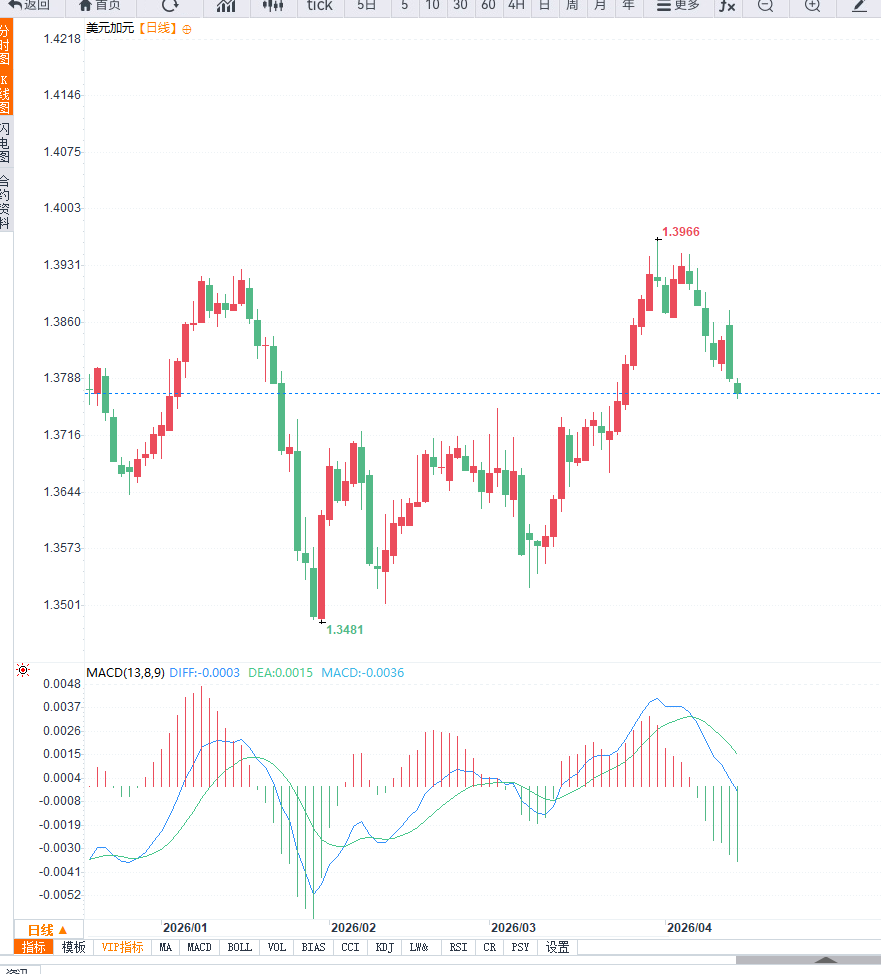
Editor's Summary : The current USD/CAD exchange rate is driven by a combination of factors: a weakening US dollar and support for the Canadian dollar from high oil prices, resulting in an overall downward trend. Although geopolitical risks have not completely subsided, optimistic market expectations regarding the prospects of negotiations have reduced demand for the US dollar as a safe haven, while persistently high oil prices continue to strengthen the Canadian dollar's fundamentals. The key to future price movements lies in three factors: whether the Middle East situation escalates, whether oil prices remain high, and the impact of US inflation data on the Federal Reserve's policy path. If oil prices remain strong, the exchange rate may have further downside potential.
US President Donald Trump stated that the US military has imposed a blockade on Iranian ports, but also revealed that Iran has proactively reached out to seek a "deal." This statement, while escalating geopolitical tensions, also signals potential negotiations. Market research indicates that although previous negotiations failed to achieve a breakthrough, both sides have left room for further dialogue, leading to a temporary recovery in market risk sentiment.
Against this backdrop, demand for the US dollar as a safe-haven asset has declined significantly. Capital flows into risk assets have weakened the overall performance of the dollar, putting continued pressure on USD/CAD. However, unlike before, this round of exchange rate declines has not accelerated, because oil prices remain relatively high, providing solid support for the Canadian dollar.
The closure of the Strait of Hormuz is expected to keep global crude oil supply tight. Although WTI crude oil prices have fallen from a high of nearly $99 on Monday to around $92 , they are still up about 40% from pre-conflict levels. This high level is a direct benefit to the Canadian economy, as energy exports are one of its core pillar industries, and rising oil prices typically increase the attractiveness of the Canadian dollar, thus putting downward pressure on the USD/CAD exchange rate.
Meanwhile, macroeconomic factors are also influencing exchange rate movements. The market is focused on the upcoming US PPI data to determine whether inflation will continue the upward trend of the previous CPI. If producer prices continue to rise, it will intensify war-induced inflationary pressures and may force the Federal Reserve to reassess its policy path, thus providing temporary support for the US dollar.
In Canada, Mark Carney secured a majority in Parliament, with his party winning 173 seats out of a total of 343. This outcome strengthens the government's ability to implement policies and boosts market confidence in economic stability. While this factor has limited impact on the short-term exchange rate, it helps support the Canadian dollar's performance in the medium term.
From a daily chart perspective, USD/CAD has broken below the midpoint of its previous trading range, indicating a shift towards a bearish trend. After repeatedly encountering resistance above 1.3850, the price has retreated and is currently testing the key support area around 1.3750. A break below this level could open up further downside potential to the 1.3650 level. The moving average system is beginning to diverge downwards, suggesting that bearish momentum is gradually strengthening.
From the 4-hour chart, the short-term trend shows a continuous downward structure with gradually lower highs, indicating that bears are in control. In terms of momentum indicators, the RSI remains in the neutral-to-weak zone, without a clear oversold signal, suggesting that the exchange rate still has room for further decline. Meanwhile, short-term rebounds have repeatedly been resisted near 1.3820, forming a significant resistance area. If the US dollar continues to weaken and oil prices remain high, USD/CAD may continue to test key support levels.
Editor's Summary : The current USD/CAD exchange rate is driven by a combination of factors: a weakening US dollar and support for the Canadian dollar from high oil prices, resulting in an overall downward trend. Although geopolitical risks have not completely subsided, optimistic market expectations regarding the prospects of negotiations have reduced demand for the US dollar as a safe haven, while persistently high oil prices continue to strengthen the Canadian dollar's fundamentals. The key to future price movements lies in three factors: whether the Middle East situation escalates, whether oil prices remain high, and the impact of US inflation data on the Federal Reserve's policy path. If oil prices remain strong, the exchange rate may have further downside potential.
- Risk Warning and Disclaimer
- The market involves risk, and trading may not be suitable for all investors. This article is for reference only and does not constitute personal investment advice, nor does it take into account certain users’ specific investment objectives, financial situation, or other needs. Any investment decisions made based on this information are at your own risk.