The IEA monthly report significantly lowered its 2026 global oil demand forecast, citing the Iran war as the reason for the expected drop of 80,000 barrels per day in demand.
2026-04-14 16:08:29
According to APP, the International Energy Agency ( IEA )'s latest monthly report indicates that global oil demand is projected to decline by 80,000 barrels per day in 2026 due to the ongoing impact of the Iran war, compared to a previous forecast of an increase of 640,000 barrels per day. This significant downward revision highlights the direct impact of the conflict on global economic growth expectations and energy consumption. The IEA also predicts that it will take approximately two months for stable exports to recover after the Strait of Hormuz reopens. Non-OPEC+ oil supply fell by 770,000 barrels per day in March compared to the previous month, while OPEC+ production is projected to decline by 2.4 million barrels per day in 2026.
The IEA report emphasizes that the war has brought export logistics from the core oil-producing regions of the Middle East to a near standstill. Coupled with infrastructure damage and shipping insurance challenges, this has resulted in a historic disruption to the global oil supply chain. The downward revision in demand is mainly due to high oil prices suppressing consumption, increased economic uncertainty, and a short-term reduction in aviation fuel and LPG usage. On the supply side, the voluntary shutdowns by OPEC+ members and the simultaneous decline in non-OPEC+ oil prices due to seasonal and geopolitical disturbances have further exacerbated the tight market balance.
Latest market data shows that as of April 14, 2026, Brent crude oil spot prices remained around $98 per barrel, about 50% higher than pre-conflict levels, fully reflecting the real pressure of tightening supply and demand. While the release of strategic reserves provides a short-term buffer, the IEA warns that if the Strait of Hormuz reopens later than expected, the market deficit could widen further in the second quarter.
The following table compares the IEA's 2026 global oil demand forecast before and after adjustments:
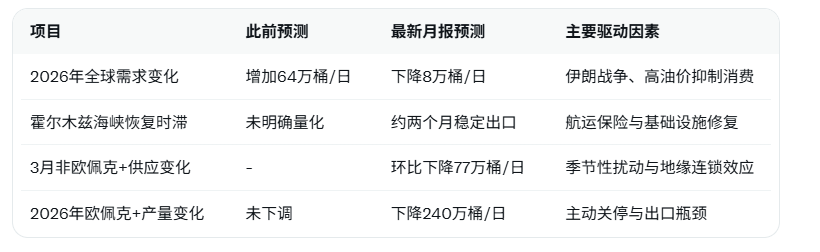
This forecast adjustment highlights the rapid shift in the global oil market from "ample supply" to "structural shortage." For major Asian countries, as key oil importers, high oil prices and supply uncertainty will directly increase import costs, impacting manufacturing, logistics, and consumer spending, potentially dampening economic growth. Simultaneously, the necessity of accelerating energy diversification strategies is further emphasized; however, in the short term, fossil fuels will still dominate the energy structure, benefiting energy-related assets but creating cost pressures on energy-intensive downstream industries.
From a broader perspective, the current situation is not simply a cyclical fluctuation, but rather a result of geopolitical events coupled with vulnerabilities in supply infrastructure. Investors need to continuously monitor the progress of the reopening of the Strait of Hormuz, non-OPEC+ actual production data, and OPEC+ coordination dynamics. If demand declines more than expected or the recovery process is delayed, oil price volatility will increase significantly, and the pace of global economic recovery will face greater challenges.
Editor's Summary : The International Energy Agency's monthly report clearly shows that the Iran war is driving a fundamental shift in the global oil supply and demand landscape. The combined effect of downward demand revisions and supply contraction will support high oil prices. Market participants should use the latest monthly report indicators as a benchmark to dynamically assess the impact of geopolitical risks and macroeconomic data on energy asset pricing, in order to effectively cope with potential inflationary and growth pressures.
The IEA report emphasizes that the war has brought export logistics from the core oil-producing regions of the Middle East to a near standstill. Coupled with infrastructure damage and shipping insurance challenges, this has resulted in a historic disruption to the global oil supply chain. The downward revision in demand is mainly due to high oil prices suppressing consumption, increased economic uncertainty, and a short-term reduction in aviation fuel and LPG usage. On the supply side, the voluntary shutdowns by OPEC+ members and the simultaneous decline in non-OPEC+ oil prices due to seasonal and geopolitical disturbances have further exacerbated the tight market balance.
Latest market data shows that as of April 14, 2026, Brent crude oil spot prices remained around $98 per barrel, about 50% higher than pre-conflict levels, fully reflecting the real pressure of tightening supply and demand. While the release of strategic reserves provides a short-term buffer, the IEA warns that if the Strait of Hormuz reopens later than expected, the market deficit could widen further in the second quarter.
The following table compares the IEA's 2026 global oil demand forecast before and after adjustments:
This forecast adjustment highlights the rapid shift in the global oil market from "ample supply" to "structural shortage." For major Asian countries, as key oil importers, high oil prices and supply uncertainty will directly increase import costs, impacting manufacturing, logistics, and consumer spending, potentially dampening economic growth. Simultaneously, the necessity of accelerating energy diversification strategies is further emphasized; however, in the short term, fossil fuels will still dominate the energy structure, benefiting energy-related assets but creating cost pressures on energy-intensive downstream industries.
From a broader perspective, the current situation is not simply a cyclical fluctuation, but rather a result of geopolitical events coupled with vulnerabilities in supply infrastructure. Investors need to continuously monitor the progress of the reopening of the Strait of Hormuz, non-OPEC+ actual production data, and OPEC+ coordination dynamics. If demand declines more than expected or the recovery process is delayed, oil price volatility will increase significantly, and the pace of global economic recovery will face greater challenges.
Editor's Summary : The International Energy Agency's monthly report clearly shows that the Iran war is driving a fundamental shift in the global oil supply and demand landscape. The combined effect of downward demand revisions and supply contraction will support high oil prices. Market participants should use the latest monthly report indicators as a benchmark to dynamically assess the impact of geopolitical risks and macroeconomic data on energy asset pricing, in order to effectively cope with potential inflationary and growth pressures.
- Risk Warning and Disclaimer
- The market involves risk, and trading may not be suitable for all investors. This article is for reference only and does not constitute personal investment advice, nor does it take into account certain users’ specific investment objectives, financial situation, or other needs. Any investment decisions made based on this information are at your own risk.