Why has the US dollar index returned to pre-war levels amid a double whammy of falling oil prices and expectations of peace?
2026-04-14 19:13:50
On Tuesday (April 14), during the Asian/European trading session, the US dollar index (USD index) showed an overall weak trend. It initially fell to around 98.08 in the early morning, before stabilizing slightly after fluctuating at lower levels. Currently, it is hovering between 98.10 and 98.35, down approximately 0.2%-0.3% from the previous trading day's close. The dollar has been declining slightly this week, with limited daily fluctuations and no significant consecutive rises or falls. However, it has retreated from its highs at the beginning of the Iran conflict, with a cumulative decline of approximately 0.5%-1%. The dollar has returned to a safe-haven trading pattern, but as market optimism regarding the resumption of US-Iran negotiations intensifies, safe-haven buying weakens, and falling oil prices further drag down the dollar's performance.
Hopes for peace talks related to the US-Iran conflict are rising, and the pullback in oil prices has weakened the safe-haven appeal of the US dollar, leading to its decline.
Fundamental analysis
Geopolitical Situation Between the US and Iran and Expectations for Peace Talks: Although the US-Iran talks in Islamabad failed at one point this weekend, Trump stated that Iran had proactively offered to restart negotiations. The market generally believes that while the Strait of Hormuz blockade is an escalation, Iran's significant losses in oil exports may ultimately force it back to the negotiating table. Optimism prevailed, risk appetite rebounded, and safe-haven buying of the US dollar weakened. If a peace agreement is reached later this week, the US dollar may face further selling pressure.
Oil Price Trends and Energy Impact: As hopes for negotiations increased, oil prices fell, easing concerns about energy supply. This indirectly negatively impacted the US dollar, as earlier oil price increases had supported safe-haven demand. The challenges facing China as a major oil importer may also prompt all parties to accelerate the resolution process.
The divergence in policies between the Federal Reserve and other central banks: While other major central banks have adopted a relatively hawkish stance, the uncertainty surrounding the Fed's policy path has led to a weakening of the dollar against some currencies. Recent PCE data has been stable, but today's PPI data warrants attention. If inflationary pressures emerge, it could provide short-term support for the dollar, but the market is more focused on geopolitical events.
Trading Positions and Market Sentiment: Traders shifted from net short to net long positions in the US dollar after the conflict (approximately $19 billion), but this position will turn unfavorable if a peaceful resolution is achieved. The US dollar index is near pre-war levels (around 97.50-98.00) and is currently hovering around 98.10, near the 50% retracement level.
mainstream view
ING believes that the failed Islamabad peace talks briefly supported the dollar (the dollar index rose by about 0.4% at one point), but the dollar does not need to rise significantly further. The dollar index will continue to be driven by energy prices, and good selling pressure will emerge if it approaches 99.50 (the top of last week's gap). ING analysts emphasize that if there are clear signs of a permanent ceasefire, the dollar index is likely to fall below 98.0, returning to pre-war levels.
Reuters reports that if the US and Iran reach a peaceful resolution, traders who previously turned bullish on the US dollar will be at a disadvantage; the dollar index has fallen below key levels, showing signs of weakness, and has broken through multiple moving averages and entered the Ichimoku Cloud.
Another article mentions that the US dollar index has fallen below a key level, with 98.10 being the 50% retracement level of this year's rally. Before the conflict, the index was around 97.50-98.00.
The latest views from platforms such as FXStreet emphasize that the US dollar index is hovering fragilely around 98.40 amid hopes for a second round of US-Iran negotiations, with optimism dominating the market.
Technical Analysis
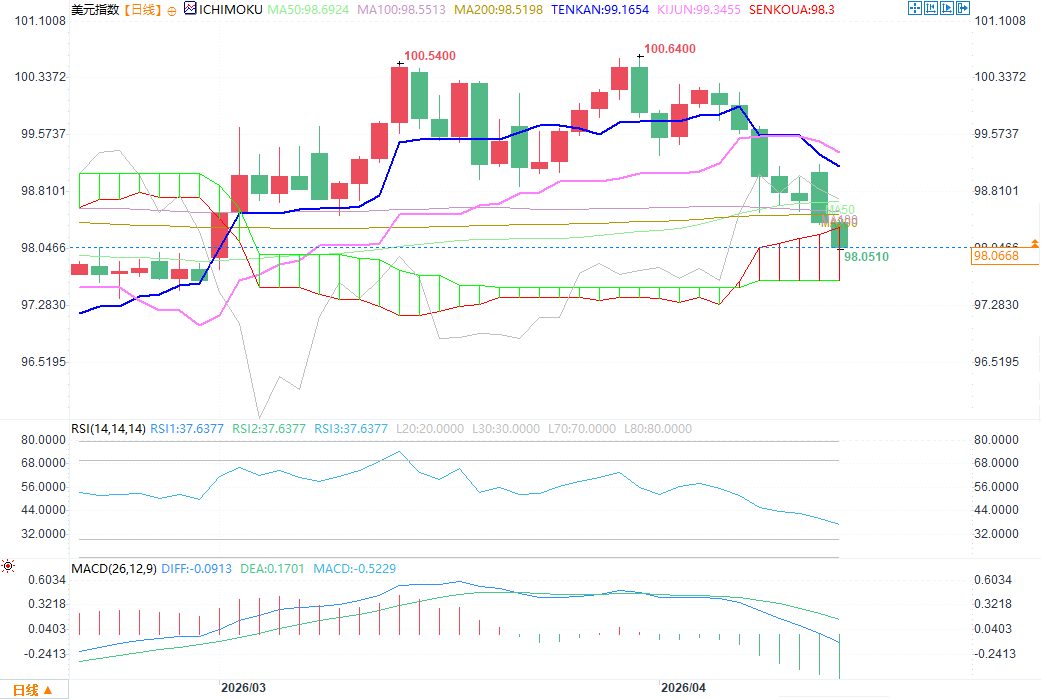
(US Dollar Index Daily Chart Source: FX678)
The US dollar index fell into the Ichimoku Cloud on the daily chart on Tuesday, indicating a shift to a neutral or slightly bearish short-term trend. The cloud can provide dynamic support/resistance; if it continues to oscillate within the cloud, attention should be paid to breakout signals from the upper/lower boundaries. Currently, the cloud area coincides with the low near 98.25, suggesting a lack of clear direction in the short term.
The US dollar index has fallen below its 50-day, 100-day, and 200-day moving averages, indicating weakening medium- to long-term momentum. Short-term moving averages are showing a death cross or a flat trend. Support is seen in the 98.00-98.10 area, while resistance is at 98.40-99.00.
The area around 98.10 represents the 50% retracement level of this year's upward trend from 95.57 to 100.64. If it falls below 98.0, it may test the pre-war level of 97.50; conversely, if it returns above the cloud and holds above 98.40, the potential for a safe-haven rebound increases.
Financial calendar (Tuesday, April 14th, Beijing time)
18:00 Beijing Time: US March NFIB Small Business Climate Index (previous value 89.4, expected to be around 91.2), with limited impact.
20:30 Beijing Time: US March Producer Price Index (PPI) month-on-month (expected +1.1% or higher, previous value +0.6%), core PPI month-on-month (expected +0.5%), and year-on-year data.
These two data points have a neutral to slightly higher impact on the market. If inflation exceeds expectations, it may provide short-term support for the US dollar, but geopolitical events will dominate.
21:00 Beijing Time: Key chapters of the IMF World Economic Outlook (WEO) and press conference, focusing on the 2026 growth forecast (estimated at 3.3%) and geopolitical risk assessment.
Other: Speeches by Federal Reserve officials; pay attention to any statements regarding policy or geopolitics. Overall, today's data is of moderate importance; the market's focus remains on the progress of US-Iran negotiations.
Frequently Asked Questions
Q1: Why is the US dollar weak today, and what are the main driving factors?
A: The core reason is the rising market optimism regarding the resumption of US-Iran peace talks. Trump's statements and news that negotiations might take place this week weakened the dollar's safe-haven appeal; simultaneously, falling oil prices further reduced the energy risk premium, leading to a sell-off in the dollar. The overall market tends to believe that the positive factors have already been partially priced in, and without significant escalation, the dollar is unlikely to receive strong support.
Q2: What are the differences in the short-term and potential long-term impacts of the US-Iran conflict on the US dollar?
A: In the short term, escalating conflict typically drives safe-haven buying of the US dollar, but currently, with negotiations taking the lead, the dollar has actually retreated. In the long term, if a permanent ceasefire is achieved, although energy prices will remain high, a recovery in risk appetite could bring the dollar back to pre-war levels; conversely, if tensions worsen, the dollar could rebound more significantly. Energy challenges from countries like China may also accelerate a diplomatic solution.
Q3: What implications do traders' position shifts have for the future trend of the US dollar?
A: Following the conflict, speculators shifted from a net short position of $20 billion to a net long position of $19 billion, indicating that risk aversion drove position building. However, if the conflict is resolved peacefully, these long positions will face liquidation pressure, leading to a rapid decline in the dollar. Current positioning still reflects uncertainty, with the market holding a cautiously optimistic view of the event.
Q4: What potential impact will today's PPI data have on the US dollar? How does it compare to other central bank policies?
A: As an upstream indicator of inflation, a significant exceedance of the PPI could temporarily benefit the US dollar and increase uncertainty surrounding Federal Reserve policy. However, other central banks (such as the ECB) have adopted a relatively hawkish stance, and the US dollar has already shown weakness against some currencies. The data's importance is moderate; geopolitical events remain the main theme.
Q5: What do the current key technical levels of the US dollar index mean?
A: 98.10, as the 50% retracement level, is an important psychological barrier. A break below this level could accelerate the decline to below 98.0 or even the pre-war level of 97.50; holding above it could lead to a rebound. However, the overall trend has entered the Ichimoku Cloud zone and broken through multiple moving averages, indicating a weak trend. We need to observe the progress of negotiations to see if there are any breakout signals.
Hopes for peace talks related to the US-Iran conflict are rising, and the pullback in oil prices has weakened the safe-haven appeal of the US dollar, leading to its decline.
Fundamental analysis
Geopolitical Situation Between the US and Iran and Expectations for Peace Talks: Although the US-Iran talks in Islamabad failed at one point this weekend, Trump stated that Iran had proactively offered to restart negotiations. The market generally believes that while the Strait of Hormuz blockade is an escalation, Iran's significant losses in oil exports may ultimately force it back to the negotiating table. Optimism prevailed, risk appetite rebounded, and safe-haven buying of the US dollar weakened. If a peace agreement is reached later this week, the US dollar may face further selling pressure.
Oil Price Trends and Energy Impact: As hopes for negotiations increased, oil prices fell, easing concerns about energy supply. This indirectly negatively impacted the US dollar, as earlier oil price increases had supported safe-haven demand. The challenges facing China as a major oil importer may also prompt all parties to accelerate the resolution process.
The divergence in policies between the Federal Reserve and other central banks: While other major central banks have adopted a relatively hawkish stance, the uncertainty surrounding the Fed's policy path has led to a weakening of the dollar against some currencies. Recent PCE data has been stable, but today's PPI data warrants attention. If inflationary pressures emerge, it could provide short-term support for the dollar, but the market is more focused on geopolitical events.
Trading Positions and Market Sentiment: Traders shifted from net short to net long positions in the US dollar after the conflict (approximately $19 billion), but this position will turn unfavorable if a peaceful resolution is achieved. The US dollar index is near pre-war levels (around 97.50-98.00) and is currently hovering around 98.10, near the 50% retracement level.
mainstream view
ING believes that the failed Islamabad peace talks briefly supported the dollar (the dollar index rose by about 0.4% at one point), but the dollar does not need to rise significantly further. The dollar index will continue to be driven by energy prices, and good selling pressure will emerge if it approaches 99.50 (the top of last week's gap). ING analysts emphasize that if there are clear signs of a permanent ceasefire, the dollar index is likely to fall below 98.0, returning to pre-war levels.
Reuters reports that if the US and Iran reach a peaceful resolution, traders who previously turned bullish on the US dollar will be at a disadvantage; the dollar index has fallen below key levels, showing signs of weakness, and has broken through multiple moving averages and entered the Ichimoku Cloud.
Another article mentions that the US dollar index has fallen below a key level, with 98.10 being the 50% retracement level of this year's rally. Before the conflict, the index was around 97.50-98.00.
The latest views from platforms such as FXStreet emphasize that the US dollar index is hovering fragilely around 98.40 amid hopes for a second round of US-Iran negotiations, with optimism dominating the market.
Technical Analysis
(US Dollar Index Daily Chart Source: FX678)
The US dollar index fell into the Ichimoku Cloud on the daily chart on Tuesday, indicating a shift to a neutral or slightly bearish short-term trend. The cloud can provide dynamic support/resistance; if it continues to oscillate within the cloud, attention should be paid to breakout signals from the upper/lower boundaries. Currently, the cloud area coincides with the low near 98.25, suggesting a lack of clear direction in the short term.
The US dollar index has fallen below its 50-day, 100-day, and 200-day moving averages, indicating weakening medium- to long-term momentum. Short-term moving averages are showing a death cross or a flat trend. Support is seen in the 98.00-98.10 area, while resistance is at 98.40-99.00.
The area around 98.10 represents the 50% retracement level of this year's upward trend from 95.57 to 100.64. If it falls below 98.0, it may test the pre-war level of 97.50; conversely, if it returns above the cloud and holds above 98.40, the potential for a safe-haven rebound increases.
Financial calendar (Tuesday, April 14th, Beijing time)
18:00 Beijing Time: US March NFIB Small Business Climate Index (previous value 89.4, expected to be around 91.2), with limited impact.
20:30 Beijing Time: US March Producer Price Index (PPI) month-on-month (expected +1.1% or higher, previous value +0.6%), core PPI month-on-month (expected +0.5%), and year-on-year data.
These two data points have a neutral to slightly higher impact on the market. If inflation exceeds expectations, it may provide short-term support for the US dollar, but geopolitical events will dominate.
21:00 Beijing Time: Key chapters of the IMF World Economic Outlook (WEO) and press conference, focusing on the 2026 growth forecast (estimated at 3.3%) and geopolitical risk assessment.
Other: Speeches by Federal Reserve officials; pay attention to any statements regarding policy or geopolitics. Overall, today's data is of moderate importance; the market's focus remains on the progress of US-Iran negotiations.
Frequently Asked Questions
Q1: Why is the US dollar weak today, and what are the main driving factors?
A: The core reason is the rising market optimism regarding the resumption of US-Iran peace talks. Trump's statements and news that negotiations might take place this week weakened the dollar's safe-haven appeal; simultaneously, falling oil prices further reduced the energy risk premium, leading to a sell-off in the dollar. The overall market tends to believe that the positive factors have already been partially priced in, and without significant escalation, the dollar is unlikely to receive strong support.
Q2: What are the differences in the short-term and potential long-term impacts of the US-Iran conflict on the US dollar?
A: In the short term, escalating conflict typically drives safe-haven buying of the US dollar, but currently, with negotiations taking the lead, the dollar has actually retreated. In the long term, if a permanent ceasefire is achieved, although energy prices will remain high, a recovery in risk appetite could bring the dollar back to pre-war levels; conversely, if tensions worsen, the dollar could rebound more significantly. Energy challenges from countries like China may also accelerate a diplomatic solution.
Q3: What implications do traders' position shifts have for the future trend of the US dollar?
A: Following the conflict, speculators shifted from a net short position of $20 billion to a net long position of $19 billion, indicating that risk aversion drove position building. However, if the conflict is resolved peacefully, these long positions will face liquidation pressure, leading to a rapid decline in the dollar. Current positioning still reflects uncertainty, with the market holding a cautiously optimistic view of the event.
Q4: What potential impact will today's PPI data have on the US dollar? How does it compare to other central bank policies?
A: As an upstream indicator of inflation, a significant exceedance of the PPI could temporarily benefit the US dollar and increase uncertainty surrounding Federal Reserve policy. However, other central banks (such as the ECB) have adopted a relatively hawkish stance, and the US dollar has already shown weakness against some currencies. The data's importance is moderate; geopolitical events remain the main theme.
Q5: What do the current key technical levels of the US dollar index mean?
A: 98.10, as the 50% retracement level, is an important psychological barrier. A break below this level could accelerate the decline to below 98.0 or even the pre-war level of 97.50; holding above it could lead to a rebound. However, the overall trend has entered the Ichimoku Cloud zone and broken through multiple moving averages, indicating a weak trend. We need to observe the progress of negotiations to see if there are any breakout signals.
- Risk Warning and Disclaimer
- The market involves risk, and trading may not be suitable for all investors. This article is for reference only and does not constitute personal investment advice, nor does it take into account certain users’ specific investment objectives, financial situation, or other needs. Any investment decisions made based on this information are at your own risk.