The weakening Korean won is pushing up inflation in South Korea, putting economic growth under double pressure.
2026-04-15 11:10:30
According to APP, Shin Hyun-song , the nominee for governor of the Bank of Korea, recently warned lawmakers that persistently high oil prices , coupled with downward pressure on the won , will significantly push up the domestic inflation rate and drag down economic growth. This statement highlights a typical policy dilemma he will face at the beginning of his term: high external uncertainty and the need to balance price stability with economic resilience domestically.

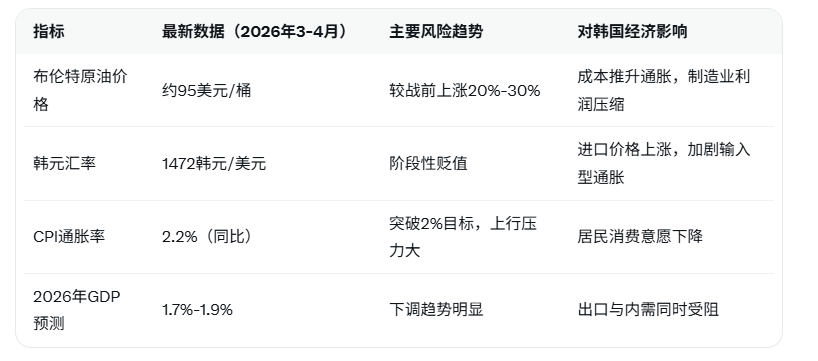
Currently, global Brent crude oil prices have stabilized around $95 per barrel, a significant increase of approximately 20%-30% compared to pre-Middle East conflict levels, far exceeding pre-war benchmarks. As a net energy importer, South Korea's costs for crude oil and natural gas are rapidly passed on to the transportation, chemical, and manufacturing sectors, directly raising the consumer price index. Latest data shows that South Korea's consumer price index rose 2.2% year-on-year in March, a 0.2 percentage point increase from February, exceeding the central bank's 2% medium-term target upper limit. During the same period, the USD/KRW exchange rate hovered around 1472, and the temporary weakening of the KRW against the USD further amplified the pressure on imported goods prices, creating a typical cycle of imported inflation.
At the hearing , Shin Hyun-song emphasized that geopolitical tensions in the Middle East remain severe, global energy prices remain high, and the monetary and fiscal policy paths of major economies remain uncertain. He pointed out, "The upside risks to inflation are significantly greater than the downside risks to economic growth. Based on the current level of forecast bias, price pressures will be the primary concern." This statement is highly consistent with his background at the Bank for International Settlements (BIS), indicating that he favors a pragmatic approach of "stabilizing prices first, then promoting growth," rather than simply "seeing through" external shocks.
On the economic growth front, the dual pressures of weak external demand and high energy costs are already evident. Several institutions have lowered their 2026 GDP growth forecasts for South Korea to the 1.7%-1.9% range, a decline from previous expectations, mainly due to slowing export momentum and pressure on domestic demand. While strategic industries such as semiconductors provide some buffer, rising overall manufacturing costs are weakening corporate profitability and investment intentions.
To provide a clear comparison of the current risk landscape, the following are the latest data on key economic indicators and risk assessments:
On the policy front, Shin Hyun-song hinted that the benchmark interest rate of 2.5% is near the neutral range, and he is likely to maintain a cautious tone in the short term after taking office, prioritizing the response to energy price transmission risks while closely monitoring excessive exchange rate volatility. If the won depreciates beyond a reasonable range, the central bank may intervene in the foreign exchange market or communicate with relevant parties to stabilize market expectations. His background at the BIS also suggests a greater emphasis on global coordination to avoid putting a single, small, open economy in a passive position.
Editor's Summary : Shin Hyun-song's latest statement sets a pragmatic tone for South Korea's monetary policy: given the ongoing external geopolitical and energy shocks, the priority is to maintain price stability while reserving policy space for economic growth. This assessment aligns with current oil prices of $95 and inflation at 2.2%, and also indicates that after officially taking office, his interest rate decisions will place greater emphasis on data-driven decision-making and risk hedging, providing important guidance for both the financial markets and the real economy.
Currently, global Brent crude oil prices have stabilized around $95 per barrel, a significant increase of approximately 20%-30% compared to pre-Middle East conflict levels, far exceeding pre-war benchmarks. As a net energy importer, South Korea's costs for crude oil and natural gas are rapidly passed on to the transportation, chemical, and manufacturing sectors, directly raising the consumer price index. Latest data shows that South Korea's consumer price index rose 2.2% year-on-year in March, a 0.2 percentage point increase from February, exceeding the central bank's 2% medium-term target upper limit. During the same period, the USD/KRW exchange rate hovered around 1472, and the temporary weakening of the KRW against the USD further amplified the pressure on imported goods prices, creating a typical cycle of imported inflation.
At the hearing , Shin Hyun-song emphasized that geopolitical tensions in the Middle East remain severe, global energy prices remain high, and the monetary and fiscal policy paths of major economies remain uncertain. He pointed out, "The upside risks to inflation are significantly greater than the downside risks to economic growth. Based on the current level of forecast bias, price pressures will be the primary concern." This statement is highly consistent with his background at the Bank for International Settlements (BIS), indicating that he favors a pragmatic approach of "stabilizing prices first, then promoting growth," rather than simply "seeing through" external shocks.
On the economic growth front, the dual pressures of weak external demand and high energy costs are already evident. Several institutions have lowered their 2026 GDP growth forecasts for South Korea to the 1.7%-1.9% range, a decline from previous expectations, mainly due to slowing export momentum and pressure on domestic demand. While strategic industries such as semiconductors provide some buffer, rising overall manufacturing costs are weakening corporate profitability and investment intentions.
To provide a clear comparison of the current risk landscape, the following are the latest data on key economic indicators and risk assessments:
On the policy front, Shin Hyun-song hinted that the benchmark interest rate of 2.5% is near the neutral range, and he is likely to maintain a cautious tone in the short term after taking office, prioritizing the response to energy price transmission risks while closely monitoring excessive exchange rate volatility. If the won depreciates beyond a reasonable range, the central bank may intervene in the foreign exchange market or communicate with relevant parties to stabilize market expectations. His background at the BIS also suggests a greater emphasis on global coordination to avoid putting a single, small, open economy in a passive position.
Editor's Summary : Shin Hyun-song's latest statement sets a pragmatic tone for South Korea's monetary policy: given the ongoing external geopolitical and energy shocks, the priority is to maintain price stability while reserving policy space for economic growth. This assessment aligns with current oil prices of $95 and inflation at 2.2%, and also indicates that after officially taking office, his interest rate decisions will place greater emphasis on data-driven decision-making and risk hedging, providing important guidance for both the financial markets and the real economy.
- Risk Warning and Disclaimer
- The market involves risk, and trading may not be suitable for all investors. This article is for reference only and does not constitute personal investment advice, nor does it take into account certain users’ specific investment objectives, financial situation, or other needs. Any investment decisions made based on this information are at your own risk.