Market risk appetite improved, and the USD/CAD pair continued its correction.
2026-04-15 14:02:00
The USD/CAD pair edged higher in European trading on Wednesday, trading around 1.3780, after hitting a near three-week low of 1.3730. Despite a short-term technical rebound, the overall trend remains directionless, with mixed market factors keeping the pair in a range-bound pattern.
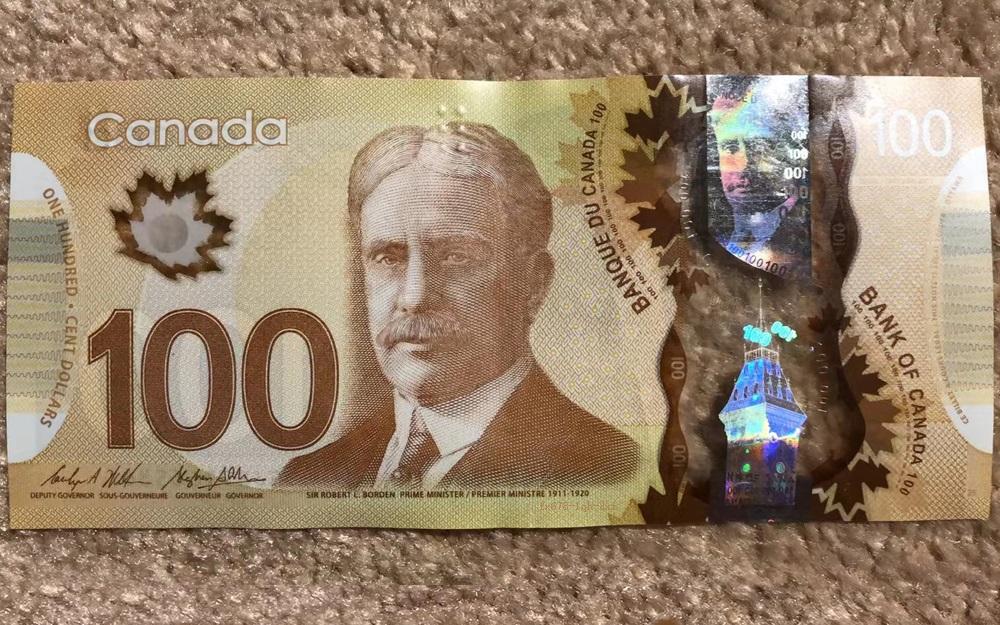
From a fundamental perspective, the current exchange rate is primarily driven by changes in geopolitical tensions and market risk sentiment. The US continues to release positive signals, suggesting that the conflict with Iran is nearing its end. US President Trump stated that the war is "very close to ending," while Vice President Vance also indicated "significant progress" in negotiations and confirmed that the ceasefire has lasted for seven days. These statements have significantly boosted market confidence, noticeably reducing investor concerns about an escalation of the conflict.
Against this backdrop, market risk appetite has clearly rebounded. S&P 500 futures are holding near 6970 points , indicating continued inflows into risk assets. This environment typically does not favor the US dollar as a safe-haven currency, thus limiting the upside potential of USD/CAD.
However, the US dollar showed some signs of stabilization after its continuous decline. The US dollar index rebounded to around 98.20 , although it is still close to the six-week low of 97.97 reached earlier, but short-term selling pressure has eased. This provided some support for USD/CAD, allowing it to rebound from its lows.
On the other hand, the Canadian dollar's performance is highly correlated with oil prices. As market expectations for a de-escalation of US-Iran relations have increased, the previous geopolitical premium in the oil market has gradually declined, leading to a price correction. This has weakened the Canadian dollar's performance as a commodity currency to some extent, thus providing upward momentum for the USD/CAD pair. However, it should be noted that if geopolitical tensions resurface, oil prices may strengthen again, supporting the Canadian dollar and suppressing its exchange rate.
Some analysts have pointed out that the current USD/CAD exchange rate has shifted from being "driven solely by the US dollar" to being "a dual game between the US dollar and oil prices," resulting in a more complex volatility structure.
From a market structure perspective, we are currently in a phase characterized by "risk appetite dominance + commodity-related influences." On the one hand, improved risk sentiment weakens the US dollar; on the other hand, falling oil prices weaken the Canadian dollar, resulting in a lack of a clear unilateral trend in the exchange rate.
From a technical perspective, on the daily chart, USD/CAD has entered a consolidation range after retreating from its highs, with the overall structure shifting from an uptrend to a consolidation pattern. The current price is encountering resistance around 1.3800 , which constitutes a key short-term resistance level, while the 1.3700 area below forms interim support. If it fails to break through 1.38 effectively, the rebound is more likely to be a corrective move.
On the 4-hour chart, the exchange rate rebounded from 1.3730 but remains within a short-term downtrend channel. The moving average system is converging, indicating an unclear trend. Momentum indicators have rebounded from low levels, suggesting a short-term rebound demand, but the strength is limited. If the price breaks through the 1.3800-1.3820 range , it may further test 1.3900 ; conversely, if it falls below the 1.3730 support again, it may continue its downward trend, testing lower levels. Overall, the short-term trend is sideways, and the medium-term direction remains to be confirmed.
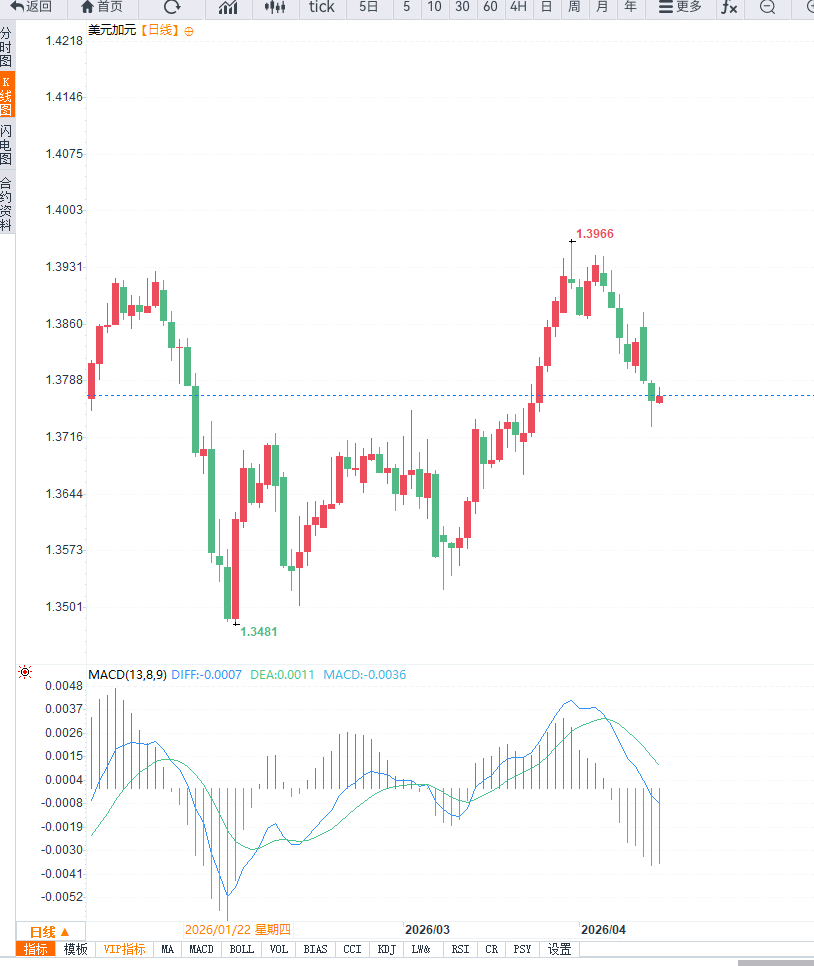
Editor's Summary: The USD/CAD pair is currently in a consolidation phase due to a confluence of factors. Easing geopolitical tensions have boosted risk appetite and reduced demand for the US dollar as a safe haven, but falling oil prices have limited the Canadian dollar's performance, making it difficult for the exchange rate to form a clear trend. In the short term, the exchange rate may continue to fluctuate within the 1.37-1.38 range, awaiting new fundamental catalysts. The future direction hinges on the progress of US-Iran negotiations and changes in oil prices. If geopolitical tensions resurface or oil prices strengthen again, the exchange rate structure could change rapidly.
From a fundamental perspective, the current exchange rate is primarily driven by changes in geopolitical tensions and market risk sentiment. The US continues to release positive signals, suggesting that the conflict with Iran is nearing its end. US President Trump stated that the war is "very close to ending," while Vice President Vance also indicated "significant progress" in negotiations and confirmed that the ceasefire has lasted for seven days. These statements have significantly boosted market confidence, noticeably reducing investor concerns about an escalation of the conflict.
Against this backdrop, market risk appetite has clearly rebounded. S&P 500 futures are holding near 6970 points , indicating continued inflows into risk assets. This environment typically does not favor the US dollar as a safe-haven currency, thus limiting the upside potential of USD/CAD.
However, the US dollar showed some signs of stabilization after its continuous decline. The US dollar index rebounded to around 98.20 , although it is still close to the six-week low of 97.97 reached earlier, but short-term selling pressure has eased. This provided some support for USD/CAD, allowing it to rebound from its lows.
On the other hand, the Canadian dollar's performance is highly correlated with oil prices. As market expectations for a de-escalation of US-Iran relations have increased, the previous geopolitical premium in the oil market has gradually declined, leading to a price correction. This has weakened the Canadian dollar's performance as a commodity currency to some extent, thus providing upward momentum for the USD/CAD pair. However, it should be noted that if geopolitical tensions resurface, oil prices may strengthen again, supporting the Canadian dollar and suppressing its exchange rate.
Some analysts have pointed out that the current USD/CAD exchange rate has shifted from being "driven solely by the US dollar" to being "a dual game between the US dollar and oil prices," resulting in a more complex volatility structure.
From a market structure perspective, we are currently in a phase characterized by "risk appetite dominance + commodity-related influences." On the one hand, improved risk sentiment weakens the US dollar; on the other hand, falling oil prices weaken the Canadian dollar, resulting in a lack of a clear unilateral trend in the exchange rate.
From a technical perspective, on the daily chart, USD/CAD has entered a consolidation range after retreating from its highs, with the overall structure shifting from an uptrend to a consolidation pattern. The current price is encountering resistance around 1.3800 , which constitutes a key short-term resistance level, while the 1.3700 area below forms interim support. If it fails to break through 1.38 effectively, the rebound is more likely to be a corrective move.
On the 4-hour chart, the exchange rate rebounded from 1.3730 but remains within a short-term downtrend channel. The moving average system is converging, indicating an unclear trend. Momentum indicators have rebounded from low levels, suggesting a short-term rebound demand, but the strength is limited. If the price breaks through the 1.3800-1.3820 range , it may further test 1.3900 ; conversely, if it falls below the 1.3730 support again, it may continue its downward trend, testing lower levels. Overall, the short-term trend is sideways, and the medium-term direction remains to be confirmed.
Editor's Summary: The USD/CAD pair is currently in a consolidation phase due to a confluence of factors. Easing geopolitical tensions have boosted risk appetite and reduced demand for the US dollar as a safe haven, but falling oil prices have limited the Canadian dollar's performance, making it difficult for the exchange rate to form a clear trend. In the short term, the exchange rate may continue to fluctuate within the 1.37-1.38 range, awaiting new fundamental catalysts. The future direction hinges on the progress of US-Iran negotiations and changes in oil prices. If geopolitical tensions resurface or oil prices strengthen again, the exchange rate structure could change rapidly.
- Risk Warning and Disclaimer
- The market involves risk, and trading may not be suitable for all investors. This article is for reference only and does not constitute personal investment advice, nor does it take into account certain users’ specific investment objectives, financial situation, or other needs. Any investment decisions made based on this information are at your own risk.