The risk of stagflation in the UK has intensified, prompting the Bank of England to remain on hold and refrain from raising interest rates.
2026-04-15 13:44:47
According to APP, Ernst & Young economist Bansie Madavani stated that the conflict in the Middle East and the resulting rise in energy prices have brought a stagflation shock to the UK economy. She predicts that the UK's overall inflation rate will rise by more than 3.0% year-on-year in the coming months, while the economic growth rate is expected to be below 1.0%. She also pointed out that a prolonged energy price shock would increase the likelihood of a recession. Therefore, the Bank of England is unlikely to raise interest rates due to the direct impact of rising energy prices, but will instead adopt a wait-and-see approach. This assessment accurately captures the core dilemma currently facing UK monetary policy: while external supply shocks are pushing up prices, domestic growth momentum has clearly slowed.

As of April 15, 2026, Brent crude oil prices rose to $95.61 per barrel, a significant increase from pre-war levels due to the ongoing tensions in the Middle East. As a net energy importer, the UK is experiencing rapid increases in gas, gasoline, and utility costs, which are beginning to be passed on to core consumer goods and services. The Bank of England's March monetary policy report showed that the CPI inflation rate had rebounded from 3.0% in January and was projected to be close to 3.5% in March, about 0.5 percentage points higher than the February forecast. It is likely to remain in the 3%-3.5% range in the second and third quarters.
Bansie Madavani 's analysis is highly consistent with the Bank of England's latest statement. She emphasized that this shock is a broad-based cost-push factor, and persistently high energy prices will amplify the risk of recession. Therefore, the central bank prefers to "observe first, then act" rather than immediately address imported inflation through interest rate hikes. The Bank of England's March meeting unanimously decided to maintain the benchmark interest rate at 3.75%, clearly stating that it will closely monitor the spillover effects of the Middle East situation on energy supply and inflation expectations to avoid premature tightening that could exacerbate the economic downturn.
Regarding economic growth, the UK's 2026 GDP forecast has been lowered by several institutions to the 0.6%-0.8% range, a decline from previous expectations. This is mainly due to high energy costs suppressing manufacturing investment, household consumption, and export competitiveness. Although January GDP grew slightly by 0.2% month-on-month, overall momentum was weak. Coupled with the transmission of energy prices, corporate profitability and the job market are both facing pressure.
To provide a clear comparison between current UK economic indicators and risk scenarios, the following table presents the latest data on key variables:
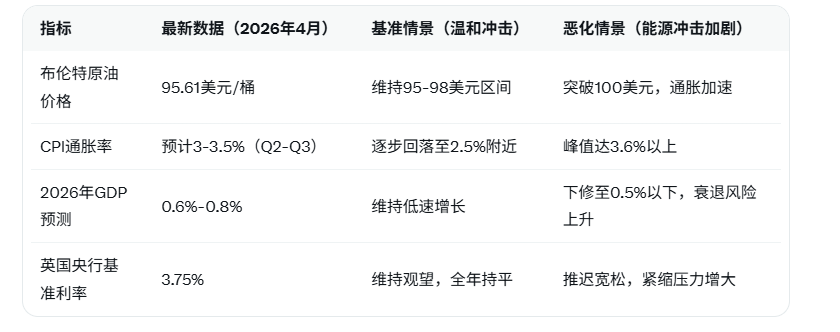
The above scenario comparison shows that energy prices have become the core driver of the risk of "stagflation" in the UK economy, and the Bank of England 's wait-and-see strategy aims to balance short-term inflation control with long-term growth resilience.
Editor's Summary : Bansie Madavani's latest assessment provides pragmatic guidance for the UK's monetary policy path: Against the backdrop of energy supply shocks driven by Middle East conflicts, the dual pressures of short-term inflation rising above 3% and economic growth below 1% have become a reality. The Bank of England's maintenance of the 3.75% interest rate and its wait-and-see approach reflect both a data-dependent and cautious principle and leave room for future policy adjustments. This analysis aligns with the latest data on current oil prices of $95.61, inflation expectations of 3-3.5%, and GDP forecasts of 0.6%-0.8%. It also reminds the market to be wary of the amplifying effect of long-term energy shocks on the probability of recession, and has significant reference value for global investors allocating UK assets.
As of April 15, 2026, Brent crude oil prices rose to $95.61 per barrel, a significant increase from pre-war levels due to the ongoing tensions in the Middle East. As a net energy importer, the UK is experiencing rapid increases in gas, gasoline, and utility costs, which are beginning to be passed on to core consumer goods and services. The Bank of England's March monetary policy report showed that the CPI inflation rate had rebounded from 3.0% in January and was projected to be close to 3.5% in March, about 0.5 percentage points higher than the February forecast. It is likely to remain in the 3%-3.5% range in the second and third quarters.
Bansie Madavani 's analysis is highly consistent with the Bank of England's latest statement. She emphasized that this shock is a broad-based cost-push factor, and persistently high energy prices will amplify the risk of recession. Therefore, the central bank prefers to "observe first, then act" rather than immediately address imported inflation through interest rate hikes. The Bank of England's March meeting unanimously decided to maintain the benchmark interest rate at 3.75%, clearly stating that it will closely monitor the spillover effects of the Middle East situation on energy supply and inflation expectations to avoid premature tightening that could exacerbate the economic downturn.
Regarding economic growth, the UK's 2026 GDP forecast has been lowered by several institutions to the 0.6%-0.8% range, a decline from previous expectations. This is mainly due to high energy costs suppressing manufacturing investment, household consumption, and export competitiveness. Although January GDP grew slightly by 0.2% month-on-month, overall momentum was weak. Coupled with the transmission of energy prices, corporate profitability and the job market are both facing pressure.
To provide a clear comparison between current UK economic indicators and risk scenarios, the following table presents the latest data on key variables:
The above scenario comparison shows that energy prices have become the core driver of the risk of "stagflation" in the UK economy, and the Bank of England 's wait-and-see strategy aims to balance short-term inflation control with long-term growth resilience.
Editor's Summary : Bansie Madavani's latest assessment provides pragmatic guidance for the UK's monetary policy path: Against the backdrop of energy supply shocks driven by Middle East conflicts, the dual pressures of short-term inflation rising above 3% and economic growth below 1% have become a reality. The Bank of England's maintenance of the 3.75% interest rate and its wait-and-see approach reflect both a data-dependent and cautious principle and leave room for future policy adjustments. This analysis aligns with the latest data on current oil prices of $95.61, inflation expectations of 3-3.5%, and GDP forecasts of 0.6%-0.8%. It also reminds the market to be wary of the amplifying effect of long-term energy shocks on the probability of recession, and has significant reference value for global investors allocating UK assets.
- Risk Warning and Disclaimer
- The market involves risk, and trading may not be suitable for all investors. This article is for reference only and does not constitute personal investment advice, nor does it take into account certain users’ specific investment objectives, financial situation, or other needs. Any investment decisions made based on this information are at your own risk.