April 16th Financial Breakfast: The US and Iran may hold face-to-face talks again; gold prices hold above $4800; US oil prices fall below $90.
2026-04-16 07:26:54
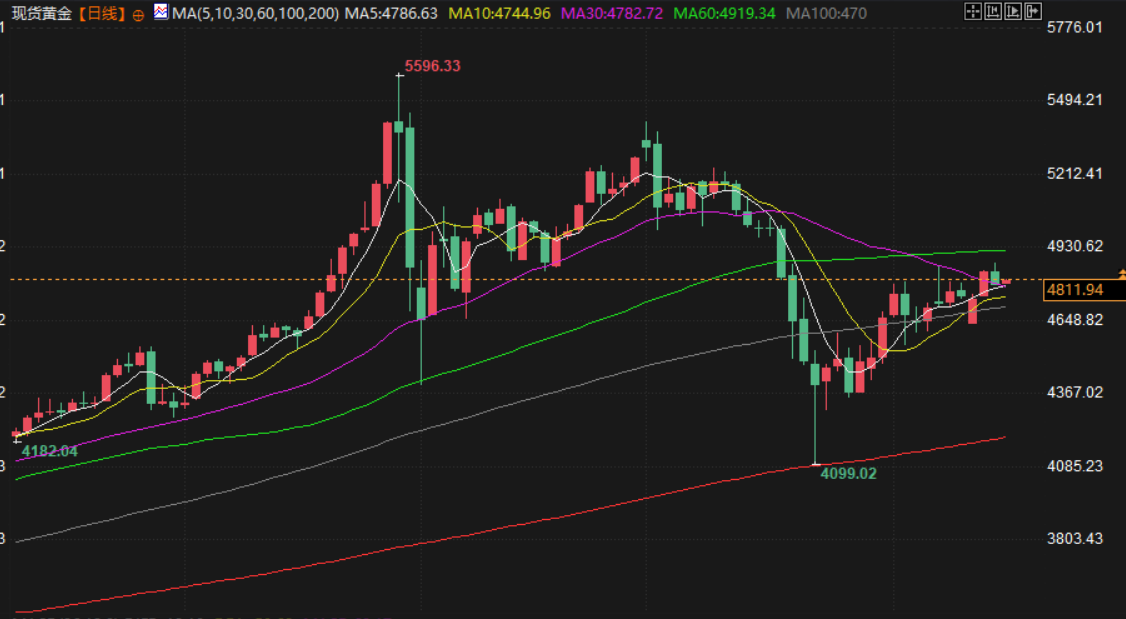
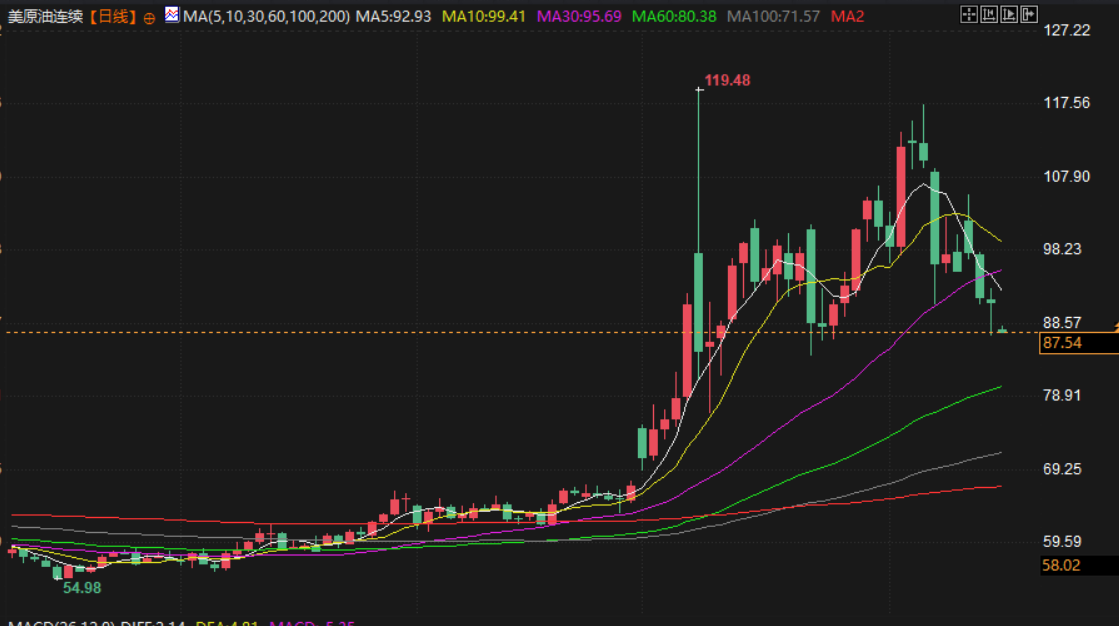
On Thursday (April 16, Beijing time) in early Asian trading, spot gold was trading around $4,812 per ounce. Gold prices fell slightly on Wednesday after hitting a one-month high, influenced by investors assessing the latest developments in the US-Iran situation and the interest rate outlook. US President Trump stated that the war with Iran was "nearly over," while the Pakistani Army Chief of Staff arrived in Tehran to try to prevent a renewed conflict. US crude oil was trading around $87.60 per barrel. Despite declining US inventories and lingering concerns about supply disruptions, the market held cautiously optimistic expectations for the resumption of new US-Iran negotiations.

U.S. stocks rose on Wednesday, boosted by corporate earnings reports and market optimism about progress in U.S.-Iran negotiations. The S&P 500 and Nasdaq both closed at record highs, with the Nasdaq hitting its first closing high since October 29 and recording its first 11-day winning streak since November 2021. The Dow Jones Industrial Average fell slightly by 0.15%, the S&P 500 rose 0.80% to 7022.95 points, and the Nasdaq rose 1.60% to 24016.02 points.
The White House said the second round of talks with Iran was “productive” but denied reports that it was calling for a ceasefire in Iran, while the U.S. Treasury Department imposed new sanctions on Iran’s oil transportation infrastructure.
The technology sector led the gains, with software stocks performing particularly well, while materials and industrials were among the biggest losers. Bank of America and Morgan Stanley rose 1.8% and 4.5% respectively, buoyed by strong earnings reports. The volatility index VIX fell to its lowest level since February 26. However, some strategists warned that with oil prices still above pre-war levels and the situation in the Middle East unresolved, the market needs new catalysts to sustain its upward momentum.
Gold prices fell slightly on Wednesday after hitting a one-month high, with spot gold closing at $4,798.89 an ounce, down 0.9%. The decline was influenced by investors assessing the latest developments in the US-Iran situation and the interest rate outlook. US President Trump stated that the war with Israel against Iran was "nearly over," while Pakistan's Army Chief of Staff arrived in Tehran in an attempt to prevent a renewed conflict.
Despite a two-week ceasefire agreement, the Iranian Revolutionary Guard announced a 45-day closure of the Strait of Hormuz, leaving the navigation status of the waterway uncertain and causing a slight increase in oil prices.
Chicago Federal Reserve Bank President John Goolsby stated that if war leads to prolonged high oil prices and delays the decline in inflation, the Fed may not cut interest rates until 2027; the market currently expects a 32% probability of a US rate cut this year. A senior analyst at Kitco Metals pointed out that the decline in gold prices was mainly due to mild profit-taking, and recent gold price movements have deviated from traditional safe-haven attributes, with traders focusing more on monetary policy tightening and inflationary pressures. Spot silver, platinum, and palladium showed mixed results.
Oil prices held steady on Wednesday, with U.S. crude futures edged down to settle at $91.39 a barrel, as lingering concerns about supply disruptions offset the impact of U.S. President Trump’s statement that the war on Iran could end soon.
Despite reports that Iran might consider allowing ships freedom of navigation in the Strait of Hormuz near Oman to prevent a renewed conflict, traffic volume has plummeted to a fraction of the pre-war 130 crossings per day after the Iranian Revolutionary Guard announced a 45-day blockade of the strait. Approximately 20% of global crude oil and liquefied natural gas transport has been disrupted, with Kpler data showing cumulative losses of 496 million barrels of Middle Eastern crude oil and condensate. US Treasury Secretary Bessenter stated that waivers for oil purchases from Iran and Russia would not be extended, and the US has imposed a blockade on ships leaving Iranian ports, reportedly completely cutting off Iran's maritime trade.
The IMF predicts that at least a dozen countries will seek new loans to cope with soaring energy prices and supply chain disruptions; Japan announced a financial framework of approximately $10 billion to help Asian countries purchase energy. Furthermore, Trump threatened to fire Federal Reserve Chairman Powell if he does not resign, while EIA data showed an unexpected decrease of 900,000 barrels in U.S. crude oil inventories last week (compared to an expected increase of 154,000 barrels), contrasting with the API report's increase of 6.1 million barrels.
The dollar edged down on Wednesday, fluctuating narrowly around flat levels throughout the session. The dollar index closed at 98.06, poised for its eighth consecutive day of decline, as investors assessed the possibility of a resumption of peace talks between the US and Iran.
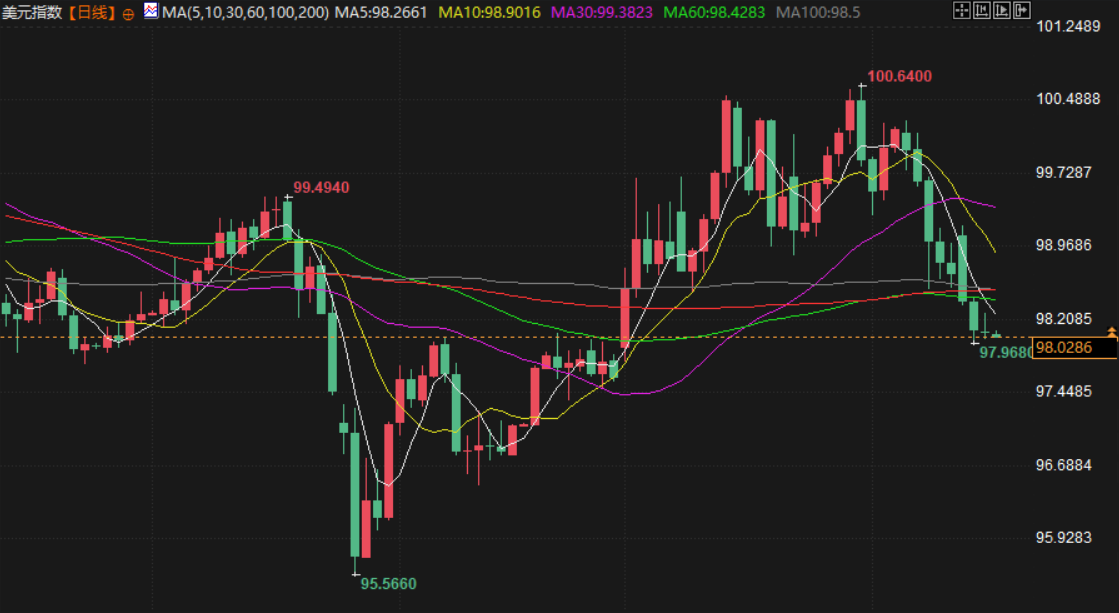
US President Trump said the war with Iran is nearing its end, Pakistan's Army Chief of Staff arrived in Tehran to mediate, and there are reports that Israel is expected to extend the ceasefire agreement for two weeks, but the White House denies that it has requested an extension.
Since the US-Israel conflict with Iran began on February 28, the Strait of Hormuz has been effectively paralyzed, triggering a surge in oil prices and concerns about global economic growth and inflation. A trading director at Monex USA stated that the market was initially driven by conflict headlines, but will now focus on economic growth.
The euro edged up 0.03% against the dollar to 1.1799 as European Central Bank policymakers remained cautious about raising interest rates this month; the dollar rose 0.18% against the yen to 159.05, nearing the 160 intervention level; and the pound was essentially unchanged against the dollar.
U.S. Treasury Secretary Bessant said economic growth will slow but rebound this quarter, and oil prices have not pushed up inflation expectations; U.S. import prices rose 0.8% month-on-month in March, lower than expected; Cleveland Fed President Hamak said the Fed has no urgent need to adjust interest rates but may cut or even raise rates in the future.
White House: Discussions on possible face-to-face talks between the US and Iran are still ongoing.
White House Press Secretary Janet Levitt said at a press conference on the 15th that discussions regarding a possible resuming face-to-face talks between the United States and Iran are ongoing, and the US remains optimistic about the prospects of reaching an agreement. Levitt emphasized that nothing is certain until the White House officially announces a statement. She said the next meeting is highly likely to take place in Islamabad, the capital of Pakistan. Pakistan's role as a mediator throughout the negotiations has been "extremely excellent." Therefore, Pakistan is the sole mediator in these negotiations. Levitt stated that reports of a formal US request to extend the US-Iran ceasefire are untrue; the two sides are currently engaged in dialogue on this matter, and these dialogues are "productive and ongoing." When asked how long the US blockade of Iranian ports would last, Levitt said she would not set any timetable on behalf of President Trump, and emphasized that the blockade is fully implemented and is being enforced against all ships of all countries entering and leaving Iranian ports, covering all Iranian ports in the Persian Gulf and the Gulf of Oman. (Xinhua)
The United States has introduced new sanctions targeting Iran's oil transportation network.
The U.S. Treasury Department’s Office of Foreign Assets Control issued a statement on the 15th, announcing increased pressure on Iran’s oil transportation infrastructure and adding more than 20 entities, individuals, and vessels to the list of new targets for sanctions. (Xinhua)
Iranian Foreign Ministry Spokesperson: It cannot be confirmed whether the ceasefire between Iran and the United States will be extended.
Iranian Foreign Ministry spokesman Baghae stated at a press conference in Tehran on the 15th that speculation regarding an extension of the Iran-US ceasefire could not be confirmed, and it was necessary to observe whether the US possessed genuine sincerity in fulfilling its stated diplomatic position. According to the Islamic Republic News Agency (IRNA), Baghae, in response to questions about the possibility of an extension of the Iran-US ceasefire and which issues had made relative progress in the negotiations, stated that the US "has repeatedly changed its position and made contradictory statements," and even if some consensus is reached, it is difficult to guarantee its implementation. Therefore, the dialogue between Iran and the US is proceeding under very complex circumstances. Regarding the progress of the negotiations, Baghae stated that the relevant issues are interconnected, and all aspects need to be advanced as a whole. Currently, the dialogue continues through Pakistan as an intermediary. (CCTV News)
Netanyahu: Israeli forces are about to capture Hezbollah strongholds
Israeli Prime Minister Benjamin Netanyahu announced in a speech on the evening of the 15th that the Israeli army was about to capture Bint Jubail, a key Hezbollah stronghold in southern Lebanon. Netanyahu stated that the Israeli army was continuing its attacks on Hezbollah, with fighting concentrated in its "core stronghold," Bint Jubail. The Israeli army was about to capture and "destroy" this major Hezbollah town. The Israeli army later confirmed that earlier that day, five Israeli soldiers were injured in a Hezbollah rocket attack in southern Lebanon, one seriously. According to a report that evening by Israel's Channel 12 television, the United States was pressuring Israel to agree to a temporary ceasefire agreement with Hezbollah. The report quoted Israeli security sources as saying that the US had proposed a temporary ceasefire of about one week, during which the two sides would conduct further negotiations, but Israel had not yet made a decision. In his speech, Netanyahu also said that he had instructed the Israeli army the previous day to continue expanding the so-called security "buffer zone," extending it eastward to the slopes of Mount Hermon in the Golan Heights. Following the upheaval in Syria in December 2024, Israel occupied the Golan Heights military buffer zone and the strategically important Mount Hermon, seeking to "fully demilitarize" several provinces in southern Syria. (Xinhua)
US Democrats launch impeachment campaign against Defense Secretary Hergsays
On May 15, Democratic members of the U.S. House of Representatives introduced six articles of impeachment against Defense Secretary John Hergsays, accusing him of war crimes, abuse of power, and reckless handling of sensitive information, among other serious misconduct. The impeachment motion was spearheaded by Arizona Representative Yassamin Ansari and co-sponsored by several other Democratic members of the House. The six articles of impeachment against Hergsays are: waging an unauthorized war against Iran with disregard for the safety of U.S. service members; violating the laws of armed conflict and targeting civilians; negligent and reckless handling of sensitive military information; obstructing Congress's oversight; abusing power and engaging in political manipulation of the military; and actions that damage the reputation of the United States and its military. (Xinhua)
Federal Reserve Beige Book: The Iran war has put US companies on a wait-and-see approach.
The Federal Reserve said in a report Wednesday that U.S. economic activity has increased and employment has remained stable in recent weeks, while also noting the significant impact of soaring energy prices during the ongoing conflict with Iran. In its latest Beige Book, the Fed stated, "The Middle East conflict is considered a major source of uncertainty, complicating decisions about hiring, pricing, and capital investment, with many businesses adopting a wait-and-see approach." The report compiles qualitative economic data from across the country, which policymakers use to help understand the economy and make interest rate decisions. The report stated, "Business prospects vary amid widespread uncertainty about future conditions." The Fed is expected to maintain its benchmark overnight interest rate in its current range of 3.50%-3.75% at its next policy meeting on April 28-29.
Trump: The US is "very likely" to reach an agreement with Iran before King Charles III's visit to the US in late April.
US President Donald Trump stated that the US is "very likely" to reach an agreement with Iran before King Charles III's visit to the US in late April. In an interview, Trump said the possibility of an agreement is currently "very high." King Charles III and Queen Camilla are scheduled to visit the US from April 27 to 30. (CCTV)
The probability of the Federal Reserve keeping interest rates unchanged in April is 98.4%, while the probability of a rate cut this year remains largely unchanged at 33.7%.
According to CME's "FedWatch": The probability of the Fed raising interest rates by 25 basis points in April is 1.6%, and the probability of keeping rates unchanged is 98.4%. The probability of the Fed cutting rates by a cumulative 25 basis points by June is 0%, the probability of keeping rates unchanged is 98%, and the probability of a cumulative 25 basis point rate hike is 2%. The probability of the Fed cutting rates by a cumulative 25 basis points by December is 33.7% (33.1% the previous day), the probability of keeping rates unchanged is 64.9% (65.9% the previous day), and the probability of a cumulative 25 basis point rate hike is 1.3% (1% the previous day).
The two departments announced that the leverage ratio for overseas loans of wholly foreign-owned banks, Sino-foreign joint venture banks, and domestic branches of foreign banks will be raised from 0.5 to 1.5.
The People's Bank of China and the State Administration of Foreign Exchange issued a notice regarding adjustments to matters related to overseas lending business of banking financial institutions. The notice stipulates that the leverage ratio for overseas loans of wholly foreign-owned banks, Sino-foreign joint venture banks, and branches of foreign banks in China will be increased from 0.5 to 1.5. This applies similarly to banking institutions established in mainland China by financial institutions from Hong Kong, Macao, and Taiwan. The leverage ratio for overseas loans of the Export-Import Bank of China will be increased from 3 to 3.5. If the calculated maximum outstanding overseas loan balance is less than RMB 10 billion, the maximum outstanding overseas loan balance for that bank will be set at RMB 10 billion. For domestic banks indirectly providing loans in RMB or foreign currencies with a term of one year or more to overseas enterprises through means such as lending funds to overseas banks, the overseas banks may handle the matter in accordance with the relevant laws and regulations of their respective countries or regions.
The National Healthcare Security Administration is actively promoting greater transparency in the pricing information of the same drug across different channels.
At a State Council policy briefing held this morning by the State Council Information Office, Wang Xiaoning, Director of the Department of Drug Pricing and Procurement of the National Healthcare Security Administration, stated that, generally speaking, due to differences in operating costs, procurement channels, and sales strategies, there are certain differences in drug prices among public hospitals, physical pharmacies, and online pharmacies. We are actively promoting greater transparency in the price information of the same drug across different channels, guiding fair and reasonable pricing across different channels, and enabling consumers to compare prices from multiple sources, making it more convenient and reassuring for people to buy medicines. (Xinhua News Agency)
Key Focus Today
stock market
U.S. stocks rose on Wednesday, boosted by corporate earnings reports and market optimism about progress in U.S.-Iran negotiations. The S&P 500 and Nasdaq both closed at record highs, with the Nasdaq hitting its first closing high since October 29 and recording its first 11-day winning streak since November 2021. The Dow Jones Industrial Average fell slightly by 0.15%, the S&P 500 rose 0.80% to 7022.95 points, and the Nasdaq rose 1.60% to 24016.02 points.
The White House said the second round of talks with Iran was “productive” but denied reports that it was calling for a ceasefire in Iran, while the U.S. Treasury Department imposed new sanctions on Iran’s oil transportation infrastructure.
The technology sector led the gains, with software stocks performing particularly well, while materials and industrials were among the biggest losers. Bank of America and Morgan Stanley rose 1.8% and 4.5% respectively, buoyed by strong earnings reports. The volatility index VIX fell to its lowest level since February 26. However, some strategists warned that with oil prices still above pre-war levels and the situation in the Middle East unresolved, the market needs new catalysts to sustain its upward momentum.
Gold Market
Gold prices fell slightly on Wednesday after hitting a one-month high, with spot gold closing at $4,798.89 an ounce, down 0.9%. The decline was influenced by investors assessing the latest developments in the US-Iran situation and the interest rate outlook. US President Trump stated that the war with Israel against Iran was "nearly over," while Pakistan's Army Chief of Staff arrived in Tehran in an attempt to prevent a renewed conflict.
Despite a two-week ceasefire agreement, the Iranian Revolutionary Guard announced a 45-day closure of the Strait of Hormuz, leaving the navigation status of the waterway uncertain and causing a slight increase in oil prices.
Chicago Federal Reserve Bank President John Goolsby stated that if war leads to prolonged high oil prices and delays the decline in inflation, the Fed may not cut interest rates until 2027; the market currently expects a 32% probability of a US rate cut this year. A senior analyst at Kitco Metals pointed out that the decline in gold prices was mainly due to mild profit-taking, and recent gold price movements have deviated from traditional safe-haven attributes, with traders focusing more on monetary policy tightening and inflationary pressures. Spot silver, platinum, and palladium showed mixed results.
oil market
Oil prices held steady on Wednesday, with U.S. crude futures edged down to settle at $91.39 a barrel, as lingering concerns about supply disruptions offset the impact of U.S. President Trump’s statement that the war on Iran could end soon.
Despite reports that Iran might consider allowing ships freedom of navigation in the Strait of Hormuz near Oman to prevent a renewed conflict, traffic volume has plummeted to a fraction of the pre-war 130 crossings per day after the Iranian Revolutionary Guard announced a 45-day blockade of the strait. Approximately 20% of global crude oil and liquefied natural gas transport has been disrupted, with Kpler data showing cumulative losses of 496 million barrels of Middle Eastern crude oil and condensate. US Treasury Secretary Bessenter stated that waivers for oil purchases from Iran and Russia would not be extended, and the US has imposed a blockade on ships leaving Iranian ports, reportedly completely cutting off Iran's maritime trade.
The IMF predicts that at least a dozen countries will seek new loans to cope with soaring energy prices and supply chain disruptions; Japan announced a financial framework of approximately $10 billion to help Asian countries purchase energy. Furthermore, Trump threatened to fire Federal Reserve Chairman Powell if he does not resign, while EIA data showed an unexpected decrease of 900,000 barrels in U.S. crude oil inventories last week (compared to an expected increase of 154,000 barrels), contrasting with the API report's increase of 6.1 million barrels.
Foreign exchange market
The dollar edged down on Wednesday, fluctuating narrowly around flat levels throughout the session. The dollar index closed at 98.06, poised for its eighth consecutive day of decline, as investors assessed the possibility of a resumption of peace talks between the US and Iran.
US President Trump said the war with Iran is nearing its end, Pakistan's Army Chief of Staff arrived in Tehran to mediate, and there are reports that Israel is expected to extend the ceasefire agreement for two weeks, but the White House denies that it has requested an extension.
Since the US-Israel conflict with Iran began on February 28, the Strait of Hormuz has been effectively paralyzed, triggering a surge in oil prices and concerns about global economic growth and inflation. A trading director at Monex USA stated that the market was initially driven by conflict headlines, but will now focus on economic growth.
The euro edged up 0.03% against the dollar to 1.1799 as European Central Bank policymakers remained cautious about raising interest rates this month; the dollar rose 0.18% against the yen to 159.05, nearing the 160 intervention level; and the pound was essentially unchanged against the dollar.
U.S. Treasury Secretary Bessant said economic growth will slow but rebound this quarter, and oil prices have not pushed up inflation expectations; U.S. import prices rose 0.8% month-on-month in March, lower than expected; Cleveland Fed President Hamak said the Fed has no urgent need to adjust interest rates but may cut or even raise rates in the future.
International News
White House: Discussions on possible face-to-face talks between the US and Iran are still ongoing.
White House Press Secretary Janet Levitt said at a press conference on the 15th that discussions regarding a possible resuming face-to-face talks between the United States and Iran are ongoing, and the US remains optimistic about the prospects of reaching an agreement. Levitt emphasized that nothing is certain until the White House officially announces a statement. She said the next meeting is highly likely to take place in Islamabad, the capital of Pakistan. Pakistan's role as a mediator throughout the negotiations has been "extremely excellent." Therefore, Pakistan is the sole mediator in these negotiations. Levitt stated that reports of a formal US request to extend the US-Iran ceasefire are untrue; the two sides are currently engaged in dialogue on this matter, and these dialogues are "productive and ongoing." When asked how long the US blockade of Iranian ports would last, Levitt said she would not set any timetable on behalf of President Trump, and emphasized that the blockade is fully implemented and is being enforced against all ships of all countries entering and leaving Iranian ports, covering all Iranian ports in the Persian Gulf and the Gulf of Oman. (Xinhua)
The United States has introduced new sanctions targeting Iran's oil transportation network.
The U.S. Treasury Department’s Office of Foreign Assets Control issued a statement on the 15th, announcing increased pressure on Iran’s oil transportation infrastructure and adding more than 20 entities, individuals, and vessels to the list of new targets for sanctions. (Xinhua)
Iranian Foreign Ministry Spokesperson: It cannot be confirmed whether the ceasefire between Iran and the United States will be extended.
Iranian Foreign Ministry spokesman Baghae stated at a press conference in Tehran on the 15th that speculation regarding an extension of the Iran-US ceasefire could not be confirmed, and it was necessary to observe whether the US possessed genuine sincerity in fulfilling its stated diplomatic position. According to the Islamic Republic News Agency (IRNA), Baghae, in response to questions about the possibility of an extension of the Iran-US ceasefire and which issues had made relative progress in the negotiations, stated that the US "has repeatedly changed its position and made contradictory statements," and even if some consensus is reached, it is difficult to guarantee its implementation. Therefore, the dialogue between Iran and the US is proceeding under very complex circumstances. Regarding the progress of the negotiations, Baghae stated that the relevant issues are interconnected, and all aspects need to be advanced as a whole. Currently, the dialogue continues through Pakistan as an intermediary. (CCTV News)
Netanyahu: Israeli forces are about to capture Hezbollah strongholds
Israeli Prime Minister Benjamin Netanyahu announced in a speech on the evening of the 15th that the Israeli army was about to capture Bint Jubail, a key Hezbollah stronghold in southern Lebanon. Netanyahu stated that the Israeli army was continuing its attacks on Hezbollah, with fighting concentrated in its "core stronghold," Bint Jubail. The Israeli army was about to capture and "destroy" this major Hezbollah town. The Israeli army later confirmed that earlier that day, five Israeli soldiers were injured in a Hezbollah rocket attack in southern Lebanon, one seriously. According to a report that evening by Israel's Channel 12 television, the United States was pressuring Israel to agree to a temporary ceasefire agreement with Hezbollah. The report quoted Israeli security sources as saying that the US had proposed a temporary ceasefire of about one week, during which the two sides would conduct further negotiations, but Israel had not yet made a decision. In his speech, Netanyahu also said that he had instructed the Israeli army the previous day to continue expanding the so-called security "buffer zone," extending it eastward to the slopes of Mount Hermon in the Golan Heights. Following the upheaval in Syria in December 2024, Israel occupied the Golan Heights military buffer zone and the strategically important Mount Hermon, seeking to "fully demilitarize" several provinces in southern Syria. (Xinhua)
US Democrats launch impeachment campaign against Defense Secretary Hergsays
On May 15, Democratic members of the U.S. House of Representatives introduced six articles of impeachment against Defense Secretary John Hergsays, accusing him of war crimes, abuse of power, and reckless handling of sensitive information, among other serious misconduct. The impeachment motion was spearheaded by Arizona Representative Yassamin Ansari and co-sponsored by several other Democratic members of the House. The six articles of impeachment against Hergsays are: waging an unauthorized war against Iran with disregard for the safety of U.S. service members; violating the laws of armed conflict and targeting civilians; negligent and reckless handling of sensitive military information; obstructing Congress's oversight; abusing power and engaging in political manipulation of the military; and actions that damage the reputation of the United States and its military. (Xinhua)
Federal Reserve Beige Book: The Iran war has put US companies on a wait-and-see approach.
The Federal Reserve said in a report Wednesday that U.S. economic activity has increased and employment has remained stable in recent weeks, while also noting the significant impact of soaring energy prices during the ongoing conflict with Iran. In its latest Beige Book, the Fed stated, "The Middle East conflict is considered a major source of uncertainty, complicating decisions about hiring, pricing, and capital investment, with many businesses adopting a wait-and-see approach." The report compiles qualitative economic data from across the country, which policymakers use to help understand the economy and make interest rate decisions. The report stated, "Business prospects vary amid widespread uncertainty about future conditions." The Fed is expected to maintain its benchmark overnight interest rate in its current range of 3.50%-3.75% at its next policy meeting on April 28-29.
Trump: The US is "very likely" to reach an agreement with Iran before King Charles III's visit to the US in late April.
US President Donald Trump stated that the US is "very likely" to reach an agreement with Iran before King Charles III's visit to the US in late April. In an interview, Trump said the possibility of an agreement is currently "very high." King Charles III and Queen Camilla are scheduled to visit the US from April 27 to 30. (CCTV)
The probability of the Federal Reserve keeping interest rates unchanged in April is 98.4%, while the probability of a rate cut this year remains largely unchanged at 33.7%.
According to CME's "FedWatch": The probability of the Fed raising interest rates by 25 basis points in April is 1.6%, and the probability of keeping rates unchanged is 98.4%. The probability of the Fed cutting rates by a cumulative 25 basis points by June is 0%, the probability of keeping rates unchanged is 98%, and the probability of a cumulative 25 basis point rate hike is 2%. The probability of the Fed cutting rates by a cumulative 25 basis points by December is 33.7% (33.1% the previous day), the probability of keeping rates unchanged is 64.9% (65.9% the previous day), and the probability of a cumulative 25 basis point rate hike is 1.3% (1% the previous day).
Domestic News
The two departments announced that the leverage ratio for overseas loans of wholly foreign-owned banks, Sino-foreign joint venture banks, and domestic branches of foreign banks will be raised from 0.5 to 1.5.
The People's Bank of China and the State Administration of Foreign Exchange issued a notice regarding adjustments to matters related to overseas lending business of banking financial institutions. The notice stipulates that the leverage ratio for overseas loans of wholly foreign-owned banks, Sino-foreign joint venture banks, and branches of foreign banks in China will be increased from 0.5 to 1.5. This applies similarly to banking institutions established in mainland China by financial institutions from Hong Kong, Macao, and Taiwan. The leverage ratio for overseas loans of the Export-Import Bank of China will be increased from 3 to 3.5. If the calculated maximum outstanding overseas loan balance is less than RMB 10 billion, the maximum outstanding overseas loan balance for that bank will be set at RMB 10 billion. For domestic banks indirectly providing loans in RMB or foreign currencies with a term of one year or more to overseas enterprises through means such as lending funds to overseas banks, the overseas banks may handle the matter in accordance with the relevant laws and regulations of their respective countries or regions.
The National Healthcare Security Administration is actively promoting greater transparency in the pricing information of the same drug across different channels.
At a State Council policy briefing held this morning by the State Council Information Office, Wang Xiaoning, Director of the Department of Drug Pricing and Procurement of the National Healthcare Security Administration, stated that, generally speaking, due to differences in operating costs, procurement channels, and sales strategies, there are certain differences in drug prices among public hospitals, physical pharmacies, and online pharmacies. We are actively promoting greater transparency in the price information of the same drug across different channels, guiding fair and reasonable pricing across different channels, and enabling consumers to compare prices from multiple sources, making it more convenient and reassuring for people to buy medicines. (Xinhua News Agency)
- Risk Warning and Disclaimer
- The market involves risk, and trading may not be suitable for all investors. This article is for reference only and does not constitute personal investment advice, nor does it take into account certain users’ specific investment objectives, financial situation, or other needs. Any investment decisions made based on this information are at your own risk.