Institutions: Gold is a high-quality, liquid asset and is playing its due role.
2026-04-16 11:33:13
The gold market is gradually recovering after its worst monthly performance in decades. While the price action has disappointed some investors, many market professionals point out that gold is actually performing its market functions precisely.
Many analysts believe that last month's gold sell-off was entirely logical. Following the joint US-Israel military action against Iran, the global economy faced severe uncertainty, triggering supply chain crises that impacted everything from food production to energy markets. In this environment, gold became an important source of liquidity.

The London Bullion Market Association (LBMA) and the World Gold Council (WGC) are stepping up efforts to gain more formal recognition for gold in the global financial system. On March 31, the two organizations jointly launched a dedicated platform designed to provide market participants and regulators with data to demonstrate gold's characteristics as a High-Quality Liquid Asset (HQLA) and to support its inclusion in a prudent regulatory framework.
LBMA Managing Director Ruth Crowell stated that recent market volatility has further reinforced gold's role as a source of liquidity during times of stress. From the global financial crisis to the COVID-19 pandemic and recent geopolitical shocks, gold has consistently served as a reliable asset, readily convertible into cash when funds are most needed.
"It's about selling the winners to pay the losers," Crowell said. "At this point, you can withdraw cash from it, and from that perspective, it behaves very similarly to U.S. Treasuries."
She explained that in the current environment, gold should not be viewed as a malfunctioning asset, but rather as a functioning one. She pointed out that many countries are liquidating their gold holdings to meet domestic liquidity needs, highlighting gold's role as a strategic financial reserve rather than simply a passive store of value.
Crowley emphasized that the key issue is not whether gold exhibits volatility, but rather its performance relative to other assets during periods of stress. She stated, "People always focus on volatility, but it's not that simple. Gold remains a safe-haven asset, a reserve asset, and it's playing its role in times of crisis. "
The platform jointly launched by the LBMA and WGC aims to address a long-standing gap in the regulatory debate by providing quantifiable data to demonstrate gold's liquidity characteristics. Historically, under Basel III rules, gold has been excluded from the highest-level classification of high-liquidity assets, primarily due to a lack of standardized data to demonstrate its performance in crisis scenarios.
Crowell explained, "We specifically created this dataset...and now we have multiple crises available for analysis."
These data consistently demonstrate that gold can provide liquidity when markets are under pressure.
The arguments put forward by the LBMA and WGC are very clear: gold has a deep and global market, no credit risk, and quick liquidity, making it a strong candidate to be included in a diversified liquidity buffer alongside traditional assets such as government bonds.
Meanwhile, the actions of central banks around the world further confirm this view. In recent years, official purchases of gold have increased significantly as countries seek to diversify their dependence on the US dollar and instead seek neutral reserve assets without counterparty risk.
"It's not surprising that gold is considered an international currency without third-party liabilities," Crawwell said.
Looking ahead, while regulators are becoming increasingly open to discussion, Crowwell emphasized that progress still requires ongoing communication and education. "This is a marathon, not a sprint," she said. She added that the organization's core message to policymakers is very simple: "Look at the data."
Beyond regulatory classifications, Crowwell also points out that broader market trends support the evolving role of gold. Investors are increasingly viewing gold not just as a hedging tool or speculative asset, but as a core component of diversified portfolios, especially in today's world of recurring geopolitical fragmentation and liquidity shocks.
"There is a growing recognition that gold should be part of any diversified portfolio," Crawwell said.
Overall , despite a short-term pullback in gold prices, gold's liquidity performance during crises has once again been validated. As global uncertainty rises, gold's status as a safe-haven asset and strategic reserve is being strengthened, and its role in the global financial system is becoming increasingly important.
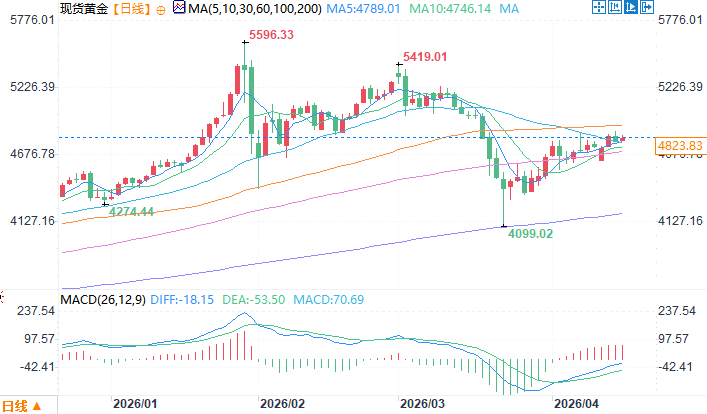
Spot gold daily chart source: EasyForex
At 11:32 AM Beijing time on April 16, spot gold was trading at $4823.83 per ounce.
Many analysts believe that last month's gold sell-off was entirely logical. Following the joint US-Israel military action against Iran, the global economy faced severe uncertainty, triggering supply chain crises that impacted everything from food production to energy markets. In this environment, gold became an important source of liquidity.
Gold's role as a high-quality liquid asset is becoming increasingly prominent.
The London Bullion Market Association (LBMA) and the World Gold Council (WGC) are stepping up efforts to gain more formal recognition for gold in the global financial system. On March 31, the two organizations jointly launched a dedicated platform designed to provide market participants and regulators with data to demonstrate gold's characteristics as a High-Quality Liquid Asset (HQLA) and to support its inclusion in a prudent regulatory framework.
LBMA Managing Director Ruth Crowell stated that recent market volatility has further reinforced gold's role as a source of liquidity during times of stress. From the global financial crisis to the COVID-19 pandemic and recent geopolitical shocks, gold has consistently served as a reliable asset, readily convertible into cash when funds are most needed.
"It's about selling the winners to pay the losers," Crowell said. "At this point, you can withdraw cash from it, and from that perspective, it behaves very similarly to U.S. Treasuries."
She explained that in the current environment, gold should not be viewed as a malfunctioning asset, but rather as a functioning one. She pointed out that many countries are liquidating their gold holdings to meet domestic liquidity needs, highlighting gold's role as a strategic financial reserve rather than simply a passive store of value.
Crowley emphasized that the key issue is not whether gold exhibits volatility, but rather its performance relative to other assets during periods of stress. She stated, "People always focus on volatility, but it's not that simple. Gold remains a safe-haven asset, a reserve asset, and it's playing its role in times of crisis. "
Data-driven platforms fill regulatory gaps
The platform jointly launched by the LBMA and WGC aims to address a long-standing gap in the regulatory debate by providing quantifiable data to demonstrate gold's liquidity characteristics. Historically, under Basel III rules, gold has been excluded from the highest-level classification of high-liquidity assets, primarily due to a lack of standardized data to demonstrate its performance in crisis scenarios.
Crowell explained, "We specifically created this dataset...and now we have multiple crises available for analysis."
These data consistently demonstrate that gold can provide liquidity when markets are under pressure.
The arguments put forward by the LBMA and WGC are very clear: gold has a deep and global market, no credit risk, and quick liquidity, making it a strong candidate to be included in a diversified liquidity buffer alongside traditional assets such as government bonds.
Meanwhile, the actions of central banks around the world further confirm this view. In recent years, official purchases of gold have increased significantly as countries seek to diversify their dependence on the US dollar and instead seek neutral reserve assets without counterparty risk.
"It's not surprising that gold is considered an international currency without third-party liabilities," Crawwell said.
Future Outlook: Gold's Rising Role in Diversified Investment Portfolios
Looking ahead, while regulators are becoming increasingly open to discussion, Crowwell emphasized that progress still requires ongoing communication and education. "This is a marathon, not a sprint," she said. She added that the organization's core message to policymakers is very simple: "Look at the data."
Beyond regulatory classifications, Crowwell also points out that broader market trends support the evolving role of gold. Investors are increasingly viewing gold not just as a hedging tool or speculative asset, but as a core component of diversified portfolios, especially in today's world of recurring geopolitical fragmentation and liquidity shocks.
"There is a growing recognition that gold should be part of any diversified portfolio," Crawwell said.
Overall , despite a short-term pullback in gold prices, gold's liquidity performance during crises has once again been validated. As global uncertainty rises, gold's status as a safe-haven asset and strategic reserve is being strengthened, and its role in the global financial system is becoming increasingly important.
Spot gold daily chart source: EasyForex
At 11:32 AM Beijing time on April 16, spot gold was trading at $4823.83 per ounce.
- Risk Warning and Disclaimer
- The market involves risk, and trading may not be suitable for all investors. This article is for reference only and does not constitute personal investment advice, nor does it take into account certain users’ specific investment objectives, financial situation, or other needs. Any investment decisions made based on this information are at your own risk.