Expectations of easing tensions in the Middle East boosted risk sentiment, and the pound continued its rebound against the dollar.
2026-04-16 10:18:04
The pound sterling stabilized and rebounded against the dollar in Asian trading on Thursday, returning to around 1.3570 , mainly benefiting from improved market risk sentiment. Previously, safe-haven demand stemming from tensions in the Middle East had eased, with funds flowing back into risk assets, supporting the pound's performance. Market surveys indicate that the US has signaled that the conflict is nearing its end, and the market widely expects the situation to gradually de-escalate.
Despite initial market speculation about a possible two-week extension of the ceasefire agreement, statements indicate that negotiations are ongoing, and the possibility of a longer-term agreement in the near future remains. However, news that the US plans to deploy approximately 10,000 additional troops to the region has kept the market cautious, suggesting that geopolitical risks have not been completely eliminated and could still cause repeated fluctuations in market sentiment.
From a macroeconomic perspective, the tight energy market continues to support global inflation. The ongoing blockade of the Strait of Hormuz is pushing up energy prices, and this imported inflationary pressure is influencing policy expectations in major economies. Market expectations that the Bank of England may implement two interest rate hikes this year to address persistent price pressures are providing fundamental support for the pound.
Meanwhile, the market is focused on the meeting between the UK Chancellor of the Exchequer and the US Treasury Secretary during an international conference, which is seen as an important window for assessing future economic coordination and policy communication. Against the backdrop of rising global economic uncertainty, policy coordination may become one of the key variables influencing exchange rates.
In contrast, the US policy path remains cautious. The latest economic report from the Federal Reserve shows that US economic activity continues to expand moderately, while the newly released producer price index rose to 4% , indicating that inflationary pressures persist. This leads the market to expect that the Federal Reserve may maintain a relatively tight stance throughout 2026 and will not easily shift to easing, thus supporting the US dollar.
Federal Reserve official Mussallem stated, "Higher oil prices could pass through to core inflation, keeping it at or slightly below 3%."
This statement reinforced the market's perception of "sticky inflation," implying that even with slowing economic growth, the room for monetary policy adjustments remains limited. Against this backdrop, while the pound benefited from improved risk sentiment, the dollar's interest rate advantage continues to exert medium-term downward pressure on the exchange rate.
From a market structure perspective, the current pound sterling's performance exhibits a clear "dual-driven" characteristic: on the one hand, a short-term rebound driven by improved risk sentiment; on the other hand, medium-term constraints stemming from divergent policy expectations between the UK and the US. Therefore, the short-term rebound in the exchange rate is more of a sentiment correction than a trend reversal.
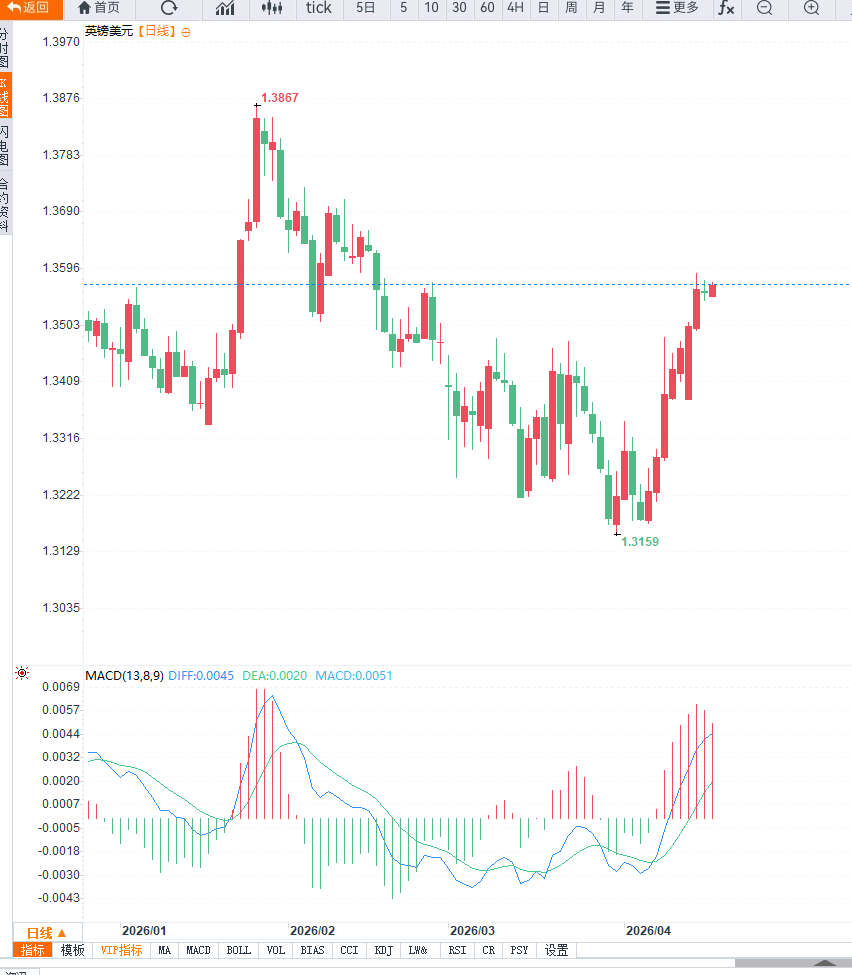
From a technical perspective, on the daily chart, the GBP/USD pair maintains an overall upward trend with fluctuations. After a recent pullback, it has stabilized again, indicating that the bulls still possess some resilience. The key resistance level is currently around 1.3650 , which is a previous high and a crucial point of contention between bulls and bears. Support is located around 1.3400 , an area that has repeatedly formed a basis for price rebounds. Momentum indicators show that the RSI remains above 50, indicating that the overall trend has not yet weakened.
The short-term 4-hour chart shows that the exchange rate has gradually recovered its previous losses after rebounding from the lows, but the momentum remains relatively limited. The MACD indicator is starting to converge upwards, indicating that there is room for further rebound in the short term, but if it cannot effectively break through 1.3650 , it may re-enter the trading range. If it falls below 1.3400 , a deeper correction should be anticipated.
Editor's Summary : Overall, the current rebound in the pound against the dollar is mainly driven by market sentiment rather than a substantial improvement in fundamentals. Easing tensions in the Middle East are supporting risk assets, but high energy prices and persistent inflationary pressures are pushing the Bank of England to maintain a tight policy stance. However, sticky inflation in the US is also limiting the Federal Reserve's policy space, keeping the dollar relatively strong. Future exchange rate movements will depend on two key variables: whether geopolitical tensions truly de-escalate and whether the divergence between UK and US monetary policies widens. Against this backdrop, the exchange rate may remain range-bound in the short term, with a breakout of key technical levels becoming a crucial signal for determining the trend direction.
Despite initial market speculation about a possible two-week extension of the ceasefire agreement, statements indicate that negotiations are ongoing, and the possibility of a longer-term agreement in the near future remains. However, news that the US plans to deploy approximately 10,000 additional troops to the region has kept the market cautious, suggesting that geopolitical risks have not been completely eliminated and could still cause repeated fluctuations in market sentiment.
From a macroeconomic perspective, the tight energy market continues to support global inflation. The ongoing blockade of the Strait of Hormuz is pushing up energy prices, and this imported inflationary pressure is influencing policy expectations in major economies. Market expectations that the Bank of England may implement two interest rate hikes this year to address persistent price pressures are providing fundamental support for the pound.
Meanwhile, the market is focused on the meeting between the UK Chancellor of the Exchequer and the US Treasury Secretary during an international conference, which is seen as an important window for assessing future economic coordination and policy communication. Against the backdrop of rising global economic uncertainty, policy coordination may become one of the key variables influencing exchange rates.
In contrast, the US policy path remains cautious. The latest economic report from the Federal Reserve shows that US economic activity continues to expand moderately, while the newly released producer price index rose to 4% , indicating that inflationary pressures persist. This leads the market to expect that the Federal Reserve may maintain a relatively tight stance throughout 2026 and will not easily shift to easing, thus supporting the US dollar.
Federal Reserve official Mussallem stated, "Higher oil prices could pass through to core inflation, keeping it at or slightly below 3%."
This statement reinforced the market's perception of "sticky inflation," implying that even with slowing economic growth, the room for monetary policy adjustments remains limited. Against this backdrop, while the pound benefited from improved risk sentiment, the dollar's interest rate advantage continues to exert medium-term downward pressure on the exchange rate.
From a market structure perspective, the current pound sterling's performance exhibits a clear "dual-driven" characteristic: on the one hand, a short-term rebound driven by improved risk sentiment; on the other hand, medium-term constraints stemming from divergent policy expectations between the UK and the US. Therefore, the short-term rebound in the exchange rate is more of a sentiment correction than a trend reversal.
From a technical perspective, on the daily chart, the GBP/USD pair maintains an overall upward trend with fluctuations. After a recent pullback, it has stabilized again, indicating that the bulls still possess some resilience. The key resistance level is currently around 1.3650 , which is a previous high and a crucial point of contention between bulls and bears. Support is located around 1.3400 , an area that has repeatedly formed a basis for price rebounds. Momentum indicators show that the RSI remains above 50, indicating that the overall trend has not yet weakened.
The short-term 4-hour chart shows that the exchange rate has gradually recovered its previous losses after rebounding from the lows, but the momentum remains relatively limited. The MACD indicator is starting to converge upwards, indicating that there is room for further rebound in the short term, but if it cannot effectively break through 1.3650 , it may re-enter the trading range. If it falls below 1.3400 , a deeper correction should be anticipated.
Editor's Summary : Overall, the current rebound in the pound against the dollar is mainly driven by market sentiment rather than a substantial improvement in fundamentals. Easing tensions in the Middle East are supporting risk assets, but high energy prices and persistent inflationary pressures are pushing the Bank of England to maintain a tight policy stance. However, sticky inflation in the US is also limiting the Federal Reserve's policy space, keeping the dollar relatively strong. Future exchange rate movements will depend on two key variables: whether geopolitical tensions truly de-escalate and whether the divergence between UK and US monetary policies widens. Against this backdrop, the exchange rate may remain range-bound in the short term, with a breakout of key technical levels becoming a crucial signal for determining the trend direction.
- Risk Warning and Disclaimer
- The market involves risk, and trading may not be suitable for all investors. This article is for reference only and does not constitute personal investment advice, nor does it take into account certain users’ specific investment objectives, financial situation, or other needs. Any investment decisions made based on this information are at your own risk.