With risk appetite recovering and the dollar weakening, the USD/JPY pair continues its correction and may have peaked in the short term.
2026-04-16 10:41:08
The dollar weakened against the yen in Asian trading on Thursday, falling to around 158.70 , near its lowest level this week. While the dollar had previously seen a brief rebound, it lacked sustained momentum and remained generally weak. The current shift towards optimistic market sentiment has diminished the dollar's appeal as a safe-haven asset, a major factor driving the decline.

Negotiations between the United States and Iran are still progressing, and the market widely expects the conflict to gradually ease or even come to an end. This expectation has significantly boosted global risk appetite, causing funds to flow out of safe-haven assets, and the dollar index to fall to near its lowest level since early March, thus putting downward pressure on the dollar against the yen.
Meanwhile, changes in the crude oil market are also influencing exchange rate movements. As market expectations for a diplomatic solution rise, oil prices have remained near three-week lows, which has somewhat alleviated previous inflation concerns. The easing of inflationary pressures has cooled market expectations for further tightening by the Federal Reserve, thereby weakening the dollar's interest rate advantage and putting downward pressure on the exchange rate.
From the perspective of the Japanese yen, market expectations of potential intervention by Japanese authorities in the foreign exchange market have provided some support for the yen. Especially as the exchange rate approaches the 160 level, the risk of policy intervention increases significantly, prompting some short sellers to cover their positions. However, the yen's upside potential remains limited by fundamentals.
Japan is highly dependent on energy imports from the Middle East, and the instability in the Strait of Hormuz poses a potential threat to its economy. Continued constraints on energy supplies will drive up import costs and impact economic growth expectations, thus limiting the yen's ability to appreciate further. This coexistence of "policy support" and "fundamental suppression" makes the yen's exchange rate complex.
From a broader market perspective, the USD/JPY pair has maintained a range-bound trading pattern over the past month, briefly reaching above 160 before retreating but failing to establish a downward trend. Currently, the market lacks clear drivers; both the USD and JPY are subject to mutual constraints, suggesting that the exchange rate is more likely to remain range-bound in the short term.
From a technical perspective, on the daily chart, the USD/JPY pair has entered a consolidation phase after retreating from its highs, with the overall trend shifting from a sustained upward movement to range-bound trading. The key resistance level is currently around 160.80 , a region of concentrated previous highs; the important support level is around 156.50 , the recent pullback low. The RSI indicator has fallen back into neutral territory, indicating a significant weakening of bullish momentum.
The 4-hour chart shows that the exchange rate is maintaining a slightly weak and volatile structure in the short term. Multiple rebounds have been met with resistance, and the MACD indicator is below the zero line, indicating that bearish momentum is dominant. If the exchange rate breaks below 158.50 , it may further test the support area; conversely, if it regains a foothold above 159.50 , a technical rebound is possible.
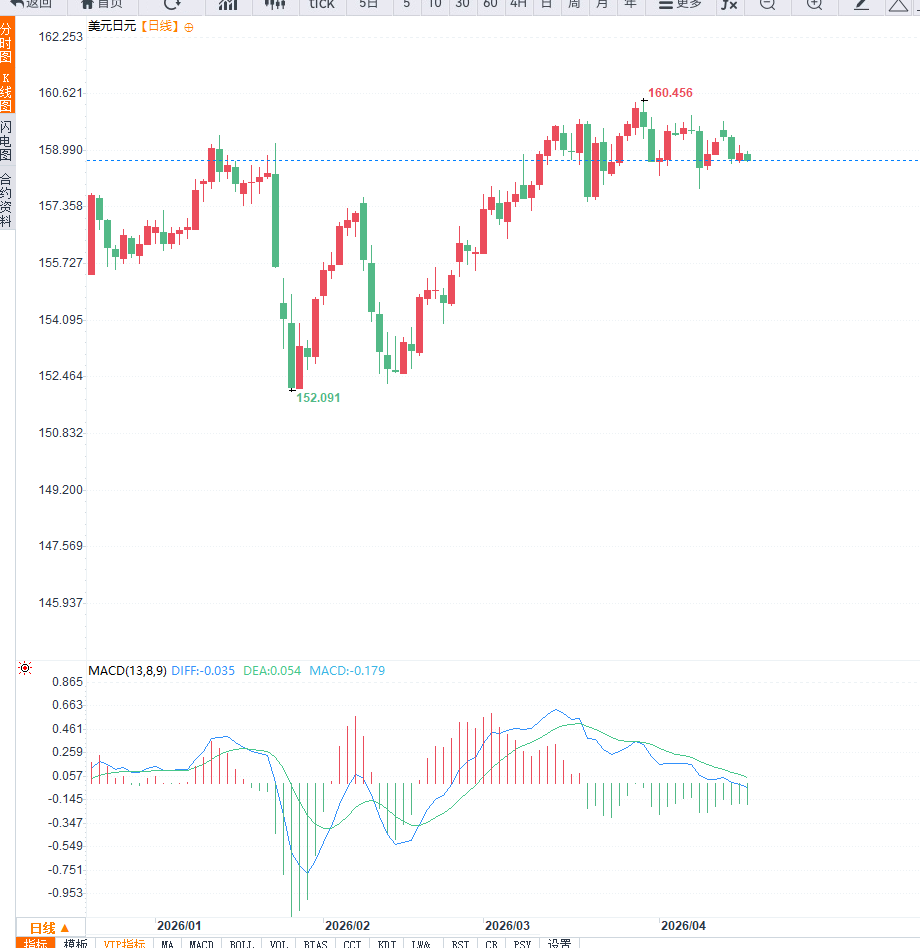
Editor's Summary : Overall, the current USD/JPY exchange rate is primarily driven by both improved risk sentiment and changing policy expectations. Easing tensions in the Middle East have weakened the dollar's safe-haven appeal, while falling oil prices have further eased inflationary pressures, suppressing the dollar's performance. Meanwhile, expectations of Japanese intervention provide temporary support for the yen, but economic risks stemming from energy dependence limit its appreciation potential. The future direction of the exchange rate will depend on whether the geopolitical situation truly stabilizes and changes in expectations regarding Federal Reserve policy. In the absence of clear drivers, the exchange rate may continue to fluctuate in the short term.
Negotiations between the United States and Iran are still progressing, and the market widely expects the conflict to gradually ease or even come to an end. This expectation has significantly boosted global risk appetite, causing funds to flow out of safe-haven assets, and the dollar index to fall to near its lowest level since early March, thus putting downward pressure on the dollar against the yen.
Meanwhile, changes in the crude oil market are also influencing exchange rate movements. As market expectations for a diplomatic solution rise, oil prices have remained near three-week lows, which has somewhat alleviated previous inflation concerns. The easing of inflationary pressures has cooled market expectations for further tightening by the Federal Reserve, thereby weakening the dollar's interest rate advantage and putting downward pressure on the exchange rate.
From the perspective of the Japanese yen, market expectations of potential intervention by Japanese authorities in the foreign exchange market have provided some support for the yen. Especially as the exchange rate approaches the 160 level, the risk of policy intervention increases significantly, prompting some short sellers to cover their positions. However, the yen's upside potential remains limited by fundamentals.
Japan is highly dependent on energy imports from the Middle East, and the instability in the Strait of Hormuz poses a potential threat to its economy. Continued constraints on energy supplies will drive up import costs and impact economic growth expectations, thus limiting the yen's ability to appreciate further. This coexistence of "policy support" and "fundamental suppression" makes the yen's exchange rate complex.
From a broader market perspective, the USD/JPY pair has maintained a range-bound trading pattern over the past month, briefly reaching above 160 before retreating but failing to establish a downward trend. Currently, the market lacks clear drivers; both the USD and JPY are subject to mutual constraints, suggesting that the exchange rate is more likely to remain range-bound in the short term.
From a technical perspective, on the daily chart, the USD/JPY pair has entered a consolidation phase after retreating from its highs, with the overall trend shifting from a sustained upward movement to range-bound trading. The key resistance level is currently around 160.80 , a region of concentrated previous highs; the important support level is around 156.50 , the recent pullback low. The RSI indicator has fallen back into neutral territory, indicating a significant weakening of bullish momentum.
The 4-hour chart shows that the exchange rate is maintaining a slightly weak and volatile structure in the short term. Multiple rebounds have been met with resistance, and the MACD indicator is below the zero line, indicating that bearish momentum is dominant. If the exchange rate breaks below 158.50 , it may further test the support area; conversely, if it regains a foothold above 159.50 , a technical rebound is possible.
Editor's Summary : Overall, the current USD/JPY exchange rate is primarily driven by both improved risk sentiment and changing policy expectations. Easing tensions in the Middle East have weakened the dollar's safe-haven appeal, while falling oil prices have further eased inflationary pressures, suppressing the dollar's performance. Meanwhile, expectations of Japanese intervention provide temporary support for the yen, but economic risks stemming from energy dependence limit its appreciation potential. The future direction of the exchange rate will depend on whether the geopolitical situation truly stabilizes and changes in expectations regarding Federal Reserve policy. In the absence of clear drivers, the exchange rate may continue to fluctuate in the short term.
- Risk Warning and Disclaimer
- The market involves risk, and trading may not be suitable for all investors. This article is for reference only and does not constitute personal investment advice, nor does it take into account certain users’ specific investment objectives, financial situation, or other needs. Any investment decisions made based on this information are at your own risk.