Gold Trading Alert: A 10-day ceasefire between Israel and Lebanon signals a turning point in Middle Eastern geopolitics, potentially leading to a major shift in gold prices.
2026-04-17 07:19:51
On Thursday (April 16), spot gold prices held steady around $4,790 per ounce, nearly unchanged, after hitting a one-month high in the previous session. While US gold futures fell slightly by 0.3% to $4,808.30, the overall market sentiment has gradually recovered from the slump in March. This change is not an isolated event, but is closely linked to the dramatic turn of events in the Middle East—after the outbreak of the war between the US and Israel against Iran, gold prices were initially pressured by inflation concerns and tightening liquidity. However, President Trump's ceasefire declaration and positive signals from US-Iran peace negotiations are injecting strong momentum into the gold market. Investors are beginning to reassess: if the war ends, energy prices fall, inflationary pressures ease, and the Fed's interest rate cut path becomes clearer, gold's attractiveness will be highlighted again. On Friday (April 17) in early Asian trading, spot gold fluctuated narrowly, currently trading at $4,792.85 per ounce.
Looking back at recent price movements, spot gold demonstrated remarkable resilience in Thursday's trading. Although it experienced slight fluctuations after hitting a one-month high in the previous session, it remained within a high range overall, a stark contrast to the significant drop in gold prices in March. At that time, the US and Israel launched a war against Iran in late February, exacerbating investor concerns about soaring inflation and market liquidity, leading to a decline in the attractiveness of non-interest-bearing gold and a significant outflow of funds from the precious metals market. However, with signs emerging that the US and Iran talks had quickly resumed after the breakdown of talks last weekend, gold prices began to quietly rebound. The market generally believes that if US-Iran tensions ease or even the war ends completely, global energy prices will fall significantly. This would not only lower inflation expectations but also open up more room for future interest rate cuts by the Federal Reserve, thus providing long-term support for gold.
David Meger, director of metals trading at High Ridge Futures, stated bluntly, "If tensions between the US and Iran ease or the war ends, the likelihood of future Fed rate cuts will be greater...this could support the precious metals market." Currently, traders' expectations for a US rate cut this year have risen to 32%, a figure that, while still lower than previous highs, is enough to boost investor confidence. Meanwhile, last week's unexpected drop in US initial jobless claims to 207,000 indicates that the labor market, despite the shadow of war, remains relatively stable. This further alleviates market fears of a hard landing for the economy, providing a more moderate macroeconomic backdrop for gold pricing.
The latest developments in the Middle East have undoubtedly been the core catalyst for the current gold price rebound. US President Trump announced on Thursday via Truth Social that the leaders of Israel and Lebanon had agreed to a 10-day ceasefire starting at 5 p.m. Eastern Time (5:00 a.m. Friday Beijing Time), a news that quickly spread globally. Subsequently, Trump told reporters outside the White House that the next meeting between the US and Iran might be held in Pakistan this weekend, optimistically predicting that "we are very close to reaching an agreement with Iran." He specifically mentioned that Iran has proposed not possessing nuclear weapons for more than 20 years, a concession considered a major compromise on the nuclear issue.
Trump further revealed that the White House plans to invite Israeli Prime Minister Netanyahu and Lebanese President Aoun to a meeting to promote lasting peace. Meanwhile, Vice President Vance, Secretary of State Rubio, and Chairman of the Joint Chiefs of Staff Kaine have been instructed to cooperate with both sides. Iran has also shown signs of flexibility: two Iranian sources revealed that Tehran is considering moving some (but not all) of its highly enriched uranium stockpile out of the country, a contrast to its previous firm refusal; furthermore, Iran is demanding UN guarantees and a permanent ceasefire before it will reopen the Strait of Hormuz. Pakistani Army Chief of Staff Munir's trip to Tehran is seen as a key step towards a breakthrough on these "thorny issues." Although US Defense Secretary Hergses emphasized that the US military is ready to resume operations, overall, the glimmer of peace has significantly reduced market concerns about a "nuclear catastrophe."
The rising expectations of peace in the Middle East are directly impacting the global economy. During the war, Iran's blockade of the Strait of Hormuz disrupted approximately 20% of global oil and liquefied natural gas transport, causing oil prices to surge and exacerbating inflationary pressures. However, with the ceasefire agreement taking effect and negotiations progressing, energy prices are expected to fall significantly, directly alleviating inflationary pressures. Trump himself emphasized, "If an agreement is reached, oil prices will fall sharply, prices will fall sharply, and inflation will fall sharply." This expectation is gradually being priced into the market.
Meanwhile, the dollar index saw a technical rebound on Thursday, rising 0.2% to 98.19, but the gains were limited, reflecting some restraint in safe-haven demand. Elias Haddad, global head of market strategy at Brown Brothers Harriman, pointed out that this "relief rebound" reflects market hopes for a diplomatic solution to the US-Iran conflict, and risk appetite is recovering. In the US bond market, yields rose slightly along with oil prices, with the two-year Treasury yield rising to 3.778% and the 10-year yield to 4.309%, but the Federal Reserve's balance between inflation and growth risks is becoming more balanced. Federal funds futures indicate that while the probability of a 25 basis point rate cut by the end of the year is less than 50%, this has completely reversed the initial expectations of rate hikes at the beginning of the war. New York Fed President Williams also stated that the Fed is prepared to deal with any economic situation.
The stock market echoed this optimism: the S&P 500 and Nasdaq both hit record closing highs for the second consecutive day, the Dow Jones Industrial Average rose 0.24%, and the energy sector led the gains with a 1.6% increase. Analysts believe that trading has shifted from simple "war fears" to more positive fundamentals, and options market positioning also suggests that there is still room for further gains.
Despite frequent signs of peace, the oil market has not fully embraced the message. Brent crude futures rose 4.7% to $99.39 on Thursday, while U.S. crude futures for May delivery rose 3.7% to $94.69, as investors questioned whether U.S.-Iran peace talks could quickly alleviate supply disruptions in the Strait of Hormuz. Iranian sources even revealed that negotiators from both sides have lowered their expectations for a full-scale peace, instead seeking a temporary memorandum to prevent a resurgence of conflict. While U.S. crude inventories decreased due to strong exports, global inventories remain under pressure, particularly jet fuel inventories in Asia and Africa. John Evans, an oil market analyst at PVM, bluntly stated, "We remain skeptical that this war can be resolved immediately."
Furthermore, the Senate confirmation hearing for Trump's nominee for Federal Reserve Chair, Warsh, is scheduled for April 21. Markets are divided on his dovish stance, potentially exacerbating options volatility. These uncertainties remind investors that while the peace process has begun, fundamental disagreements such as nuclear programs and sanctions de-escalation remain before a permanent agreement can be reached.
In summary, the positive progress in the US-Iran peace talks is injecting much-needed certainty into the global gold market. The stabilization of spot gold around $4790 not only signifies a decline in safe-haven demand from its peak but also indicates that gold will once again attract long-term capital inflows as energy prices and inflation expectations ease. Trump's ceasefire declaration and the breakthrough in negotiations have helped the market gradually emerge from the "worst-case scenario," while the warming expectations of a Fed rate cut will further solidify gold's position as a safe-haven asset.
Of course, investors still need to remain vigilant: if negotiations falter again, a rebound in oil prices could reignite inflation concerns, and gold prices may face short-term downward pressure. However, in the medium to long term, a "soft landing" of this geopolitical crisis is expected to open a new upward channel for gold.
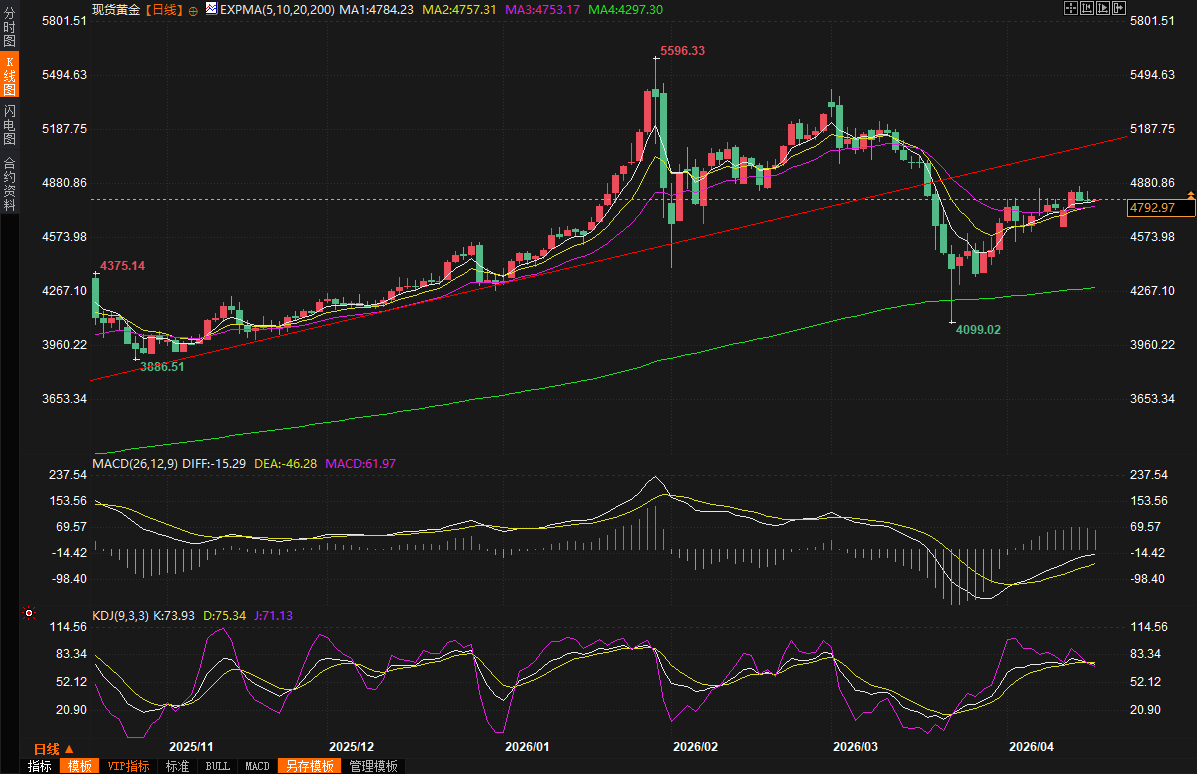
(Spot gold daily chart, source: FX678)
At 07:19 Beijing time, spot gold was trading at $4795.81 per ounce.
Spot gold holds steady and rebounds: a market shift from the shadow of war to expectations of peace.
Looking back at recent price movements, spot gold demonstrated remarkable resilience in Thursday's trading. Although it experienced slight fluctuations after hitting a one-month high in the previous session, it remained within a high range overall, a stark contrast to the significant drop in gold prices in March. At that time, the US and Israel launched a war against Iran in late February, exacerbating investor concerns about soaring inflation and market liquidity, leading to a decline in the attractiveness of non-interest-bearing gold and a significant outflow of funds from the precious metals market. However, with signs emerging that the US and Iran talks had quickly resumed after the breakdown of talks last weekend, gold prices began to quietly rebound. The market generally believes that if US-Iran tensions ease or even the war ends completely, global energy prices will fall significantly. This would not only lower inflation expectations but also open up more room for future interest rate cuts by the Federal Reserve, thus providing long-term support for gold.
David Meger, director of metals trading at High Ridge Futures, stated bluntly, "If tensions between the US and Iran ease or the war ends, the likelihood of future Fed rate cuts will be greater...this could support the precious metals market." Currently, traders' expectations for a US rate cut this year have risen to 32%, a figure that, while still lower than previous highs, is enough to boost investor confidence. Meanwhile, last week's unexpected drop in US initial jobless claims to 207,000 indicates that the labor market, despite the shadow of war, remains relatively stable. This further alleviates market fears of a hard landing for the economy, providing a more moderate macroeconomic backdrop for gold pricing.
A Geopolitical Turning Point in the Middle East: The Profound Impact of Trump's Major Declaration and the Ceasefire Agreement
The latest developments in the Middle East have undoubtedly been the core catalyst for the current gold price rebound. US President Trump announced on Thursday via Truth Social that the leaders of Israel and Lebanon had agreed to a 10-day ceasefire starting at 5 p.m. Eastern Time (5:00 a.m. Friday Beijing Time), a news that quickly spread globally. Subsequently, Trump told reporters outside the White House that the next meeting between the US and Iran might be held in Pakistan this weekend, optimistically predicting that "we are very close to reaching an agreement with Iran." He specifically mentioned that Iran has proposed not possessing nuclear weapons for more than 20 years, a concession considered a major compromise on the nuclear issue.
Trump further revealed that the White House plans to invite Israeli Prime Minister Netanyahu and Lebanese President Aoun to a meeting to promote lasting peace. Meanwhile, Vice President Vance, Secretary of State Rubio, and Chairman of the Joint Chiefs of Staff Kaine have been instructed to cooperate with both sides. Iran has also shown signs of flexibility: two Iranian sources revealed that Tehran is considering moving some (but not all) of its highly enriched uranium stockpile out of the country, a contrast to its previous firm refusal; furthermore, Iran is demanding UN guarantees and a permanent ceasefire before it will reopen the Strait of Hormuz. Pakistani Army Chief of Staff Munir's trip to Tehran is seen as a key step towards a breakthrough on these "thorny issues." Although US Defense Secretary Hergses emphasized that the US military is ready to resume operations, overall, the glimmer of peace has significantly reduced market concerns about a "nuclear catastrophe."
Economic interconnectedness: falling oil prices, easing inflation, and a shift in Federal Reserve policy.
The rising expectations of peace in the Middle East are directly impacting the global economy. During the war, Iran's blockade of the Strait of Hormuz disrupted approximately 20% of global oil and liquefied natural gas transport, causing oil prices to surge and exacerbating inflationary pressures. However, with the ceasefire agreement taking effect and negotiations progressing, energy prices are expected to fall significantly, directly alleviating inflationary pressures. Trump himself emphasized, "If an agreement is reached, oil prices will fall sharply, prices will fall sharply, and inflation will fall sharply." This expectation is gradually being priced into the market.
Meanwhile, the dollar index saw a technical rebound on Thursday, rising 0.2% to 98.19, but the gains were limited, reflecting some restraint in safe-haven demand. Elias Haddad, global head of market strategy at Brown Brothers Harriman, pointed out that this "relief rebound" reflects market hopes for a diplomatic solution to the US-Iran conflict, and risk appetite is recovering. In the US bond market, yields rose slightly along with oil prices, with the two-year Treasury yield rising to 3.778% and the 10-year yield to 4.309%, but the Federal Reserve's balance between inflation and growth risks is becoming more balanced. Federal funds futures indicate that while the probability of a 25 basis point rate cut by the end of the year is less than 50%, this has completely reversed the initial expectations of rate hikes at the beginning of the war. New York Fed President Williams also stated that the Fed is prepared to deal with any economic situation.
The stock market echoed this optimism: the S&P 500 and Nasdaq both hit record closing highs for the second consecutive day, the Dow Jones Industrial Average rose 0.24%, and the energy sector led the gains with a 1.6% increase. Analysts believe that trading has shifted from simple "war fears" to more positive fundamentals, and options market positioning also suggests that there is still room for further gains.
Oil Market Concerns and Overall Risks: While Talks Are Imminent, Lasting Peace Still Needs to Be Proven.
Despite frequent signs of peace, the oil market has not fully embraced the message. Brent crude futures rose 4.7% to $99.39 on Thursday, while U.S. crude futures for May delivery rose 3.7% to $94.69, as investors questioned whether U.S.-Iran peace talks could quickly alleviate supply disruptions in the Strait of Hormuz. Iranian sources even revealed that negotiators from both sides have lowered their expectations for a full-scale peace, instead seeking a temporary memorandum to prevent a resurgence of conflict. While U.S. crude inventories decreased due to strong exports, global inventories remain under pressure, particularly jet fuel inventories in Asia and Africa. John Evans, an oil market analyst at PVM, bluntly stated, "We remain skeptical that this war can be resolved immediately."
Furthermore, the Senate confirmation hearing for Trump's nominee for Federal Reserve Chair, Warsh, is scheduled for April 21. Markets are divided on his dovish stance, potentially exacerbating options volatility. These uncertainties remind investors that while the peace process has begun, fundamental disagreements such as nuclear programs and sanctions de-escalation remain before a permanent agreement can be reached.
Gold Investment Outlook: Strategic Opportunities and Cautious Planning Under the Peace Dividend
In summary, the positive progress in the US-Iran peace talks is injecting much-needed certainty into the global gold market. The stabilization of spot gold around $4790 not only signifies a decline in safe-haven demand from its peak but also indicates that gold will once again attract long-term capital inflows as energy prices and inflation expectations ease. Trump's ceasefire declaration and the breakthrough in negotiations have helped the market gradually emerge from the "worst-case scenario," while the warming expectations of a Fed rate cut will further solidify gold's position as a safe-haven asset.
Of course, investors still need to remain vigilant: if negotiations falter again, a rebound in oil prices could reignite inflation concerns, and gold prices may face short-term downward pressure. However, in the medium to long term, a "soft landing" of this geopolitical crisis is expected to open a new upward channel for gold.
(Spot gold daily chart, source: FX678)
At 07:19 Beijing time, spot gold was trading at $4795.81 per ounce.
- Risk Warning and Disclaimer
- The market involves risk, and trading may not be suitable for all investors. This article is for reference only and does not constitute personal investment advice, nor does it take into account certain users’ specific investment objectives, financial situation, or other needs. Any investment decisions made based on this information are at your own risk.