Stronger oil prices boosted the Canadian dollar, while safe-haven demand supported the US dollar, causing the USD/CAD pair to fluctuate and decline.
2026-04-17 10:30:04
The US dollar continued its decline against the Canadian dollar during Friday's Asian trading session, trading around 1.3700, marking its fifth consecutive day of pressure. The main reason for the weakening exchange rate was the strengthening of the commodity currency Canadian dollar driven by rising oil prices, while the US dollar, although supported by safe-haven demand, had limited overall momentum.
From a fundamental perspective, the Canadian dollar's performance is closely correlated with oil prices. As the largest exporter of crude oil to the United States, the Canadian economy is highly sensitive to energy prices. Currently, WTI crude oil prices are hovering around $90, mainly supported by supply concerns. The market remains highly focused on the situation in the Middle East, especially on the eve of US-Iran negotiations, with investors generally adopting a cautious attitude.
Despite a 10-day ceasefire agreement between Israel and Lebanon, the situation has not fully stabilized. The Lebanese military has stated that numerous violations have been recorded since the ceasefire took effect, and that some areas continue to be subjected to intermittent shelling. This situation has intensified market concerns about supply disruptions, thus supporting oil prices.
Meanwhile, US President Donald Trump stated that he had communicated with Lebanese President Joseph Aoun and Israeli Prime Minister Benjamin Netanyahu and confirmed a ceasefire agreement. The US and Iran are expected to resume negotiations over the weekend, and Trump is optimistic about reaching a long-term agreement.
However, the market remains cautious about the outcome of the negotiations. On the one hand, progress in the negotiations would alleviate supply risks and depress oil prices; on the other hand, risk aversion continues to support the US dollar index until the outcome is clear. This uncertainty keeps the dollar resilient in the short term, thus limiting the downside potential of USD/CAD.
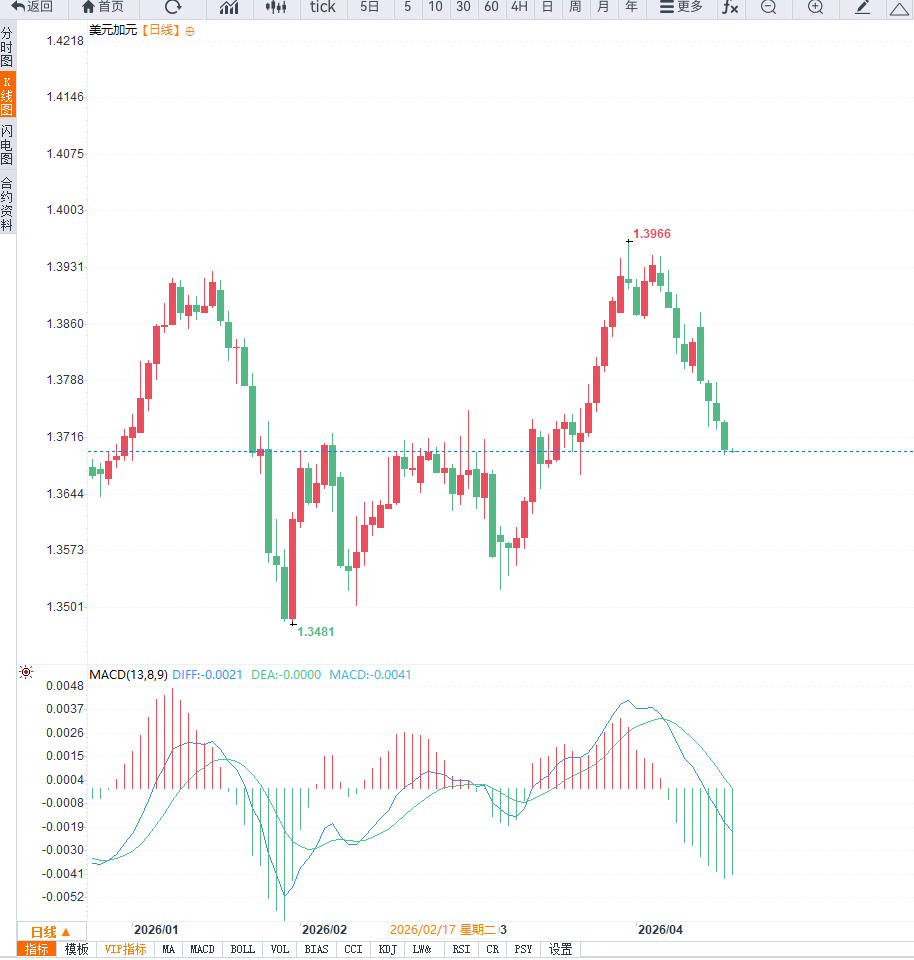
From a market structure perspective, the current USD/CAD exchange rate exhibits a typical "dual-drive pattern": on the one hand, rising oil prices are pushing the Canadian dollar stronger; on the other hand, safe-haven demand is supporting the US dollar. The exchange rate has reached a temporary equilibrium around 1.3700 , indicating a temporary balance between bullish and bearish forces.
At the global market level, fluctuations in energy prices are impacting inflation expectations in major economies. Rising oil prices could push up inflation, thereby influencing central bank policy paths, a factor that also indirectly affects the exchange rate market through interest rate expectations.
From an investor sentiment perspective, the market is currently exhibiting a clear trend towards caution. In the short term, trading logic is more focused on geopolitical situations and oil price fluctuations, rather than being driven by single economic data. This event-driven nature makes exchange rates more likely to remain range-bound rather than exhibit a trending pattern .
From a technical perspective, on the daily chart, USD/CAD has retreated from its highs, shifting from an upward trend to a weak, range-bound pattern. The price has broken below short-term moving average support, and momentum indicators show increasing bearish pressure, but a clear trend has not yet formed. Key support levels are at 1.3680 and 1.3650; a break below these levels could lead to a further test of 1.3600. Resistance levels to watch are 1.3740 and 1.3780; a failed rebound would likely continue the downward trend. On the 4-hour chart, the price is exhibiting a downward channel with gradually lower highs. Short-term moving averages are in a bearish alignment, the RSI is below 50, and the MACD is below the zero line, indicating continued short-term weakness, although downward momentum has slowed, suggesting a potential consolidation phase in the short term.
Editor's Summary : Overall, the current USD/CAD exchange rate is influenced by both oil prices and risk aversion. Rising oil prices strengthen the Canadian dollar, while geopolitical uncertainties provide support for the US dollar, making it difficult for the exchange rate to form a one-sided trend. In the short term, market focus will remain on US-Iran negotiations and changes in the Middle East situation. If oil prices continue to strengthen, the exchange rate may fall further; however, if risk aversion intensifies, the US dollar may regain its advantage. Overall, USD/CAD is more likely to maintain a weak and volatile pattern.
From a fundamental perspective, the Canadian dollar's performance is closely correlated with oil prices. As the largest exporter of crude oil to the United States, the Canadian economy is highly sensitive to energy prices. Currently, WTI crude oil prices are hovering around $90, mainly supported by supply concerns. The market remains highly focused on the situation in the Middle East, especially on the eve of US-Iran negotiations, with investors generally adopting a cautious attitude.
Despite a 10-day ceasefire agreement between Israel and Lebanon, the situation has not fully stabilized. The Lebanese military has stated that numerous violations have been recorded since the ceasefire took effect, and that some areas continue to be subjected to intermittent shelling. This situation has intensified market concerns about supply disruptions, thus supporting oil prices.
Meanwhile, US President Donald Trump stated that he had communicated with Lebanese President Joseph Aoun and Israeli Prime Minister Benjamin Netanyahu and confirmed a ceasefire agreement. The US and Iran are expected to resume negotiations over the weekend, and Trump is optimistic about reaching a long-term agreement.
However, the market remains cautious about the outcome of the negotiations. On the one hand, progress in the negotiations would alleviate supply risks and depress oil prices; on the other hand, risk aversion continues to support the US dollar index until the outcome is clear. This uncertainty keeps the dollar resilient in the short term, thus limiting the downside potential of USD/CAD.
From a market structure perspective, the current USD/CAD exchange rate exhibits a typical "dual-drive pattern": on the one hand, rising oil prices are pushing the Canadian dollar stronger; on the other hand, safe-haven demand is supporting the US dollar. The exchange rate has reached a temporary equilibrium around 1.3700 , indicating a temporary balance between bullish and bearish forces.
At the global market level, fluctuations in energy prices are impacting inflation expectations in major economies. Rising oil prices could push up inflation, thereby influencing central bank policy paths, a factor that also indirectly affects the exchange rate market through interest rate expectations.
From an investor sentiment perspective, the market is currently exhibiting a clear trend towards caution. In the short term, trading logic is more focused on geopolitical situations and oil price fluctuations, rather than being driven by single economic data. This event-driven nature makes exchange rates more likely to remain range-bound rather than exhibit a trending pattern .
From a technical perspective, on the daily chart, USD/CAD has retreated from its highs, shifting from an upward trend to a weak, range-bound pattern. The price has broken below short-term moving average support, and momentum indicators show increasing bearish pressure, but a clear trend has not yet formed. Key support levels are at 1.3680 and 1.3650; a break below these levels could lead to a further test of 1.3600. Resistance levels to watch are 1.3740 and 1.3780; a failed rebound would likely continue the downward trend. On the 4-hour chart, the price is exhibiting a downward channel with gradually lower highs. Short-term moving averages are in a bearish alignment, the RSI is below 50, and the MACD is below the zero line, indicating continued short-term weakness, although downward momentum has slowed, suggesting a potential consolidation phase in the short term.
Editor's Summary : Overall, the current USD/CAD exchange rate is influenced by both oil prices and risk aversion. Rising oil prices strengthen the Canadian dollar, while geopolitical uncertainties provide support for the US dollar, making it difficult for the exchange rate to form a one-sided trend. In the short term, market focus will remain on US-Iran negotiations and changes in the Middle East situation. If oil prices continue to strengthen, the exchange rate may fall further; however, if risk aversion intensifies, the US dollar may regain its advantage. Overall, USD/CAD is more likely to maintain a weak and volatile pattern.
- Risk Warning and Disclaimer
- The market involves risk, and trading may not be suitable for all investors. This article is for reference only and does not constitute personal investment advice, nor does it take into account certain users’ specific investment objectives, financial situation, or other needs. Any investment decisions made based on this information are at your own risk.