Risk appetite declined, and the Australian dollar rebounded slightly against the US dollar, maintaining a high level of fluctuation.
2026-04-20 16:52:45
The Australian dollar rebounded from its lows against the US dollar in Asian trading on Monday, rising to around 0.7150 and recovering from an earlier low of 0.7132 . Despite the technical rebound, the pair remains below the previous high of 0.7200 , indicating that upward momentum is still limited.

In the context of this development, the situation in the Middle East has once again become a core factor in market volatility. The standoff between the United States and Iran in the Strait of Hormuz continues to escalate, with the US seizing an Iranian cargo ship and Iran warning of retaliatory measures and hinting that it may not participate in a new round of negotiations. This development has increased uncertainty about the prospects for a ceasefire, significantly suppressing market risk appetite.
Against this backdrop, the safe-haven appeal of the US dollar has resurfaced, putting some downward pressure on the Australian dollar. As a typical risk-sensitive currency, the Australian dollar typically weakens when market sentiment deteriorates. However, the market still holds some hope for a de-escalation of the situation, which has prevented a sharp decline in the Australian dollar, instead keeping it fluctuating at relatively high levels.
From a macroeconomic perspective, while the US dollar is supported by safe-haven demand, its upward momentum is limited. On the one hand, market expectations for further interest rate hikes by the Federal Reserve have cooled; on the other hand, investors are still awaiting further economic data guidance, resulting in a relatively stable overall performance for the US dollar. This environment provides some buffer for the Australian dollar.
The market will now focus on US retail sales data and statements from the Federal Reserve. The market expects March retail sales to grow by approximately 1.3% month-on-month. Strong data will support the US dollar and put pressure on the Australian dollar; conversely, weaker-than-expected data could drive a further rebound in the Australian dollar. In addition, Australia will release its PMI data this week, which will provide an important reference for the market to assess the economic situation.
Overall, the current movement of the Australian dollar against the US dollar is mainly driven by risk sentiment, with geopolitical uncertainties and changes in macroeconomic expectations jointly influencing the exchange rate. Amidst this interplay of bullish and bearish factors, the short-term trend is expected to be primarily range-bound.
From a technical perspective, the daily chart shows that the Australian dollar against the US dollar has pulled back after touching resistance near 0.7200 and is currently in a consolidation phase within an uptrend. 0.7085 forms a key support level; as long as this level holds, the overall bullish structure remains unchanged. A break above 0.7190 could lead to a further test of the 0.7250 area. Looking at the 4-hour chart, the pair has been trading within a short-term consolidation range after rebounding from its lows. Momentum has weakened slightly, but it remains within an upward channel. If it retraces and stabilizes at support, there is still room for a short-term rebound; however, a break below 0.7085 could lead to a deeper correction.
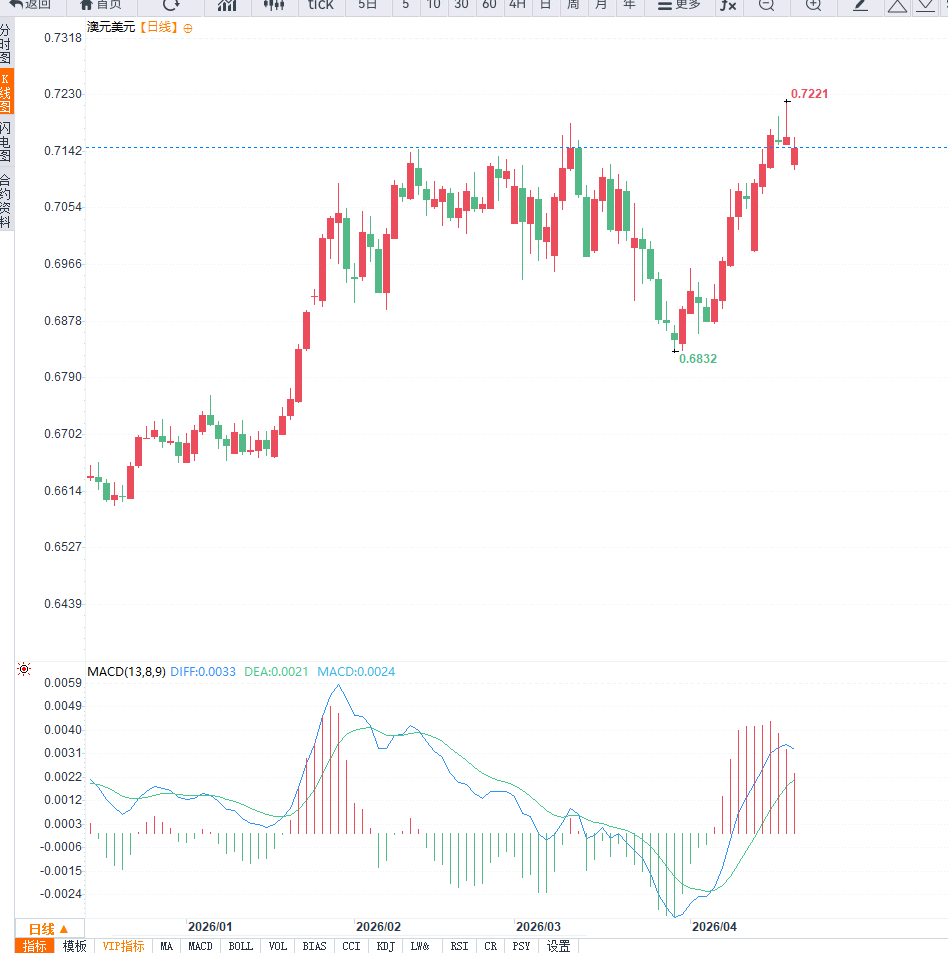
Editor's Summary : Overall, the current Australian dollar/US dollar exchange rate is influenced by both geopolitical risks and macroeconomic expectations. In the short term, the situation in the Middle East remains the dominant factor. If the conflict continues to escalate, the Australian dollar may come under pressure; however, if there are signs of easing tensions, a rebound in risk appetite could drive the exchange rate higher. From a technical perspective, the exchange rate remains within a bullish framework, but it is necessary to pay attention to whether key support levels hold. Future trends will depend on geopolitical developments and the performance of US and Australian economic data; investors should remain cautious.
In the context of this development, the situation in the Middle East has once again become a core factor in market volatility. The standoff between the United States and Iran in the Strait of Hormuz continues to escalate, with the US seizing an Iranian cargo ship and Iran warning of retaliatory measures and hinting that it may not participate in a new round of negotiations. This development has increased uncertainty about the prospects for a ceasefire, significantly suppressing market risk appetite.
Against this backdrop, the safe-haven appeal of the US dollar has resurfaced, putting some downward pressure on the Australian dollar. As a typical risk-sensitive currency, the Australian dollar typically weakens when market sentiment deteriorates. However, the market still holds some hope for a de-escalation of the situation, which has prevented a sharp decline in the Australian dollar, instead keeping it fluctuating at relatively high levels.
From a macroeconomic perspective, while the US dollar is supported by safe-haven demand, its upward momentum is limited. On the one hand, market expectations for further interest rate hikes by the Federal Reserve have cooled; on the other hand, investors are still awaiting further economic data guidance, resulting in a relatively stable overall performance for the US dollar. This environment provides some buffer for the Australian dollar.
The market will now focus on US retail sales data and statements from the Federal Reserve. The market expects March retail sales to grow by approximately 1.3% month-on-month. Strong data will support the US dollar and put pressure on the Australian dollar; conversely, weaker-than-expected data could drive a further rebound in the Australian dollar. In addition, Australia will release its PMI data this week, which will provide an important reference for the market to assess the economic situation.
Overall, the current movement of the Australian dollar against the US dollar is mainly driven by risk sentiment, with geopolitical uncertainties and changes in macroeconomic expectations jointly influencing the exchange rate. Amidst this interplay of bullish and bearish factors, the short-term trend is expected to be primarily range-bound.
From a technical perspective, the daily chart shows that the Australian dollar against the US dollar has pulled back after touching resistance near 0.7200 and is currently in a consolidation phase within an uptrend. 0.7085 forms a key support level; as long as this level holds, the overall bullish structure remains unchanged. A break above 0.7190 could lead to a further test of the 0.7250 area. Looking at the 4-hour chart, the pair has been trading within a short-term consolidation range after rebounding from its lows. Momentum has weakened slightly, but it remains within an upward channel. If it retraces and stabilizes at support, there is still room for a short-term rebound; however, a break below 0.7085 could lead to a deeper correction.
Editor's Summary : Overall, the current Australian dollar/US dollar exchange rate is influenced by both geopolitical risks and macroeconomic expectations. In the short term, the situation in the Middle East remains the dominant factor. If the conflict continues to escalate, the Australian dollar may come under pressure; however, if there are signs of easing tensions, a rebound in risk appetite could drive the exchange rate higher. From a technical perspective, the exchange rate remains within a bullish framework, but it is necessary to pay attention to whether key support levels hold. Future trends will depend on geopolitical developments and the performance of US and Australian economic data; investors should remain cautious.
- Risk Warning and Disclaimer
- The market involves risk, and trading may not be suitable for all investors. This article is for reference only and does not constitute personal investment advice, nor does it take into account certain users’ specific investment objectives, financial situation, or other needs. Any investment decisions made based on this information are at your own risk.