It is widely believed that the Bank of Japan will "pause its hawkish stance" in April. What is USD/JPY waiting for as it tugs at the 159 level?
2026-04-20 18:43:39
On Monday (April 20), the USD/JPY pair traded in a narrow range during the Asian and European sessions, with bulls and bears locked in a fierce battle around the 159.00 level. The core driver of the day's movement was the fluctuating global geopolitical situation. Despite positive signals of mediation efforts in Islamabad, the lukewarm response from all parties to the second round of talks reignited risk aversion. As a result, the yen strengthened slightly on safe-haven buying, while the USD/JPY pair retreated from its earlier highs, hitting a low of around 158.80.
From an overall market perspective, a cautious wait-and-see attitude prevailed. Although the yen has faced some depreciation pressure recently, its status as a traditional safe-haven currency has been partially reflected due to unresolved geopolitical conflicts . Meanwhile, Japan is at the start of a new fiscal year, and the reallocation of some institutional funds has provided marginal liquidity support for the yen. Trading volume was relatively moderate that day, with investors generally awaiting clearer policy signals or developments in the situation to determine whether the exchange rate will break out of its current trading range.
From a fundamental perspective, the Bank of Japan's (BOJ) policy moves and fluctuations in Japanese government bond yields are the core variables determining the yen's exchange rate trajectory. According to mainstream market opinion, the BOJ is highly likely to remain on hold at its upcoming policy meeting on April 27-28. This expectation is primarily based on the current high degree of uncertainty in the external environment, particularly the potential impact of the Middle East situation on energy prices.
Fundamental logic chain analysis:
The current macroeconomic backdrop presents a complex picture of a "hawkish pause." While the Bank of Japan may postpone its April rate hike, the underlying logic is not a shift towards a dovish stance, but rather a desire to establish a window for observation. With the transmission of oil price fluctuations, domestic inflationary pressures in Japan remain robust, leading to widespread market expectations that the central bank will release a clearer signal regarding rate hikes at its June meeting. Notably, the Japanese government bond yield curve showed a significant flattening today. The 5-year yield fell 1.5 basis points to 1.82%, while the 10-year yield decreased by 2 basis points to 2.40%. This sharp decline in yields on ultra-long-term bonds (20-year and 40-year) reflects that some investors are inclined to lock in current yields and allocate bonds in advance ahead of the upcoming "Golden Week" holiday. This buying in the bond market has provided some support for the yen in the short term, limiting further appreciation of the USD/JPY exchange rate.
Technical analysis and range projection:
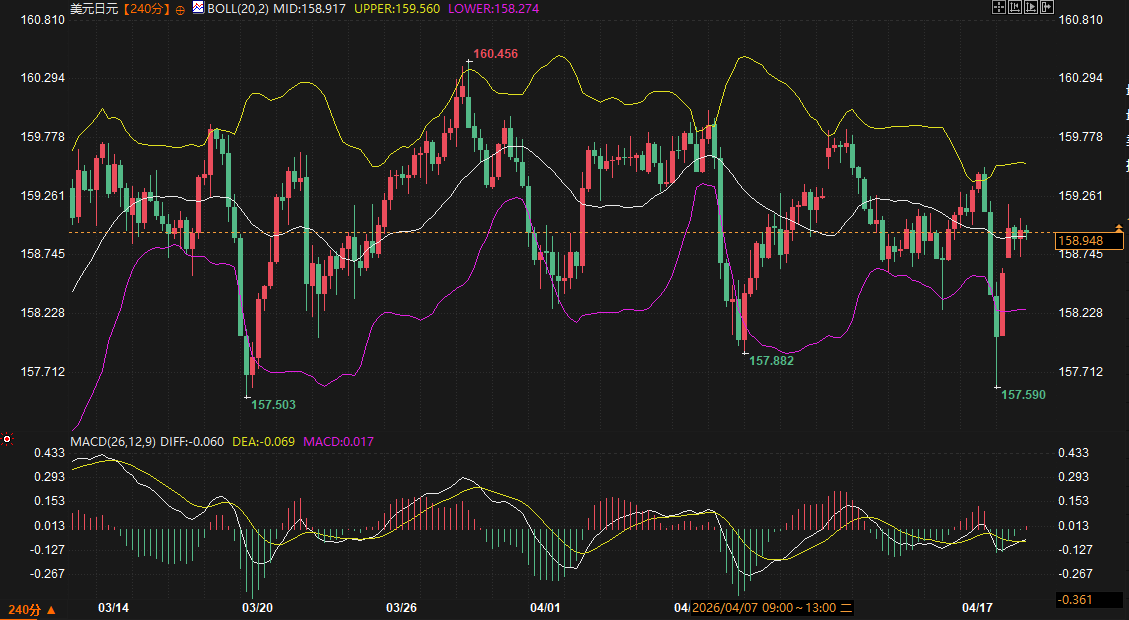
Based on the 4-hour technical chart, USD/JPY is currently in a pullback and correction phase after consolidating at high levels.
1. Price Position and Bollinger Bands: The latest price of 158.948 is located near the middle Bollinger Band (158.917). The upper and lower Bollinger Bands are currently compressed between 158.274 and 159.560, indicating that the exchange rate will enter a period of consolidation and fluctuation in the short term.
2. Momentum Indicators: The MACD indicator shows that although the DIFF line (-0.060) is slightly higher than the DEA line (-0.069) and some red momentum bars have appeared, the fact that both lines are below the zero axis indicates that the strength of the bullish counterattack is still insufficient, and the overall structure is still a weak recovery.
3. Support and resistance range prediction:
Resistance range: 159.56 - 160.45. The first resistance level is the upper Bollinger Band at 159.56. If this level is broken, the target will be the high of 160.45 reached at the end of March.
Support range: 157.50 - 158.27. The lower Bollinger Band at 158.27 provides the first line of defense, while the key support lies near the mid-April low of 157.59.
Key points to watch during trading: The 159.00 level needs to be closely monitored for stabilization. If gold or crude oil prices fluctuate sharply due to external factors, the yen may trigger a stronger safe-haven inflow, potentially testing the 157.50 support level.
Looking ahead, the USD/JPY exchange rate will likely enter a phase driven by "expectation gaps." On one hand, if the Bank of Japan not only maintains its interest rate unchanged at its April meeting but also fails to provide sufficient hints of a June rate hike, the yen may face renewed selling pressure due to its interest rate disadvantage. On the other hand, disturbances from tariff rhetoric and evolutions in the external geopolitical situation could disrupt the current equilibrium at any time.
Before Japan enters its "Golden Week" holiday next week, market liquidity may gradually shrink, which often amplifies intraday price fluctuations. Technically, if the exchange rate can continue to stabilize above the middle band at 158.90, there is a chance it will retest the 160.00 level; conversely, if it breaks below the 158.20 support, it means the downward trend since April will extend further, seeking buying support around 157.50. Overall, the yen will likely remain in a low-level consolidation phase in the short term, awaiting further clarification of fundamental catalysts.
1. Why might the Bank of Japan choose to keep interest rates unchanged in April despite inflationary pressures?
The prevailing market view is that the current unstable external situation has resulted in extremely low transparency regarding the economic outlook. Given Japan's heavy reliance on energy imports, sharp fluctuations in oil prices could both drive up inflation and dampen real consumption. The Bank of Japan tends to use a "hawkish pause" to obtain more data to assess the true impact of energy shocks on economic growth and avoid excessively tightening monetary policy in a time of uncertainty.
2. What direct impact does the flattening of the Japanese bond yield curve have on exchange rates?
A flattening yield curve typically reflects cautious market expectations for long-term economic growth or a surge in demand for long-term bonds. Today, the yields on 20-year and 40-year Japanese government bonds declined significantly, indicating strong institutional support for Japanese bonds ahead of the "Golden Week" holiday. This strengthening bond market will likely attract funds back to the yen in the short term, creating resistance when the USD/JPY exchange rate touches the 160 level.
3. How to understand the technical significance of the current USD/JPY range of 157.50-157.60?
From a candlestick chart perspective, the exchange rate rebounded rapidly after dipping to 157.590 in mid-April, forming a long lower shadow. In technical analysis, this is a clear "demand zone," indicating significant demand from Japanese importers for foreign exchange settlement or long position liquidation near this level. As long as this range is not broken by a large bearish candlestick, the overall pullback in USD/JPY remains within a manageable range of fluctuation.
4. What risks does the "Golden Week" holiday pose for yen traders?
During Japan's "Golden Week" holiday, the Tokyo foreign exchange market is closed, leading to a significant drop in liquidity. In this low-liquidity environment, even small trading volumes can cause sharp fluctuations in exchange rates, potentially resulting in "flash crashes" or "sudden surges." Furthermore, if geopolitical tensions change drastically during this period, the yen, lacking domestic buying support, may experience irrational and wide-ranging volatility.
5. If the Bank of Japan confirms an interest rate hike in June, will the yen immediately begin a strong upward trend?
This depends on the extent to which the interest rate differential between Japan and the US narrows at that time. Even if the Bank of Japan raises interest rates to around 1.0%, the yen will still be a low-yielding currency compared to dollar assets. The yen's performance after the rate hike will depend more on market expectations regarding the frequency of subsequent rate hikes. If the Bank of Japan only makes a "symbolic" adjustment and the external environment remains volatile, the yen's appreciation potential may be suppressed by carry trade positions.
From an overall market perspective, a cautious wait-and-see attitude prevailed. Although the yen has faced some depreciation pressure recently, its status as a traditional safe-haven currency has been partially reflected due to unresolved geopolitical conflicts . Meanwhile, Japan is at the start of a new fiscal year, and the reallocation of some institutional funds has provided marginal liquidity support for the yen. Trading volume was relatively moderate that day, with investors generally awaiting clearer policy signals or developments in the situation to determine whether the exchange rate will break out of its current trading range.
In-depth analysis of macroeconomic fundamentals and technical aspects
From a fundamental perspective, the Bank of Japan's (BOJ) policy moves and fluctuations in Japanese government bond yields are the core variables determining the yen's exchange rate trajectory. According to mainstream market opinion, the BOJ is highly likely to remain on hold at its upcoming policy meeting on April 27-28. This expectation is primarily based on the current high degree of uncertainty in the external environment, particularly the potential impact of the Middle East situation on energy prices.
Fundamental logic chain analysis:
The current macroeconomic backdrop presents a complex picture of a "hawkish pause." While the Bank of Japan may postpone its April rate hike, the underlying logic is not a shift towards a dovish stance, but rather a desire to establish a window for observation. With the transmission of oil price fluctuations, domestic inflationary pressures in Japan remain robust, leading to widespread market expectations that the central bank will release a clearer signal regarding rate hikes at its June meeting. Notably, the Japanese government bond yield curve showed a significant flattening today. The 5-year yield fell 1.5 basis points to 1.82%, while the 10-year yield decreased by 2 basis points to 2.40%. This sharp decline in yields on ultra-long-term bonds (20-year and 40-year) reflects that some investors are inclined to lock in current yields and allocate bonds in advance ahead of the upcoming "Golden Week" holiday. This buying in the bond market has provided some support for the yen in the short term, limiting further appreciation of the USD/JPY exchange rate.
Technical analysis and range projection:
Based on the 4-hour technical chart, USD/JPY is currently in a pullback and correction phase after consolidating at high levels.
1. Price Position and Bollinger Bands: The latest price of 158.948 is located near the middle Bollinger Band (158.917). The upper and lower Bollinger Bands are currently compressed between 158.274 and 159.560, indicating that the exchange rate will enter a period of consolidation and fluctuation in the short term.
2. Momentum Indicators: The MACD indicator shows that although the DIFF line (-0.060) is slightly higher than the DEA line (-0.069) and some red momentum bars have appeared, the fact that both lines are below the zero axis indicates that the strength of the bullish counterattack is still insufficient, and the overall structure is still a weak recovery.
3. Support and resistance range prediction:
Resistance range: 159.56 - 160.45. The first resistance level is the upper Bollinger Band at 159.56. If this level is broken, the target will be the high of 160.45 reached at the end of March.
Support range: 157.50 - 158.27. The lower Bollinger Band at 158.27 provides the first line of defense, while the key support lies near the mid-April low of 157.59.
Key points to watch during trading: The 159.00 level needs to be closely monitored for stabilization. If gold or crude oil prices fluctuate sharply due to external factors, the yen may trigger a stronger safe-haven inflow, potentially testing the 157.50 support level.
Future Trend Outlook
Looking ahead, the USD/JPY exchange rate will likely enter a phase driven by "expectation gaps." On one hand, if the Bank of Japan not only maintains its interest rate unchanged at its April meeting but also fails to provide sufficient hints of a June rate hike, the yen may face renewed selling pressure due to its interest rate disadvantage. On the other hand, disturbances from tariff rhetoric and evolutions in the external geopolitical situation could disrupt the current equilibrium at any time.
Before Japan enters its "Golden Week" holiday next week, market liquidity may gradually shrink, which often amplifies intraday price fluctuations. Technically, if the exchange rate can continue to stabilize above the middle band at 158.90, there is a chance it will retest the 160.00 level; conversely, if it breaks below the 158.20 support, it means the downward trend since April will extend further, seeking buying support around 157.50. Overall, the yen will likely remain in a low-level consolidation phase in the short term, awaiting further clarification of fundamental catalysts.
Frequently Asked Questions
1. Why might the Bank of Japan choose to keep interest rates unchanged in April despite inflationary pressures?
The prevailing market view is that the current unstable external situation has resulted in extremely low transparency regarding the economic outlook. Given Japan's heavy reliance on energy imports, sharp fluctuations in oil prices could both drive up inflation and dampen real consumption. The Bank of Japan tends to use a "hawkish pause" to obtain more data to assess the true impact of energy shocks on economic growth and avoid excessively tightening monetary policy in a time of uncertainty.
2. What direct impact does the flattening of the Japanese bond yield curve have on exchange rates?
A flattening yield curve typically reflects cautious market expectations for long-term economic growth or a surge in demand for long-term bonds. Today, the yields on 20-year and 40-year Japanese government bonds declined significantly, indicating strong institutional support for Japanese bonds ahead of the "Golden Week" holiday. This strengthening bond market will likely attract funds back to the yen in the short term, creating resistance when the USD/JPY exchange rate touches the 160 level.
3. How to understand the technical significance of the current USD/JPY range of 157.50-157.60?
From a candlestick chart perspective, the exchange rate rebounded rapidly after dipping to 157.590 in mid-April, forming a long lower shadow. In technical analysis, this is a clear "demand zone," indicating significant demand from Japanese importers for foreign exchange settlement or long position liquidation near this level. As long as this range is not broken by a large bearish candlestick, the overall pullback in USD/JPY remains within a manageable range of fluctuation.
4. What risks does the "Golden Week" holiday pose for yen traders?
During Japan's "Golden Week" holiday, the Tokyo foreign exchange market is closed, leading to a significant drop in liquidity. In this low-liquidity environment, even small trading volumes can cause sharp fluctuations in exchange rates, potentially resulting in "flash crashes" or "sudden surges." Furthermore, if geopolitical tensions change drastically during this period, the yen, lacking domestic buying support, may experience irrational and wide-ranging volatility.
5. If the Bank of Japan confirms an interest rate hike in June, will the yen immediately begin a strong upward trend?
This depends on the extent to which the interest rate differential between Japan and the US narrows at that time. Even if the Bank of Japan raises interest rates to around 1.0%, the yen will still be a low-yielding currency compared to dollar assets. The yen's performance after the rate hike will depend more on market expectations regarding the frequency of subsequent rate hikes. If the Bank of Japan only makes a "symbolic" adjustment and the external environment remains volatile, the yen's appreciation potential may be suppressed by carry trade positions.
- Risk Warning and Disclaimer
- The market involves risk, and trading may not be suitable for all investors. This article is for reference only and does not constitute personal investment advice, nor does it take into account certain users’ specific investment objectives, financial situation, or other needs. Any investment decisions made based on this information are at your own risk.