Iran announces participation in second peace talks; gold experiences V-shaped rebound.
2026-04-20 20:43:10
On Wednesday (April 20), during the Asian and European trading sessions, international spot gold experienced a dramatic reversal. After opening lower in the morning, it quickly fell, plunging more than 2% at one point, hitting a low of around $4,737 per ounce, as market risk aversion sentiment was concentrated.
However, the bearish momentum failed to hold, and gold prices subsequently staged a strong rebound, gradually recovering lost ground. As of now, it is trading around $4,820 per ounce, just one step away from turning positive, demonstrating extremely strong market resilience.
The immediate trigger for this sharp fluctuation was the sudden geopolitical shock over the weekend—Iran abruptly announced on Saturday that it would re-close the Strait of Hormuz. This news triggered panic in global markets, causing gold and equity assets to open lower on Monday, setting the tone for market turmoil at the beginning of the week.
Hassett stated: The president's tweets are the core signal.
White House National Economic Council Director Hassett clearly stated that President Trump's social media posts clearly reflect the latest developments on the situation in Iran, while also confirming Trump's previous explicit statement that peace talks with Iran would be held.
This statement directly drew market attention to Trump's social media posts, becoming a key entry point for understanding the future of US-Iran relations.
Trump Makes a Major Announcement on Social Media: Multiple Stances Released in Quick Succession<br/>Trump posted a series of tweets on social media, detailing the US position and assessment of the situation. Key points included:
Condemning Iran for violating the ceasefire agreement: "Iran decided to fire in the Strait of Hormuz yesterday—a complete violation of our ceasefire agreement! Many of the targets were French ships and British cargo ships, which is not good, is it?"
Clarifying the blockade controversy: "We have not blockaded Iranian ships! Iran recently announced the closure of the Strait, which is strange because our blockade has already been lifted."
He emphasized that the US suffered no losses and actually benefited: "They are helping us without us even realizing it, while they are losing $50 billion a day because of the closed channels! The US has lost nothing."
In fact, many ships are en route to the United States, Texas, Louisiana, and Alaska for loading, all thanks to the Revolutionary Guard, who always want to play the 'tough guy'!
The announcement of the negotiation arrangements and a strong threat: "My representatives will travel to Islamabad, Pakistan—they will be negotiating there tomorrow night."
We have proposed a very fair and reasonable agreement, and I hope they will accept it, because if they do not, the United States will destroy all of Iran's power plants and bridges.
Iran and Pakistan's responses
According to the Associated Press, two Pakistani officials revealed on Monday that Iran has expressed its willingness to send a delegation to Islamabad this week for the second round of negotiations.
For security reasons, Pakistan has not disclosed specific details of the travel plans between the two sides, leaving the actual progress of the negotiations uncertain.
The latest gold futures positioning data released by the U.S. Commodity Futures Trading Commission (CFTC) on April 14, 2026 (compared to April 7) has completely reversed the previous market concerns about a "top-out retreat" and presented a pattern of fierce confrontation between speculative funds, industrial capital, and financial institutions.
ManagedMoney (a market bellwether and other speculative players) has made a 180-degree turn in its trading attitude.
During the week of April 7, these funds significantly increased their short positions, with short positions surging by 12.5%, attempting to short at the peak and putting downward pressure on gold prices.
By the week of April 14, speculative forces had completely conceded defeat and exited the market, turning bullish again. Long positions rose by 3.9% week-on-week, while short positions fell by 1.3% simultaneously. This means that smart money has stopped shorting and accelerated its long positions, and gold prices are likely to continue their upward trend in the short term.
Total open interest (TOTALOI) surged from 354,877 lots to 362,274 lots, indicating a large influx of funds into the market and becoming a key piece of evidence for the rise in gold prices.
This round of gold price increases was not driven by short-selling stop-loss orders, but by new capital inflows, further solidifying the sustainability of the short-term rise.
Despite the strong bullish momentum, the bears' defenses are equally solid. Swap dealers and gold producers have joined forces to build strong resistance: swap dealers' short positions reached 210,841 contracts, an increase of 3.0% month-on-month, while long positions were only 28,289 contracts. The massive short positions correspond to large-scale defensive hedging by physical gold holders and financial intermediaries. Unless there is a major geopolitical crisis or extreme inflation, speculative funds will find it difficult to break through this selling pressure.
Although long positions held by gold producers rose by 12.3%, short positions of 31,681 lots were still 2.4 times that of long positions. Mining companies are increasing their hedging efforts to lock in production profits at current price levels, and industrial capital has a clear long-term bearish stance.
Changes in retail investor positions signal the end of the market rally. On April 7, retail investors were still reducing their positions and observing the market, but by April 14, they had all turned to increasing their positions, with long positions increasing by 5.0% and short positions increasing by as much as 11.5%. This collective shift from observation to active buying by retail investors is a typical characteristic of a market entering its "tail end" phase, and the momentum for further buying is likely to gradually weaken.
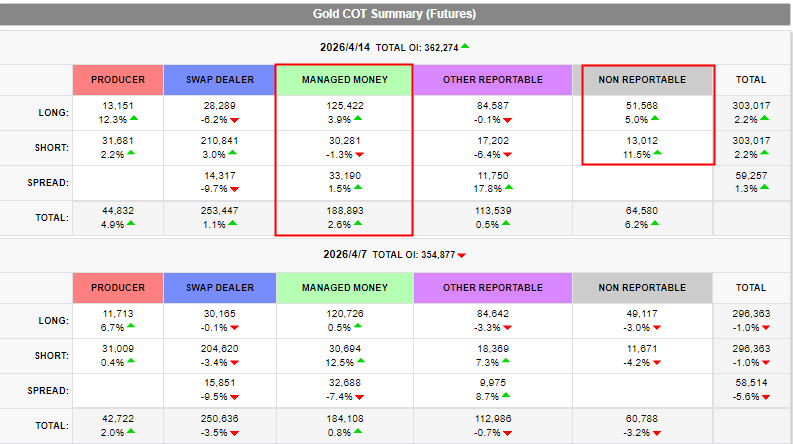
(Gold CFTC positioning, source: CME Group)
Combining geopolitical dynamics with the CFTC positioning structure, gold prices are expected to fluctuate slightly upwards in the short term. Speculative players are re-entering the market, and the increase in total open interest is providing support for the bulls. Coupled with the uncertainty of the US-Iran situation, gold prices still have room for further upward momentum.
Medium-term risks have risen sharply. The huge short positions of swap traders are like time bombs. Coupled with the pattern of miners continuously hedging and leaving the market, and retail investors following the trend of going long, the probability of a sharp reversal after a high-level bull trap has increased significantly.
In terms of strategy, it is recommended to follow the core idea of "being bullish in the short term, but not suitable for long-term holding".
The upside potential for gold prices is currently significantly limited by short positions held by financial institutions. Going forward, it's crucial to closely monitor signals of substantial reductions in long positions by Managed Money, as this could be a key exit point for the current bullish trend. Meanwhile, developments in the Strait of Hormuz and progress in US-Iran negotiations will continue to dominate short-term gold price fluctuations. Investors should closely monitor these developments to guard against further market volatility.
From a technical perspective, spot gold has broken below the middle channel line. We need to observe whether it can regain its footing above the middle channel line; otherwise, it may turn around and test the support level of 4705.
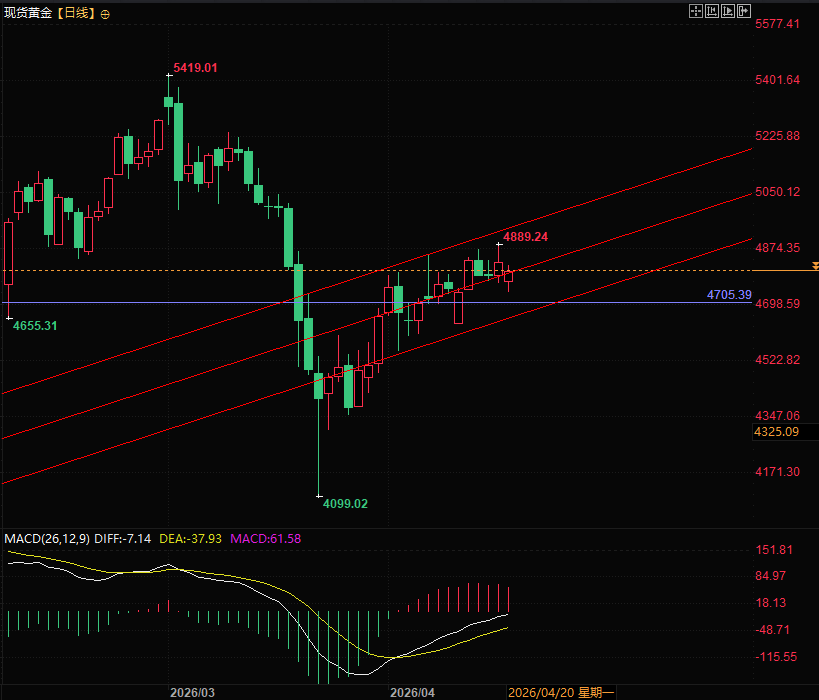
(Spot gold daily chart, source: EasyForex subsidiary)
At 20:41 Beijing time, spot gold is currently trading at $4,804 per ounce.
However, the bearish momentum failed to hold, and gold prices subsequently staged a strong rebound, gradually recovering lost ground. As of now, it is trading around $4,820 per ounce, just one step away from turning positive, demonstrating extremely strong market resilience.
The immediate trigger for this sharp fluctuation was the sudden geopolitical shock over the weekend—Iran abruptly announced on Saturday that it would re-close the Strait of Hormuz. This news triggered panic in global markets, causing gold and equity assets to open lower on Monday, setting the tone for market turmoil at the beginning of the week.
The protracted tug-of-war between the US and Iran: a game of tweets and a fog of negotiation.
Hassett stated: The president's tweets are the core signal.
White House National Economic Council Director Hassett clearly stated that President Trump's social media posts clearly reflect the latest developments on the situation in Iran, while also confirming Trump's previous explicit statement that peace talks with Iran would be held.
This statement directly drew market attention to Trump's social media posts, becoming a key entry point for understanding the future of US-Iran relations.
Trump Makes a Major Announcement on Social Media: Multiple Stances Released in Quick Succession<br/>Trump posted a series of tweets on social media, detailing the US position and assessment of the situation. Key points included:
Condemning Iran for violating the ceasefire agreement: "Iran decided to fire in the Strait of Hormuz yesterday—a complete violation of our ceasefire agreement! Many of the targets were French ships and British cargo ships, which is not good, is it?"
Clarifying the blockade controversy: "We have not blockaded Iranian ships! Iran recently announced the closure of the Strait, which is strange because our blockade has already been lifted."
He emphasized that the US suffered no losses and actually benefited: "They are helping us without us even realizing it, while they are losing $50 billion a day because of the closed channels! The US has lost nothing."
In fact, many ships are en route to the United States, Texas, Louisiana, and Alaska for loading, all thanks to the Revolutionary Guard, who always want to play the 'tough guy'!
The announcement of the negotiation arrangements and a strong threat: "My representatives will travel to Islamabad, Pakistan—they will be negotiating there tomorrow night."
We have proposed a very fair and reasonable agreement, and I hope they will accept it, because if they do not, the United States will destroy all of Iran's power plants and bridges.
Iran and Pakistan's responses
According to the Associated Press, two Pakistani officials revealed on Monday that Iran has expressed its willingness to send a delegation to Islamabad this week for the second round of negotiations.
For security reasons, Pakistan has not disclosed specific details of the travel plans between the two sides, leaving the actual progress of the negotiations uncertain.
In-depth analysis of CFTC positioning: The battle between bulls and bears intensifies.
The latest gold futures positioning data released by the U.S. Commodity Futures Trading Commission (CFTC) on April 14, 2026 (compared to April 7) has completely reversed the previous market concerns about a "top-out retreat" and presented a pattern of fierce confrontation between speculative funds, industrial capital, and financial institutions.
ManagedMoney (a market bellwether and other speculative players) has made a 180-degree turn in its trading attitude.
During the week of April 7, these funds significantly increased their short positions, with short positions surging by 12.5%, attempting to short at the peak and putting downward pressure on gold prices.
By the week of April 14, speculative forces had completely conceded defeat and exited the market, turning bullish again. Long positions rose by 3.9% week-on-week, while short positions fell by 1.3% simultaneously. This means that smart money has stopped shorting and accelerated its long positions, and gold prices are likely to continue their upward trend in the short term.
Total open interest (TOTALOI) surged from 354,877 lots to 362,274 lots, indicating a large influx of funds into the market and becoming a key piece of evidence for the rise in gold prices.
This round of gold price increases was not driven by short-selling stop-loss orders, but by new capital inflows, further solidifying the sustainability of the short-term rise.
Despite the strong bullish momentum, the bears' defenses are equally solid. Swap dealers and gold producers have joined forces to build strong resistance: swap dealers' short positions reached 210,841 contracts, an increase of 3.0% month-on-month, while long positions were only 28,289 contracts. The massive short positions correspond to large-scale defensive hedging by physical gold holders and financial intermediaries. Unless there is a major geopolitical crisis or extreme inflation, speculative funds will find it difficult to break through this selling pressure.
Although long positions held by gold producers rose by 12.3%, short positions of 31,681 lots were still 2.4 times that of long positions. Mining companies are increasing their hedging efforts to lock in production profits at current price levels, and industrial capital has a clear long-term bearish stance.
Changes in retail investor positions signal the end of the market rally. On April 7, retail investors were still reducing their positions and observing the market, but by April 14, they had all turned to increasing their positions, with long positions increasing by 5.0% and short positions increasing by as much as 11.5%. This collective shift from observation to active buying by retail investors is a typical characteristic of a market entering its "tail end" phase, and the momentum for further buying is likely to gradually weaken.
(Gold CFTC positioning, source: CME Group)
Summary and Technical Analysis:
Combining geopolitical dynamics with the CFTC positioning structure, gold prices are expected to fluctuate slightly upwards in the short term. Speculative players are re-entering the market, and the increase in total open interest is providing support for the bulls. Coupled with the uncertainty of the US-Iran situation, gold prices still have room for further upward momentum.
Medium-term risks have risen sharply. The huge short positions of swap traders are like time bombs. Coupled with the pattern of miners continuously hedging and leaving the market, and retail investors following the trend of going long, the probability of a sharp reversal after a high-level bull trap has increased significantly.
In terms of strategy, it is recommended to follow the core idea of "being bullish in the short term, but not suitable for long-term holding".
The upside potential for gold prices is currently significantly limited by short positions held by financial institutions. Going forward, it's crucial to closely monitor signals of substantial reductions in long positions by Managed Money, as this could be a key exit point for the current bullish trend. Meanwhile, developments in the Strait of Hormuz and progress in US-Iran negotiations will continue to dominate short-term gold price fluctuations. Investors should closely monitor these developments to guard against further market volatility.
From a technical perspective, spot gold has broken below the middle channel line. We need to observe whether it can regain its footing above the middle channel line; otherwise, it may turn around and test the support level of 4705.
(Spot gold daily chart, source: EasyForex subsidiary)
At 20:41 Beijing time, spot gold is currently trading at $4,804 per ounce.
- Risk Warning and Disclaimer
- The market involves risk, and trading may not be suitable for all investors. This article is for reference only and does not constitute personal investment advice, nor does it take into account certain users’ specific investment objectives, financial situation, or other needs. Any investment decisions made based on this information are at your own risk.