April 21st Financial Breakfast: The US-Iran ceasefire deadline is approaching; Vance's convoy departs from the White House; gold prices touch above $4830; US oil battles for the $85.50 mark.
2026-04-21 07:16:09
On Tuesday (April 21, Beijing time) in early Asian trading, spot gold rose slightly, trading around $4,826 per ounce, benefiting from a weaker dollar. Despite the approaching expiration of the two-week ceasefire agreement between the US and Iran, and the lack of clear progress on whether the second round of talks could be held before the ceasefire ends, the market remained generally optimistic. It was reported that US Vice President Vance's motorcade departed from the White House at 6:13 AM Beijing time on the 21st. Oil prices fell, with US crude oil dropping more than 1%, trading around $86.45 per barrel, after briefly touching the $85.50 per barrel mark at the open.

U.S. stocks closed slightly lower on Monday, with the Dow Jones Industrial Average down 0.01%, the S&P 500 down 0.24%, and the Nasdaq Composite down 0.26%, mainly due to renewed tensions between the U.S. and Iran: Iran closed the Strait of Hormuz again over the weekend after briefly opening it.
Despite reports that Iran is considering peace talks with Pakistan and the United States, US Vice President Vance denied that he would attend. The energy sector bucked the trend, rising 0.21%, while the communications services sector performed the worst, with Meta falling over 2% after a nine-day winning streak, and Netflix continuing its decline, falling approximately 2.55%.
In addition, QXO announced its acquisition of TopBuild for $17 billion, causing QXO's stock to fall 3.12% while TopBuild's stock surged 19.38%. This week, several tech giants, including Tesla, will release their earnings reports, and the market continues to focus on the impact of geopolitics on the real economy.
Gold prices hit a one-week low on Monday, with spot gold falling 0.4% to $4,810.26 per ounce, after hitting a new low since April 13 during the session. U.S. gold futures closed down 1% at $4,828.8, mainly due to renewed tensions between the U.S. and Iran: Iran threatened retaliation after the U.S. seized an Iranian cargo ship, causing the dollar index to rise to its highest level in nearly a week and the 10-year U.S. Treasury yield to rise.
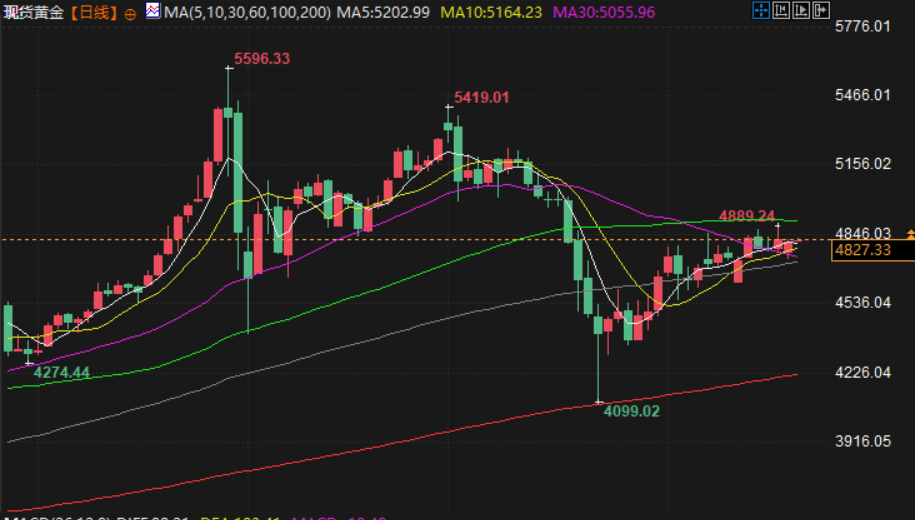
Analysts point out that the escalating situation in the Middle East has led to a rise in the US dollar and bond yields, increasing the opportunity cost of holding gold and putting downward pressure on gold prices; however, from a technical perspective, the next target for June gold futures bulls is to close above the strong resistance level of $5,000.
In other precious metals, spot silver fell 1.3% to $79.76, platinum fell 1.4%, and palladium fell 0.2%, briefly hitting a one-week low.
Oil prices surged on Monday, with Brent crude futures rising 4.9% to $67.32 a barrel and WTI crude futures climbing 5.1% to $63.84, marking the biggest one-day gain in nearly two weeks. Escalating tensions between the US and Iran directly pushed up risk premiums, with market concerns about shipping safety in the Strait of Hormuz, coupled with rising expectations of supply disruptions from some Middle Eastern oil-producing countries, significantly strengthening short-term bullish sentiment.
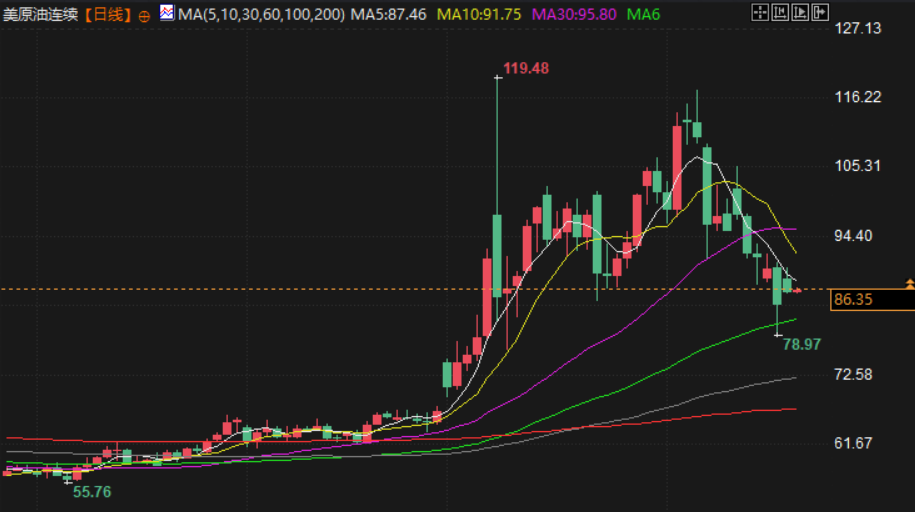
However, analysts caution that demand remains under pressure, with the global manufacturing PMI remaining below the expansion/contraction threshold for several consecutive months, limiting the upside potential for oil prices.
The dollar weakened against the euro on Monday, with the dollar index falling 0.39% to 98.07 and the euro rising 0.16% to $1.1781, as traders remained optimistic about a breakthrough in the Iranian peace process, despite renewed tensions between the U.S. and Iran over the weekend (the U.S. seized an Iranian cargo ship, and Iran threatened retaliation).
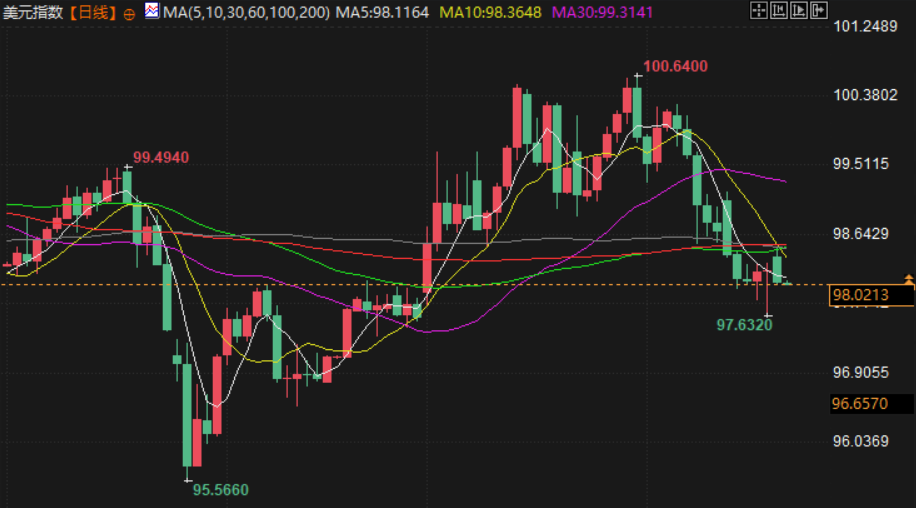
A senior Iranian official revealed that Iran is considering participating in peace talks with the United States in Pakistan. Scotiabank analysts stated that the market initially reacted with instinctive panic, but subsequent price action showed some easing and rekindled hopes for a resolution.
The yen fell 0.1% to 158.81 against the dollar, while the pound rose 0.16% to $1.3535. Markets are also focused on Tuesday's Senate confirmation hearing for Donald Warsh, Trump's nominee for Federal Reserve chairman, who has pledged to ensure strict independence in monetary policy decisions.
The probability of the Federal Reserve keeping interest rates unchanged in April is 100%, and the probability of at least one rate cut this year is 46.9%.
According to CME's "FedWatch": The probability of the Fed raising interest rates by 25 basis points in April is 0%, and the probability of keeping rates unchanged is 100%. The probability of the Fed cutting rates by a cumulative 25 basis points by June is 2.5%, and the probability of keeping rates unchanged is 97.5%. The probability of the Fed cutting rates by a cumulative 25 basis points by December is 46.9%, and the probability of keeping rates unchanged is 53.1%.
Iranian Parliament Speaker: Iran will not accept negotiations under the shadow of threats.
Early on the morning of the 21st local time, Iranian Parliament Speaker Mohammad Ghalibaf announced that US President Trump, through imposing blockades and violating the ceasefire agreement, was "attempting to turn this negotiating table into a surrender table," or perhaps seeking an excuse to reignite war. Ghalibaf emphasized that "Iran will not accept negotiations under the shadow of threats," and stated that in the past two weeks, Iran has prepared to "play new cards" on the battlefield. (CCTV)
Iran's Supreme Leader reiterates three core positions
On March 20, local time, Iran's Supreme Leader Mojtaba Khamenei reiterated his three core positions, including the demand for "war reparations," emphasizing the need to resolutely safeguard national interests. A message posted on Mojtaba's official social media account stated that Iran will hold those responsible for the attacks against it accountable and seek compensation for losses incurred in the conflict; push for a new phase in the management of the Strait of Hormuz; and at the same time, will never relinquish its legitimate rights and regard all "resistance fronts" in the region as a unified whole. On March 9, Mojtaba had previously issued a written statement on the 40th anniversary of the martyrdom of former Supreme Leader Ali Khamenei and the current conflict, first proposing the above three points. (Xinhua)
With the ceasefire deadline approaching, the US unilaterally "finalized" a negotiation date, but Iran has yet to agree to attend.
The United States and Iran began a two-week ceasefire on April 8th (Beijing time), which is scheduled to end on April 22nd. As of now, there has been no clear progress on whether the second round of talks between the US and Iran can be held smoothly before the ceasefire expires. US sources say that talks are "going ahead as planned," but Iran says it has not yet decided whether to participate in the negotiations, leaving the final stage of the talks fraught with uncertainty.
U.S. Customs and Border Protection initiates Phase One of Tariff Refunds
U.S. Customs and Border Protection announced on the 20th that it had initiated the first phase of refunds for tariffs collected under the International Emergency Economic Powers Act. Importers or their authorized customs brokers can submit tariff refund applications through a new feature module in the customs declaration system.
Experts: Iran establishes the "Laraq Corridor" in an attempt to compete with the US.
On the 19th local time, according to Iranian sources, the Iranian Islamic Revolutionary Guard Corps Navy has designated a new shipping route from south of Hormuz Island to south of Larak Island. This route, reportedly named the "Larak Corridor," is prohibited from passage without the Revolutionary Guard Navy's permission. What impact will Iran's establishment of the "Larak Corridor" have on the situation? Special commentator Su Xiaohui stated that Iran's designation of a new shipping route, named the "Larak Corridor," reflects Iran's intention to strengthen control over navigation in the Strait of Hormuz and engage in a power struggle with the United States. (CCTV News)
British media: At least 26 ships involved in Iranian shipping have broken through US blockade.
According to a report by the British shipping media outlet Lloyd's Ship Daily on the 20th, at least 26 ships involved in shipping to Iran have broken through the US military blockade. The report stated that since the US military imposed a blockade on ships entering and leaving Iranian ports on the 13th, among those breaking through the blockade were 11 oil tankers carrying Iranian goods. Since the US military expanded the blockade of shipping goods to Iran last week, more than 10 ships have successfully crossed the blockade area. In addition, a bulk carrier owned by a Greek shipowner departed an Iranian port on the 15th and passed through the blockade line on the 19th. (Xinhua)
French National Security Documents Service user data breach
According to a statement released on the French Ministry of the Interior website on the 20th, the French National Security Documents Agency, responsible for processing vehicle registrations, driver's licenses, ID cards, and passports, detected a security incident on the 15th involving a data breach of its portal website. The French Ministry of the Interior stated that the leaked data involving users' personal accounts included personally identifiable information such as names, email addresses, and dates of birth; in some cases, it may have also included mailing addresses, places of birth, and phone numbers. However, this data breach did not include supplementary documents submitted by users during the application process, nor did it lead to unauthorized access to the portal website accounts. (Xinhua)
Trump stated that he would not lift the sanctions against Iran until a "deal" is reached.
On April 20, local time, US President Trump posted on social media that he would never lift the blockade (against Iran) until an "agreement" was reached. The US military imposed a blockade on ships entering and leaving Iranian ports starting April 13. The US Central Command stated on April 14 that it had "completely cut off Iran's maritime economic and trade activities." Iran announced on April 17 that it would open the Strait of Hormuz to merchant ships, and later on April 18 announced that, given the US had not lifted the maritime blockade, Iran would regain control of the Strait of Hormuz. According to a senior Iranian official on April 20, Pakistan is currently actively mediating efforts to persuade the US to lift the maritime blockade to ensure Iran's participation in negotiations. (CCTV News)
U.S. Department of Energy: Global strategic petroleum reserves will reach 2.5 billion barrels by the end of 2025.
The U.S. Energy Information Administration (EIA) said Monday that global strategic petroleum reserves totaled approximately 2.5 billion barrels at the end of last year. The EIA stated that as of December 2025, the three countries with the largest strategic petroleum reserves are China, the United States, and Japan. Other significant holders of strategic reserves include OECD member countries, as well as some countries in the Middle East and Asia. At the end of last year, the U.S. Strategic Petroleum Reserve held 413 million barrels, and as of April 10, it held approximately 409 million barrels. The total crude oil storage capacity of the U.S. Strategic Petroleum Reserve is 714 million barrels. In addition, the U.S. also holds over 400 million barrels of commercial crude oil. The EIA stated that Japan holds the world's third-largest strategic petroleum reserves, with its government holding approximately 263 million barrels as of December 2025. The country requires its industrial sector to hold reserves equivalent to 70 days of demand (approximately 220 million barrels), in addition to a government-regulated 90-day strategic reserve. The EIA stated that South Korea will also hold substantial strategic petroleum reserves during the same period in 2025, averaging 79 million barrels. The EIA estimates that as of December 2025, OECD-affiliated European governments will hold 179 million barrels of oil in onshore storage facilities. As of the end of last year, Saudi Arabia's onshore storage facilities held an average of 82 million barrels of oil, while the UAE's onshore oil inventories averaged 34 million barrels. The EIA states that, according to data from Vortexa and Kpler, Iran's onshore oil inventories will average 71 million barrels as of December 2025.
Vietnam plans to extend its tax incentives for electric vehicles until 2030.
The Vietnamese National Assembly Office announced over the weekend that, in order to boost electric vehicle sales and reduce carbon emissions, Vietnam plans to extend the special consumption tax exemption policy for electric vehicles for nearly four years, until the end of 2030. The announcement cited a Ministry of Finance report, stating that the government will submit this tax reduction extension proposal to the National Assembly for consideration. Vietnam lowered the special consumption tax on electric vehicles in March 2022, reducing the rate from 4%-11% to 1%-3%. The original exemption policy was set to expire in February 2027. Data shows that, thanks to the tax reduction policy, Vietnam's annual electric vehicle sales surged from nearly 7,000 units in 2022 to nearly 175,000 units last year.
my country's new display industry cluster has taken shape, with total output value exceeding 800 billion yuan.
The 15th Five-Year Plan outlines the cultivation and expansion of emerging and future industries. Currently, a number of cutting-edge fields in my country are entering a crucial stage of accelerated breakthroughs and cluster development. New display technologies, encompassing LCD, OLED, and holographic displays, are among my country's important emerging industries, widely used in smartphones, computers, televisions, and wearable devices. (CCTV News)
Key Focus Today
stock market
U.S. stocks closed slightly lower on Monday, with the Dow Jones Industrial Average down 0.01%, the S&P 500 down 0.24%, and the Nasdaq Composite down 0.26%, mainly due to renewed tensions between the U.S. and Iran: Iran closed the Strait of Hormuz again over the weekend after briefly opening it.
Despite reports that Iran is considering peace talks with Pakistan and the United States, US Vice President Vance denied that he would attend. The energy sector bucked the trend, rising 0.21%, while the communications services sector performed the worst, with Meta falling over 2% after a nine-day winning streak, and Netflix continuing its decline, falling approximately 2.55%.
In addition, QXO announced its acquisition of TopBuild for $17 billion, causing QXO's stock to fall 3.12% while TopBuild's stock surged 19.38%. This week, several tech giants, including Tesla, will release their earnings reports, and the market continues to focus on the impact of geopolitics on the real economy.
Gold Market
Gold prices hit a one-week low on Monday, with spot gold falling 0.4% to $4,810.26 per ounce, after hitting a new low since April 13 during the session. U.S. gold futures closed down 1% at $4,828.8, mainly due to renewed tensions between the U.S. and Iran: Iran threatened retaliation after the U.S. seized an Iranian cargo ship, causing the dollar index to rise to its highest level in nearly a week and the 10-year U.S. Treasury yield to rise.
Analysts point out that the escalating situation in the Middle East has led to a rise in the US dollar and bond yields, increasing the opportunity cost of holding gold and putting downward pressure on gold prices; however, from a technical perspective, the next target for June gold futures bulls is to close above the strong resistance level of $5,000.
In other precious metals, spot silver fell 1.3% to $79.76, platinum fell 1.4%, and palladium fell 0.2%, briefly hitting a one-week low.
oil market
Oil prices surged on Monday, with Brent crude futures rising 4.9% to $67.32 a barrel and WTI crude futures climbing 5.1% to $63.84, marking the biggest one-day gain in nearly two weeks. Escalating tensions between the US and Iran directly pushed up risk premiums, with market concerns about shipping safety in the Strait of Hormuz, coupled with rising expectations of supply disruptions from some Middle Eastern oil-producing countries, significantly strengthening short-term bullish sentiment.
However, analysts caution that demand remains under pressure, with the global manufacturing PMI remaining below the expansion/contraction threshold for several consecutive months, limiting the upside potential for oil prices.
Foreign exchange market
The dollar weakened against the euro on Monday, with the dollar index falling 0.39% to 98.07 and the euro rising 0.16% to $1.1781, as traders remained optimistic about a breakthrough in the Iranian peace process, despite renewed tensions between the U.S. and Iran over the weekend (the U.S. seized an Iranian cargo ship, and Iran threatened retaliation).
A senior Iranian official revealed that Iran is considering participating in peace talks with the United States in Pakistan. Scotiabank analysts stated that the market initially reacted with instinctive panic, but subsequent price action showed some easing and rekindled hopes for a resolution.
The yen fell 0.1% to 158.81 against the dollar, while the pound rose 0.16% to $1.3535. Markets are also focused on Tuesday's Senate confirmation hearing for Donald Warsh, Trump's nominee for Federal Reserve chairman, who has pledged to ensure strict independence in monetary policy decisions.
International News
The probability of the Federal Reserve keeping interest rates unchanged in April is 100%, and the probability of at least one rate cut this year is 46.9%.
According to CME's "FedWatch": The probability of the Fed raising interest rates by 25 basis points in April is 0%, and the probability of keeping rates unchanged is 100%. The probability of the Fed cutting rates by a cumulative 25 basis points by June is 2.5%, and the probability of keeping rates unchanged is 97.5%. The probability of the Fed cutting rates by a cumulative 25 basis points by December is 46.9%, and the probability of keeping rates unchanged is 53.1%.
Iranian Parliament Speaker: Iran will not accept negotiations under the shadow of threats.
Early on the morning of the 21st local time, Iranian Parliament Speaker Mohammad Ghalibaf announced that US President Trump, through imposing blockades and violating the ceasefire agreement, was "attempting to turn this negotiating table into a surrender table," or perhaps seeking an excuse to reignite war. Ghalibaf emphasized that "Iran will not accept negotiations under the shadow of threats," and stated that in the past two weeks, Iran has prepared to "play new cards" on the battlefield. (CCTV)
Iran's Supreme Leader reiterates three core positions
On March 20, local time, Iran's Supreme Leader Mojtaba Khamenei reiterated his three core positions, including the demand for "war reparations," emphasizing the need to resolutely safeguard national interests. A message posted on Mojtaba's official social media account stated that Iran will hold those responsible for the attacks against it accountable and seek compensation for losses incurred in the conflict; push for a new phase in the management of the Strait of Hormuz; and at the same time, will never relinquish its legitimate rights and regard all "resistance fronts" in the region as a unified whole. On March 9, Mojtaba had previously issued a written statement on the 40th anniversary of the martyrdom of former Supreme Leader Ali Khamenei and the current conflict, first proposing the above three points. (Xinhua)
With the ceasefire deadline approaching, the US unilaterally "finalized" a negotiation date, but Iran has yet to agree to attend.
The United States and Iran began a two-week ceasefire on April 8th (Beijing time), which is scheduled to end on April 22nd. As of now, there has been no clear progress on whether the second round of talks between the US and Iran can be held smoothly before the ceasefire expires. US sources say that talks are "going ahead as planned," but Iran says it has not yet decided whether to participate in the negotiations, leaving the final stage of the talks fraught with uncertainty.
U.S. Customs and Border Protection initiates Phase One of Tariff Refunds
U.S. Customs and Border Protection announced on the 20th that it had initiated the first phase of refunds for tariffs collected under the International Emergency Economic Powers Act. Importers or their authorized customs brokers can submit tariff refund applications through a new feature module in the customs declaration system.
Experts: Iran establishes the "Laraq Corridor" in an attempt to compete with the US.
On the 19th local time, according to Iranian sources, the Iranian Islamic Revolutionary Guard Corps Navy has designated a new shipping route from south of Hormuz Island to south of Larak Island. This route, reportedly named the "Larak Corridor," is prohibited from passage without the Revolutionary Guard Navy's permission. What impact will Iran's establishment of the "Larak Corridor" have on the situation? Special commentator Su Xiaohui stated that Iran's designation of a new shipping route, named the "Larak Corridor," reflects Iran's intention to strengthen control over navigation in the Strait of Hormuz and engage in a power struggle with the United States. (CCTV News)
British media: At least 26 ships involved in Iranian shipping have broken through US blockade.
According to a report by the British shipping media outlet Lloyd's Ship Daily on the 20th, at least 26 ships involved in shipping to Iran have broken through the US military blockade. The report stated that since the US military imposed a blockade on ships entering and leaving Iranian ports on the 13th, among those breaking through the blockade were 11 oil tankers carrying Iranian goods. Since the US military expanded the blockade of shipping goods to Iran last week, more than 10 ships have successfully crossed the blockade area. In addition, a bulk carrier owned by a Greek shipowner departed an Iranian port on the 15th and passed through the blockade line on the 19th. (Xinhua)
French National Security Documents Service user data breach
According to a statement released on the French Ministry of the Interior website on the 20th, the French National Security Documents Agency, responsible for processing vehicle registrations, driver's licenses, ID cards, and passports, detected a security incident on the 15th involving a data breach of its portal website. The French Ministry of the Interior stated that the leaked data involving users' personal accounts included personally identifiable information such as names, email addresses, and dates of birth; in some cases, it may have also included mailing addresses, places of birth, and phone numbers. However, this data breach did not include supplementary documents submitted by users during the application process, nor did it lead to unauthorized access to the portal website accounts. (Xinhua)
Trump stated that he would not lift the sanctions against Iran until a "deal" is reached.
On April 20, local time, US President Trump posted on social media that he would never lift the blockade (against Iran) until an "agreement" was reached. The US military imposed a blockade on ships entering and leaving Iranian ports starting April 13. The US Central Command stated on April 14 that it had "completely cut off Iran's maritime economic and trade activities." Iran announced on April 17 that it would open the Strait of Hormuz to merchant ships, and later on April 18 announced that, given the US had not lifted the maritime blockade, Iran would regain control of the Strait of Hormuz. According to a senior Iranian official on April 20, Pakistan is currently actively mediating efforts to persuade the US to lift the maritime blockade to ensure Iran's participation in negotiations. (CCTV News)
U.S. Department of Energy: Global strategic petroleum reserves will reach 2.5 billion barrels by the end of 2025.
The U.S. Energy Information Administration (EIA) said Monday that global strategic petroleum reserves totaled approximately 2.5 billion barrels at the end of last year. The EIA stated that as of December 2025, the three countries with the largest strategic petroleum reserves are China, the United States, and Japan. Other significant holders of strategic reserves include OECD member countries, as well as some countries in the Middle East and Asia. At the end of last year, the U.S. Strategic Petroleum Reserve held 413 million barrels, and as of April 10, it held approximately 409 million barrels. The total crude oil storage capacity of the U.S. Strategic Petroleum Reserve is 714 million barrels. In addition, the U.S. also holds over 400 million barrels of commercial crude oil. The EIA stated that Japan holds the world's third-largest strategic petroleum reserves, with its government holding approximately 263 million barrels as of December 2025. The country requires its industrial sector to hold reserves equivalent to 70 days of demand (approximately 220 million barrels), in addition to a government-regulated 90-day strategic reserve. The EIA stated that South Korea will also hold substantial strategic petroleum reserves during the same period in 2025, averaging 79 million barrels. The EIA estimates that as of December 2025, OECD-affiliated European governments will hold 179 million barrels of oil in onshore storage facilities. As of the end of last year, Saudi Arabia's onshore storage facilities held an average of 82 million barrels of oil, while the UAE's onshore oil inventories averaged 34 million barrels. The EIA states that, according to data from Vortexa and Kpler, Iran's onshore oil inventories will average 71 million barrels as of December 2025.
Vietnam plans to extend its tax incentives for electric vehicles until 2030.
The Vietnamese National Assembly Office announced over the weekend that, in order to boost electric vehicle sales and reduce carbon emissions, Vietnam plans to extend the special consumption tax exemption policy for electric vehicles for nearly four years, until the end of 2030. The announcement cited a Ministry of Finance report, stating that the government will submit this tax reduction extension proposal to the National Assembly for consideration. Vietnam lowered the special consumption tax on electric vehicles in March 2022, reducing the rate from 4%-11% to 1%-3%. The original exemption policy was set to expire in February 2027. Data shows that, thanks to the tax reduction policy, Vietnam's annual electric vehicle sales surged from nearly 7,000 units in 2022 to nearly 175,000 units last year.
Domestic News
my country's new display industry cluster has taken shape, with total output value exceeding 800 billion yuan.
The 15th Five-Year Plan outlines the cultivation and expansion of emerging and future industries. Currently, a number of cutting-edge fields in my country are entering a crucial stage of accelerated breakthroughs and cluster development. New display technologies, encompassing LCD, OLED, and holographic displays, are among my country's important emerging industries, widely used in smartphones, computers, televisions, and wearable devices. (CCTV News)
- Risk Warning and Disclaimer
- The market involves risk, and trading may not be suitable for all investors. This article is for reference only and does not constitute personal investment advice, nor does it take into account certain users’ specific investment objectives, financial situation, or other needs. Any investment decisions made based on this information are at your own risk.