Gold prices have fallen nearly 20% in two weeks; are investors panicking and fleeing? Institutions say the pullback is an opportunity.
2026-04-21 10:58:08
Recent conflicts in the Middle East have triggered significant volatility in global markets, leading to noticeable short-term fluctuations in gold prices. However, the medium- to long-term outlook for gold prices remains optimistic.
Rodolphe Bohn, a foreign exchange and commodities strategist at HSBC, pointed out that although gold prices have fluctuated in the short term due to geopolitical risks, the continued rise in geopolitical risks, the widening fiscal deficits of major economies, and the continued gold purchases by central banks will jointly support gold prices at higher levels.
Since the beginning of 2026, the gold market has experienced significant fluctuations. At the end of January, gold prices climbed to a high of $5,415 per ounce, before falling back to around $4,400 per ounce by March 26 due to the escalating conflict in the Middle East, particularly with Iran, a drop of nearly 20%. This sharp volatility reflects the market's rapid reaction to risk events.
Born stated that during this risk-averse phase, Brent crude oil prices surged, the US dollar strengthened significantly as the market's most popular safe-haven asset, bond yields rose, and the stock market declined. He further explained that gold did not play its typical "geopolitical hedging" role during this period because investors sold their gold holdings to raise liquidity, while the US dollar absorbed most of the demand for safe-haven funds.
However, he added that the recent ceasefire agreement has shown that gold prices can rebound quickly as market conditions gradually stabilize, which provides a positive signal for future trends.
The correlation between gold and oil prices is not fixed but adjusts according to the nature of the shock. Born points out that before the conflict, the prices of the two commodities showed a clear positive correlation, but as the situation developed, oil and gold prices briefly moved in opposite directions, and this relationship quickly became neutral.
He analyzed that a significant rise in the US dollar typically puts pressure on both gold and crude oil. However, due to the supply shock in the Middle East, Brent crude oil prices rose even with a stronger dollar, while gold was dragged down by the dollar's strength. In the current market environment, a strong rise in oil prices does not necessarily lead to a similarly strong reaction in gold prices. This dynamic relationship requires continued attention from investors.
Monetary policy remains a key factor influencing the future trend of gold. Born stated that while HSBC does not expect a significant interest rate cut to provide an immediate boost, persistent inflationary pressures and potential threats to economic growth will provide important support for gold.
He specifically mentioned that high real yields typically pose a headwind for gold because gold itself does not generate returns. Since the outbreak of the conflict, the impact of long-term bond yields has been more pronounced, with these yields moving in tandem with a stronger dollar, weaker stock markets, and rising oil prices. While the Federal Reserve's policy rate is expected to remain largely unchanged in 2026 and 2027, potentially limiting gold's upside potential to some extent, the existence of stagflation risks will continue to support market demand for gold.
Aside from short-term factors, ongoing fiscal dynamics and central bank demand are considered the core drivers of gold's long-term strength . He pointed out that rising fiscal deficits and debt levels in the United States and other countries are prompting investors to increase their allocation to hard assets, especially during periods of concern about financial stability and policy flexibility.
The International Monetary Fund estimates that the US debt-to-GDP ratio will approach 100% by 2025, while increased global defense spending further exacerbates the debt burden. These trends are unlikely to reverse in the short to medium term, and therefore will provide strong support for gold prices for a considerable period.
Regarding central bank behavior, Born stated that the peak in central bank gold purchases between 2022 and 2024 has cooled somewhat, with some central banks selling gold to maintain foreign exchange reserves due to rising energy import costs and increased defense spending. Nevertheless, with the reimplementation of long-term asset diversification policies, central bank gold demand is expected to gradually recover later this year.
High gold prices are also profoundly changing the physical supply and demand structure of gold. Born points out that jewelry consumer demand has been most significantly impacted, while demand for gold coins remains weak. In contrast, institutional investor demand for large-sized gold bars has been relatively robust, thanks to adjustments in relevant regulatory policies in markets such as India and other major Asian countries.
On the supply side, mine production is projected to see a slight increase from 2026 to 2027, while high gold prices will stimulate more scrap gold to enter the recycling market, leading to an increase in recycling volume. These changes mean that there will be more physical gold to absorb and process in the future.
Born cautioned that if investment demand remains low for an extended period, this additional supply could restrain further increases in gold prices. However, recent demand from retail investors has begun to show a more significant impact, injecting new vitality into the market.
The short-term direction of gold prices largely depends on developments in the broader de-escalation of the situation in the Middle East. Born concluded that if the ceasefire continues and eventually evolves into a complete cessation of hostilities in the region, the formal reopening of the Strait of Hormuz, and Brent crude oil prices stabilize at lower levels, then market financial pressures will ease, inflation concerns are expected to subside, and bond yields may decline. These factors will collectively create a more favorable environment for gold.
Based on the above analysis , HSBC maintains a bullish outlook on gold in the medium to long term. Although short-term fluctuations may still be affected by geopolitical events, the dollar's performance, and oil price volatility, in the longer term, multiple structural supporting factors are collectively driving gold to trade in a higher price range.
For investors who focus on commodities and asset allocation, gold remains a key area to track and allocate to.
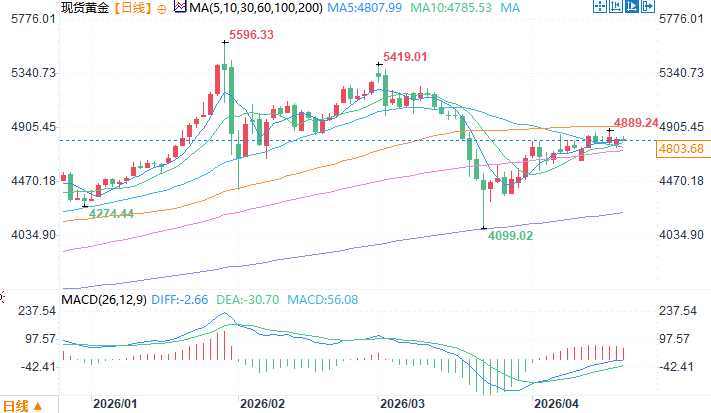
Spot gold daily chart source: EasyForex
At 10:49 AM Beijing time on April 21, spot gold was trading at $4803.68 per ounce.
Rodolphe Bohn, a foreign exchange and commodities strategist at HSBC, pointed out that although gold prices have fluctuated in the short term due to geopolitical risks, the continued rise in geopolitical risks, the widening fiscal deficits of major economies, and the continued gold purchases by central banks will jointly support gold prices at higher levels.
The gold market experienced significant volatility in early 2026.
Since the beginning of 2026, the gold market has experienced significant fluctuations. At the end of January, gold prices climbed to a high of $5,415 per ounce, before falling back to around $4,400 per ounce by March 26 due to the escalating conflict in the Middle East, particularly with Iran, a drop of nearly 20%. This sharp volatility reflects the market's rapid reaction to risk events.
Born stated that during this risk-averse phase, Brent crude oil prices surged, the US dollar strengthened significantly as the market's most popular safe-haven asset, bond yields rose, and the stock market declined. He further explained that gold did not play its typical "geopolitical hedging" role during this period because investors sold their gold holdings to raise liquidity, while the US dollar absorbed most of the demand for safe-haven funds.
However, he added that the recent ceasefire agreement has shown that gold prices can rebound quickly as market conditions gradually stabilize, which provides a positive signal for future trends.
Dynamic changes in the relationship between gold and oil prices
The correlation between gold and oil prices is not fixed but adjusts according to the nature of the shock. Born points out that before the conflict, the prices of the two commodities showed a clear positive correlation, but as the situation developed, oil and gold prices briefly moved in opposite directions, and this relationship quickly became neutral.
He analyzed that a significant rise in the US dollar typically puts pressure on both gold and crude oil. However, due to the supply shock in the Middle East, Brent crude oil prices rose even with a stronger dollar, while gold was dragged down by the dollar's strength. In the current market environment, a strong rise in oil prices does not necessarily lead to a similarly strong reaction in gold prices. This dynamic relationship requires continued attention from investors.
The impact of monetary policy and real yield on gold
Monetary policy remains a key factor influencing the future trend of gold. Born stated that while HSBC does not expect a significant interest rate cut to provide an immediate boost, persistent inflationary pressures and potential threats to economic growth will provide important support for gold.
He specifically mentioned that high real yields typically pose a headwind for gold because gold itself does not generate returns. Since the outbreak of the conflict, the impact of long-term bond yields has been more pronounced, with these yields moving in tandem with a stronger dollar, weaker stock markets, and rising oil prices. While the Federal Reserve's policy rate is expected to remain largely unchanged in 2026 and 2027, potentially limiting gold's upside potential to some extent, the existence of stagflation risks will continue to support market demand for gold.
Fiscal deficits and central bank gold purchases provide long-term support.
Aside from short-term factors, ongoing fiscal dynamics and central bank demand are considered the core drivers of gold's long-term strength . He pointed out that rising fiscal deficits and debt levels in the United States and other countries are prompting investors to increase their allocation to hard assets, especially during periods of concern about financial stability and policy flexibility.
The International Monetary Fund estimates that the US debt-to-GDP ratio will approach 100% by 2025, while increased global defense spending further exacerbates the debt burden. These trends are unlikely to reverse in the short to medium term, and therefore will provide strong support for gold prices for a considerable period.
Regarding central bank behavior, Born stated that the peak in central bank gold purchases between 2022 and 2024 has cooled somewhat, with some central banks selling gold to maintain foreign exchange reserves due to rising energy import costs and increased defense spending. Nevertheless, with the reimplementation of long-term asset diversification policies, central bank gold demand is expected to gradually recover later this year.
The supply and demand pattern of physical goods is being reshaped.
High gold prices are also profoundly changing the physical supply and demand structure of gold. Born points out that jewelry consumer demand has been most significantly impacted, while demand for gold coins remains weak. In contrast, institutional investor demand for large-sized gold bars has been relatively robust, thanks to adjustments in relevant regulatory policies in markets such as India and other major Asian countries.
On the supply side, mine production is projected to see a slight increase from 2026 to 2027, while high gold prices will stimulate more scrap gold to enter the recycling market, leading to an increase in recycling volume. These changes mean that there will be more physical gold to absorb and process in the future.
Born cautioned that if investment demand remains low for an extended period, this additional supply could restrain further increases in gold prices. However, recent demand from retail investors has begun to show a more significant impact, injecting new vitality into the market.
Short-term trends depend on the degree of easing tensions in the Middle East.
The short-term direction of gold prices largely depends on developments in the broader de-escalation of the situation in the Middle East. Born concluded that if the ceasefire continues and eventually evolves into a complete cessation of hostilities in the region, the formal reopening of the Strait of Hormuz, and Brent crude oil prices stabilize at lower levels, then market financial pressures will ease, inflation concerns are expected to subside, and bond yields may decline. These factors will collectively create a more favorable environment for gold.
Based on the above analysis , HSBC maintains a bullish outlook on gold in the medium to long term. Although short-term fluctuations may still be affected by geopolitical events, the dollar's performance, and oil price volatility, in the longer term, multiple structural supporting factors are collectively driving gold to trade in a higher price range.
For investors who focus on commodities and asset allocation, gold remains a key area to track and allocate to.
Spot gold daily chart source: EasyForex
At 10:49 AM Beijing time on April 21, spot gold was trading at $4803.68 per ounce.
- Risk Warning and Disclaimer
- The market involves risk, and trading may not be suitable for all investors. This article is for reference only and does not constitute personal investment advice, nor does it take into account certain users’ specific investment objectives, financial situation, or other needs. Any investment decisions made based on this information are at your own risk.