Oil price rebound supports Canadian dollar, USD/CAD continues to adjust.
2026-04-22 11:08:55
The USD/CAD pair continued its decline during Wednesday's Asian trading session, trading around 1.3655. Overall, the Canadian dollar strengthened relatively, supported by oil prices, while the US dollar, though supported by data, lacked momentum, resulting in a volatile downward trend.

From a fundamental perspective, the situation in the Middle East remains one of the core drivers of the current market. The US's announcement of extending the ceasefire and maintaining blockade measures in the relevant waters perpetuates concerns about energy transport disruptions. The Strait of Hormuz handles approximately 20% of global oil shipping , and any potential risks could significantly impact the supply side, thereby pushing up international oil prices.
This factor is particularly crucial for the Canadian dollar. As one of the world's major energy exporters, the Canadian economy is highly correlated with crude oil prices. Rising oil prices typically provide a direct boost to the Canadian dollar , as this improves its terms of trade and increases foreign exchange earnings. In the current environment, volatility in the energy market provides significant support for the Canadian dollar, making it relatively stable among major currencies.
Meanwhile, market uncertainty surrounding US-Iran relations is also influencing exchange rate movements. Although the ceasefire agreement has been extended, negotiations are progressing slowly, and differences remain between the two sides. This uncertainty is pushing up oil prices, which is beneficial to the Canadian dollar; on the other hand, it is also increasing safe-haven demand, providing some support for the US dollar and limiting overall exchange rate volatility.
From a macroeconomic perspective, the US economy remains robust. Market surveys show that US retail sales rose 1.7% month-on-month in March, significantly exceeding market expectations of 1.4%, and increased by 4.0% year-on-year. This data indicates that consumer demand remains solid, reinforcing market confidence in the economy's resilience. Strong data typically supports the US dollar and, to some extent, offsets the Canadian dollar's advantage, thus limiting the downside potential of the USD/CAD exchange rate.
From a market sentiment perspective, investors are currently weighing the Canadian dollar's strength against the support of oil prices and the support of US dollar data. Overall, the Canadian dollar has benefited from its relatively strong commodity performance, but the US dollar has not shown significant weakness, keeping the exchange rate fluctuating within a range.
From a technical perspective, the daily chart shows that the USD/CAD pair has entered a consolidation phase after falling from its highs, with an overall structure exhibiting a slightly bearish bias. The 1.3700 area constitutes a significant short-term resistance level , with multiple failed attempts to break through indicating substantial upward pressure. Support lies around 1.3600; a break below this level could lead to a further decline towards the 1.3550 area. Regarding the moving average system, short-term moving averages are turning downwards, while medium-term moving averages are flattening, indicating a shift from a strong to a weak trend.
From a 4-hour chart perspective, the exchange rate exhibits a descending channel structure, with gradually lower highs, indicating that bears are in control. Technically, the RSI is hovering around 45, showing market weakness but not yet in oversold territory; the MACD is below the zero line and has not shown a clear reversal signal, suggesting continued downward pressure in the short term. If any subsequent rebound fails to break above 1.3680, the bearish structure may continue; conversely, if it holds above this level, it may test the 1.3720 area.
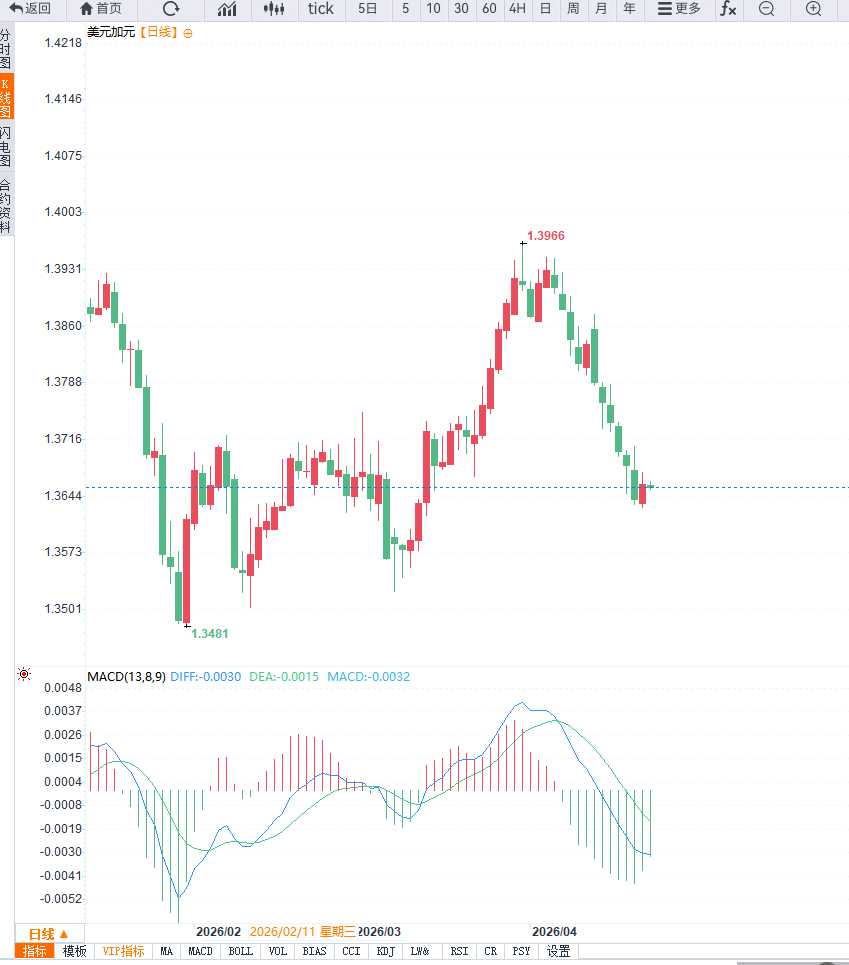
Overall, the USD/CAD exchange rate is currently in a phase of flux, driven by both oil prices and economic data. The Canadian dollar is supported by energy prices, while the US dollar is supported by economic data, causing the exchange rate to remain weak and volatile.
Editor's Summary : The current USD/CAD exchange rate exhibits a typical fundamental divergence: rising oil prices continue to support the Canadian dollar, while robust US economic data limits the downside potential of the US dollar. In the short term, the exchange rate may maintain a range-bound, slightly weak pattern. Future movements will depend on whether oil prices continue to rise and the performance of US macroeconomic data. If the energy market remains tight, the Canadian dollar may strengthen further; conversely, if the US dollar's momentum strengthens, the exchange rate may stabilize and rebound.
From a fundamental perspective, the situation in the Middle East remains one of the core drivers of the current market. The US's announcement of extending the ceasefire and maintaining blockade measures in the relevant waters perpetuates concerns about energy transport disruptions. The Strait of Hormuz handles approximately 20% of global oil shipping , and any potential risks could significantly impact the supply side, thereby pushing up international oil prices.
This factor is particularly crucial for the Canadian dollar. As one of the world's major energy exporters, the Canadian economy is highly correlated with crude oil prices. Rising oil prices typically provide a direct boost to the Canadian dollar , as this improves its terms of trade and increases foreign exchange earnings. In the current environment, volatility in the energy market provides significant support for the Canadian dollar, making it relatively stable among major currencies.
Meanwhile, market uncertainty surrounding US-Iran relations is also influencing exchange rate movements. Although the ceasefire agreement has been extended, negotiations are progressing slowly, and differences remain between the two sides. This uncertainty is pushing up oil prices, which is beneficial to the Canadian dollar; on the other hand, it is also increasing safe-haven demand, providing some support for the US dollar and limiting overall exchange rate volatility.
From a macroeconomic perspective, the US economy remains robust. Market surveys show that US retail sales rose 1.7% month-on-month in March, significantly exceeding market expectations of 1.4%, and increased by 4.0% year-on-year. This data indicates that consumer demand remains solid, reinforcing market confidence in the economy's resilience. Strong data typically supports the US dollar and, to some extent, offsets the Canadian dollar's advantage, thus limiting the downside potential of the USD/CAD exchange rate.
From a market sentiment perspective, investors are currently weighing the Canadian dollar's strength against the support of oil prices and the support of US dollar data. Overall, the Canadian dollar has benefited from its relatively strong commodity performance, but the US dollar has not shown significant weakness, keeping the exchange rate fluctuating within a range.
From a technical perspective, the daily chart shows that the USD/CAD pair has entered a consolidation phase after falling from its highs, with an overall structure exhibiting a slightly bearish bias. The 1.3700 area constitutes a significant short-term resistance level , with multiple failed attempts to break through indicating substantial upward pressure. Support lies around 1.3600; a break below this level could lead to a further decline towards the 1.3550 area. Regarding the moving average system, short-term moving averages are turning downwards, while medium-term moving averages are flattening, indicating a shift from a strong to a weak trend.
From a 4-hour chart perspective, the exchange rate exhibits a descending channel structure, with gradually lower highs, indicating that bears are in control. Technically, the RSI is hovering around 45, showing market weakness but not yet in oversold territory; the MACD is below the zero line and has not shown a clear reversal signal, suggesting continued downward pressure in the short term. If any subsequent rebound fails to break above 1.3680, the bearish structure may continue; conversely, if it holds above this level, it may test the 1.3720 area.
Overall, the USD/CAD exchange rate is currently in a phase of flux, driven by both oil prices and economic data. The Canadian dollar is supported by energy prices, while the US dollar is supported by economic data, causing the exchange rate to remain weak and volatile.
Editor's Summary : The current USD/CAD exchange rate exhibits a typical fundamental divergence: rising oil prices continue to support the Canadian dollar, while robust US economic data limits the downside potential of the US dollar. In the short term, the exchange rate may maintain a range-bound, slightly weak pattern. Future movements will depend on whether oil prices continue to rise and the performance of US macroeconomic data. If the energy market remains tight, the Canadian dollar may strengthen further; conversely, if the US dollar's momentum strengthens, the exchange rate may stabilize and rebound.
- Risk Warning and Disclaimer
- The market involves risk, and trading may not be suitable for all investors. This article is for reference only and does not constitute personal investment advice, nor does it take into account certain users’ specific investment objectives, financial situation, or other needs. Any investment decisions made based on this information are at your own risk.