The USD/JPY pair is consolidating at high levels, awaiting directional guidance.
2026-04-22 10:29:49
The USD/JPY pair traded in a narrow range during Wednesday's Asian session, hovering around 159.30, slightly below the one-week high reached in the previous session. Overall, the pair has been fluctuating within a range over the past month, with a lack of clear market direction, making aggressive one-sided bets unwise in the short term.

From a fundamental perspective, the core factors contributing to the continued pressure on the yen remain the combined effects of the external environment and internal policies. Firstly, the uncertainty surrounding the situation in the Middle East indirectly impacts the Japanese economy. Given Japan's heavy reliance on energy imports, with the Strait of Hormuz handling approximately 20% of global oil shipping , any disruption to this passage would significantly increase Japan's import costs and exacerbate inflationary pressures. This expectation weakens the yen's stability, keeping it weak in the current environment.
Meanwhile, expectations regarding the Bank of Japan's policy have become a significant variable influencing the yen. The market widely anticipates that the Bank of Japan will maintain its interest rate at its upcoming policy meeting, an expectation that limits the yen's potential for rebound in the short term. However, market surveys indicate that the Bank of Japan is internally assessing the possibility of future interest rate hikes and may even signal a tightening stance by mid-year. This divergence in expectations has resulted in a "weak but stable" yen performance.
On the other hand, the performance of the US dollar is relatively complex. On one hand, signs of a temporary easing in the Middle East situation have weakened safe-haven demand; on the other hand, a slight decline in oil prices has eased inflationary pressures, cooling market expectations for further interest rate hikes by the Federal Reserve. These factors combined have somewhat limited the upward momentum of the US dollar. While the dollar's strength remains, its short-term momentum has weakened , thus limiting further upside potential for the USD/JPY pair.
It is worth noting that the potential risk of foreign exchange intervention by Japanese authorities also constrained the market. As the exchange rate approached the key psychological level of 160, the market generally remained cautious, concerned that the authorities might take action to stabilize the exchange rate, which to some extent limited the willingness of bulls to push the exchange rate higher.
From a technical perspective, the daily chart shows that USD/JPY is maintaining a high-level range-bound structure, with the overall trend still bullish, but the upward momentum has clearly slowed. The 160.00 level constitutes a key psychological resistance level , and multiple unsuccessful tests indicate heavy selling pressure above. Conversely, the 158.00 area forms strong support, and a break below this level could trigger a deeper correction. The moving average system remains generally bullish, but short-term moving averages are beginning to flatten, reflecting a consolidation phase. In terms of momentum indicators, the RSI is oscillating around 60, not entering extreme areas, indicating a lack of directional drive in the market; the MACD is converging at high levels, suggesting weakening bullish momentum.
From a 4-hour chart perspective, the exchange rate is trading within a sideways consolidation range, with narrowing highs and lows, exhibiting a typical oscillating structure. Short-term resistance is concentrated around 159.80, while support lies at 158.80. Technical indicators show the RSI fluctuating around 50, indicating a relatively balanced market sentiment; the MACD is repeatedly crossing near the zero line, suggesting a lack of clear trend. A break above and hold above 159.80 could test the 160 level; conversely, a break below 158.80 could lead to a pullback to 158 or even lower.
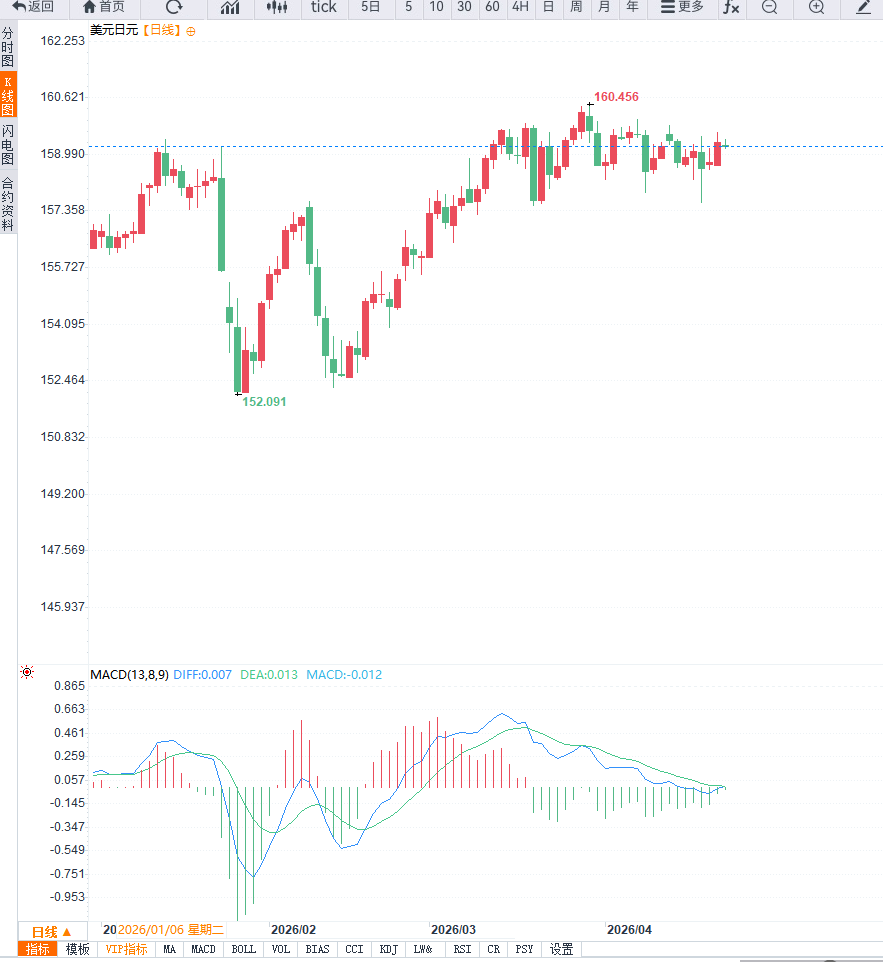
Overall, the USD/JPY pair is currently in a phase of "fundamental divergence + technical consolidation." The market is repeatedly weighing geopolitical risks, monetary policy expectations, and intervention risks, keeping the exchange rate in a high-level consolidation pattern.
Editor's Summary : The USD/JPY pair is currently exhibiting typical high-level consolidation characteristics. The yen is suppressed by energy risks and expectations of policy easing, while the dollar lacks sustained upward momentum due to changes in interest rate expectations. In the short term, the exchange rate is likely to maintain a range-bound trading pattern, with key levels to watch being the psychological level of 160 and the support area of 158. Future direction will depend on policy signals from the Bank of Japan and changes in the Federal Reserve's interest rate path, while the potential for intervention and its unforeseen impact on the market should be closely monitored.
From a fundamental perspective, the core factors contributing to the continued pressure on the yen remain the combined effects of the external environment and internal policies. Firstly, the uncertainty surrounding the situation in the Middle East indirectly impacts the Japanese economy. Given Japan's heavy reliance on energy imports, with the Strait of Hormuz handling approximately 20% of global oil shipping , any disruption to this passage would significantly increase Japan's import costs and exacerbate inflationary pressures. This expectation weakens the yen's stability, keeping it weak in the current environment.
Meanwhile, expectations regarding the Bank of Japan's policy have become a significant variable influencing the yen. The market widely anticipates that the Bank of Japan will maintain its interest rate at its upcoming policy meeting, an expectation that limits the yen's potential for rebound in the short term. However, market surveys indicate that the Bank of Japan is internally assessing the possibility of future interest rate hikes and may even signal a tightening stance by mid-year. This divergence in expectations has resulted in a "weak but stable" yen performance.
On the other hand, the performance of the US dollar is relatively complex. On one hand, signs of a temporary easing in the Middle East situation have weakened safe-haven demand; on the other hand, a slight decline in oil prices has eased inflationary pressures, cooling market expectations for further interest rate hikes by the Federal Reserve. These factors combined have somewhat limited the upward momentum of the US dollar. While the dollar's strength remains, its short-term momentum has weakened , thus limiting further upside potential for the USD/JPY pair.
It is worth noting that the potential risk of foreign exchange intervention by Japanese authorities also constrained the market. As the exchange rate approached the key psychological level of 160, the market generally remained cautious, concerned that the authorities might take action to stabilize the exchange rate, which to some extent limited the willingness of bulls to push the exchange rate higher.
From a technical perspective, the daily chart shows that USD/JPY is maintaining a high-level range-bound structure, with the overall trend still bullish, but the upward momentum has clearly slowed. The 160.00 level constitutes a key psychological resistance level , and multiple unsuccessful tests indicate heavy selling pressure above. Conversely, the 158.00 area forms strong support, and a break below this level could trigger a deeper correction. The moving average system remains generally bullish, but short-term moving averages are beginning to flatten, reflecting a consolidation phase. In terms of momentum indicators, the RSI is oscillating around 60, not entering extreme areas, indicating a lack of directional drive in the market; the MACD is converging at high levels, suggesting weakening bullish momentum.
From a 4-hour chart perspective, the exchange rate is trading within a sideways consolidation range, with narrowing highs and lows, exhibiting a typical oscillating structure. Short-term resistance is concentrated around 159.80, while support lies at 158.80. Technical indicators show the RSI fluctuating around 50, indicating a relatively balanced market sentiment; the MACD is repeatedly crossing near the zero line, suggesting a lack of clear trend. A break above and hold above 159.80 could test the 160 level; conversely, a break below 158.80 could lead to a pullback to 158 or even lower.
Overall, the USD/JPY pair is currently in a phase of "fundamental divergence + technical consolidation." The market is repeatedly weighing geopolitical risks, monetary policy expectations, and intervention risks, keeping the exchange rate in a high-level consolidation pattern.
Editor's Summary : The USD/JPY pair is currently exhibiting typical high-level consolidation characteristics. The yen is suppressed by energy risks and expectations of policy easing, while the dollar lacks sustained upward momentum due to changes in interest rate expectations. In the short term, the exchange rate is likely to maintain a range-bound trading pattern, with key levels to watch being the psychological level of 160 and the support area of 158. Future direction will depend on policy signals from the Bank of Japan and changes in the Federal Reserve's interest rate path, while the potential for intervention and its unforeseen impact on the market should be closely monitored.
- Risk Warning and Disclaimer
- The market involves risk, and trading may not be suitable for all investors. This article is for reference only and does not constitute personal investment advice, nor does it take into account certain users’ specific investment objectives, financial situation, or other needs. Any investment decisions made based on this information are at your own risk.