Tensions escalate! The US military forcefully intercepts multiple Iranian oil tankers in Asian waters, nearly paralyzing shipping in the Strait of Hormuz.
2026-04-23 09:54:58
Tensions have reignited in the Strait of Hormuz, with the maritime rivalry between the US and Iran escalating dramatically. The US military has forcefully intercepted Iranian oil tankers in Asian waters, prompting Iran to retaliate by seizing its own vessels. With the global energy lifeline nearly paralyzed, is an even greater storm brewing?
Multiple sources in the shipping and security sectors revealed on Wednesday (April 22) that the U.S. military had successfully intercepted at least three Iranian-flagged oil tankers in Asian waters and was driving them away from waters near India, Malaysia, and Sri Lanka. This action marks a further escalation of the U.S. policy of maritime trade blockade against Iran and adds new tensions to an already strained Middle East situation.
Meanwhile, Iran also took strong countermeasures in the Strait of Hormuz. Just this Wednesday, the Iranian Revolutionary Guard opened fire on two container ships attempting to pass through the strait and ultimately seized them. This marks Iran's first maritime seizure operation nearly two months after the US-Israel war against Iran. Currently, although the two sides are under a fragile ceasefire, there are almost no signs of a resumption of peace talks, and the situation remains highly tense.
The Strait of Hormuz, the only sea route connecting the Persian Gulf and the Indian Ocean, is a crucial choke point for global oil and gas transport. However, this energy artery is now nearly at a standstill as Iran fires on and blocks ships attempting to pass through the strait. Iran's justification is retaliation for a blockade of its maritime trade by the United States and its allies, but the actual consequences are extremely serious—approximately one-fifth of the world's oil and gas supply is directly disrupted, and an energy crisis affecting countries worldwide is rapidly spreading.
In this standoff, the maritime rivalry between the US and Iran is escalating. Recently, the US military seized an Iranian cargo ship and an oil tanker. Iran, in response, took action on Wednesday, firing on two container ships and another vessel, successfully seizing two container ships attempting to leave the Persian Gulf. This is Iran's first seizure operation since the outbreak of the war, undoubtedly sending a strong signal of confrontation to the outside world.
According to two shipping sources from the United States and India, as well as two Western maritime security sources, the U.S. military has recently ordered at least three more Iranian-flagged oil tankers to change their original routes. These ships, which may have originally attempted to break through the blockade to transport Iranian crude oil to Asian customers, have now been forcibly intervened by the U.S. military.
Using ship tracking data from the MarineTraffic platform, sources further disclosed details about the intercepted vessels. One of them was the Iranian-flagged supertanker "Deepsea," partially carrying crude oil. About a week ago, its publicly available transponder last showed a location near the coast of Malaysia. Since then, the ship has lost public signal, suggesting it may have been seized or driven away by the US military.
The other intercepted vessel, named "Severn," also flew the Iranian flag but was smaller. Its maximum fuel capacity was approximately one million barrels, and at the time of interception, it was carrying about 65% of its total capacity. Vessel tracking data showed that the ship was last seen off the coast of Malaysia a month prior, and its movements had not been publicly disclosed since.
The third oil tanker confirmed to have been intercepted is the Iranian-flagged supertanker, the "Dorena." The ship, carrying approximately two million barrels of crude oil, was last publicly identified three days ago as being off the southern coast of India. U.S. Central Command issued a statement on Wednesday on the social media platform X, stating that the "Dorena," after attempting to break through the blockade, is currently being "escorted" by a U.S. Navy destroyer in the Indian Ocean—effectively meaning the ship is now under complete U.S. military control.
In addition, shipping sources revealed that the US military may have intercepted another Iranian oil tanker named "Derya." The ship had previously attempted to unload its cargo of Iranian crude oil in India, but failed before the US waiver for Iranian oil purchases expired on Sunday. MarineTraffic data shows that the ship was last located near India's west coast last Friday, after which its signal disappeared, and its fate remains unclear.
The U.S. Central Command further disclosed the overall scale of the blockade operation in a statement on Wednesday. Since the U.S. imposed the blockade on ships entering and leaving Iranian ports, the U.S. military has ordered a total of 29 ships to turn back or return to port. This number far exceeds the previously reported range, demonstrating the considerable breadth and intensity of the U.S. maritime blockade operation.
However, the U.S. military has not yet released a complete list of all the ships it intercepted, nor has it immediately responded to questions regarding the specifics of the USS Delya and the USS Deepsea. This lack of transparency has further exacerbated concerns about an escalation of the situation.
A third maritime security source provided a more in-depth tactical analysis. This source pointed out that the U.S. military is currently attempting to target Iranian vessels in international waters outside the Strait of Hormuz. This strategy is based on clear risk considerations—interception operations within the narrow Strait of Hormuz are highly vulnerable to Iranian-laid floating mines and other asymmetric threats. In contrast, interceptions in the open Indian Ocean and Asian waters not only reduce the risks to U.S. warships themselves but also more effectively cut off Iran's oil export routes via sea lanes.
Oil prices rose more than $3, supported by a decline in U.S. gasoline and distillate inventories, reports of gunfire on at least three container ships in the Strait of Hormuz, and news of stalled progress in U.S.-Iran peace talks. Brent crude futures closed up $3.43, or 3.48%, at $101.91 a barrel. U.S. crude futures closed up $3.29, or 3.67%, at $92.96 a barrel. In early Asian trading on Thursday (April 23), Brent crude had risen as much as 4% to 4.22% to $106.05 a barrel.
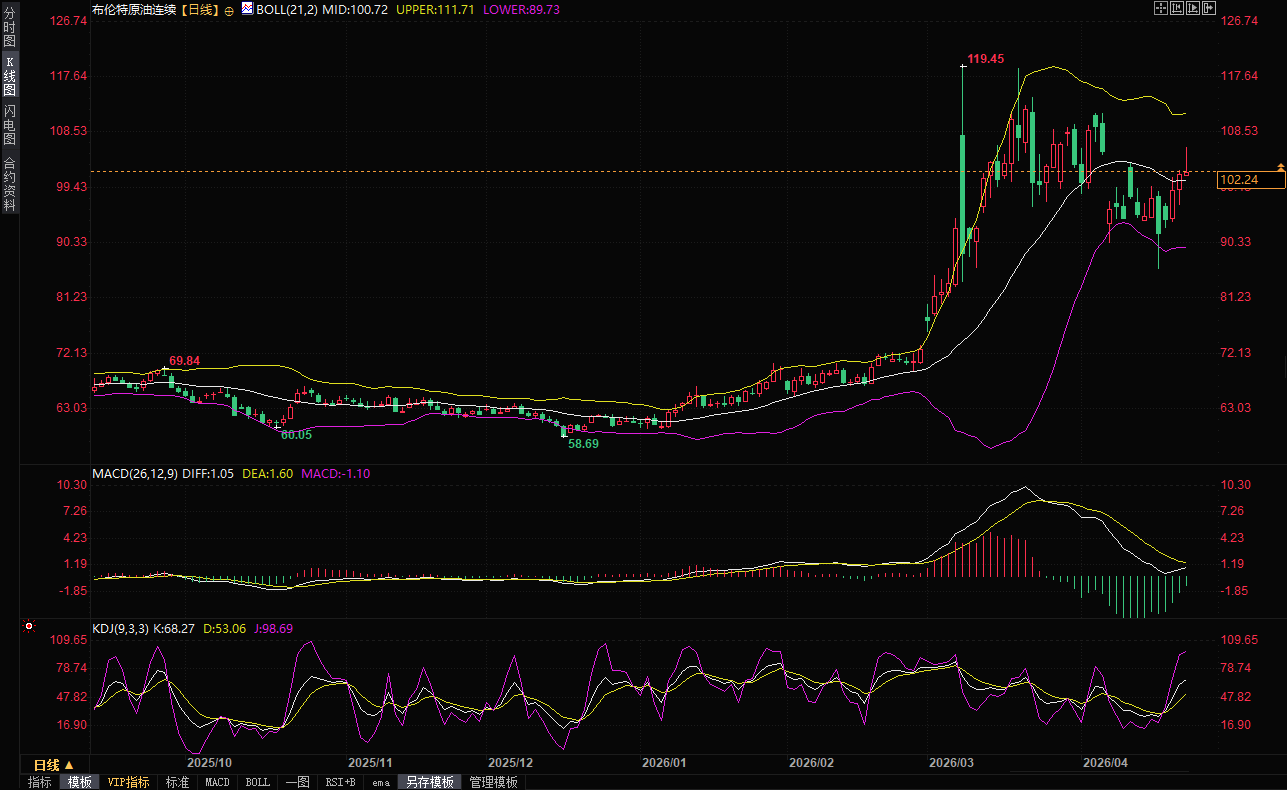
(Brent crude oil daily chart, source: EasyForex)
In conclusion, the US military's interception of Iranian oil tankers in Asian waters, and Iran's retaliatory seizure in the Strait of Hormuz, together constitute the grim picture of the current maritime standoff in the Middle East. The US is attempting to exert pressure by completely blocking Iran's maritime trade, while Iran is responding by blocking the Strait of Hormuz and seizing passing ships. One-fifth of the world's oil and gas supply has been substantially affected, and the energy crisis is spreading worldwide.
More worryingly, nearly two months after the outbreak of war, the two sides remain in a stalemate without a formal ceasefire agreement or any willingness to negotiate. With the escalating US interception operations on the high seas, Iran is highly likely to take more aggressive retaliatory measures. When shipping will resume in the Strait of Hormuz and when the global energy market will stabilize remains uncertain. The international community urgently needs to intervene; otherwise, a larger-scale conflict may be unavoidable.
At 09:52 Beijing time, Brent crude oil was trading at $102.22 per barrel.
I. Overview of the Incident: US Military Launches Interception Operation in Asian Waters
Multiple sources in the shipping and security sectors revealed on Wednesday (April 22) that the U.S. military had successfully intercepted at least three Iranian-flagged oil tankers in Asian waters and was driving them away from waters near India, Malaysia, and Sri Lanka. This action marks a further escalation of the U.S. policy of maritime trade blockade against Iran and adds new tensions to an already strained Middle East situation.
Meanwhile, Iran also took strong countermeasures in the Strait of Hormuz. Just this Wednesday, the Iranian Revolutionary Guard opened fire on two container ships attempting to pass through the strait and ultimately seized them. This marks Iran's first maritime seizure operation nearly two months after the US-Israel war against Iran. Currently, although the two sides are under a fragile ceasefire, there are almost no signs of a resumption of peace talks, and the situation remains highly tense.
II. Strait of Hormuz Blockade: Global Energy Lifeline Disrupted
The Strait of Hormuz, the only sea route connecting the Persian Gulf and the Indian Ocean, is a crucial choke point for global oil and gas transport. However, this energy artery is now nearly at a standstill as Iran fires on and blocks ships attempting to pass through the strait. Iran's justification is retaliation for a blockade of its maritime trade by the United States and its allies, but the actual consequences are extremely serious—approximately one-fifth of the world's oil and gas supply is directly disrupted, and an energy crisis affecting countries worldwide is rapidly spreading.
In this standoff, the maritime rivalry between the US and Iran is escalating. Recently, the US military seized an Iranian cargo ship and an oil tanker. Iran, in response, took action on Wednesday, firing on two container ships and another vessel, successfully seizing two container ships attempting to leave the Persian Gulf. This is Iran's first seizure operation since the outbreak of the war, undoubtedly sending a strong signal of confrontation to the outside world.
III. Details of the US military's interception operation: Several Iranian oil tankers were forced to change course
According to two shipping sources from the United States and India, as well as two Western maritime security sources, the U.S. military has recently ordered at least three more Iranian-flagged oil tankers to change their original routes. These ships, which may have originally attempted to break through the blockade to transport Iranian crude oil to Asian customers, have now been forcibly intervened by the U.S. military.
Using ship tracking data from the MarineTraffic platform, sources further disclosed details about the intercepted vessels. One of them was the Iranian-flagged supertanker "Deepsea," partially carrying crude oil. About a week ago, its publicly available transponder last showed a location near the coast of Malaysia. Since then, the ship has lost public signal, suggesting it may have been seized or driven away by the US military.
The other intercepted vessel, named "Severn," also flew the Iranian flag but was smaller. Its maximum fuel capacity was approximately one million barrels, and at the time of interception, it was carrying about 65% of its total capacity. Vessel tracking data showed that the ship was last seen off the coast of Malaysia a month prior, and its movements had not been publicly disclosed since.
The third oil tanker confirmed to have been intercepted is the Iranian-flagged supertanker, the "Dorena." The ship, carrying approximately two million barrels of crude oil, was last publicly identified three days ago as being off the southern coast of India. U.S. Central Command issued a statement on Wednesday on the social media platform X, stating that the "Dorena," after attempting to break through the blockade, is currently being "escorted" by a U.S. Navy destroyer in the Indian Ocean—effectively meaning the ship is now under complete U.S. military control.
In addition, shipping sources revealed that the US military may have intercepted another Iranian oil tanker named "Derya." The ship had previously attempted to unload its cargo of Iranian crude oil in India, but failed before the US waiver for Iranian oil purchases expired on Sunday. MarineTraffic data shows that the ship was last located near India's west coast last Friday, after which its signal disappeared, and its fate remains unclear.
IV. Scale of the US blockade: 29 ships have been ordered to change course.
The U.S. Central Command further disclosed the overall scale of the blockade operation in a statement on Wednesday. Since the U.S. imposed the blockade on ships entering and leaving Iranian ports, the U.S. military has ordered a total of 29 ships to turn back or return to port. This number far exceeds the previously reported range, demonstrating the considerable breadth and intensity of the U.S. maritime blockade operation.
However, the U.S. military has not yet released a complete list of all the ships it intercepted, nor has it immediately responded to questions regarding the specifics of the USS Delya and the USS Deepsea. This lack of transparency has further exacerbated concerns about an escalation of the situation.
V. Area of Operation and Tactical Considerations: Risk Game on the High Seas
A third maritime security source provided a more in-depth tactical analysis. This source pointed out that the U.S. military is currently attempting to target Iranian vessels in international waters outside the Strait of Hormuz. This strategy is based on clear risk considerations—interception operations within the narrow Strait of Hormuz are highly vulnerable to Iranian-laid floating mines and other asymmetric threats. In contrast, interceptions in the open Indian Ocean and Asian waters not only reduce the risks to U.S. warships themselves but also more effectively cut off Iran's oil export routes via sea lanes.
Oil prices rose more than $3, supported by a decline in U.S. gasoline and distillate inventories, reports of gunfire on at least three container ships in the Strait of Hormuz, and news of stalled progress in U.S.-Iran peace talks. Brent crude futures closed up $3.43, or 3.48%, at $101.91 a barrel. U.S. crude futures closed up $3.29, or 3.67%, at $92.96 a barrel. In early Asian trading on Thursday (April 23), Brent crude had risen as much as 4% to 4.22% to $106.05 a barrel.
(Brent crude oil daily chart, source: EasyForex)
VI. Summary and Outlook: The standoff continues, and the dawn of peace is unlikely to appear.
In conclusion, the US military's interception of Iranian oil tankers in Asian waters, and Iran's retaliatory seizure in the Strait of Hormuz, together constitute the grim picture of the current maritime standoff in the Middle East. The US is attempting to exert pressure by completely blocking Iran's maritime trade, while Iran is responding by blocking the Strait of Hormuz and seizing passing ships. One-fifth of the world's oil and gas supply has been substantially affected, and the energy crisis is spreading worldwide.
More worryingly, nearly two months after the outbreak of war, the two sides remain in a stalemate without a formal ceasefire agreement or any willingness to negotiate. With the escalating US interception operations on the high seas, Iran is highly likely to take more aggressive retaliatory measures. When shipping will resume in the Strait of Hormuz and when the global energy market will stabilize remains uncertain. The international community urgently needs to intervene; otherwise, a larger-scale conflict may be unavoidable.
At 09:52 Beijing time, Brent crude oil was trading at $102.22 per barrel.
- Risk Warning and Disclaimer
- The market involves risk, and trading may not be suitable for all investors. This article is for reference only and does not constitute personal investment advice, nor does it take into account certain users’ specific investment objectives, financial situation, or other needs. Any investment decisions made based on this information are at your own risk.