Standard Chartered Bank: $95 becomes the new equilibrium point for Brent crude, but the gas market is surprisingly calm.
2026-04-23 11:11:53
On Wednesday (April 22), Iran's Islamic Revolutionary Guard Corps (IRGC) seized two merchant ships in the Strait of Hormuz, causing international oil prices to surge again. June Brent crude futures rose nearly 3% that day, closing at $101.71. On Thursday (April 22), prices continued to rise by more than 4% in early Asian trading, reaching $106.15 per barrel.
Iranian state media reported that the seized vessels are suspected of violating maritime regulations by sailing without permission and tampering with navigation systems. The Revolutionary Guard confirmed that the seized vessels are the Panamanian-flagged MSC Francesca and the Liberian-flagged Epaminondas. In addition, a third vessel, the Euphoria, ran aground off the Iranian coast after being shot at.
Hours before the seizure, US President Trump announced an indefinite extension of the ceasefire agreement with Iran to give the Iranian leadership time to submit a unified proposal and end the ongoing conflict. However, Trump also instructed the US military to continue the naval blockade of Iranian ports.
A commodities expert at Standard Chartered Bank points out that the Brent crude oil price of $95 per barrel appears to have reached a fragile equilibrium. The market is hoping for a de-escalation of the conflict, while the structural tensions in physical crude oil supply are intensifying over time.
Although the Brent crude oil near-month contract fluctuated within a range of $13.71 per barrel in the past week, the price broke through $95 per barrel on eight out of the past nine trading days, and the closing price was within $1 per barrel on six of those trading days. The near-month contract even closed at $95.48 per barrel on April 20.
The crude oil forward curve maintained a strong premium structure to the spot price, with slight adjustments during the week. Prices at the far end of the curve rose slightly, with the 5-year Brent crude oil contract rising $0.33 per barrel to $70.13 per barrel during the week; the 2027 contract weakened slightly. On April 20, the 1-month Brent spot price fell $8.03 per barrel during the week, closing at $96.17 per barrel, and the spread between the physical and financial benchmarks narrowed. Brent spot, as a key physical pricing benchmark, represents the price of North Sea light sweet crude oil, and delivery typically occurs within the next 10 to 30 days.
Standard Chartered Bank emphasizes that short-term oil price movements are almost entirely driven by news, fluctuating repeatedly with the escalation and easing of the US-Iran conflict, coupled with tightening supply in the physical market. Restrictions on shipping in the Strait of Hormuz have forced Gulf oil-producing countries to shut down some production capacity, with reductions ranging from 25% to 80%. This highlights the issues of limited spare capacity and over-reliance on specific shipping routes. Experts predict that this theme will persist even after OPEC introduces the Maximum Sustainable Capacity (MSC) benchmark.
Last November, OPEC+ authorized the OPEC Secretariat to develop and implement a new Maximum Sustainable Production Capacity (MSC) benchmark, with an assessment period from January to September 2026. This audited technical benchmark will be used to determine the production baseline starting in 2027, replacing previously politically negotiated quotas. OPEC defines MSC as "the maximum daily crude oil production achievable within 90 days and sustainable for a full year, including all planned maintenance." Its core objectives are to incentivize upstream capacity investment, increase transparency, and close loopholes to curb overproduction.
The Brent crude oil forward curve currently shows a strong premium to the spot price, with forward prices remaining stable in the range of $68 to $70 per barrel. Standard Chartered Bank predicts that even after the most intense phase of the conflict ends, oil prices will still be $10 to $20 per barrel higher than before the conflict, supported by factors such as strategic reserve purchases, resource nationalism and hoarding tendencies, and logistical delays caused by supply disruptions.
In stark contrast to the oil market, the natural gas market has shown remarkable resilience despite widespread supply disruptions in the Middle East. Henry Hub natural gas prices fell from a one-year high of around $7.50/MMBtu at the start of the US-Iran conflict in late February to $2.85/MMBtu on Wednesday; European gas prices also declined from over €60 per megawatt-hour (MWh) at the time of the conflict to around €43 on Wednesday.
Standard Chartered Bank points out that the expected supply entering the market in the coming years exceeds current and anticipated supply reductions, effectively mitigating market gaps and price volatility. However, Europe and Asia may face competition for gas supplies this summer, and Europe has begun replenishing its low-stocked gas storage facilities, which is expected to support higher gas prices. US gas prices remain low due to weather and ample supply, but in the medium to long term, increased domestic demand for data center power generation and cooling/heating, as well as increased medium-term liquefied natural gas (LNG) export demand, will provide support for prices.
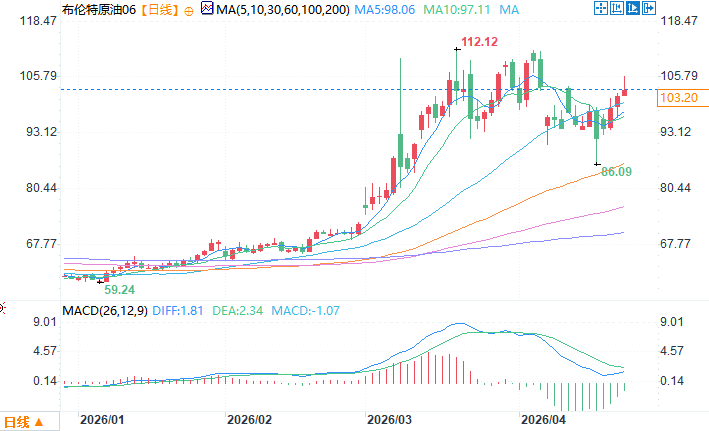
Brent crude oil daily chart source: EasyForex
At 11:05 AM Beijing time on April 23, June Brent crude oil was trading at $103.83 per barrel.
Iran's seizure of ships has disrupted the oil market, and the situation under the ceasefire agreement has become more uncertain.
Iranian state media reported that the seized vessels are suspected of violating maritime regulations by sailing without permission and tampering with navigation systems. The Revolutionary Guard confirmed that the seized vessels are the Panamanian-flagged MSC Francesca and the Liberian-flagged Epaminondas. In addition, a third vessel, the Euphoria, ran aground off the Iranian coast after being shot at.
Hours before the seizure, US President Trump announced an indefinite extension of the ceasefire agreement with Iran to give the Iranian leadership time to submit a unified proposal and end the ongoing conflict. However, Trump also instructed the US military to continue the naval blockade of Iranian ports.
Standard Chartered Bank: $95/barrel becomes a fragile equilibrium point for Brent crude oil
A commodities expert at Standard Chartered Bank points out that the Brent crude oil price of $95 per barrel appears to have reached a fragile equilibrium. The market is hoping for a de-escalation of the conflict, while the structural tensions in physical crude oil supply are intensifying over time.
Although the Brent crude oil near-month contract fluctuated within a range of $13.71 per barrel in the past week, the price broke through $95 per barrel on eight out of the past nine trading days, and the closing price was within $1 per barrel on six of those trading days. The near-month contract even closed at $95.48 per barrel on April 20.
The crude oil forward curve maintained a strong premium structure to the spot price, with slight adjustments during the week. Prices at the far end of the curve rose slightly, with the 5-year Brent crude oil contract rising $0.33 per barrel to $70.13 per barrel during the week; the 2027 contract weakened slightly. On April 20, the 1-month Brent spot price fell $8.03 per barrel during the week, closing at $96.17 per barrel, and the spread between the physical and financial benchmarks narrowed. Brent spot, as a key physical pricing benchmark, represents the price of North Sea light sweet crude oil, and delivery typically occurs within the next 10 to 30 days.
Oil prices are entirely driven by the situation; blockages in the Strait of Hormuz have led to significant production cuts by Gulf oil-producing countries.
Standard Chartered Bank emphasizes that short-term oil price movements are almost entirely driven by news, fluctuating repeatedly with the escalation and easing of the US-Iran conflict, coupled with tightening supply in the physical market. Restrictions on shipping in the Strait of Hormuz have forced Gulf oil-producing countries to shut down some production capacity, with reductions ranging from 25% to 80%. This highlights the issues of limited spare capacity and over-reliance on specific shipping routes. Experts predict that this theme will persist even after OPEC introduces the Maximum Sustainable Capacity (MSC) benchmark.
Last November, OPEC+ authorized the OPEC Secretariat to develop and implement a new Maximum Sustainable Production Capacity (MSC) benchmark, with an assessment period from January to September 2026. This audited technical benchmark will be used to determine the production baseline starting in 2027, replacing previously politically negotiated quotas. OPEC defines MSC as "the maximum daily crude oil production achievable within 90 days and sustainable for a full year, including all planned maintenance." Its core objectives are to incentivize upstream capacity investment, increase transparency, and close loopholes to curb overproduction.
The Brent crude oil forward curve currently shows a strong premium to the spot price, with forward prices remaining stable in the range of $68 to $70 per barrel. Standard Chartered Bank predicts that even after the most intense phase of the conflict ends, oil prices will still be $10 to $20 per barrel higher than before the conflict, supported by factors such as strategic reserve purchases, resource nationalism and hoarding tendencies, and logistical delays caused by supply disruptions.
Gas markets diverged: Middle Eastern supply plummeted, while gas prices in Europe and the US fell sharply.
In stark contrast to the oil market, the natural gas market has shown remarkable resilience despite widespread supply disruptions in the Middle East. Henry Hub natural gas prices fell from a one-year high of around $7.50/MMBtu at the start of the US-Iran conflict in late February to $2.85/MMBtu on Wednesday; European gas prices also declined from over €60 per megawatt-hour (MWh) at the time of the conflict to around €43 on Wednesday.
Standard Chartered Bank points out that the expected supply entering the market in the coming years exceeds current and anticipated supply reductions, effectively mitigating market gaps and price volatility. However, Europe and Asia may face competition for gas supplies this summer, and Europe has begun replenishing its low-stocked gas storage facilities, which is expected to support higher gas prices. US gas prices remain low due to weather and ample supply, but in the medium to long term, increased domestic demand for data center power generation and cooling/heating, as well as increased medium-term liquefied natural gas (LNG) export demand, will provide support for prices.
Brent crude oil daily chart source: EasyForex
At 11:05 AM Beijing time on April 23, June Brent crude oil was trading at $103.83 per barrel.
- Risk Warning and Disclaimer
- The market involves risk, and trading may not be suitable for all investors. This article is for reference only and does not constitute personal investment advice, nor does it take into account certain users’ specific investment objectives, financial situation, or other needs. Any investment decisions made based on this information are at your own risk.