The Eurozone's April HCOB Composite PMI unexpectedly declined, indicating contraction, and the euro remained in a state of fluctuation and adjustment.
2026-04-23 16:37:00
According to APP, the Eurozone's preliminary HCOB composite PMI for April unexpectedly plummeted to 48.6, far below economists' expectations of 50.2, and down from 50.7 in March. This data signals a contraction in Eurozone private sector activity, reflecting the deepening drag on economic growth from the Middle East conflict.

The breakdown of data showed that the services PMI contracted sharply to 47.4, significantly lower than the expected 49.8 and March's 50.2; while the manufacturing PMI unexpectedly expanded rapidly to 52.2, higher than the expected 50.8 and the previous value of 51.6. Following the data release, the EUR/USD exchange rate remained relatively stable, hovering around 1.1700.
Chris Williamson, chief business economist at S&P Global Market Intelligence, recently commented on this data, stating: "The Eurozone is facing a deepening economic crisis stemming from the Middle East conflict, posing a significant challenge to policymakers. The conflict has already led to a decline in economic activity in April, while simultaneously pushing inflation up significantly. Widespread supply shortages are expected to further dampen growth and exacerbate price pressures in the coming weeks. Currently, the war is hitting the service sector the hardest, with its business activity declining at the fastest pace since the pandemic lockdowns began in early 2021."
The subsequent release of Germany's preliminary April HCOB composite PMI also unexpectedly declined to 48.3, below the expected 51.1 and March's 51.9. Germany's services PMI fell sharply to 46.9, far below the expected 50.3 and the previous reading of 50.9, while the manufacturing PMI expanded moderately to 51.2, close to the expected 51.3 and the previous reading of 52.2.
Phil Smith, Associate Director of Economics at S&P Global Market Intelligence, recently commented: "The Middle East wars have halted the momentum of Germany's economic recovery. The ten-month growth streak ended in April, with business activity contracting amid high uncertainty and sharp price increases."
The following is a comparison of the actual performance and expectations of the preliminary PMI data for April in the Eurozone and Germany (based on the latest released data):
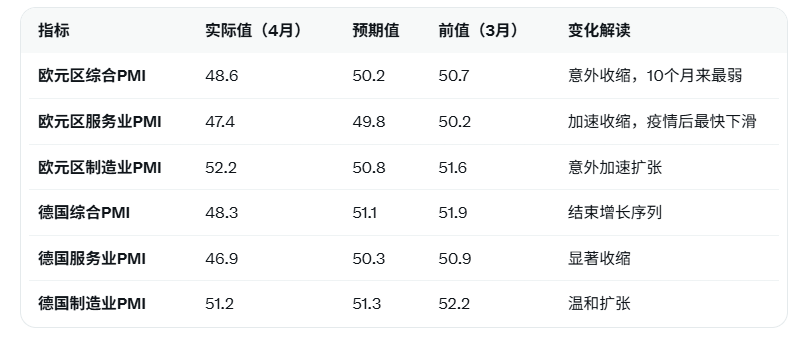
Economic activity weakened simultaneously in both the Eurozone and Germany, primarily due to rising energy prices, supply chain disruptions, and weak demand stemming from the Middle East conflict. The service sector was particularly hard hit by slowing consumer spending, while manufacturing, though resilient due to factors such as prior stockpiling, saw a significant deterioration in overall business confidence. Input costs rose to a high level in recent years, further pushing up output prices and creating a risk of stagflation.
The EUR/USD pair did not experience significant volatility after the data release and is currently hovering around 1.1700. Technically, the exchange rate has retraced to near the 20-period exponential moving average (approximately 1.1691), but remains above the 38.2% Fibonacci retracement level (1.1666), suggesting support during this shallow pullback. The Relative Strength Index (RSI) has fallen back to the 40-60 range, with momentum showing a balanced but slightly upward bias.
Initial resistance is at the 50% Fibonacci retracement level of 1.1745. A decisive break above this level would open up potential upside to the 61.8% retracement level at 1.1825 and even higher. On the downside, 1.1691 is immediate support, with a further break potentially testing 1.1666 and even 1.1567. Structural support lies around 1.1408. For major Asian countries, the Eurozone economic slowdown could be transmitted through trade channels, increasing export pressure, while high energy costs will also push up import inflation expectations.
Editor's Summary:
April's Eurozone and German PMI data highlighted the substantial impact of the Middle East conflict on the European economy, with the contrast between the contraction in the service sector and the resilience of the manufacturing sector exacerbating policy dilemmas. Market concerns about stagflation risks may influence the ECB's subsequent path. Exchange rates are expected to remain range-bound in the short term, with close attention needed to further developments in geopolitical situations and inflation data.
The breakdown of data showed that the services PMI contracted sharply to 47.4, significantly lower than the expected 49.8 and March's 50.2; while the manufacturing PMI unexpectedly expanded rapidly to 52.2, higher than the expected 50.8 and the previous value of 51.6. Following the data release, the EUR/USD exchange rate remained relatively stable, hovering around 1.1700.
Chris Williamson, chief business economist at S&P Global Market Intelligence, recently commented on this data, stating: "The Eurozone is facing a deepening economic crisis stemming from the Middle East conflict, posing a significant challenge to policymakers. The conflict has already led to a decline in economic activity in April, while simultaneously pushing inflation up significantly. Widespread supply shortages are expected to further dampen growth and exacerbate price pressures in the coming weeks. Currently, the war is hitting the service sector the hardest, with its business activity declining at the fastest pace since the pandemic lockdowns began in early 2021."
The subsequent release of Germany's preliminary April HCOB composite PMI also unexpectedly declined to 48.3, below the expected 51.1 and March's 51.9. Germany's services PMI fell sharply to 46.9, far below the expected 50.3 and the previous reading of 50.9, while the manufacturing PMI expanded moderately to 51.2, close to the expected 51.3 and the previous reading of 52.2.
Phil Smith, Associate Director of Economics at S&P Global Market Intelligence, recently commented: "The Middle East wars have halted the momentum of Germany's economic recovery. The ten-month growth streak ended in April, with business activity contracting amid high uncertainty and sharp price increases."
The following is a comparison of the actual performance and expectations of the preliminary PMI data for April in the Eurozone and Germany (based on the latest released data):
Economic activity weakened simultaneously in both the Eurozone and Germany, primarily due to rising energy prices, supply chain disruptions, and weak demand stemming from the Middle East conflict. The service sector was particularly hard hit by slowing consumer spending, while manufacturing, though resilient due to factors such as prior stockpiling, saw a significant deterioration in overall business confidence. Input costs rose to a high level in recent years, further pushing up output prices and creating a risk of stagflation.
The EUR/USD pair did not experience significant volatility after the data release and is currently hovering around 1.1700. Technically, the exchange rate has retraced to near the 20-period exponential moving average (approximately 1.1691), but remains above the 38.2% Fibonacci retracement level (1.1666), suggesting support during this shallow pullback. The Relative Strength Index (RSI) has fallen back to the 40-60 range, with momentum showing a balanced but slightly upward bias.
Initial resistance is at the 50% Fibonacci retracement level of 1.1745. A decisive break above this level would open up potential upside to the 61.8% retracement level at 1.1825 and even higher. On the downside, 1.1691 is immediate support, with a further break potentially testing 1.1666 and even 1.1567. Structural support lies around 1.1408. For major Asian countries, the Eurozone economic slowdown could be transmitted through trade channels, increasing export pressure, while high energy costs will also push up import inflation expectations.
Editor's Summary:
April's Eurozone and German PMI data highlighted the substantial impact of the Middle East conflict on the European economy, with the contrast between the contraction in the service sector and the resilience of the manufacturing sector exacerbating policy dilemmas. Market concerns about stagflation risks may influence the ECB's subsequent path. Exchange rates are expected to remain range-bound in the short term, with close attention needed to further developments in geopolitical situations and inflation data.
- Risk Warning and Disclaimer
- The market involves risk, and trading may not be suitable for all investors. This article is for reference only and does not constitute personal investment advice, nor does it take into account certain users’ specific investment objectives, financial situation, or other needs. Any investment decisions made based on this information are at your own risk.