Behind the rollercoaster of oil prices: US military leadership change and tough stance against Iran; three aircraft carriers assembled but fearing shore-based missiles; can Trump's gamble lead to lower oil prices?
2026-04-23 17:14:41
On Wednesday (April 23), during the Asian and European sessions, international oil prices experienced a rapid surge followed by a decline at the opening. Within half an hour, international oil prices rose to around 4% before falling back to near the zero line. Global financial markets also opened with trepidation.
U.S. Navy Secretary John Phelan was officially dismissed and replaced by the hardliner Hung Cao. Meanwhile, Iranian Parliament Speaker Mohammad-Bagael Ghalibaf stated that Iran would not open the Strait of Hormuz as long as the United States continues to violate the ceasefire (including its maritime blockade).
Behind this rollercoaster ride lies a contest between the Pentagon's powerful personnel appointments and Iran's tough rhetoric, while the US is also waging a costly military gamble.
Just as the situation between the US and Iran was reaching a fever pitch, the US Navy experienced a rare personnel upheaval.
The formal dismissal of Navy Secretary John Phelan is not an isolated administrative change, but rather a sign that the Pentagon's internal power struggle has become public.
Ferran's dismissal stemmed from months of tension with Defense Secretary Hegseth.
It has been revealed that Ferran bypassed the chain of command and directly pitched his "modernized warships" plan to Trump, a "reporting over the chain" that touched a nerve with the military establishment.
With Hegsays firing more than 20 senior officers, including the Army Chief of Staff, the Pentagon's professionalism is giving way to a "loyalty test."
The rise of the new acting secretary, a hardliner named Hung Cao, sends a dangerous signal: U.S. military decision-making is shifting from rational assessment to extreme radicalism.
To facilitate this political maneuvering, the U.S. military has assembled a rare "three-carrier strike group" in the Middle East since World War II—the USS Lincoln, the USS Ford, and the USS Bush, which is on its way at full speed.
However, this seemingly invincible deterrent is actually all show and no substance:
The USS Lincoln, which has been on high-intensity duty in the northern Arabian Sea for several months, is showing signs of fatigue among its crew; the USS Ford, which had previously been repaired after a fire, is now operating beyond its capacity.
A fragile supply chain: a maritime blockade is a war of attrition. The U.S. military has already ordered 29 ships to return to port, and this large-scale interception places near-desperate demands on the carrier strike group's fuel, ammunition, and logistical supplies.
A "no-go zone" that no one dares to approach: Despite possessing three aircraft carriers, U.S. warships can only patrol the Gulf of Oman outside the Persian Gulf in the face of Iran's dense shore-based missiles and suicide drones.
They possess devastating firepower, yet are unable to truly enter the narrow straits to carry out "scavenger" mine-clearing missions.
Why did Trump choose to deploy three aircraft carriers when he had "no other options"?
This was actually his "last all-in" after both diplomatic and economic sanctions failed.
Iranian Parliament Speaker Ghalibaf has taken an extremely hard line: the Strait of Hormuz will not be open unless the United States lifts its maritime blockade. For Trump, there is no turning back—negotiations are impossible; withdrawal would be a loss of face.
Therefore, he chose to use the world's most expensive military assets to "extend the life" of his Middle East policy, which had already reached a stalemate.
These three aircraft carriers are not for territorial conquest, but to demonstrate a “mad will” to Iran, to allies, and even more so to domestic voters.
He attempted to force Iran to back down before its economy completely collapsed by creating the illusion that he was "ready to fight at any time."
But this is essentially a gamble: a gamble that Iran wouldn't dare to fight to the death, and a gamble that the US supply lines could wait for the other side to change its mind before collapsing.
However, the final bill for this military game is being paid for in real time by global oil prices.
Iran is using the world economy as a hostage, betting on the American people's tolerance for high oil prices.
The sharp fluctuations in oil prices this morning reflect the market's understanding of the US predicament: if the three aircraft carriers cannot break the deadlock in the short term, a prolonged blockade will result in a loss of tens of millions of barrels of crude oil supply globally every day.
For the American public, they don't care who is the Secretary of the Navy, nor do they care how impressive the three aircraft carriers are; they only see the numbers jumping at the gas stations.
If Trump's "most expensive life-saving measure" cannot quickly translate into a drop in oil prices, then every missile dropped by the three carrier strike groups will ultimately become a sharp blade aimed at his approval ratings.
Oil prices are no longer just an energy indicator; they are the only timer that can determine the success or failure of Trump's "life-extending" efforts in this Middle East deadlock.
The newly appointed Secretary of the Navy is also in the midst of war, and he will most likely demonstrate his strength upon taking office. The US military continues to exert maximum pressure on Iran in hopes of achieving enough results to allow for a troop withdrawal. The US military may be able to assemble three aircraft carriers within 3-5 days. Traders need to continue to observe the US military's movements.
Technically, although oil prices surged and then retreated, the price action effectively broke through numerous resistance levels, indicating a potential for a strong reversal. As mentioned in previous articles, fundamentally, the pressure of tight inventories at global upstream chemical companies and the potential for future restocking will continue to push up the valuation center of oil prices. At the same time, funds that have deeply invested in the market are unable to exit their positions during the sharp decline, so oil prices must have a rebound demand.
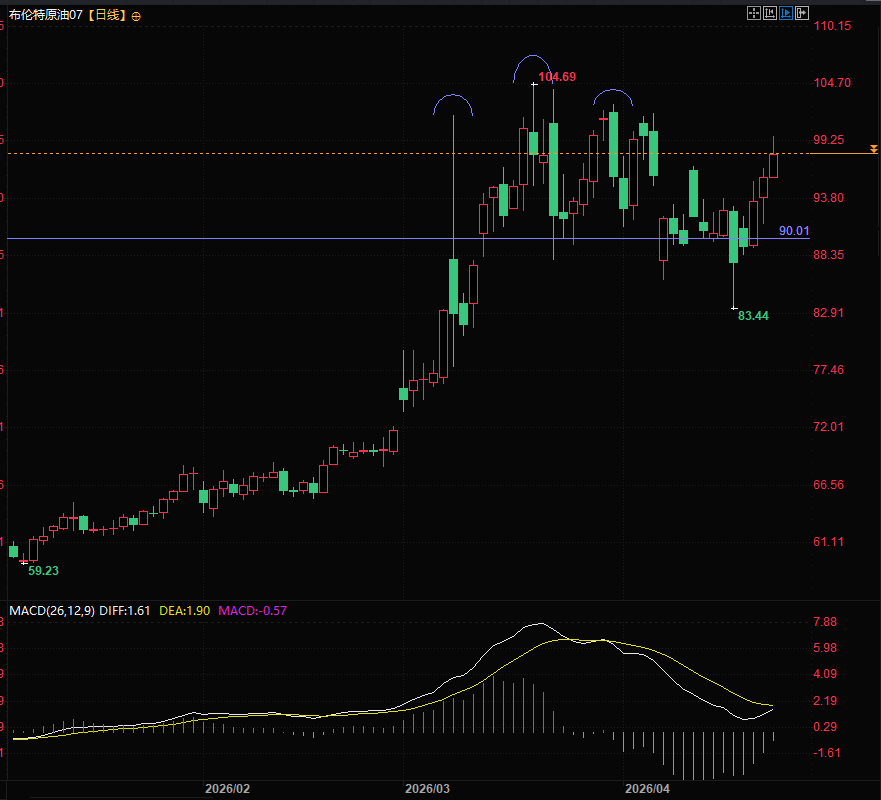
(Brent crude oil July contract daily chart, source: EasyForex)
At 17:13 Beijing time, the Brent crude oil July futures contract was trading at $98.18 per barrel.
U.S. Navy Secretary John Phelan was officially dismissed and replaced by the hardliner Hung Cao. Meanwhile, Iranian Parliament Speaker Mohammad-Bagael Ghalibaf stated that Iran would not open the Strait of Hormuz as long as the United States continues to violate the ceasefire (including its maritime blockade).
Behind this rollercoaster ride lies a contest between the Pentagon's powerful personnel appointments and Iran's tough rhetoric, while the US is also waging a costly military gamble.
The Pentagon's "Great Purge": A Major Taboo in Military Strategy - Changing Commanders in the Midst of Battle
Just as the situation between the US and Iran was reaching a fever pitch, the US Navy experienced a rare personnel upheaval.
The formal dismissal of Navy Secretary John Phelan is not an isolated administrative change, but rather a sign that the Pentagon's internal power struggle has become public.
Ferran's dismissal stemmed from months of tension with Defense Secretary Hegseth.
It has been revealed that Ferran bypassed the chain of command and directly pitched his "modernized warships" plan to Trump, a "reporting over the chain" that touched a nerve with the military establishment.
With Hegsays firing more than 20 senior officers, including the Army Chief of Staff, the Pentagon's professionalism is giving way to a "loyalty test."
The rise of the new acting secretary, a hardliner named Hung Cao, sends a dangerous signal: U.S. military decision-making is shifting from rational assessment to extreme radicalism.
The weakness behind the prosperity: the "moment of barely holding on" for the three aircraft carriers.
To facilitate this political maneuvering, the U.S. military has assembled a rare "three-carrier strike group" in the Middle East since World War II—the USS Lincoln, the USS Ford, and the USS Bush, which is on its way at full speed.
However, this seemingly invincible deterrent is actually all show and no substance:
The USS Lincoln, which has been on high-intensity duty in the northern Arabian Sea for several months, is showing signs of fatigue among its crew; the USS Ford, which had previously been repaired after a fire, is now operating beyond its capacity.
A fragile supply chain: a maritime blockade is a war of attrition. The U.S. military has already ordered 29 ships to return to port, and this large-scale interception places near-desperate demands on the carrier strike group's fuel, ammunition, and logistical supplies.
A "no-go zone" that no one dares to approach: Despite possessing three aircraft carriers, U.S. warships can only patrol the Gulf of Oman outside the Persian Gulf in the face of Iran's dense shore-based missiles and suicide drones.
They possess devastating firepower, yet are unable to truly enter the narrow straits to carry out "scavenger" mine-clearing missions.
"Staying alive" in dire straits: Trump's expensive gamble
Why did Trump choose to deploy three aircraft carriers when he had "no other options"?
This was actually his "last all-in" after both diplomatic and economic sanctions failed.
Iranian Parliament Speaker Ghalibaf has taken an extremely hard line: the Strait of Hormuz will not be open unless the United States lifts its maritime blockade. For Trump, there is no turning back—negotiations are impossible; withdrawal would be a loss of face.
Therefore, he chose to use the world's most expensive military assets to "extend the life" of his Middle East policy, which had already reached a stalemate.
These three aircraft carriers are not for territorial conquest, but to demonstrate a “mad will” to Iran, to allies, and even more so to domestic voters.
He attempted to force Iran to back down before its economy completely collapsed by creating the illusion that he was "ready to fight at any time."
But this is essentially a gamble: a gamble that Iran wouldn't dare to fight to the death, and a gamble that the US supply lines could wait for the other side to change its mind before collapsing.
The final calculation: oil prices are the sole judge.
However, the final bill for this military game is being paid for in real time by global oil prices.
Iran is using the world economy as a hostage, betting on the American people's tolerance for high oil prices.
The sharp fluctuations in oil prices this morning reflect the market's understanding of the US predicament: if the three aircraft carriers cannot break the deadlock in the short term, a prolonged blockade will result in a loss of tens of millions of barrels of crude oil supply globally every day.
For the American public, they don't care who is the Secretary of the Navy, nor do they care how impressive the three aircraft carriers are; they only see the numbers jumping at the gas stations.
If Trump's "most expensive life-saving measure" cannot quickly translate into a drop in oil prices, then every missile dropped by the three carrier strike groups will ultimately become a sharp blade aimed at his approval ratings.
Oil prices are no longer just an energy indicator; they are the only timer that can determine the success or failure of Trump's "life-extending" efforts in this Middle East deadlock.
Summary and Technical Analysis:
The newly appointed Secretary of the Navy is also in the midst of war, and he will most likely demonstrate his strength upon taking office. The US military continues to exert maximum pressure on Iran in hopes of achieving enough results to allow for a troop withdrawal. The US military may be able to assemble three aircraft carriers within 3-5 days. Traders need to continue to observe the US military's movements.
Technically, although oil prices surged and then retreated, the price action effectively broke through numerous resistance levels, indicating a potential for a strong reversal. As mentioned in previous articles, fundamentally, the pressure of tight inventories at global upstream chemical companies and the potential for future restocking will continue to push up the valuation center of oil prices. At the same time, funds that have deeply invested in the market are unable to exit their positions during the sharp decline, so oil prices must have a rebound demand.
(Brent crude oil July contract daily chart, source: EasyForex)
At 17:13 Beijing time, the Brent crude oil July futures contract was trading at $98.18 per barrel.
- Risk Warning and Disclaimer
- The market involves risk, and trading may not be suitable for all investors. This article is for reference only and does not constitute personal investment advice, nor does it take into account certain users’ specific investment objectives, financial situation, or other needs. Any investment decisions made based on this information are at your own risk.