A rebound in UK consumption data failed to alleviate structural pressures, and coupled with a weak European economy, the EUR/GBP exchange rate fluctuated around 0.8675.
2026-04-24 15:35:01
The euro traded in a narrow range against the pound during Friday's European session, hovering around 0.8675. Despite strong UK economic data, the exchange rate reacted only moderately, indicating that the market was generally in a wait-and-see mode.

In the UK, the latest retail sales data showed strong performance. The data indicated that retail sales rose 0.7% month-on-month in March, significantly higher than the market expectation of 0.2%, showing a recovery in consumer demand. However, core retail sales, excluding fuel and automobiles, only grew by 0.2%, indicating that the recovery in consumption remains uneven. This somewhat weakened the data's positive impact on the pound.
At the same time, cost pressures are rising. Business surveys show that while the UK manufacturing and service sectors continue to expand, cost levels have risen to historic highs, with rising energy prices being a major driving factor. These cost pressures could erode corporate profits and drag down future economic activity.
From a consumer perspective, confidence has clearly weakened. Latest data shows that the UK consumer confidence index has fallen to its lowest point in nearly three years, reflecting a cautious attitude among residents towards the future economic outlook. Rising energy prices and expectations of increased mortgage costs have dampened consumer spending, putting some pressure on the pound.
Regarding monetary policy, the market widely expects the Bank of England to maintain interest rates at a high level to combat inflationary pressures. While high interest rates are generally beneficial to the currency, tightening policy could exacerbate the risk of an economic slowdown, thus limiting the pound's performance, especially given the pressure on economic growth.
In the Eurozone, the fundamentals are also weak. The market is focused on Germany's IFO Business Climate Index, with April data expected to decline, reflecting the impact of rising energy costs on business confidence. In the current environment, the euro lacks clear upward momentum and remains relatively balanced with the pound.
From an external perspective, the situation in the Middle East remains a significant variable. Continued tensions surrounding the Strait of Hormuz are increasing shipping risks and keeping energy prices high. This not only impacts the economic prospects of Europe and the UK but also exacerbates market uncertainty, making investors more cautious.
From a technical perspective, on the daily chart, EUR/GBP maintains a range-bound structure, with prices fluctuating repeatedly within the 0.8650-0.8680 range. Current resistance is at 0.8680, the area where the recent rebound high was located; a break above this level could lead to a further test of the 0.8720 area. Support is at 0.8650; a break below this level could open up downside potential to around 0.8600.
From a 4-hour chart perspective, the exchange rate is trending neutrally, with short-term moving averages flattening out, indicating a lack of clear trend. The price is oscillating within a range, and momentum indicators also fail to show a clear directional signal. The key short-term support and resistance levels remain unchanged; a breakout is needed to confirm the subsequent direction.
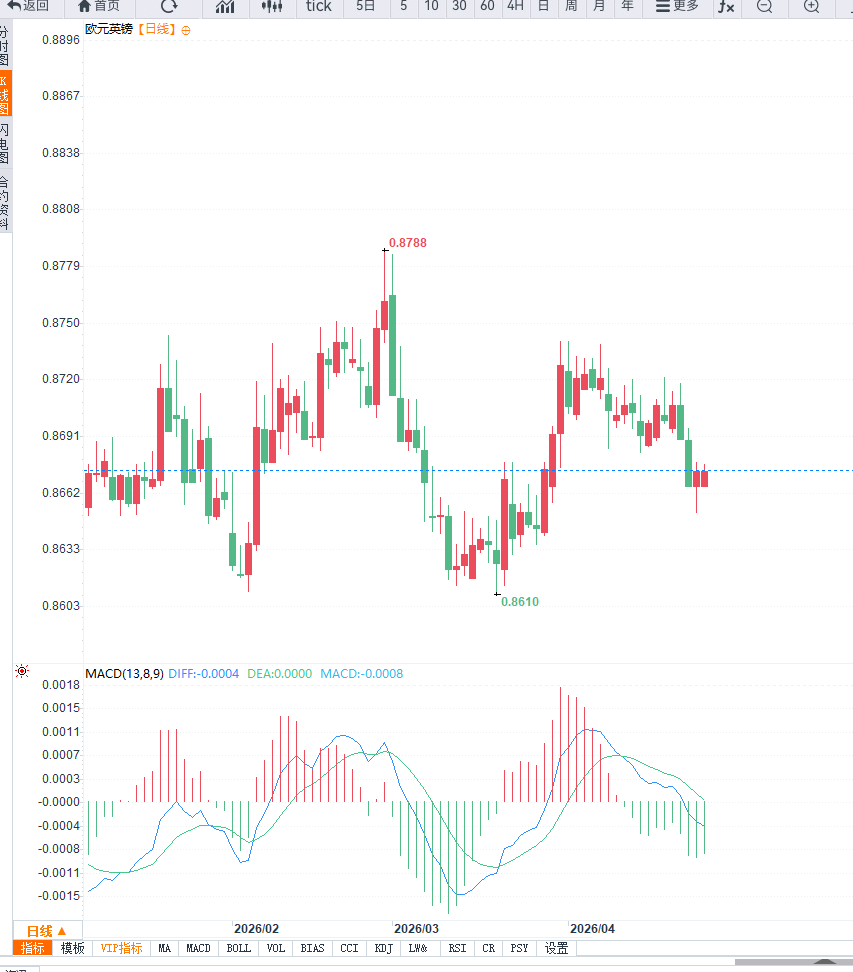
Overall, EUR/GBP is currently in a state of equilibrium between fundamentals and technicals, and its short-term trend is mainly range-bound with a lack of unilateral driving factors.
Editor's Summary
The current EUR/GBP exchange rate reflects the shared challenges facing the UK and European economies. While the UK has seen some short-term data improvement, cost pressures and weak confidence limit its sustained performance; the Eurozone, on the other hand, is impacted by energy costs, putting pressure on its economic outlook. Limited fundamental differences between the two have kept the exchange rate in a volatile pattern. Future movements will depend on changes in economic data and energy price trends; only a significant divergence could lead to a trend breakout.
In the UK, the latest retail sales data showed strong performance. The data indicated that retail sales rose 0.7% month-on-month in March, significantly higher than the market expectation of 0.2%, showing a recovery in consumer demand. However, core retail sales, excluding fuel and automobiles, only grew by 0.2%, indicating that the recovery in consumption remains uneven. This somewhat weakened the data's positive impact on the pound.
At the same time, cost pressures are rising. Business surveys show that while the UK manufacturing and service sectors continue to expand, cost levels have risen to historic highs, with rising energy prices being a major driving factor. These cost pressures could erode corporate profits and drag down future economic activity.
From a consumer perspective, confidence has clearly weakened. Latest data shows that the UK consumer confidence index has fallen to its lowest point in nearly three years, reflecting a cautious attitude among residents towards the future economic outlook. Rising energy prices and expectations of increased mortgage costs have dampened consumer spending, putting some pressure on the pound.
Regarding monetary policy, the market widely expects the Bank of England to maintain interest rates at a high level to combat inflationary pressures. While high interest rates are generally beneficial to the currency, tightening policy could exacerbate the risk of an economic slowdown, thus limiting the pound's performance, especially given the pressure on economic growth.
In the Eurozone, the fundamentals are also weak. The market is focused on Germany's IFO Business Climate Index, with April data expected to decline, reflecting the impact of rising energy costs on business confidence. In the current environment, the euro lacks clear upward momentum and remains relatively balanced with the pound.
From an external perspective, the situation in the Middle East remains a significant variable. Continued tensions surrounding the Strait of Hormuz are increasing shipping risks and keeping energy prices high. This not only impacts the economic prospects of Europe and the UK but also exacerbates market uncertainty, making investors more cautious.
From a technical perspective, on the daily chart, EUR/GBP maintains a range-bound structure, with prices fluctuating repeatedly within the 0.8650-0.8680 range. Current resistance is at 0.8680, the area where the recent rebound high was located; a break above this level could lead to a further test of the 0.8720 area. Support is at 0.8650; a break below this level could open up downside potential to around 0.8600.
From a 4-hour chart perspective, the exchange rate is trending neutrally, with short-term moving averages flattening out, indicating a lack of clear trend. The price is oscillating within a range, and momentum indicators also fail to show a clear directional signal. The key short-term support and resistance levels remain unchanged; a breakout is needed to confirm the subsequent direction.
Overall, EUR/GBP is currently in a state of equilibrium between fundamentals and technicals, and its short-term trend is mainly range-bound with a lack of unilateral driving factors.
Editor's Summary
The current EUR/GBP exchange rate reflects the shared challenges facing the UK and European economies. While the UK has seen some short-term data improvement, cost pressures and weak confidence limit its sustained performance; the Eurozone, on the other hand, is impacted by energy costs, putting pressure on its economic outlook. Limited fundamental differences between the two have kept the exchange rate in a volatile pattern. Future movements will depend on changes in economic data and energy price trends; only a significant divergence could lead to a trend breakout.
- Risk Warning and Disclaimer
- The market involves risk, and trading may not be suitable for all investors. This article is for reference only and does not constitute personal investment advice, nor does it take into account certain users’ specific investment objectives, financial situation, or other needs. Any investment decisions made based on this information are at your own risk.