Escalating tensions in the Middle East have boosted the safe-haven dollar, keeping it volatile at high levels, while the pound continues its correction against the dollar.
2026-04-27 09:39:46
On Monday during Asian trading hours, the British pound continued its weakness against the US dollar. Although it recovered some of its losses during the session, it remained around 1.3520. As a risk-sensitive currency, the pound was clearly under pressure amid rising market risk aversion, while the US dollar was supported by capital inflows, pushing the exchange rate lower overall.
The US has adjusted its previous arrangement of communicating through third parties, preferring direct dialogue with relevant parties. Iran, on the other hand, has made it clear that it will not negotiate under pressure or a blockade. This indicates that substantial progress in the negotiations is unlikely in the short term, and market expectations for a de-escalation of the Middle East situation have cooled significantly.
Meanwhile, the conflict between Israel and Lebanon escalated again. Despite a previous short-term ceasefire agreement, its implementation fell short of expectations, and regional tensions continued to rise. This heightened geopolitical risk prompted global funds to shift towards safe-haven assets, thus supporting the US dollar. Driven by safe-haven demand, the dollar generally strengthened against major currencies , becoming a significant factor suppressing the pound against the dollar.
Furthermore, the market was also affected by unforeseen security events, further exacerbating short-term uncertainty. Deteriorating risk sentiment led investors to reduce their allocation to high-risk assets, thus weakening the pound's performance. Overall, the core driver of the current market has shifted from economic data to changes in geopolitical and risk sentiment.
From a macroeconomic perspective, rising risk aversion is typically accompanied by a stronger US dollar, while the British pound is more dependent on improved global risk appetite. Therefore, in the current environment, the dominant logic is "a stronger safe-haven dollar + pressure on risk currencies," and a significant reversal is unlikely in the short term.
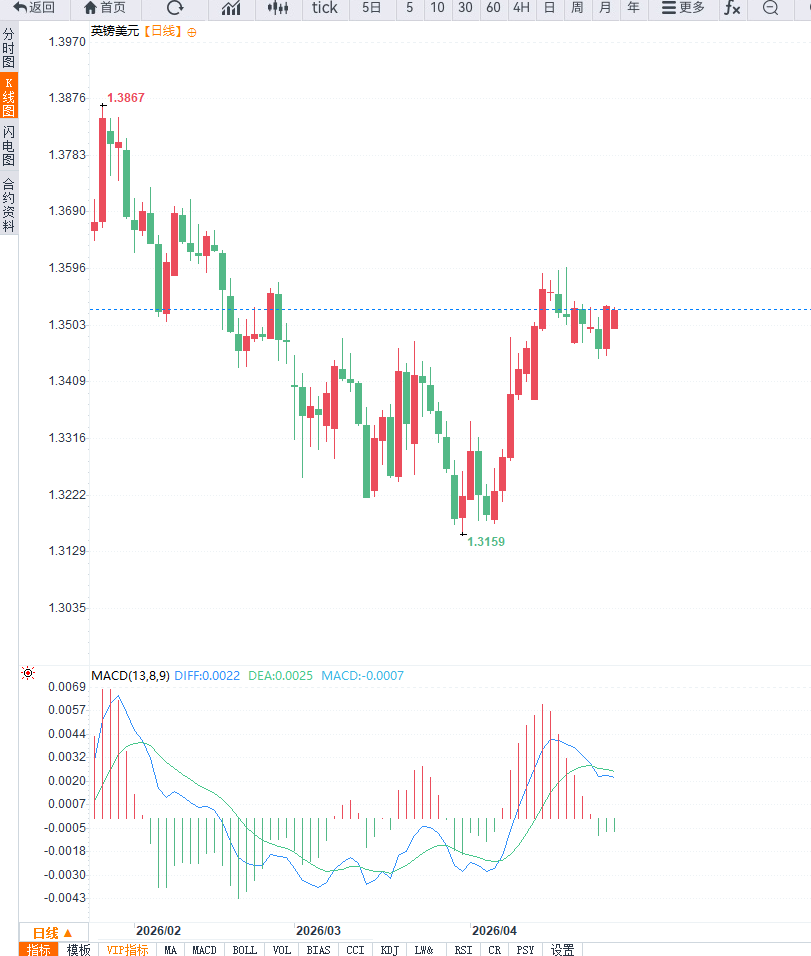
From a technical perspective, on the daily chart, GBP/USD has entered a consolidation phase after falling from its previous highs, currently trading below short-term moving averages, indicating weakening upward momentum. Key support is around 1.3480 ; a break below this level could lead to a further test of the 1.3400 level . Resistance is concentrated around the 1.3600 level . Momentum indicators suggest bears are in control, but prices have not yet entered extreme oversold territory. On the 4-hour chart, the exchange rate exhibits a downward-trending structure, with short-term moving averages diverging downwards. If a rebound is capped around 1.3560, the downward trend may continue.
Editor's Summary:
The current exchange rate of the British pound against the US dollar is mainly driven by safe-haven demand stemming from geopolitical risks. A stronger dollar is the dominant factor, while the pound, as a risk-sensitive currency, continues to face pressure. In the short term, if the situation in the Middle East does not show significant easing, the exchange rate may continue its weak and volatile pattern. The medium-term trend will depend on changes in global risk sentiment and the policy paths of major central banks, especially whether the US dollar continues to receive support from safe-haven flows.
The US has adjusted its previous arrangement of communicating through third parties, preferring direct dialogue with relevant parties. Iran, on the other hand, has made it clear that it will not negotiate under pressure or a blockade. This indicates that substantial progress in the negotiations is unlikely in the short term, and market expectations for a de-escalation of the Middle East situation have cooled significantly.
Meanwhile, the conflict between Israel and Lebanon escalated again. Despite a previous short-term ceasefire agreement, its implementation fell short of expectations, and regional tensions continued to rise. This heightened geopolitical risk prompted global funds to shift towards safe-haven assets, thus supporting the US dollar. Driven by safe-haven demand, the dollar generally strengthened against major currencies , becoming a significant factor suppressing the pound against the dollar.
Furthermore, the market was also affected by unforeseen security events, further exacerbating short-term uncertainty. Deteriorating risk sentiment led investors to reduce their allocation to high-risk assets, thus weakening the pound's performance. Overall, the core driver of the current market has shifted from economic data to changes in geopolitical and risk sentiment.
From a macroeconomic perspective, rising risk aversion is typically accompanied by a stronger US dollar, while the British pound is more dependent on improved global risk appetite. Therefore, in the current environment, the dominant logic is "a stronger safe-haven dollar + pressure on risk currencies," and a significant reversal is unlikely in the short term.
From a technical perspective, on the daily chart, GBP/USD has entered a consolidation phase after falling from its previous highs, currently trading below short-term moving averages, indicating weakening upward momentum. Key support is around 1.3480 ; a break below this level could lead to a further test of the 1.3400 level . Resistance is concentrated around the 1.3600 level . Momentum indicators suggest bears are in control, but prices have not yet entered extreme oversold territory. On the 4-hour chart, the exchange rate exhibits a downward-trending structure, with short-term moving averages diverging downwards. If a rebound is capped around 1.3560, the downward trend may continue.
Editor's Summary:
The current exchange rate of the British pound against the US dollar is mainly driven by safe-haven demand stemming from geopolitical risks. A stronger dollar is the dominant factor, while the pound, as a risk-sensitive currency, continues to face pressure. In the short term, if the situation in the Middle East does not show significant easing, the exchange rate may continue its weak and volatile pattern. The medium-term trend will depend on changes in global risk sentiment and the policy paths of major central banks, especially whether the US dollar continues to receive support from safe-haven flows.
- Risk Warning and Disclaimer
- The market involves risk, and trading may not be suitable for all investors. This article is for reference only and does not constitute personal investment advice, nor does it take into account certain users’ specific investment objectives, financial situation, or other needs. Any investment decisions made based on this information are at your own risk.