A super central bank week is coming; Barclays expects the Federal Reserve to keep interest rates unchanged.
2026-04-27 13:31:17
According to APP, Barclays analysts noted in their latest report that with inflation remaining high, the Federal Reserve is expected to keep the target range for the federal funds rate unchanged at its meeting this week, but a rate cut is still possible later this year. Analysts emphasized that in a highly uncertain environment, the Fed tends to remain patient; strong demand and still-high inflation data support policymakers' decision to hold off for now, while policymakers have also signaled a weakening of confidence in further policy easing in the near term.
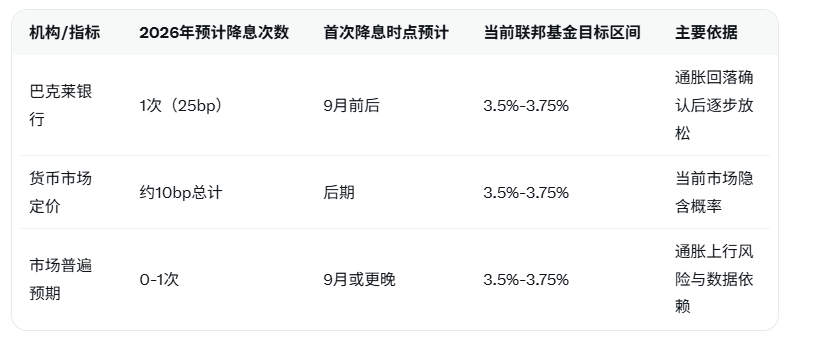
Barclays analysts stated that if inflation follows the expected decline, the Federal Reserve is likely to gain sufficient confidence around September to begin gradually easing monetary policy. They maintain their forecast of rate cuts this year, believing that gradually slowing inflation will provide room for policy adjustments. The money market currently prices in approximately 10 basis points of rate cuts by the Fed in 2026, reflecting a cautious market expectation regarding the policy path.
The Federal Reserve's target range for the federal funds rate remains unchanged at 3.5%-3.75%, having been held steady for several consecutive meetings since the end of 2025. Latest data shows that the US Consumer Price Index (CPI) rose 3.3% year-on-year in March, a significant rebound from 2.4% in February, mainly driven by a sharp rise in energy prices, while core inflation also showed moderate upward pressure. Against this backdrop, the probability of the Federal Reserve maintaining its current interest rate at its meeting on April 28-29 this week is close to 100%, and the market widely expects policymakers to emphasize a data-dependent and cautious approach.
Barclays' analysis highlights the current dilemma facing monetary policy: on the one hand, strong economic demand and a resilient labor market are supporting economic growth; on the other hand, geopolitical factors causing energy price volatility are pushing up inflation expectations, increasing the threshold for policy easing. Analysts believe the Federal Reserve needs to observe more months of moderate core inflation data to be certain that inflation is back on track, thus laying the groundwork for a potential first rate cut in September. This is largely consistent with some market institutions' expectations of one or two rate cuts this year, but the actual path remains highly dependent on subsequent economic data developments.
To clearly illustrate the comparison of expected Fed rate paths, the following table summarizes key scenarios (based on the latest market and institutional views, unit: basis points):
A recent report by Barclays has repeatedly stated that, given the lingering inflationary pressures and heightened external uncertainties, Federal Reserve policymakers are more inclined to remain on hold to avoid the risk of double-dip inflation that could result from premature easing. This aligns closely with the current transmission effect of energy price fluctuations on overall prices.
Editor's Summary:
Rising inflation and geopolitical uncertainty are jointly constraining the Federal Reserve's short-term policy space. Analysis from institutions such as Barclays indicates that the window for interest rate cuts still exists this year, but sustained improvement in inflation data is required. Both markets and policymakers need to closely monitor subsequent CPI, employment, and energy price developments to assess the actual timing and magnitude of a monetary policy shift.
Barclays analysts stated that if inflation follows the expected decline, the Federal Reserve is likely to gain sufficient confidence around September to begin gradually easing monetary policy. They maintain their forecast of rate cuts this year, believing that gradually slowing inflation will provide room for policy adjustments. The money market currently prices in approximately 10 basis points of rate cuts by the Fed in 2026, reflecting a cautious market expectation regarding the policy path.
The Federal Reserve's target range for the federal funds rate remains unchanged at 3.5%-3.75%, having been held steady for several consecutive meetings since the end of 2025. Latest data shows that the US Consumer Price Index (CPI) rose 3.3% year-on-year in March, a significant rebound from 2.4% in February, mainly driven by a sharp rise in energy prices, while core inflation also showed moderate upward pressure. Against this backdrop, the probability of the Federal Reserve maintaining its current interest rate at its meeting on April 28-29 this week is close to 100%, and the market widely expects policymakers to emphasize a data-dependent and cautious approach.
Barclays' analysis highlights the current dilemma facing monetary policy: on the one hand, strong economic demand and a resilient labor market are supporting economic growth; on the other hand, geopolitical factors causing energy price volatility are pushing up inflation expectations, increasing the threshold for policy easing. Analysts believe the Federal Reserve needs to observe more months of moderate core inflation data to be certain that inflation is back on track, thus laying the groundwork for a potential first rate cut in September. This is largely consistent with some market institutions' expectations of one or two rate cuts this year, but the actual path remains highly dependent on subsequent economic data developments.
To clearly illustrate the comparison of expected Fed rate paths, the following table summarizes key scenarios (based on the latest market and institutional views, unit: basis points):
A recent report by Barclays has repeatedly stated that, given the lingering inflationary pressures and heightened external uncertainties, Federal Reserve policymakers are more inclined to remain on hold to avoid the risk of double-dip inflation that could result from premature easing. This aligns closely with the current transmission effect of energy price fluctuations on overall prices.
Editor's Summary:
Rising inflation and geopolitical uncertainty are jointly constraining the Federal Reserve's short-term policy space. Analysis from institutions such as Barclays indicates that the window for interest rate cuts still exists this year, but sustained improvement in inflation data is required. Both markets and policymakers need to closely monitor subsequent CPI, employment, and energy price developments to assess the actual timing and magnitude of a monetary policy shift.
- Risk Warning and Disclaimer
- The market involves risk, and trading may not be suitable for all investors. This article is for reference only and does not constitute personal investment advice, nor does it take into account certain users’ specific investment objectives, financial situation, or other needs. Any investment decisions made based on this information are at your own risk.