Middle East supply risks boosted oil prices, supporting a stronger Canadian dollar; the USD/CAD pair remained range-bound at low levels.
2026-04-27 13:03:26
The US dollar continued its decline against the Canadian dollar during Monday's Asian trading session, remaining under pressure for the second consecutive trading day and trading around 1.3660. The weakening exchange rate was mainly due to the combined effects of a stronger Canadian dollar and a pullback in the US dollar, with rising oil prices being a key factor supporting the Canadian dollar.

As one of the world's major energy exporters, Canada's economy is highly correlated with crude oil prices. Recently, international oil prices rebounded after a brief correction, with WTI crude oil prices rising back to around $94. The core factor driving the price increase is the uncertainty surrounding the situation in the Middle East, with market concerns about global supply disruptions clearly intensifying.
The US has adjusted its external communication methods, and related negotiations have not made substantial progress. Meanwhile, Iran has refused to participate in negotiations under pressure, further complicating the situation. At the same time, the Strait of Hormuz, a key passage for approximately 20% of the world's seaborne crude oil , continues to experience shipping restrictions, fueling market concerns about supply disruptions and supporting higher oil prices.
Furthermore, the US maritime blockade of relevant ports, coupled with transportation restrictions, has led to market expectations that supply disruptions may persist, further reinforcing risk premiums in the energy market. Against this backdrop, rising oil prices have directly boosted the Canadian dollar, which is heavily reliant on resource exports, thus putting downward pressure on the USD/CAD exchange rate.
From the perspective of the US dollar, although geopolitical tensions typically generate safe-haven demand, the recent continuous pullback in the dollar indicates a divergence in market fund flows. The continued weakening of the dollar has reduced support for the exchange rate , putting further pressure on USD/CAD against the backdrop of rising oil prices and a stronger Canadian dollar.
Overall, the current exchange rate trend is mainly driven by the dual factors of "rising oil prices supporting the Canadian dollar" and "short-term weakening of the US dollar". Market sentiment is biased towards the negative impact of USD/CAD, and a significant rebound is unlikely in the short term.
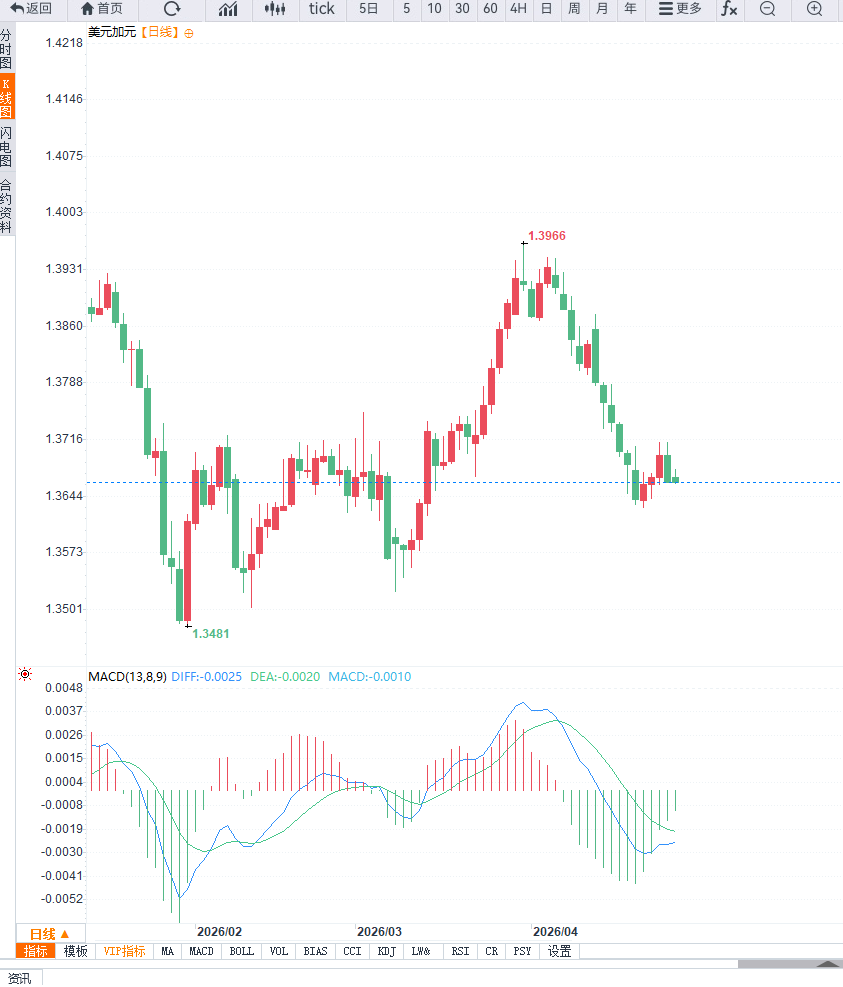
From a technical perspective, on the daily chart, USD/CAD has entered a consolidation phase after falling from its highs, with the price gradually breaking below short-term moving average support, indicating weakening upward momentum. The current key support level is around 1.3620 ; a break below this level could lead to a further decline towards the 1.3550 area . Resistance is concentrated in the 1.3720-1.3750 range , which represents a previous rebound high combined with moving average resistance. Momentum indicators suggest that bearish pressure is gradually increasing. On the 4-hour chart, the exchange rate exhibits a downward-trending structure, with short-term moving averages diverging downwards. Rebounds have repeatedly been met with resistance around 1.3700, indicating heavy selling pressure above. A break below 1.3620 could accelerate the downward movement.
Editor's Summary:
The current USD/CAD exchange rate movement is primarily driven by the strengthening of the Canadian dollar, fueled by rising oil prices, while the recent pullback in the US dollar has further amplified downward pressure on the exchange rate. In the short term, if tensions in the Middle East continue, oil prices may remain high, thus continuing to support the Canadian dollar. The medium-term trend will depend on the sustainability of oil price increases and whether the US dollar regains its strength. Given these multiple factors, USD/CAD is likely to remain in a downward-trending pattern in the short term.
As one of the world's major energy exporters, Canada's economy is highly correlated with crude oil prices. Recently, international oil prices rebounded after a brief correction, with WTI crude oil prices rising back to around $94. The core factor driving the price increase is the uncertainty surrounding the situation in the Middle East, with market concerns about global supply disruptions clearly intensifying.
The US has adjusted its external communication methods, and related negotiations have not made substantial progress. Meanwhile, Iran has refused to participate in negotiations under pressure, further complicating the situation. At the same time, the Strait of Hormuz, a key passage for approximately 20% of the world's seaborne crude oil , continues to experience shipping restrictions, fueling market concerns about supply disruptions and supporting higher oil prices.
Furthermore, the US maritime blockade of relevant ports, coupled with transportation restrictions, has led to market expectations that supply disruptions may persist, further reinforcing risk premiums in the energy market. Against this backdrop, rising oil prices have directly boosted the Canadian dollar, which is heavily reliant on resource exports, thus putting downward pressure on the USD/CAD exchange rate.
From the perspective of the US dollar, although geopolitical tensions typically generate safe-haven demand, the recent continuous pullback in the dollar indicates a divergence in market fund flows. The continued weakening of the dollar has reduced support for the exchange rate , putting further pressure on USD/CAD against the backdrop of rising oil prices and a stronger Canadian dollar.
Overall, the current exchange rate trend is mainly driven by the dual factors of "rising oil prices supporting the Canadian dollar" and "short-term weakening of the US dollar". Market sentiment is biased towards the negative impact of USD/CAD, and a significant rebound is unlikely in the short term.
From a technical perspective, on the daily chart, USD/CAD has entered a consolidation phase after falling from its highs, with the price gradually breaking below short-term moving average support, indicating weakening upward momentum. The current key support level is around 1.3620 ; a break below this level could lead to a further decline towards the 1.3550 area . Resistance is concentrated in the 1.3720-1.3750 range , which represents a previous rebound high combined with moving average resistance. Momentum indicators suggest that bearish pressure is gradually increasing. On the 4-hour chart, the exchange rate exhibits a downward-trending structure, with short-term moving averages diverging downwards. Rebounds have repeatedly been met with resistance around 1.3700, indicating heavy selling pressure above. A break below 1.3620 could accelerate the downward movement.
Editor's Summary:
The current USD/CAD exchange rate movement is primarily driven by the strengthening of the Canadian dollar, fueled by rising oil prices, while the recent pullback in the US dollar has further amplified downward pressure on the exchange rate. In the short term, if tensions in the Middle East continue, oil prices may remain high, thus continuing to support the Canadian dollar. The medium-term trend will depend on the sustainability of oil price increases and whether the US dollar regains its strength. Given these multiple factors, USD/CAD is likely to remain in a downward-trending pattern in the short term.
- Risk Warning and Disclaimer
- The market involves risk, and trading may not be suitable for all investors. This article is for reference only and does not constitute personal investment advice, nor does it take into account certain users’ specific investment objectives, financial situation, or other needs. Any investment decisions made based on this information are at your own risk.