The upcoming decisions from the Bank of Japan and the Bank of America mark a crucial turning point for the US and Japan.
2026-04-27 10:44:22
This week, the foreign exchange market's focus is entirely on the USD/JPY exchange rate, marking a significant turning point in the overall market. The Federal Reserve and the Bank of Japan will both release their latest benchmark interest rate decisions, coupled with the ongoing geopolitical risks surrounding Iran in the Middle East. These multiple factors, both positive and negative, are converging, leading to increasingly fierce competition between bulls and bears.
Currently, the USD/JPY exchange rate is under slight pressure, trading below the key resistance level of 160. Market participants are generally adopting a wait-and-see approach, awaiting policy direction from the two major central banks. Geopolitical tensions are also influencing short-term exchange rate fluctuations, significantly increasing the probability of unusual market movements in the short term.
The Bank of Japan is set to announce its latest monthly interest rate decision this week, becoming a key domestic fundamental factor affecting the yen's exchange rate in the short term. Major economists unanimously predict that the Bank of Japan will maintain its current benchmark interest rate of 0.75%, refraining from adjusting its monetary easing policies and continuing to monitor the long-term impact of the Russia-Ukraine conflict on Japan's real economy, trade, and import/export supply chains.

The official economic statistics report released last Friday clearly showed that, influenced by geopolitical disturbances driving up prices of energy commodities such as Brent crude oil, Japan's nationwide consumer price inflation data rose again in March. Currently, there are no signs of easing in the shipping control and blockade of the Strait of Hormuz, and industry institutions predict that the high energy price situation will continue for a long time, further increasing upward pressure on domestic inflation in Japan.
On the diplomatic front, the US proactively signaled its willingness to engage in multilateral talks with Iran, but Iran maintained a consistently negative and resistant attitude, offering no clear response. Previously, Trump publicly stated that the US-Iran talks would definitely proceed, and simultaneously announced that Vance would lead a delegation to Pakistan for a diplomatic meeting. However, subsequent changes to the travel itinerary and the appearance of a motorcade at the White House led to further disruptions in the weekend's diplomatic arrangements. Trump later explained that due to disagreements and a lack of consensus among high-ranking Iranian officials, the US proactively halted the Pakistani diplomatic trip to avoid a diplomatic embarrassment and salvage the situation. Iran immediately and publicly refuted these claims as untrue.
In addition to its core interest rate decision, the Bank of Japan will also release forward guidance on subsequent phased monetary policy. The International Monetary Fund has repeatedly urged the Bank of Japan to initiate interest rate hikes in due course. Professional analysts, based on economic fundamentals, believe that an interest rate hike this year is feasible. Meanwhile, the yen has experienced a sustained and deep depreciation in recent years, resulting in a significant reduction in purchasing power. The Bank of Japan is highly likely to implement specific stabilization measures at this meeting to fully support the safe-haven yen exchange rate and mitigate the risk of a one-sided downward trend in the foreign exchange market.
The Federal Reserve will hold its monthly interest rate meeting, and the tone of its decision will directly affect the strength of the US dollar index and indirectly influence the USD/JPY exchange rate.
Industry analysts predict that the Federal Reserve will maintain a steady pace at this meeting, keeping the benchmark interest rate unchanged at 3.50% to 3.75%. Previously, Trump had repeatedly pressured the Fed Chairman to implement interest rate cuts quickly, but with persistently high inflation data in the US, the Fed, after comprehensively assessing key economic indicators, has determined that there is currently no need for any rate cuts. The latest official macroeconomic data shows that the overall US household inflation rate has jumped significantly to 3.3%, and the OECD's special forecast report also indicates that the peak inflation rate in the US this year is expected to climb to 4.3%, indicating persistent pressure to control prices.
More alarmingly, the US economy is showing typical signs of stagflation, with high inflation and slow economic growth occurring simultaneously, and negative economic signals continuing to strengthen. The preliminary GDP data to be released this week will likely confirm that the US economy grew by less than 2% in the first quarter, indicating weak economic recovery momentum and further exacerbating the uncertainty surrounding the dollar's price fluctuations.
From a comprehensive technical analysis of the long-term weekly chart, the USD/JPY pair has steadily approached the important psychological level of 160. The price has firmly held above the 50-week and 100-week moving averages, indicating that bullish funds have a firm grip on the market and the downside potential is very limited.
The current chart pattern has formed a standard ascending triangle, with horizontal support lines providing support at the bottom and a steadily rising upward trend line at the top, indicating a complete bullish technical structure and clear signals.
Based on a comprehensive analysis of fundamentals, policy, and technical factors, the USD/JPY pair is highly likely to initiate a phase of upward rebound after stabilizing following a pullback this week. It is expected to subsequently test the key resistance level of 163, becoming the core trading theme for the week. Overall, before the decisions of the two central banks are released, the exchange rate will likely fluctuate within a narrow range, consolidating before breaking out of this range and establishing a one-sided trend.
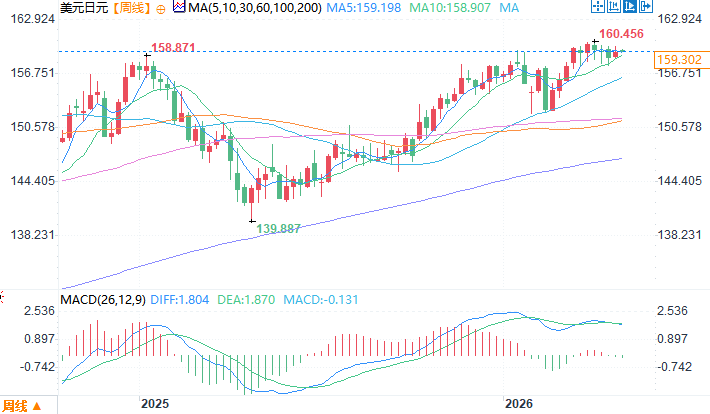
USD/JPY Weekly Chart Source: FX168
At 10:43 AM Beijing time on April 27, the USD/JPY exchange rate was 159.30/31.
Currently, the USD/JPY exchange rate is under slight pressure, trading below the key resistance level of 160. Market participants are generally adopting a wait-and-see approach, awaiting policy direction from the two major central banks. Geopolitical tensions are also influencing short-term exchange rate fluctuations, significantly increasing the probability of unusual market movements in the short term.
The Bank of Japan is set to hold rates steady, with inflation and geopolitical factors weighing on the Japanese currency.
The Bank of Japan is set to announce its latest monthly interest rate decision this week, becoming a key domestic fundamental factor affecting the yen's exchange rate in the short term. Major economists unanimously predict that the Bank of Japan will maintain its current benchmark interest rate of 0.75%, refraining from adjusting its monetary easing policies and continuing to monitor the long-term impact of the Russia-Ukraine conflict on Japan's real economy, trade, and import/export supply chains.
The official economic statistics report released last Friday clearly showed that, influenced by geopolitical disturbances driving up prices of energy commodities such as Brent crude oil, Japan's nationwide consumer price inflation data rose again in March. Currently, there are no signs of easing in the shipping control and blockade of the Strait of Hormuz, and industry institutions predict that the high energy price situation will continue for a long time, further increasing upward pressure on domestic inflation in Japan.
On the diplomatic front, the US proactively signaled its willingness to engage in multilateral talks with Iran, but Iran maintained a consistently negative and resistant attitude, offering no clear response. Previously, Trump publicly stated that the US-Iran talks would definitely proceed, and simultaneously announced that Vance would lead a delegation to Pakistan for a diplomatic meeting. However, subsequent changes to the travel itinerary and the appearance of a motorcade at the White House led to further disruptions in the weekend's diplomatic arrangements. Trump later explained that due to disagreements and a lack of consensus among high-ranking Iranian officials, the US proactively halted the Pakistani diplomatic trip to avoid a diplomatic embarrassment and salvage the situation. Iran immediately and publicly refuted these claims as untrue.
In addition to its core interest rate decision, the Bank of Japan will also release forward guidance on subsequent phased monetary policy. The International Monetary Fund has repeatedly urged the Bank of Japan to initiate interest rate hikes in due course. Professional analysts, based on economic fundamentals, believe that an interest rate hike this year is feasible. Meanwhile, the yen has experienced a sustained and deep depreciation in recent years, resulting in a significant reduction in purchasing power. The Bank of Japan is highly likely to implement specific stabilization measures at this meeting to fully support the safe-haven yen exchange rate and mitigate the risk of a one-sided downward trend in the foreign exchange market.
The Federal Reserve kept interest rates unchanged, and the risk of stagflation in the US economy continues to escalate.
The Federal Reserve will hold its monthly interest rate meeting, and the tone of its decision will directly affect the strength of the US dollar index and indirectly influence the USD/JPY exchange rate.
Industry analysts predict that the Federal Reserve will maintain a steady pace at this meeting, keeping the benchmark interest rate unchanged at 3.50% to 3.75%. Previously, Trump had repeatedly pressured the Fed Chairman to implement interest rate cuts quickly, but with persistently high inflation data in the US, the Fed, after comprehensively assessing key economic indicators, has determined that there is currently no need for any rate cuts. The latest official macroeconomic data shows that the overall US household inflation rate has jumped significantly to 3.3%, and the OECD's special forecast report also indicates that the peak inflation rate in the US this year is expected to climb to 4.3%, indicating persistent pressure to control prices.
More alarmingly, the US economy is showing typical signs of stagflation, with high inflation and slow economic growth occurring simultaneously, and negative economic signals continuing to strengthen. The preliminary GDP data to be released this week will likely confirm that the US economy grew by less than 2% in the first quarter, indicating weak economic recovery momentum and further exacerbating the uncertainty surrounding the dollar's price fluctuations.
The technical outlook remains bullish, and there is ample room for the exchange rate to rebound.
From a comprehensive technical analysis of the long-term weekly chart, the USD/JPY pair has steadily approached the important psychological level of 160. The price has firmly held above the 50-week and 100-week moving averages, indicating that bullish funds have a firm grip on the market and the downside potential is very limited.
The current chart pattern has formed a standard ascending triangle, with horizontal support lines providing support at the bottom and a steadily rising upward trend line at the top, indicating a complete bullish technical structure and clear signals.
Based on a comprehensive analysis of fundamentals, policy, and technical factors, the USD/JPY pair is highly likely to initiate a phase of upward rebound after stabilizing following a pullback this week. It is expected to subsequently test the key resistance level of 163, becoming the core trading theme for the week. Overall, before the decisions of the two central banks are released, the exchange rate will likely fluctuate within a narrow range, consolidating before breaking out of this range and establishing a one-sided trend.
USD/JPY Weekly Chart Source: FX168
At 10:43 AM Beijing time on April 27, the USD/JPY exchange rate was 159.30/31.
- Risk Warning and Disclaimer
- The market involves risk, and trading may not be suitable for all investors. This article is for reference only and does not constitute personal investment advice, nor does it take into account certain users’ specific investment objectives, financial situation, or other needs. Any investment decisions made based on this information are at your own risk.