The Bank of Japan's hawkish stance and inaction, coupled with uncertainty in the Middle East, caused the USD/JPY exchange rate to fluctuate at high levels, approaching the 160 mark.
2026-04-28 10:24:27
The Bank of Japan is set to announce its latest interest rate decision on Tuesday, with the market widely expecting it to maintain the benchmark interest rate at 0.75% , while simultaneously signaling a potential future rate hike. This "hawkish hold-up" policy mix reflects the Bank of Japan's cautious stance in the current complex environment. On the one hand, continued strength in domestic inflation and the labor market is driving the normalization of policy; on the other hand, global uncertainties stemming from the Middle East situation limit its room for rapid action.
Economic data shows that Japan's inflation is trending moderately upward. Latest data shows that the Consumer Price Index (CPI) rose 1.5% year-on-year in March, higher than the market expectation of 1.4%; core inflation rose to 1.8% , significantly higher than previously expected. Meanwhile, the unemployment rate remained low at 2.6% , indicating a tightening labor market. Theoretically, this macroeconomic environment provides conditions for further interest rate hikes, but the Bank of Japan has not acted hastily, demonstrating its high vigilance regarding external risks.
The greatest uncertainty currently stems from the situation in the Middle East. The conflict has lasted for nearly two months, with no clear signs of easing in the short term. Rising energy prices and the risk of supply disruptions continue to put pressure on global inflation. For Japan, an economy heavily reliant on energy imports, rising oil prices will not only push up imported inflation but may also drag down economic growth. This combination of rising inflation and pressure on growth presents a dilemma for policymakers.
In a recent statement, Bank of Japan Governor Kazuo Ueda clearly pointed out that rising energy prices pose both upward risks to inflation and downward pressure on the economy, making policy choices more complex. He also emphasized that developments in the Middle East will be a significant variable in policy decisions, and reiterated that the central bank will focus on achieving its 2% inflation target and will adopt the most appropriate policy path.
From a policy perspective, the market widely expects the Bank of Japan to maintain its interest rate at this meeting, but may strengthen its tightening stance through forward guidance. Current market pricing indicates that the cumulative rate hikes by 2026 could reach 50 basis points . Against this backdrop, if the Bank of Japan unexpectedly raises rates earlier than anticipated, or clearly hints at action at its next meeting, this would be interpreted by the market as a distinctly hawkish signal, thereby driving the yen higher.
However, from a practical standpoint, the Bank of Japan typically avoids aggressive action in highly uncertain environments. Therefore, a more likely scenario is to maintain interest rates while preserving policy flexibility. This strategy avoids market shocks while also allowing room for future adjustments.
From the perspective of the currency market, the USD/JPY exchange rate has recently maintained a high-level fluctuation pattern. Since early April, the exchange rate has generally traded below the 160 level , indicating a relative balance between bullish and bearish forces. The core factor currently driving the exchange rate remains the interplay between risk sentiment and interest rate differential expectations. On the one hand, the situation in the Middle East strengthens the safe-haven appeal of the US dollar; on the other hand, the expectation of a potential interest rate hike in Japan provides some support for the yen.
From a market sentiment perspective, investors currently show a clear preference for the US dollar. During periods of rising risk, the US dollar typically becomes the preferred safe-haven asset, while the Japanese yen, although also possessing safe-haven attributes, has relatively limited appeal given the current low interest rate environment. Therefore, unless the Bank of Japan releases a strong hawkish signal, the yen is unlikely to establish a sustained appreciation trend in the short term.
From a technical perspective, the USD/JPY daily chart shows a consolidation pattern at high levels. The price is oscillating around the 20-day moving average , which has clearly flattened, indicating an unclear short-term trend. Meanwhile, the 100-day and 200-day moving averages continue to rise and are well below the current price level, suggesting a continued bullish structure in the medium to long term. The current exchange rate is near the year's high of 160.40 , forming a key resistance area. Momentum indicators show the RSI in a slightly downward-biased neutral range, and the MACD momentum is weakening, indicating a slowdown in upward momentum. The key support level is at 159.00 ; a break below this level could lead to further declines towards 158.40 or even the 157.90 area.
From the 4-hour chart, the short-term trend shows a narrow range-bound pattern, with the price fluctuating repeatedly between 159.00 and 160.00. Structurally, the exchange rate has formed a sideways consolidation platform, with 160.00 acting as significant psychological resistance and 159.00 providing short-term support. Technically, the RSI remains in the 40-60 range, indicating a lack of clear market direction; the MACD has crossed near the zero line multiple times, suggesting a balance between bullish and bearish forces. If the exchange rate breaks through and holds above 160.00, it may retest the 160.40 high ; conversely, a break below 159.00 could trigger a technical correction.
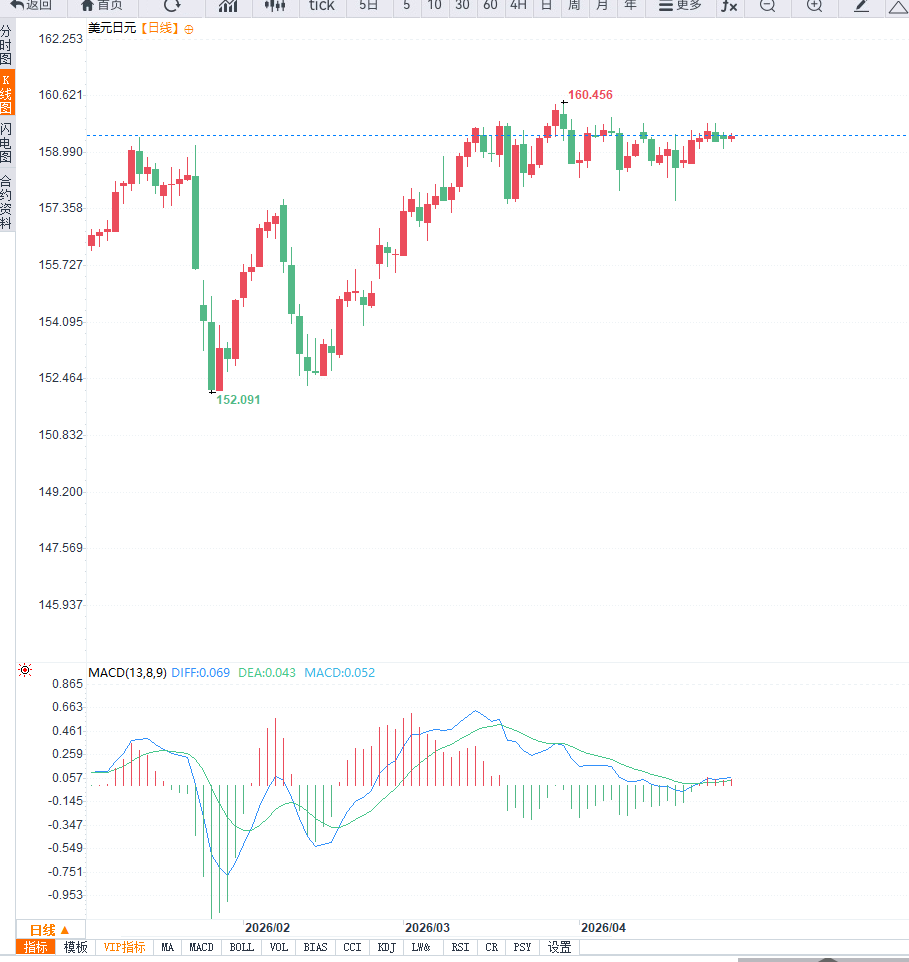
From a technical perspective, the USD/JPY pair is currently in a consolidation phase before a trend continues. The daily chart maintains a bullish pattern but momentum is weakening, while the 4-hour chart shows range-bound trading. This combination typically indicates that the market is awaiting a fundamental catalyst, and the Bank of Japan's interest rate decision is one of the key triggers.
Editor's Summary : Overall, the Bank of Japan is at a critical juncture in its policy shift. Domestic inflation and employment data support interest rate hikes, but external risks from the Middle East situation limit its pace of action. In the short term, a "hawkish stance with no action" remains the most likely path, offering limited support for the yen. The USD/JPY pair, supported by safe-haven demand and interest rate differentials, continues to fluctuate at high levels. Future trends will hinge on whether the Bank of Japan releases stronger signals regarding interest rate hikes and whether global risk sentiment changes. In the current environment, exchange rate volatility may continue to amplify, and the market needs to be wary of unexpected policy surprises leading to breakouts.
Economic data shows that Japan's inflation is trending moderately upward. Latest data shows that the Consumer Price Index (CPI) rose 1.5% year-on-year in March, higher than the market expectation of 1.4%; core inflation rose to 1.8% , significantly higher than previously expected. Meanwhile, the unemployment rate remained low at 2.6% , indicating a tightening labor market. Theoretically, this macroeconomic environment provides conditions for further interest rate hikes, but the Bank of Japan has not acted hastily, demonstrating its high vigilance regarding external risks.
The greatest uncertainty currently stems from the situation in the Middle East. The conflict has lasted for nearly two months, with no clear signs of easing in the short term. Rising energy prices and the risk of supply disruptions continue to put pressure on global inflation. For Japan, an economy heavily reliant on energy imports, rising oil prices will not only push up imported inflation but may also drag down economic growth. This combination of rising inflation and pressure on growth presents a dilemma for policymakers.
In a recent statement, Bank of Japan Governor Kazuo Ueda clearly pointed out that rising energy prices pose both upward risks to inflation and downward pressure on the economy, making policy choices more complex. He also emphasized that developments in the Middle East will be a significant variable in policy decisions, and reiterated that the central bank will focus on achieving its 2% inflation target and will adopt the most appropriate policy path.
From a policy perspective, the market widely expects the Bank of Japan to maintain its interest rate at this meeting, but may strengthen its tightening stance through forward guidance. Current market pricing indicates that the cumulative rate hikes by 2026 could reach 50 basis points . Against this backdrop, if the Bank of Japan unexpectedly raises rates earlier than anticipated, or clearly hints at action at its next meeting, this would be interpreted by the market as a distinctly hawkish signal, thereby driving the yen higher.
However, from a practical standpoint, the Bank of Japan typically avoids aggressive action in highly uncertain environments. Therefore, a more likely scenario is to maintain interest rates while preserving policy flexibility. This strategy avoids market shocks while also allowing room for future adjustments.
From the perspective of the currency market, the USD/JPY exchange rate has recently maintained a high-level fluctuation pattern. Since early April, the exchange rate has generally traded below the 160 level , indicating a relative balance between bullish and bearish forces. The core factor currently driving the exchange rate remains the interplay between risk sentiment and interest rate differential expectations. On the one hand, the situation in the Middle East strengthens the safe-haven appeal of the US dollar; on the other hand, the expectation of a potential interest rate hike in Japan provides some support for the yen.
From a market sentiment perspective, investors currently show a clear preference for the US dollar. During periods of rising risk, the US dollar typically becomes the preferred safe-haven asset, while the Japanese yen, although also possessing safe-haven attributes, has relatively limited appeal given the current low interest rate environment. Therefore, unless the Bank of Japan releases a strong hawkish signal, the yen is unlikely to establish a sustained appreciation trend in the short term.
From a technical perspective, the USD/JPY daily chart shows a consolidation pattern at high levels. The price is oscillating around the 20-day moving average , which has clearly flattened, indicating an unclear short-term trend. Meanwhile, the 100-day and 200-day moving averages continue to rise and are well below the current price level, suggesting a continued bullish structure in the medium to long term. The current exchange rate is near the year's high of 160.40 , forming a key resistance area. Momentum indicators show the RSI in a slightly downward-biased neutral range, and the MACD momentum is weakening, indicating a slowdown in upward momentum. The key support level is at 159.00 ; a break below this level could lead to further declines towards 158.40 or even the 157.90 area.
From the 4-hour chart, the short-term trend shows a narrow range-bound pattern, with the price fluctuating repeatedly between 159.00 and 160.00. Structurally, the exchange rate has formed a sideways consolidation platform, with 160.00 acting as significant psychological resistance and 159.00 providing short-term support. Technically, the RSI remains in the 40-60 range, indicating a lack of clear market direction; the MACD has crossed near the zero line multiple times, suggesting a balance between bullish and bearish forces. If the exchange rate breaks through and holds above 160.00, it may retest the 160.40 high ; conversely, a break below 159.00 could trigger a technical correction.
From a technical perspective, the USD/JPY pair is currently in a consolidation phase before a trend continues. The daily chart maintains a bullish pattern but momentum is weakening, while the 4-hour chart shows range-bound trading. This combination typically indicates that the market is awaiting a fundamental catalyst, and the Bank of Japan's interest rate decision is one of the key triggers.
Editor's Summary : Overall, the Bank of Japan is at a critical juncture in its policy shift. Domestic inflation and employment data support interest rate hikes, but external risks from the Middle East situation limit its pace of action. In the short term, a "hawkish stance with no action" remains the most likely path, offering limited support for the yen. The USD/JPY pair, supported by safe-haven demand and interest rate differentials, continues to fluctuate at high levels. Future trends will hinge on whether the Bank of Japan releases stronger signals regarding interest rate hikes and whether global risk sentiment changes. In the current environment, exchange rate volatility may continue to amplify, and the market needs to be wary of unexpected policy surprises leading to breakouts.
- Risk Warning and Disclaimer
- The market involves risk, and trading may not be suitable for all investors. This article is for reference only and does not constitute personal investment advice, nor does it take into account certain users’ specific investment objectives, financial situation, or other needs. Any investment decisions made based on this information are at your own risk.