April 29th Financial Breakfast: Hopes for US-Iran negotiations dwindle, UAE withdraws from OPEC and OPEC+, gold prices test the $4500 mark, oil prices surge over 3%.
2026-04-29 06:46:44
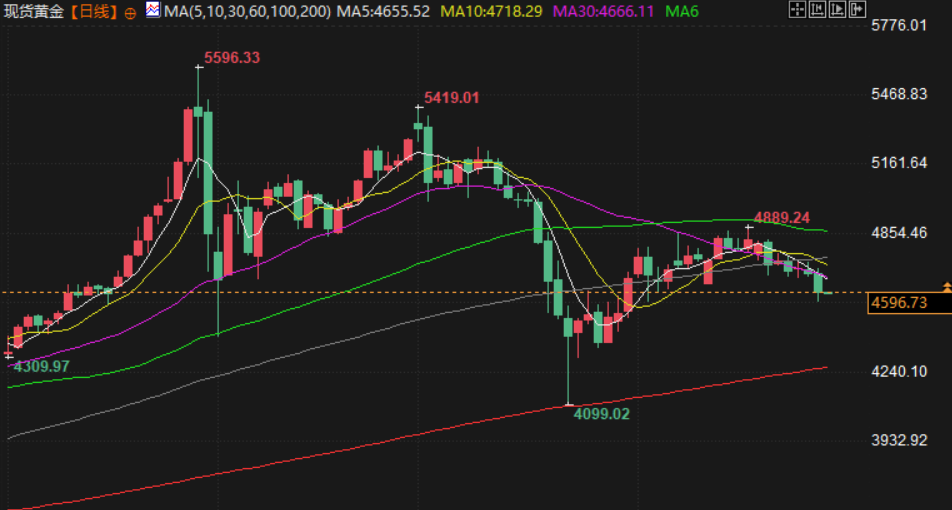
On Wednesday (April 29, Beijing time) in early Asian trading, spot gold was trading around $4,593 per ounce. Gold prices fell nearly 2% on Tuesday, dropping to a four-week low of $4,554.91 per ounce. It may test the $4,500 per ounce level during the day. Trump's dissatisfaction with Iran's latest proposal to end the war has dampened hopes for a resolution to the conflict. At the same time, the UAE's announcement of its withdrawal from OPEC and OPEC+ further pushed up oil prices and reignited inflation concerns. Oil prices surged by more than 3%, with US crude oil returning to test the $100 per barrel mark.

U.S. stocks closed lower on Tuesday, with the S&P 500 down 0.49%, the Nasdaq down 0.90%, and the Dow Jones Industrial Average down slightly by 0.05%. Renewed concerns about the growth prospects of artificial intelligence weighed on tech stocks ahead of earnings reports from several tech giants.
According to The Wall Street Journal, OpenAI's failure to meet its internal targets for weekly active users and revenue raised questions about the sustainability of its massive data center spending, causing Oracle's stock price to fall 4.1%. Chip stocks such as Nvidia, AMD, and Broadcom fell between 1.6% and 4.4%, while CoreWeave dropped 5.8%. Meanwhile, General Motors rose 1.3% after reporting better-than-expected quarterly profits and raising its full-year earnings forecast, while UPS fell 4.0% as soaring fuel costs offset improved fundamentals, and Coca-Cola rose 3.9% after raising its annual earnings forecast.
In addition, the UAE's announcement of its withdrawal from OPEC pushed crude oil prices soar and reignited inflation concerns. The market is also focused on the ongoing Federal Reserve meeting to see how policymakers assess the inflation risks posed by rising energy prices.
Gold prices fell to a near four-week low on Tuesday, with spot gold down 1.7% to $4,600.61 an ounce and U.S. gold futures down 1.8% to $4,608.40, mainly driven by tensions in the Middle East pushing up oil prices and persistent inflation concerns.
U.S. officials said President Trump was unhappy with Iran’s latest proposals to end the war, dampening hopes for a resolution to the conflict, while the UAE’s announcement of its withdrawal from OPEC and OPEC+ further pushed up oil prices and reignited inflation concerns.
The market is focused on this week's Federal Reserve monetary policy meeting, which is expected to keep interest rates unchanged, and investors are also closely watching Chairman Powell's speech.
In other precious metals, spot silver fell 2.7%, platinum fell 1.5%, and palladium fell 0.8%.
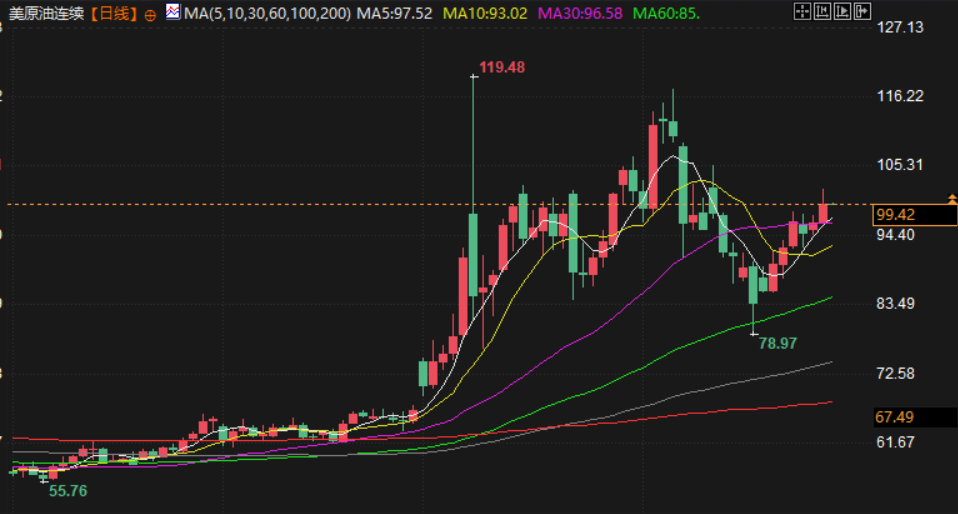
Oil prices rose nearly 3% on Tuesday, with Brent crude futures climbing 2.8% to $111.26 a barrel, marking their seventh consecutive day of gains, while WTI crude futures rose 3.7% to $99.93 a barrel, briefly breaking the $100 mark during the session. Continued concerns about supply shortages stemming from the potential blockade of the Strait of Hormuz completely offset the negative impact of the UAE's announcement that it would withdraw from OPEC and the OPEC+ alliance on May 1st.
Again Capital partners pointed out that although the UAE's withdrawal could theoretically lead to an increase in daily production of 1 million to 1.5 million barrels, the Strait of Hormuz has been effectively blocked, preventing oil from being transported out, thus causing oil prices to continue to climb.
In addition, US President Trump expressed dissatisfaction with Iran's latest proposal to end the war, which attempts to postpone discussions on its nuclear program; shipping data shows that six Iranian oil tankers were forced to turn back due to the US blockade, but a liquefied natural gas carrier operated by Abu Dhabi National Oil Company transited the Strait of Hormuz for the first time since the outbreak of the war.
The dollar index ended a two-day losing streak on Tuesday, rising 0.2% to 98.66, as investor concerns about a war with Iran and soaring oil prices spurred capital inflows into the dollar.
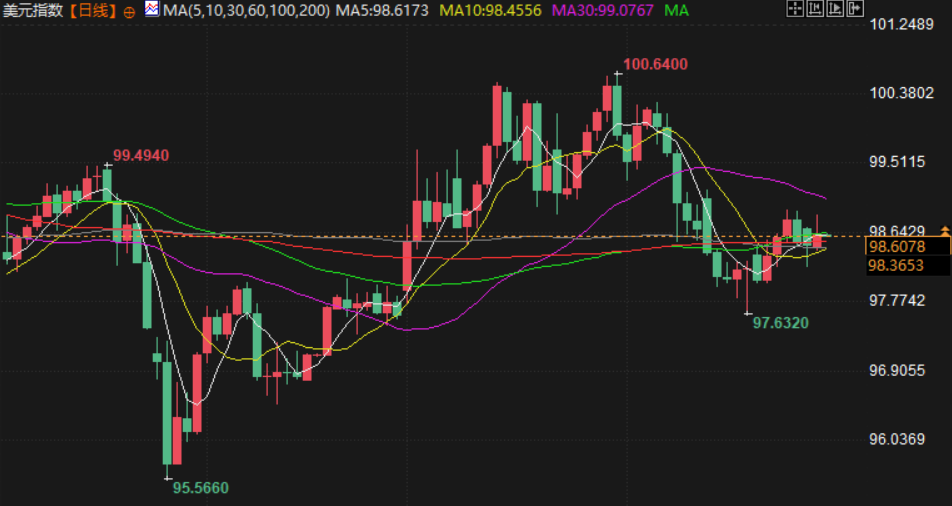
The Bank of Japan kept its policy rate unchanged at 0.75%, but saw the largest split since Governor Kazuo Ueda took office, a 6-3 vote with three members supporting a rate hike to 1.0% to address energy inflation risks. This split initially boosted the yen, but Ueda's subsequent press conference put pressure on the economic growth outlook, causing the yen to give back its gains. The dollar was flat against the yen at 159.65, and the euro was at 186.90 against the yen.
Meanwhile, US President Trump expressed dissatisfaction with Iran's latest peace proposal, diminishing hopes for a resolution to the conflict and further boosting safe-haven demand. The euro fell 0.11% to $1.17085, the dollar rose 0.51% against the Swiss franc to 0.79 francs, the pound fell 0.12% to $1.352, and the Canadian dollar weakened 0.42% to C$1.368 ahead of the Bank of Canada's interest rate decision. Market attention also turned to Wednesday's Federal Reserve meeting, which will be Powell's last meeting as chairman. His successor, Warsh, is expected to advocate for interest rate cuts, but soaring energy prices may keep policymakers cautious.
The United States announced sanctions against 35 Iranian-related entities and individuals.
On April 28 local time, the United States announced sanctions against 35 Iranian-related entities and individuals, accusing them of helping to circumvent sanctions and providing financial support to Iran. U.S. Treasury Secretary Bessenter stated that any institution involved in or assisting Iran's "shadow banking" system will face severe consequences. (CCTV News)
The United States has banned individuals and entities from paying passage fees to Iran in the Strait of Hormuz.
A U.S. Treasury Department Office of Foreign Assets Control (OFAC) released an explanatory document on the 28th, stating that the United States prohibits U.S. individuals or entities from paying security fees to Iran for passage through the Strait of Hormuz. The document states that no entity, including U.S. individuals, U.S. financial institutions, or foreign entities owned or controlled by the United States, may directly or indirectly pay security fees to the Iranian government or the Iranian Islamic Revolutionary Guard Corps for passage through the Strait of Hormuz. (Xinhua)
The U.S. Department of Defense has formally applied to change its name to the "Department of War."
The Pentagon has formally submitted a name change application, proposing to rename the "Department of Defense" to the "Department of War," with the related adjustments expected to cost over $50 million. It is understood that the Pentagon's Office of General Counsel has released a related proposal to push for legal amendments to complete the formal name change. (CCTV News)
Iranian Army Spokesperson: The war is not over yet, and the army is on high alert.
Iran's Tasnim News Agency reported on the 28th, citing Iranian Army spokesman Mohammad Akraminia, that the military considers the current situation to be still at war, and ground troops have been deployed throughout the country, ready to respond to threats. He stated that Iran has completed a comprehensive update of its target list and combat equipment, and all troops are fully prepared to deal with possible enemy military attacks. (Xinhua)
Satellite images show multiple oil tankers in the waters near the Iranian port of Chabahar.
Satellite images released on the 28th local time showed multiple oil tankers near the Iranian port of Chabahar, including eight very large crude carriers (VLCCs) and several smaller vessels, with a total capacity of approximately 14 million barrels of crude oil. Chabahar port is located on the southeastern coast of Iran, on the Gulf of Oman. Although situated outside the Persian Gulf, the port is close to the US-established blockade line. Analysts suggest that with traffic in the Strait of Hormuz virtually nonexistent, adjusting some oil export routes is one of Iran's measures to minimize disruption to its oil exports. (CCTV News)
UAE Energy Minister: Exiting OPEC will have limited impact on the market.
UAE Energy Minister Suhail al-Mazrouei stated in a media interview on the 28th that the UAE's decision to withdraw from the Organization of the Petroleum Exporting Countries (OPEC) at this time was primarily due to factors such as the current restrictions on passage through the Strait of Hormuz, and he believes this decision will have a limited impact on the global oil market. Mazrouei told CNN that the UAE's announcement of its withdrawal was "timely" and would not have a significant impact on the oil market and prices, because of the restrictions on passage through the Strait of Hormuz, which also apply to the UAE. This decision will help alleviate price pressures. (Xinhua)
German Chancellor Merz: I don't see any exit strategy from the US in the war against Iran.
On the 27th local time, German Chancellor Merz, while attending an event at a school in North Rhine-Westphalia, stated that he saw no clear exit strategy from the United States in its war against Iran. Chancellor Merz said, "The Americans clearly don't have a (clear) strategy. The problem with these kinds of conflicts isn't just about how to intervene, but also about how to withdraw. Our painful 20 years in Afghanistan fully demonstrate this, as did our experience in Iraq. So, as I said, this whole thing is, at least, poorly planned. Currently, I don't see what strategic exit strategy the Americans have chosen, especially given Iran's negotiating skills, which are clearly very sophisticated, or rather, very cleverly 'non-negotiating,' leading the Americans to Islamabad only to leave empty-handed." (CCTV News)
The Iranian Revolutionary Guard claims permanent control of Hormuz.
The deputy commander of the Iranian Islamic Revolutionary Guard Corps Navy stated today (April 28) that "Iran has achieved absolute control over the Strait of Hormuz and demands that passing vessels pay passage fees. Foreign vessels must abide by Iranian rules when passing through, including using Persian for communication." He added, "Without the orders of Iran's Supreme Leader and the will of the people, Iran will not allow even a single liter of oil to flow out of the strait. The Iranian armed forces are currently 'on high alert.' Iran is capable of dealing with any form of maritime blockade, and the US hegemony in the Persian Gulf has ended." (CCTV International News)
The Ukrainian parliament approved a 90-day extension of the state of war.
According to Ukraine's Interfax news agency, the Ukrainian Verkhovna Rada (parliament) voted on May 28 to extend the state of war and military mobilization for another 90 days. On May 27, Ukrainian President Volodymyr Zelenskyy submitted a draft decree to the Verkhovna Rada proposing to extend the state of war and military mobilization from May 4 to August 2, a total of 90 days. The draft decree on extending the state of war and military mobilization received support from 315 and 304 members of parliament respectively, both exceeding the 226 votes required for passage. This is the 19th time the Verkhovna Rada has approved extensions of related decrees since the escalation of the Russia-Ukraine conflict in February 2022. (Xinhua)
Key initiatives of the 15th Five-Year Plan! China's "artificial sun" accelerates industrialization.
Nuclear fusion energy has been included in the National 15th Five-Year Plan and listed as a key future industrial direction. Its basic principle is the same as the sun's energy source, hence it is called the "artificial sun." The 15th Five-Year Plan period was a strategically crucial period for China's fusion technology to fully transition from scientific experiments to engineering and industrialization. What is the latest progress of the fusion industry? At the National Fusion Industry Test Platform in Chengdu, Sichuan, the first wall of the core component of the "artificial sun" acts like armor, directly facing the challenges of the extremely high temperature of the central plasma and the bombardment of particles. Its core raw materials include three metals: tungsten, copper, and stainless steel. (CCTV News)
The National Data Administration has established two new organizations to promote the development of data infrastructure and data standards.
On April 28, the National Data Administration announced the establishment of the "Data Infrastructure Technology Community" and the release of the "Data Standard Semanticization Service Platform," aiming to accelerate the national-level data infrastructure and data standardization process during the 15th Five-Year Plan period. It is understood that data infrastructure construction has been included in the 109 major projects of the national 15th Five-Year Plan. The newly established "Data Infrastructure Technology Community" brings together data infrastructure builders, operators, technical service providers, scenario developers, and data processors to conduct technical discussions, verification, sharing, application, and popularization, jointly lowering the barriers to data infrastructure implementation. The newly released "Data Standard Semanticization Service Platform" will assist artificial intelligence technologies such as large-scale models in accurately analyzing data, deeply mining information, and conducting intelligent computing, providing standard guarantees for data processing, value mining, and business implementation. (CCTV News)
Key Focus Today
stock market
U.S. stocks closed lower on Tuesday, with the S&P 500 down 0.49%, the Nasdaq down 0.90%, and the Dow Jones Industrial Average down slightly by 0.05%. Renewed concerns about the growth prospects of artificial intelligence weighed on tech stocks ahead of earnings reports from several tech giants.
According to The Wall Street Journal, OpenAI's failure to meet its internal targets for weekly active users and revenue raised questions about the sustainability of its massive data center spending, causing Oracle's stock price to fall 4.1%. Chip stocks such as Nvidia, AMD, and Broadcom fell between 1.6% and 4.4%, while CoreWeave dropped 5.8%. Meanwhile, General Motors rose 1.3% after reporting better-than-expected quarterly profits and raising its full-year earnings forecast, while UPS fell 4.0% as soaring fuel costs offset improved fundamentals, and Coca-Cola rose 3.9% after raising its annual earnings forecast.
In addition, the UAE's announcement of its withdrawal from OPEC pushed crude oil prices soar and reignited inflation concerns. The market is also focused on the ongoing Federal Reserve meeting to see how policymakers assess the inflation risks posed by rising energy prices.
Gold Market
Gold prices fell to a near four-week low on Tuesday, with spot gold down 1.7% to $4,600.61 an ounce and U.S. gold futures down 1.8% to $4,608.40, mainly driven by tensions in the Middle East pushing up oil prices and persistent inflation concerns.
U.S. officials said President Trump was unhappy with Iran’s latest proposals to end the war, dampening hopes for a resolution to the conflict, while the UAE’s announcement of its withdrawal from OPEC and OPEC+ further pushed up oil prices and reignited inflation concerns.
The market is focused on this week's Federal Reserve monetary policy meeting, which is expected to keep interest rates unchanged, and investors are also closely watching Chairman Powell's speech.
In other precious metals, spot silver fell 2.7%, platinum fell 1.5%, and palladium fell 0.8%.
oil market
Oil prices rose nearly 3% on Tuesday, with Brent crude futures climbing 2.8% to $111.26 a barrel, marking their seventh consecutive day of gains, while WTI crude futures rose 3.7% to $99.93 a barrel, briefly breaking the $100 mark during the session. Continued concerns about supply shortages stemming from the potential blockade of the Strait of Hormuz completely offset the negative impact of the UAE's announcement that it would withdraw from OPEC and the OPEC+ alliance on May 1st.
Again Capital partners pointed out that although the UAE's withdrawal could theoretically lead to an increase in daily production of 1 million to 1.5 million barrels, the Strait of Hormuz has been effectively blocked, preventing oil from being transported out, thus causing oil prices to continue to climb.
In addition, US President Trump expressed dissatisfaction with Iran's latest proposal to end the war, which attempts to postpone discussions on its nuclear program; shipping data shows that six Iranian oil tankers were forced to turn back due to the US blockade, but a liquefied natural gas carrier operated by Abu Dhabi National Oil Company transited the Strait of Hormuz for the first time since the outbreak of the war.
Foreign exchange market
The dollar index ended a two-day losing streak on Tuesday, rising 0.2% to 98.66, as investor concerns about a war with Iran and soaring oil prices spurred capital inflows into the dollar.
The Bank of Japan kept its policy rate unchanged at 0.75%, but saw the largest split since Governor Kazuo Ueda took office, a 6-3 vote with three members supporting a rate hike to 1.0% to address energy inflation risks. This split initially boosted the yen, but Ueda's subsequent press conference put pressure on the economic growth outlook, causing the yen to give back its gains. The dollar was flat against the yen at 159.65, and the euro was at 186.90 against the yen.
Meanwhile, US President Trump expressed dissatisfaction with Iran's latest peace proposal, diminishing hopes for a resolution to the conflict and further boosting safe-haven demand. The euro fell 0.11% to $1.17085, the dollar rose 0.51% against the Swiss franc to 0.79 francs, the pound fell 0.12% to $1.352, and the Canadian dollar weakened 0.42% to C$1.368 ahead of the Bank of Canada's interest rate decision. Market attention also turned to Wednesday's Federal Reserve meeting, which will be Powell's last meeting as chairman. His successor, Warsh, is expected to advocate for interest rate cuts, but soaring energy prices may keep policymakers cautious.
International News
The United States announced sanctions against 35 Iranian-related entities and individuals.
On April 28 local time, the United States announced sanctions against 35 Iranian-related entities and individuals, accusing them of helping to circumvent sanctions and providing financial support to Iran. U.S. Treasury Secretary Bessenter stated that any institution involved in or assisting Iran's "shadow banking" system will face severe consequences. (CCTV News)
The United States has banned individuals and entities from paying passage fees to Iran in the Strait of Hormuz.
A U.S. Treasury Department Office of Foreign Assets Control (OFAC) released an explanatory document on the 28th, stating that the United States prohibits U.S. individuals or entities from paying security fees to Iran for passage through the Strait of Hormuz. The document states that no entity, including U.S. individuals, U.S. financial institutions, or foreign entities owned or controlled by the United States, may directly or indirectly pay security fees to the Iranian government or the Iranian Islamic Revolutionary Guard Corps for passage through the Strait of Hormuz. (Xinhua)
The U.S. Department of Defense has formally applied to change its name to the "Department of War."
The Pentagon has formally submitted a name change application, proposing to rename the "Department of Defense" to the "Department of War," with the related adjustments expected to cost over $50 million. It is understood that the Pentagon's Office of General Counsel has released a related proposal to push for legal amendments to complete the formal name change. (CCTV News)
Iranian Army Spokesperson: The war is not over yet, and the army is on high alert.
Iran's Tasnim News Agency reported on the 28th, citing Iranian Army spokesman Mohammad Akraminia, that the military considers the current situation to be still at war, and ground troops have been deployed throughout the country, ready to respond to threats. He stated that Iran has completed a comprehensive update of its target list and combat equipment, and all troops are fully prepared to deal with possible enemy military attacks. (Xinhua)
Satellite images show multiple oil tankers in the waters near the Iranian port of Chabahar.
Satellite images released on the 28th local time showed multiple oil tankers near the Iranian port of Chabahar, including eight very large crude carriers (VLCCs) and several smaller vessels, with a total capacity of approximately 14 million barrels of crude oil. Chabahar port is located on the southeastern coast of Iran, on the Gulf of Oman. Although situated outside the Persian Gulf, the port is close to the US-established blockade line. Analysts suggest that with traffic in the Strait of Hormuz virtually nonexistent, adjusting some oil export routes is one of Iran's measures to minimize disruption to its oil exports. (CCTV News)
UAE Energy Minister: Exiting OPEC will have limited impact on the market.
UAE Energy Minister Suhail al-Mazrouei stated in a media interview on the 28th that the UAE's decision to withdraw from the Organization of the Petroleum Exporting Countries (OPEC) at this time was primarily due to factors such as the current restrictions on passage through the Strait of Hormuz, and he believes this decision will have a limited impact on the global oil market. Mazrouei told CNN that the UAE's announcement of its withdrawal was "timely" and would not have a significant impact on the oil market and prices, because of the restrictions on passage through the Strait of Hormuz, which also apply to the UAE. This decision will help alleviate price pressures. (Xinhua)
German Chancellor Merz: I don't see any exit strategy from the US in the war against Iran.
On the 27th local time, German Chancellor Merz, while attending an event at a school in North Rhine-Westphalia, stated that he saw no clear exit strategy from the United States in its war against Iran. Chancellor Merz said, "The Americans clearly don't have a (clear) strategy. The problem with these kinds of conflicts isn't just about how to intervene, but also about how to withdraw. Our painful 20 years in Afghanistan fully demonstrate this, as did our experience in Iraq. So, as I said, this whole thing is, at least, poorly planned. Currently, I don't see what strategic exit strategy the Americans have chosen, especially given Iran's negotiating skills, which are clearly very sophisticated, or rather, very cleverly 'non-negotiating,' leading the Americans to Islamabad only to leave empty-handed." (CCTV News)
The Iranian Revolutionary Guard claims permanent control of Hormuz.
The deputy commander of the Iranian Islamic Revolutionary Guard Corps Navy stated today (April 28) that "Iran has achieved absolute control over the Strait of Hormuz and demands that passing vessels pay passage fees. Foreign vessels must abide by Iranian rules when passing through, including using Persian for communication." He added, "Without the orders of Iran's Supreme Leader and the will of the people, Iran will not allow even a single liter of oil to flow out of the strait. The Iranian armed forces are currently 'on high alert.' Iran is capable of dealing with any form of maritime blockade, and the US hegemony in the Persian Gulf has ended." (CCTV International News)
The Ukrainian parliament approved a 90-day extension of the state of war.
According to Ukraine's Interfax news agency, the Ukrainian Verkhovna Rada (parliament) voted on May 28 to extend the state of war and military mobilization for another 90 days. On May 27, Ukrainian President Volodymyr Zelenskyy submitted a draft decree to the Verkhovna Rada proposing to extend the state of war and military mobilization from May 4 to August 2, a total of 90 days. The draft decree on extending the state of war and military mobilization received support from 315 and 304 members of parliament respectively, both exceeding the 226 votes required for passage. This is the 19th time the Verkhovna Rada has approved extensions of related decrees since the escalation of the Russia-Ukraine conflict in February 2022. (Xinhua)
Domestic News
Key initiatives of the 15th Five-Year Plan! China's "artificial sun" accelerates industrialization.
Nuclear fusion energy has been included in the National 15th Five-Year Plan and listed as a key future industrial direction. Its basic principle is the same as the sun's energy source, hence it is called the "artificial sun." The 15th Five-Year Plan period was a strategically crucial period for China's fusion technology to fully transition from scientific experiments to engineering and industrialization. What is the latest progress of the fusion industry? At the National Fusion Industry Test Platform in Chengdu, Sichuan, the first wall of the core component of the "artificial sun" acts like armor, directly facing the challenges of the extremely high temperature of the central plasma and the bombardment of particles. Its core raw materials include three metals: tungsten, copper, and stainless steel. (CCTV News)
The National Data Administration has established two new organizations to promote the development of data infrastructure and data standards.
On April 28, the National Data Administration announced the establishment of the "Data Infrastructure Technology Community" and the release of the "Data Standard Semanticization Service Platform," aiming to accelerate the national-level data infrastructure and data standardization process during the 15th Five-Year Plan period. It is understood that data infrastructure construction has been included in the 109 major projects of the national 15th Five-Year Plan. The newly established "Data Infrastructure Technology Community" brings together data infrastructure builders, operators, technical service providers, scenario developers, and data processors to conduct technical discussions, verification, sharing, application, and popularization, jointly lowering the barriers to data infrastructure implementation. The newly released "Data Standard Semanticization Service Platform" will assist artificial intelligence technologies such as large-scale models in accurately analyzing data, deeply mining information, and conducting intelligent computing, providing standard guarantees for data processing, value mining, and business implementation. (CCTV News)
- Risk Warning and Disclaimer
- The market involves risk, and trading may not be suitable for all investors. This article is for reference only and does not constitute personal investment advice, nor does it take into account certain users’ specific investment objectives, financial situation, or other needs. Any investment decisions made based on this information are at your own risk.