Crude oil trading alert: The UAE's announcement of its withdrawal from OPEC, coupled with the ongoing Hormuz blockade, has kept oil prices fluctuating at high levels.
2026-04-29 09:17:25
Just hours after the UAE announced its formal withdrawal from OPEC on May 1, the global energy market quickly entered an assessment phase. In terms of short-term market reaction, this event did not trigger significant volatility; Brent crude oil prices only retreated slightly by about 1% from their intraday high, but still recorded an overall daily gain of about 3% , indicating that the current market's dominant logic is not a change in oil-producing countries' policies, but rather the more pressing risk of supply disruptions.

Several Wall Street institutions agree on a core assessment: short-term oil price fluctuations are limited, primarily due to the continued restriction of the Strait of Hormuz. It's important to emphasize that the Strait of Hormuz handles approximately 20% of global seaborne crude oil transport ; its obstruction directly limits the Gulf region's export capacity, making it difficult for oil-producing countries with the potential to increase production to quickly release it into the international market. This structural contradiction of "existing production capacity but inability to transport it" is a crucial support for maintaining high oil prices.
However, from a medium-term perspective, the market structure is undergoing potential changes. The UAE's exit from OPEC means it will no longer be subject to quota restrictions. Once geopolitical tensions ease and shipping returns to normal, the country could rapidly increase production, thus impacting global supply. As OPEC's third-largest oil producer, the UAE's policy shift will weaken the organization's overall production control, thereby undermining its role in regulating oil prices.
Meanwhile, supply and demand data are sending increasingly tense signals. A Goldman Sachs report points out that approximately 14.4 million barrels of crude oil supply per day in the Persian Gulf region is currently affected, driving global inventories to be depleted rapidly at a rate of 11 to 12 million barrels per day—a scale that even exceeds the daily consumption of some developed economies. From a supply and demand balance perspective, the market originally expected a supply surplus of approximately 1.8 million barrels per day in 2025, but based on the current rate of consumption, it is projected to turn into a supply deficit of approximately 9.4 million barrels per day by the second quarter of 2026, indicating a dramatic reversal in the supply and demand structure in a very short period.
At the macro level, geopolitical risks and policy uncertainties continue to affect market sentiment. Slow progress in negotiations between the United States and Iran has repeatedly delayed market expectations for a recovery in energy supplies.
Jefferies chief European economist Mohit Kumar said, "The longer the Strait of Hormuz is blocked, the greater the negative impact on the global economy will be."
Jim Reid, head of macro research at Deutsche Bank, noted: "The market has been catching any signals of a potential peace talks, and the lack of such signals is exacerbating concerns about a breakdown in negotiations."
Against this backdrop, several institutions have significantly raised their oil price forecast ranges. Goldman Sachs predicts that Brent crude oil prices in the fourth quarter of 2026 could diverge considerably depending on the scenario: if shipping resumes by mid-June, the average price could be below $80 ; if delayed until the end of July, the average price could exceed $100 ; and if shipping recovery is severely hampered, the price could approach $120 . Meanwhile, Bank of America offers a more aggressive assessment, predicting that in a scenario of "partial recovery" or continued conflict, the average Brent price could reach between $120 and $150 .
From a market sentiment perspective, investors are currently in a state of high uncertainty. On the one hand, supply disruptions are fueling bullish sentiment; on the other hand, the potential risk of supply releases is limiting further upside potential. This divergence has resulted in a market characterized by "high-level support but converging volatility," with funds more inclined towards short-term trading rather than long-term directional positioning.
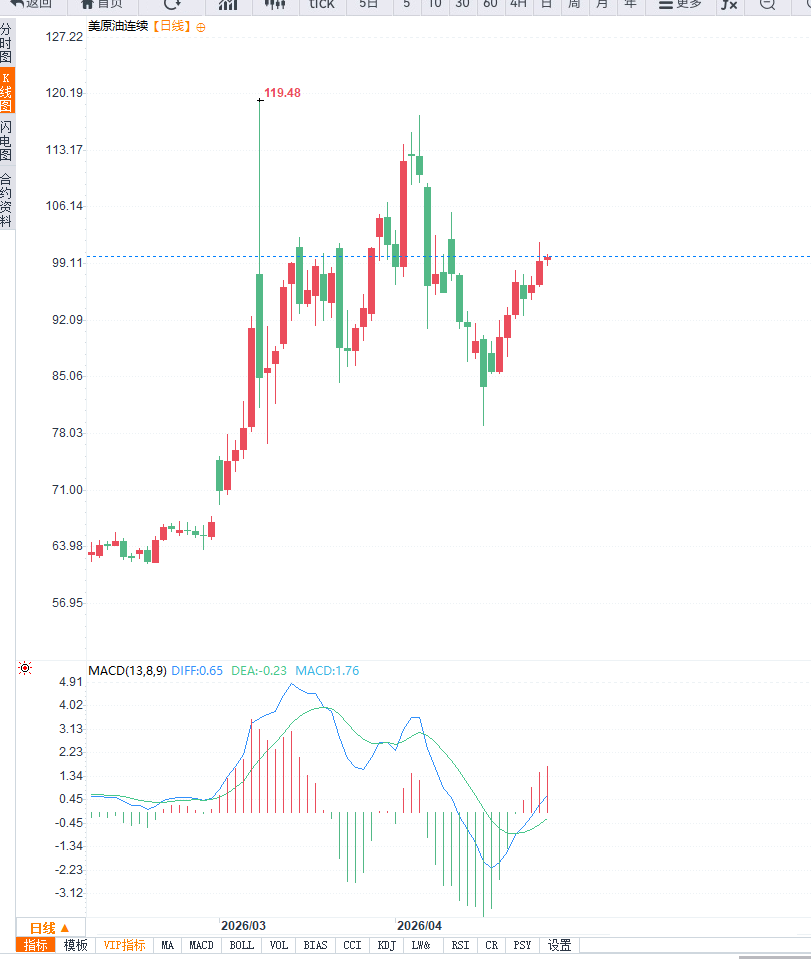
From a technical perspective, WTI crude oil is maintaining an upward trend on the daily chart, with prices consistently trading above key moving averages. $95 forms a significant support level, while $9105 represents a short-term resistance level. A break above this level could lead to a further push towards the $115 mark. Momentum-wise, bullish forces remain dominant, but indicators have entered overbought territory, suggesting a potential slowdown in the upward momentum. On the 4-hour chart, the short-term trend has entered a consolidation phase at higher levels, with prices fluctuating around $100 . The RSI is near neutral to slightly bullish. A decisive break above the upper limit of this range could lead to continued upward movement in the short term; otherwise, a pullback to confirm support is possible.
Editor's Summary : Overall, the current crude oil market is in a typical phase of "short-term supply shocks dominating, long-term structural reshaping brewing." The Strait of Hormuz blockade provides core support for short-term oil prices, while the UAE's withdrawal from OPEC introduces uncertainty into the medium- to long-term supply landscape. Future oil price trends will depend on the development of geopolitical tensions and the pace of supply recovery. In the short term, oil prices may remain volatile at high levels, but if transportation recovers and production increases, the market may face the risk of a phased correction; conversely, if the conflict continues, the upside potential for oil prices remains significant.
Several Wall Street institutions agree on a core assessment: short-term oil price fluctuations are limited, primarily due to the continued restriction of the Strait of Hormuz. It's important to emphasize that the Strait of Hormuz handles approximately 20% of global seaborne crude oil transport ; its obstruction directly limits the Gulf region's export capacity, making it difficult for oil-producing countries with the potential to increase production to quickly release it into the international market. This structural contradiction of "existing production capacity but inability to transport it" is a crucial support for maintaining high oil prices.
However, from a medium-term perspective, the market structure is undergoing potential changes. The UAE's exit from OPEC means it will no longer be subject to quota restrictions. Once geopolitical tensions ease and shipping returns to normal, the country could rapidly increase production, thus impacting global supply. As OPEC's third-largest oil producer, the UAE's policy shift will weaken the organization's overall production control, thereby undermining its role in regulating oil prices.
Meanwhile, supply and demand data are sending increasingly tense signals. A Goldman Sachs report points out that approximately 14.4 million barrels of crude oil supply per day in the Persian Gulf region is currently affected, driving global inventories to be depleted rapidly at a rate of 11 to 12 million barrels per day—a scale that even exceeds the daily consumption of some developed economies. From a supply and demand balance perspective, the market originally expected a supply surplus of approximately 1.8 million barrels per day in 2025, but based on the current rate of consumption, it is projected to turn into a supply deficit of approximately 9.4 million barrels per day by the second quarter of 2026, indicating a dramatic reversal in the supply and demand structure in a very short period.
At the macro level, geopolitical risks and policy uncertainties continue to affect market sentiment. Slow progress in negotiations between the United States and Iran has repeatedly delayed market expectations for a recovery in energy supplies.
Jefferies chief European economist Mohit Kumar said, "The longer the Strait of Hormuz is blocked, the greater the negative impact on the global economy will be."
Jim Reid, head of macro research at Deutsche Bank, noted: "The market has been catching any signals of a potential peace talks, and the lack of such signals is exacerbating concerns about a breakdown in negotiations."
Against this backdrop, several institutions have significantly raised their oil price forecast ranges. Goldman Sachs predicts that Brent crude oil prices in the fourth quarter of 2026 could diverge considerably depending on the scenario: if shipping resumes by mid-June, the average price could be below $80 ; if delayed until the end of July, the average price could exceed $100 ; and if shipping recovery is severely hampered, the price could approach $120 . Meanwhile, Bank of America offers a more aggressive assessment, predicting that in a scenario of "partial recovery" or continued conflict, the average Brent price could reach between $120 and $150 .
From a market sentiment perspective, investors are currently in a state of high uncertainty. On the one hand, supply disruptions are fueling bullish sentiment; on the other hand, the potential risk of supply releases is limiting further upside potential. This divergence has resulted in a market characterized by "high-level support but converging volatility," with funds more inclined towards short-term trading rather than long-term directional positioning.
From a technical perspective, WTI crude oil is maintaining an upward trend on the daily chart, with prices consistently trading above key moving averages. $95 forms a significant support level, while $9105 represents a short-term resistance level. A break above this level could lead to a further push towards the $115 mark. Momentum-wise, bullish forces remain dominant, but indicators have entered overbought territory, suggesting a potential slowdown in the upward momentum. On the 4-hour chart, the short-term trend has entered a consolidation phase at higher levels, with prices fluctuating around $100 . The RSI is near neutral to slightly bullish. A decisive break above the upper limit of this range could lead to continued upward movement in the short term; otherwise, a pullback to confirm support is possible.
Editor's Summary : Overall, the current crude oil market is in a typical phase of "short-term supply shocks dominating, long-term structural reshaping brewing." The Strait of Hormuz blockade provides core support for short-term oil prices, while the UAE's withdrawal from OPEC introduces uncertainty into the medium- to long-term supply landscape. Future oil price trends will depend on the development of geopolitical tensions and the pace of supply recovery. In the short term, oil prices may remain volatile at high levels, but if transportation recovers and production increases, the market may face the risk of a phased correction; conversely, if the conflict continues, the upside potential for oil prices remains significant.
- Risk Warning and Disclaimer
- The market involves risk, and trading may not be suitable for all investors. This article is for reference only and does not constitute personal investment advice, nor does it take into account certain users’ specific investment objectives, financial situation, or other needs. Any investment decisions made based on this information are at your own risk.