Demand for the US dollar as a safe haven, coupled with hawkish expectations from the Federal Reserve, kept the USD/JPY pair fluctuating at high levels.
2026-04-29 09:26:54
The USD/JPY pair traded in a narrow range around 159.50 during Wednesday's Asian trading session, continuing its consolidation pattern over the past month. Although the pair had previously rebounded from below 159.00 , upward momentum did not strengthen significantly, indicating that the market remains cautious ahead of key risk events.

The core factor driving exchange rate fluctuations remains the uncertainty surrounding the Middle East situation. The ongoing negotiations between the US and Iran have stalled, and market expectations for a ceasefire have cooled. Meanwhile, the issue of restricted shipping through the Strait of Hormuz continues to escalate. This waterway handles approximately 20% of global energy transport , and its blockade directly pushes up energy prices and exacerbates global inflation expectations. Against this backdrop, the US dollar's safe-haven status as the global reserve currency is strengthened, attracting capital inflows and thus supporting the USD/JPY exchange rate.
In contrast, the yen has been relatively weak. Despite the Bank of Japan's previous hawkish signals of maintaining its policy stance, the market reaction was limited, primarily due to the Japanese economy's heavy reliance on Middle Eastern energy. With energy supplies disrupted, Japan faces the dual pressures of imported inflation and slowing economic growth, which diminishes the yen's appeal. Furthermore, rising energy prices could negatively impact Japanese corporate costs and consumption, leading to market caution regarding the economic outlook.
On the policy front, the Federal Reserve is expected to keep interest rates unchanged at 3.50%-3.75% at its meeting this week, but the market is more focused on the future policy path. As rising oil prices may push inflation back up, market expectations have strengthened that the Fed will maintain high interest rates or even delay rate cuts, providing additional support for the dollar. Meanwhile, although the Bank of Japan is gradually signaling policy normalization, the actual pace of interest rate hikes remains relatively slow, keeping the Japan-US interest rate differential high and thus supporting the USD/JPY exchange rate at a high level.
However, the upside potential for the exchange rate remains somewhat limited. On the one hand, expectations of future interest rate hikes by the Bank of Japan persist, providing potential support for the yen; on the other hand, the market widely anticipates that Japanese authorities may intervene as the exchange rate approaches the 160 mark to curb excessive yen depreciation. Therefore, despite the fundamentals favoring a strong dollar, a one-sided breakout in the exchange rate is unlikely.
From a market sentiment perspective, investors are currently clearly in a wait-and-see mode. On the one hand, risk aversion and interest rate advantages support the US dollar; on the other hand, policy uncertainty and the risk of intervention limit further long positions, causing the exchange rate to exhibit the typical characteristics of "high-level fluctuations".
From a technical perspective, the USD/JPY pair maintains a high-level consolidation pattern on the daily chart, with the overall trend still bullish, but upward momentum has weakened. The price has been trading above the support zone of 157.50 for an extended period, indicating that the bullish structure remains intact. The 160.00 level forms a key psychological and technical resistance; a decisive break above this level could open up further upside potential to the 161.50 area. Looking at momentum indicators, the RSI is oscillating in the high range without a significant overbought pullback, suggesting the market is still in a strong consolidation phase, but upward momentum is insufficient.
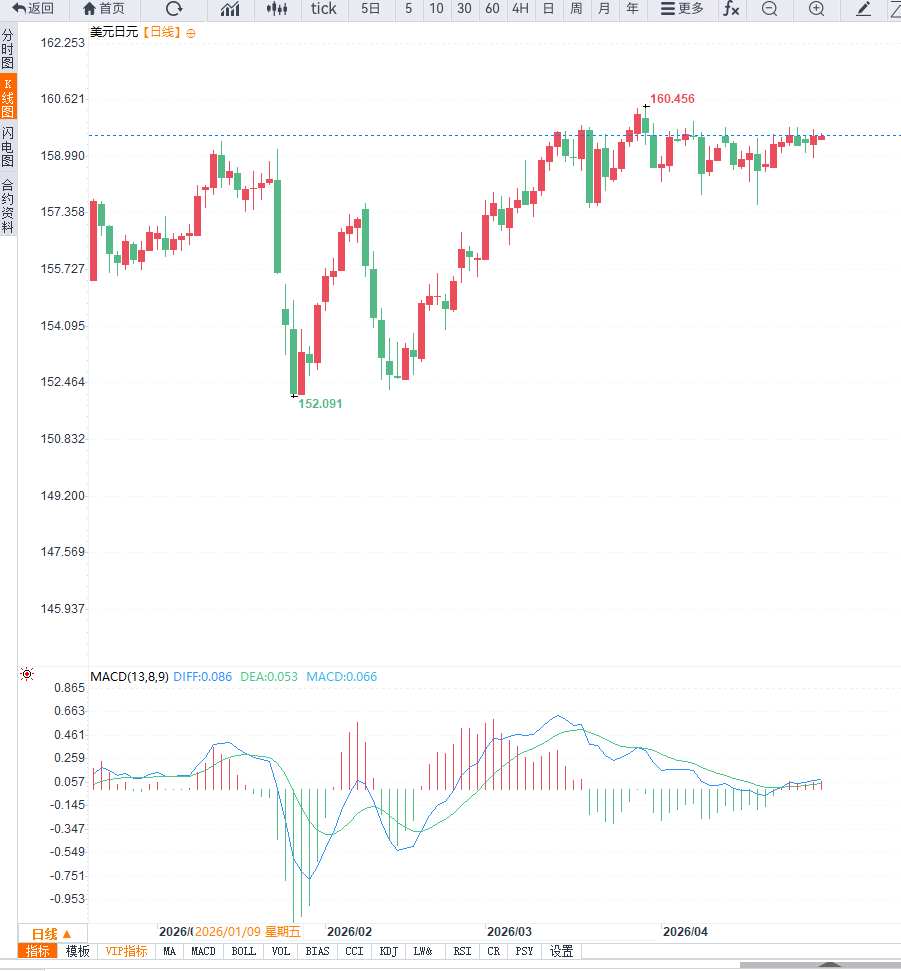
Editor's Summary : Overall, the USD/JPY exchange rate is currently in a phase of "coexisting fundamental support and policy constraints." The Middle East situation and energy risks are driving the dollar higher, while Japan's energy dependence is putting pressure on the yen. However, expectations surrounding the Bank of Japan's policy and potential currency intervention constitute significant resistance, making it difficult for the exchange rate to break through the 160 level. In the short term, the exchange rate may continue to fluctuate at high levels, and its future direction will depend on the Federal Reserve's policy signals and changes in the geopolitical situation.
The core factor driving exchange rate fluctuations remains the uncertainty surrounding the Middle East situation. The ongoing negotiations between the US and Iran have stalled, and market expectations for a ceasefire have cooled. Meanwhile, the issue of restricted shipping through the Strait of Hormuz continues to escalate. This waterway handles approximately 20% of global energy transport , and its blockade directly pushes up energy prices and exacerbates global inflation expectations. Against this backdrop, the US dollar's safe-haven status as the global reserve currency is strengthened, attracting capital inflows and thus supporting the USD/JPY exchange rate.
In contrast, the yen has been relatively weak. Despite the Bank of Japan's previous hawkish signals of maintaining its policy stance, the market reaction was limited, primarily due to the Japanese economy's heavy reliance on Middle Eastern energy. With energy supplies disrupted, Japan faces the dual pressures of imported inflation and slowing economic growth, which diminishes the yen's appeal. Furthermore, rising energy prices could negatively impact Japanese corporate costs and consumption, leading to market caution regarding the economic outlook.
On the policy front, the Federal Reserve is expected to keep interest rates unchanged at 3.50%-3.75% at its meeting this week, but the market is more focused on the future policy path. As rising oil prices may push inflation back up, market expectations have strengthened that the Fed will maintain high interest rates or even delay rate cuts, providing additional support for the dollar. Meanwhile, although the Bank of Japan is gradually signaling policy normalization, the actual pace of interest rate hikes remains relatively slow, keeping the Japan-US interest rate differential high and thus supporting the USD/JPY exchange rate at a high level.
However, the upside potential for the exchange rate remains somewhat limited. On the one hand, expectations of future interest rate hikes by the Bank of Japan persist, providing potential support for the yen; on the other hand, the market widely anticipates that Japanese authorities may intervene as the exchange rate approaches the 160 mark to curb excessive yen depreciation. Therefore, despite the fundamentals favoring a strong dollar, a one-sided breakout in the exchange rate is unlikely.
From a market sentiment perspective, investors are currently clearly in a wait-and-see mode. On the one hand, risk aversion and interest rate advantages support the US dollar; on the other hand, policy uncertainty and the risk of intervention limit further long positions, causing the exchange rate to exhibit the typical characteristics of "high-level fluctuations".
From a technical perspective, the USD/JPY pair maintains a high-level consolidation pattern on the daily chart, with the overall trend still bullish, but upward momentum has weakened. The price has been trading above the support zone of 157.50 for an extended period, indicating that the bullish structure remains intact. The 160.00 level forms a key psychological and technical resistance; a decisive break above this level could open up further upside potential to the 161.50 area. Looking at momentum indicators, the RSI is oscillating in the high range without a significant overbought pullback, suggesting the market is still in a strong consolidation phase, but upward momentum is insufficient.
Editor's Summary : Overall, the USD/JPY exchange rate is currently in a phase of "coexisting fundamental support and policy constraints." The Middle East situation and energy risks are driving the dollar higher, while Japan's energy dependence is putting pressure on the yen. However, expectations surrounding the Bank of Japan's policy and potential currency intervention constitute significant resistance, making it difficult for the exchange rate to break through the 160 level. In the short term, the exchange rate may continue to fluctuate at high levels, and its future direction will depend on the Federal Reserve's policy signals and changes in the geopolitical situation.
- Risk Warning and Disclaimer
- The market involves risk, and trading may not be suitable for all investors. This article is for reference only and does not constitute personal investment advice, nor does it take into account certain users’ specific investment objectives, financial situation, or other needs. Any investment decisions made based on this information are at your own risk.