Trump's secret meeting with oil giants, the potential long-term US military blockade of the Strait of Hormuz, Iran's threat of an "unprecedented" retaliation, and oil prices soaring.
2026-04-30 09:35:14
After diplomatic efforts to resolve the Iranian nuclear issue and shipping disputes stalled recently, US President Trump is accelerating a strategic plan aimed at imposing a long-term maritime blockade on Iran. According to media reports on April 30, Trump met with senior executives from several US oil companies at the White House on Tuesday (April 28). The two sides focused on how to extend the blockade of Iranian ports for several months if necessary, and to minimize the impact on the US domestic energy market and consumers.
Meanwhile, Trump posted a composite image on social media of himself holding a machine gun and wearing sunglasses, captioned "No more nice guy," and publicly urged Tehran to "wake up" and sign a so-called "non-nuclear agreement" as soon as possible. This series of actions indicates that the US government is attempting to exert maximum economic pressure on Iran to force it to reopen the Strait of Hormuz, while Tehran has responded with "unprecedented military action," escalating regional tensions dramatically.
This blockade plan, which has drawn global attention, originated from the US attempt to completely squeeze Iran's oil export capacity through maritime interception and port blockade, thereby forcing Iran to make concessions on shipping issues in the Strait of Hormuz. On Tuesday, Trump personally convened a closed-door meeting at the White House with executives from major US oil companies to discuss the potential global supply disruptions caused by the blockade and contingency plans.
A White House official told the media on Wednesday (April 29) that Trump and industry executives had "deep discussions about his measures to ease the global oil market, and contingency plans for the U.S. to maintain the current lockdown for months if necessary, minimizing the impact on American consumers." It is noteworthy that this meeting took place against the backdrop of a serious impasse in diplomatic efforts to resolve the Iranian conflict. Although Pakistan, as a mediator, is working to prevent escalation and continues to convey messages of a potential agreement between Washington and Tehran, the gap between the two sides on their core demands remains unbridged.
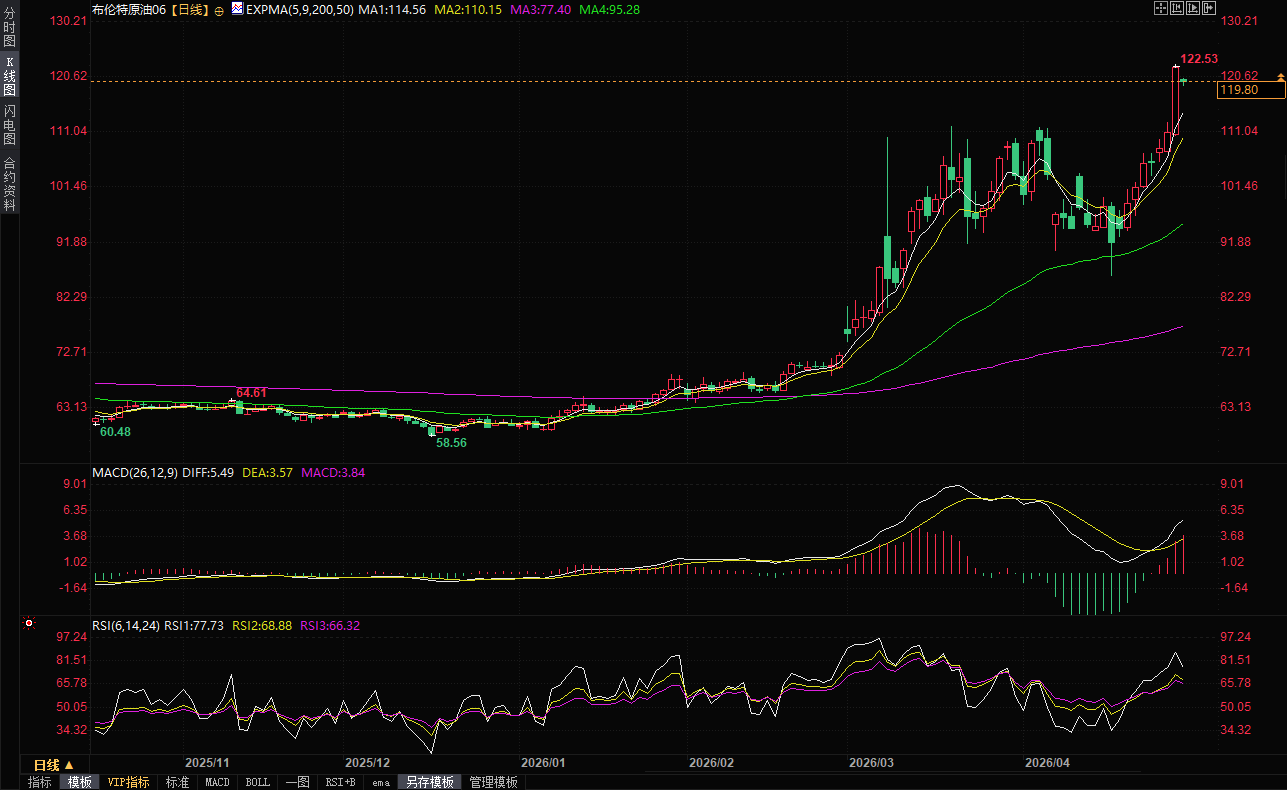
International crude oil markets experienced sharp fluctuations on Wednesday, influenced by both the potential for a prolonged U.S. blockade and the escalating risk of shipping disruptions in the Strait of Hormuz. Brent crude futures contracts surged more than 6% in a single day, reaching their highest level in nearly a month, with June Brent futures even rising to $122.5 per barrel, a near three-year high.
Analysts point out that the Strait of Hormuz is one of the world's most important oil shipping chokepoints. A prolonged blockade would not only directly impact Iranian oil exports but could also trigger a chain reaction affecting energy supplies throughout the Gulf region. Market concerns about supply disruptions have shifted from short-term event-driven to pricing in medium- to long-term structural risks, reflecting, to some extent, the rapidly fading expectations of a short-term compromise between the US and Iran.
On the diplomatic front, Trump continued his signature strategy of combining maximum pressure with social media rhetoric. Earlier on Wednesday, he posted on Truth Social, stating that Tehran "can't get things straight," accompanied by a visually striking composite image of Trump wearing sunglasses and holding a machine gun, with the caption "No more nice guy." In his post, he explicitly stated that Iran cannot possess nuclear weapons and urged Iranian leaders to "wake up as soon as possible" and sign a so-called "nuclear-free agreement."
However, Trump did not elaborate on the specific terms or negotiation framework of the agreement in this post, and this ambiguity has fueled widespread speculation about his true intentions. Some analysts believe that Trump may be attempting to reshape the tone of negotiations by unilaterally declaring some form of "victory," while White House intelligence agencies are currently assessing, at the request of senior officials, how Iran would react if the president suddenly declared a U.S. victory in the conflict with Iran.
Faced with the US's threats of blockade and its publicly humiliating social media propaganda, Iran's top leadership responded swiftly and forcefully. In an audio message posted on Telegram, Iranian Parliament Speaker and Chief Negotiator Ghalibaf stated that Trump's true intention was to divide the Iranian people and force Tehran to surrender unconditionally through continued economic sanctions. He emphasized, "There is only one solution to the enemy's new conspiracy: unity. Unity has always been the nemesis of all enemy conspiracies."
Meanwhile, Tehran issued a public warning on Wednesday that if the United States continues to blockade ships linked to Iran, Iran will retaliate with "unprecedented military action." Although Iran did not elaborate on the specifics of these military actions, given its past record of threatening to block the Strait of Hormuz, seizing foreign oil tankers, and launching drone and missile attacks, the international community is generally concerned about the risk of escalation.
Amid the open threats and private information exchanges between the US and Iran, a key procedural disagreement is hindering any possible breakthrough.
According to Pakistani sources involved in the mediation, Iran's latest proposed solution seeks to temporarily suspend further discussions on its nuclear program until the current conflict is formally ended and the shipping blockade is resolved. This implies that Tehran hopes to adopt a "ceasefire first, nuclear talks later" negotiation approach.
However, the Trump administration's position is exactly the opposite, demanding that Iran address the nuclear issue at the outset of negotiations as a precondition for lifting the blockade and resuming shipping. Due to this fundamental disagreement, the US has already relayed its "opinions" regarding Iran's proposals, and the ball is now back in Iran's court.
Pakistani sources say Iran has requested time until the end of this week before making a further response.
Meanwhile, two U.S. officials and a source familiar with the matter told the media that, at the request of senior government officials, U.S. intelligence agencies are urgently studying a hypothetical scenario: what response strategy Tehran would adopt if Trump unilaterally declared that the United States had achieved victory in the conflict with Iran. The results of this study are likely to directly influence Trump's next phase of diplomatic and military decisions.
In conclusion, the US's long-term blockade plan against Iran has moved from strategic conception to the operational level. The Trump administration is attempting to force Tehran to make concessions on the nuclear issue and shipping disputes through a three-pronged approach: pressure in the oil market, military deterrence, and a social media propaganda war. However, Iran has not only demonstrated a high degree of internal unity but has also used "unprecedented military action" as leverage, while adhering to the diplomatic principle of "resolving the crisis first, then discussing nuclear issues." With Pakistan's mediation efforts stalled and US intelligence agencies conducting risk assessments for a "unilateral declaration of victory," the US-Iran standoff is highly likely to enter a more dangerous and unpredictable new phase in the coming weeks and even days.
Question 1: Why did the United States impose a months-long maritime blockade on Iranian ports ?
A: The direct goal of this US blockade is to squeeze Iran's oil exports, thereby forcing Iran to reopen the Strait of Hormuz. The Strait of Hormuz is the vital route for approximately one-fifth of the world's oil shipments, and Iran has repeatedly threatened to close it as a retaliatory measure. The US believes that a prolonged blockade can sever Iran's economic lifeline, thereby gaining absolute dominance in nuclear negotiations.
Question 2: What exactly does Trump mean by the "non-nuclear agreement" he has mentioned repeatedly? Is its content clear?
A: As of now, Trump has not provided any detailed explanation of the specific terms of a "non-nuclear agreement." Based on his public statements, his core demand is an agreement that can completely limit or eliminate Iran's nuclear program, and the nuclear issue must be placed at the forefront of any reconciliation measures with Iran. However, Iran believes that the most pressing issue is ending the shipping blockade and military conflict, and the nuclear issue can be discussed later. This dispute over procedural priorities is the key sticking point of the diplomatic deadlock.
Question 3: What means might Iran's so-called "unprecedented military operation" include?
A: Based on Iran's past military strategies and regional capabilities, such actions could include, but are not limited to: laying numerous mines in the Strait of Hormuz, using drones or missiles to attack merchant ships or warships affiliated with the United States, seizing foreign oil tankers sailing in the Persian Gulf as hostages, and even potentially launching long-range strikes against US allies such as Saudi Arabia and the UAE through proxies like the Houthi rebels in Yemen. Iran's warning is intended to increase the cost of US military adventurism.
Question 4: What role does Pakistan play between the US and Iran? Why is Pakistan chosen as the mediator?
A: Pakistan is an influential Islamic country in the Middle East and South Asia, sharing a land border with Iran and a long history of security cooperation with the United States. Given the lack of direct communication channels between the Trump administration and Iran, Pakistan has proactively acted as a mediator and de-escalator, relaying written and verbal messages of potential agreements between Tehran and Washington. Currently, mediation is stalled because the two sides cannot agree on the negotiation process.
Question 5: What information is the US intelligence agencies investigating regarding Trump's unilateral declaration of victory?
A: The core assumption of this study is: if Trump suddenly and publicly announces that the US has won the conflict with Iran by imposing sanctions and pressure, without reaching a concrete agreement with Iran, what kind of chain reaction would occur from the Iranian leadership, military, and domestic public opinion? Intelligence agencies need to assess the possible retaliatory measures Iran might take (such as terrorist attacks, missile strikes, or escalation of sanctions) and their potential threats to US troops stationed in the Middle East, allies, and even homeland security, thereby providing a risk assessment for Trump's decision-making.
At 09:31 Beijing time, the Brent crude oil futures contract was trading at $110.85 per barrel.
Meanwhile, Trump posted a composite image on social media of himself holding a machine gun and wearing sunglasses, captioned "No more nice guy," and publicly urged Tehran to "wake up" and sign a so-called "non-nuclear agreement" as soon as possible. This series of actions indicates that the US government is attempting to exert maximum economic pressure on Iran to force it to reopen the Strait of Hormuz, while Tehran has responded with "unprecedented military action," escalating regional tensions dramatically.
White House closed-door meeting: Oil giants participate in discussions on the feasibility of a long-term blockade.
This blockade plan, which has drawn global attention, originated from the US attempt to completely squeeze Iran's oil export capacity through maritime interception and port blockade, thereby forcing Iran to make concessions on shipping issues in the Strait of Hormuz. On Tuesday, Trump personally convened a closed-door meeting at the White House with executives from major US oil companies to discuss the potential global supply disruptions caused by the blockade and contingency plans.
A White House official told the media on Wednesday (April 29) that Trump and industry executives had "deep discussions about his measures to ease the global oil market, and contingency plans for the U.S. to maintain the current lockdown for months if necessary, minimizing the impact on American consumers." It is noteworthy that this meeting took place against the backdrop of a serious impasse in diplomatic efforts to resolve the Iranian conflict. Although Pakistan, as a mediator, is working to prevent escalation and continues to convey messages of a potential agreement between Washington and Tehran, the gap between the two sides on their core demands remains unbridged.
Oil market reacts sharply: Brent crude oil hits new monthly high.
International crude oil markets experienced sharp fluctuations on Wednesday, influenced by both the potential for a prolonged U.S. blockade and the escalating risk of shipping disruptions in the Strait of Hormuz. Brent crude futures contracts surged more than 6% in a single day, reaching their highest level in nearly a month, with June Brent futures even rising to $122.5 per barrel, a near three-year high.
Analysts point out that the Strait of Hormuz is one of the world's most important oil shipping chokepoints. A prolonged blockade would not only directly impact Iranian oil exports but could also trigger a chain reaction affecting energy supplies throughout the Gulf region. Market concerns about supply disruptions have shifted from short-term event-driven to pricing in medium- to long-term structural risks, reflecting, to some extent, the rapidly fading expectations of a short-term compromise between the US and Iran.
Trump's "non-nuclear agreement" red lines and social media offensive
On the diplomatic front, Trump continued his signature strategy of combining maximum pressure with social media rhetoric. Earlier on Wednesday, he posted on Truth Social, stating that Tehran "can't get things straight," accompanied by a visually striking composite image of Trump wearing sunglasses and holding a machine gun, with the caption "No more nice guy." In his post, he explicitly stated that Iran cannot possess nuclear weapons and urged Iranian leaders to "wake up as soon as possible" and sign a so-called "nuclear-free agreement."
However, Trump did not elaborate on the specific terms or negotiation framework of the agreement in this post, and this ambiguity has fueled widespread speculation about his true intentions. Some analysts believe that Trump may be attempting to reshape the tone of negotiations by unilaterally declaring some form of "victory," while White House intelligence agencies are currently assessing, at the request of senior officials, how Iran would react if the president suddenly declared a U.S. victory in the conflict with Iran.
Tehran's Counterattack: Unity is the Nemesis, Military Operation Unprecedented
Faced with the US's threats of blockade and its publicly humiliating social media propaganda, Iran's top leadership responded swiftly and forcefully. In an audio message posted on Telegram, Iranian Parliament Speaker and Chief Negotiator Ghalibaf stated that Trump's true intention was to divide the Iranian people and force Tehran to surrender unconditionally through continued economic sanctions. He emphasized, "There is only one solution to the enemy's new conspiracy: unity. Unity has always been the nemesis of all enemy conspiracies."
Meanwhile, Tehran issued a public warning on Wednesday that if the United States continues to blockade ships linked to Iran, Iran will retaliate with "unprecedented military action." Although Iran did not elaborate on the specifics of these military actions, given its past record of threatening to block the Strait of Hormuz, seizing foreign oil tankers, and launching drone and missile attacks, the international community is generally concerned about the risk of escalation.
The timetable dispute in the diplomatic deadlock: nuclear talks first or suspension of flights first?
Amid the open threats and private information exchanges between the US and Iran, a key procedural disagreement is hindering any possible breakthrough.
According to Pakistani sources involved in the mediation, Iran's latest proposed solution seeks to temporarily suspend further discussions on its nuclear program until the current conflict is formally ended and the shipping blockade is resolved. This implies that Tehran hopes to adopt a "ceasefire first, nuclear talks later" negotiation approach.
However, the Trump administration's position is exactly the opposite, demanding that Iran address the nuclear issue at the outset of negotiations as a precondition for lifting the blockade and resuming shipping. Due to this fundamental disagreement, the US has already relayed its "opinions" regarding Iran's proposals, and the ball is now back in Iran's court.
Pakistani sources say Iran has requested time until the end of this week before making a further response.
Meanwhile, two U.S. officials and a source familiar with the matter told the media that, at the request of senior government officials, U.S. intelligence agencies are urgently studying a hypothetical scenario: what response strategy Tehran would adopt if Trump unilaterally declared that the United States had achieved victory in the conflict with Iran. The results of this study are likely to directly influence Trump's next phase of diplomatic and military decisions.
Summary
In conclusion, the US's long-term blockade plan against Iran has moved from strategic conception to the operational level. The Trump administration is attempting to force Tehran to make concessions on the nuclear issue and shipping disputes through a three-pronged approach: pressure in the oil market, military deterrence, and a social media propaganda war. However, Iran has not only demonstrated a high degree of internal unity but has also used "unprecedented military action" as leverage, while adhering to the diplomatic principle of "resolving the crisis first, then discussing nuclear issues." With Pakistan's mediation efforts stalled and US intelligence agencies conducting risk assessments for a "unilateral declaration of victory," the US-Iran standoff is highly likely to enter a more dangerous and unpredictable new phase in the coming weeks and even days.
Frequently Asked Questions
Question 1: Why did the United States impose a months-long maritime blockade on Iranian ports ?
A: The direct goal of this US blockade is to squeeze Iran's oil exports, thereby forcing Iran to reopen the Strait of Hormuz. The Strait of Hormuz is the vital route for approximately one-fifth of the world's oil shipments, and Iran has repeatedly threatened to close it as a retaliatory measure. The US believes that a prolonged blockade can sever Iran's economic lifeline, thereby gaining absolute dominance in nuclear negotiations.
Question 2: What exactly does Trump mean by the "non-nuclear agreement" he has mentioned repeatedly? Is its content clear?
A: As of now, Trump has not provided any detailed explanation of the specific terms of a "non-nuclear agreement." Based on his public statements, his core demand is an agreement that can completely limit or eliminate Iran's nuclear program, and the nuclear issue must be placed at the forefront of any reconciliation measures with Iran. However, Iran believes that the most pressing issue is ending the shipping blockade and military conflict, and the nuclear issue can be discussed later. This dispute over procedural priorities is the key sticking point of the diplomatic deadlock.
Question 3: What means might Iran's so-called "unprecedented military operation" include?
A: Based on Iran's past military strategies and regional capabilities, such actions could include, but are not limited to: laying numerous mines in the Strait of Hormuz, using drones or missiles to attack merchant ships or warships affiliated with the United States, seizing foreign oil tankers sailing in the Persian Gulf as hostages, and even potentially launching long-range strikes against US allies such as Saudi Arabia and the UAE through proxies like the Houthi rebels in Yemen. Iran's warning is intended to increase the cost of US military adventurism.
Question 4: What role does Pakistan play between the US and Iran? Why is Pakistan chosen as the mediator?
A: Pakistan is an influential Islamic country in the Middle East and South Asia, sharing a land border with Iran and a long history of security cooperation with the United States. Given the lack of direct communication channels between the Trump administration and Iran, Pakistan has proactively acted as a mediator and de-escalator, relaying written and verbal messages of potential agreements between Tehran and Washington. Currently, mediation is stalled because the two sides cannot agree on the negotiation process.
Question 5: What information is the US intelligence agencies investigating regarding Trump's unilateral declaration of victory?
A: The core assumption of this study is: if Trump suddenly and publicly announces that the US has won the conflict with Iran by imposing sanctions and pressure, without reaching a concrete agreement with Iran, what kind of chain reaction would occur from the Iranian leadership, military, and domestic public opinion? Intelligence agencies need to assess the possible retaliatory measures Iran might take (such as terrorist attacks, missile strikes, or escalation of sanctions) and their potential threats to US troops stationed in the Middle East, allies, and even homeland security, thereby providing a risk assessment for Trump's decision-making.
At 09:31 Beijing time, the Brent crude oil futures contract was trading at $110.85 per barrel.
- Risk Warning and Disclaimer
- The market involves risk, and trading may not be suitable for all investors. This article is for reference only and does not constitute personal investment advice, nor does it take into account certain users’ specific investment objectives, financial situation, or other needs. Any investment decisions made based on this information are at your own risk.