The Fed's hawkish signals have strengthened interest rate expectations, supporting the dollar, which is expected to maintain a volatile rebound in the short term.
2026-04-30 11:00:57
The US dollar index traded around 98.95 in Asian trading on Thursday, maintaining a high level after the Federal Reserve's policy meeting. The core driver of this movement was the hawkish signals from the Fed, which prompted the market to reassess the future path of interest rates, thus supporting the overall performance of the dollar.
The Federal Reserve voted 8-4 at its latest meeting to keep interest rates unchanged at 3.50%-3.75% , marking its most divided meeting since 1992. Several officials opposed further easing, indicating a significant internal disagreement on policy direction. This structural uncertainty has reinforced market expectations of "high interest rates remaining for a longer period," thus supporting the US dollar index.
At his final meeting as Federal Reserve Chairman Jerome Powell, the Fed governor stated that short-term inflation expectations are rising and emphasized that he will continue to serve on the Fed's board of governors for some time. This statement was interpreted by the market as indicating that policy continuity will be maintained, but also suggesting that future policy adjustments may be more cautious. Against this backdrop, the attractiveness of the US dollar as a high-interest-rate asset has further increased.
From a market expectation perspective, traders have now repriced the probability of future rate hikes to approximately 55% (as of the April 2027 meeting), a significant increase from around 20% before the policy decision. This change reflects the market's gradual acceptance of a longer-term tightening environment, thus providing medium-term support for the US dollar index.
Furthermore, market focus is shifting to the upcoming release of the preliminary US Q1 GDP figures and the March core PCE price index. If the data shows both economic growth and inflation strengthening, it will reinforce the logic of "high interest rates for longer," further boosting the dollar; conversely, if the data falls short of expectations, it could lead to a short-term pullback in the dollar.
From a fundamental perspective, the US economy continues to demonstrate resilience, with stable business investment and consumer activity maintaining the dollar's advantageous position in global asset allocation. Meanwhile, persistent geopolitical risks also provide for the dollar's safe-haven appeal in the short term.
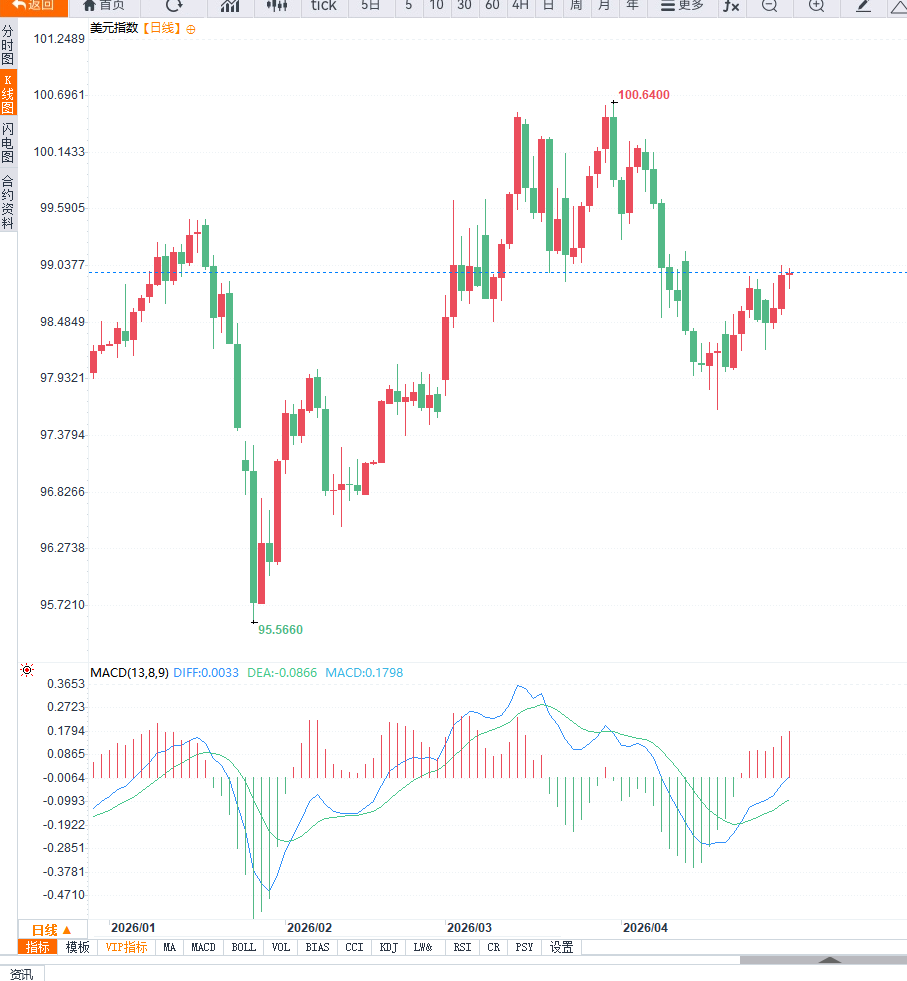
From a technical perspective, the US dollar index maintains a slightly bullish, oscillating pattern on the daily chart. After breaking out of the previous range, the price stabilized above 98.50 and is currently trading within the 98.80-99.20 range. Short-term resistance levels are at 99.50 and the psychological level of 100.00 ; a decisive break above these levels would open up further upside potential. Support levels to watch are the 98.50 and 98.00 area; a break below these levels could lead to a pullback to the previous consolidation platform.
On the 4-hour chart, the DXY indicator shows a high-level consolidation structure, with the moving average system converging, indicating that the market has entered a data-driven phase. The RSI indicator is in the neutral-to-strong zone, suggesting that bullish momentum remains but lacks further breakthrough potential. Short-term price action is more likely to fluctuate around 99, awaiting direction from macroeconomic data.
Editor's Summary:
The US dollar index is currently in a phase of interplay between policy expectations and economic data. The Federal Reserve's hawkish stance has strengthened medium-term support for the dollar, but its short-term trajectory still depends on the upcoming GDP and PCE data. If the data remains strong, the dollar may strengthen further and test the 100 level; if the data falls short of expectations, it could trigger a period of pullback. Overall, the DXY index maintains a slightly bullish, oscillating pattern, but its directional direction still awaits confirmation from the data.
The Federal Reserve voted 8-4 at its latest meeting to keep interest rates unchanged at 3.50%-3.75% , marking its most divided meeting since 1992. Several officials opposed further easing, indicating a significant internal disagreement on policy direction. This structural uncertainty has reinforced market expectations of "high interest rates remaining for a longer period," thus supporting the US dollar index.
At his final meeting as Federal Reserve Chairman Jerome Powell, the Fed governor stated that short-term inflation expectations are rising and emphasized that he will continue to serve on the Fed's board of governors for some time. This statement was interpreted by the market as indicating that policy continuity will be maintained, but also suggesting that future policy adjustments may be more cautious. Against this backdrop, the attractiveness of the US dollar as a high-interest-rate asset has further increased.
From a market expectation perspective, traders have now repriced the probability of future rate hikes to approximately 55% (as of the April 2027 meeting), a significant increase from around 20% before the policy decision. This change reflects the market's gradual acceptance of a longer-term tightening environment, thus providing medium-term support for the US dollar index.
Furthermore, market focus is shifting to the upcoming release of the preliminary US Q1 GDP figures and the March core PCE price index. If the data shows both economic growth and inflation strengthening, it will reinforce the logic of "high interest rates for longer," further boosting the dollar; conversely, if the data falls short of expectations, it could lead to a short-term pullback in the dollar.
From a fundamental perspective, the US economy continues to demonstrate resilience, with stable business investment and consumer activity maintaining the dollar's advantageous position in global asset allocation. Meanwhile, persistent geopolitical risks also provide for the dollar's safe-haven appeal in the short term.
From a technical perspective, the US dollar index maintains a slightly bullish, oscillating pattern on the daily chart. After breaking out of the previous range, the price stabilized above 98.50 and is currently trading within the 98.80-99.20 range. Short-term resistance levels are at 99.50 and the psychological level of 100.00 ; a decisive break above these levels would open up further upside potential. Support levels to watch are the 98.50 and 98.00 area; a break below these levels could lead to a pullback to the previous consolidation platform.
On the 4-hour chart, the DXY indicator shows a high-level consolidation structure, with the moving average system converging, indicating that the market has entered a data-driven phase. The RSI indicator is in the neutral-to-strong zone, suggesting that bullish momentum remains but lacks further breakthrough potential. Short-term price action is more likely to fluctuate around 99, awaiting direction from macroeconomic data.
Editor's Summary:
The US dollar index is currently in a phase of interplay between policy expectations and economic data. The Federal Reserve's hawkish stance has strengthened medium-term support for the dollar, but its short-term trajectory still depends on the upcoming GDP and PCE data. If the data remains strong, the dollar may strengthen further and test the 100 level; if the data falls short of expectations, it could trigger a period of pullback. Overall, the DXY index maintains a slightly bullish, oscillating pattern, but its directional direction still awaits confirmation from the data.
- Risk Warning and Disclaimer
- The market involves risk, and trading may not be suitable for all investors. This article is for reference only and does not constitute personal investment advice, nor does it take into account certain users’ specific investment objectives, financial situation, or other needs. Any investment decisions made based on this information are at your own risk.