A stronger US dollar coupled with uncertainty surrounding central bank policies weighed on the British pound, causing GBP/USD to fall below the 1.3500 level.
2026-04-30 09:57:18
The pound weakened significantly against the dollar during Thursday's Asian trading session and is currently trading around 1.3480. Overall, the exchange rate has broken below the key psychological level of 1.3500 , indicating a clear shift in short-term market sentiment towards caution.
This decline was primarily driven by three factors. First, market research showed that hawkish rhetoric from US President Donald Trump pushed international oil prices sharply higher, with Brent crude briefly surpassing $110 per barrel , reinforcing market risk aversion and thus boosting demand for the US dollar. Second, while the Federal Reserve maintained interest rates at the 3.50%-3.75% range, the vote was 8-4 , one of the most severe divisions in decades, signaling uncertainty about the policy path. Finally, hawkish comments from Federal Reserve Chairman Jerome Powell at his press conference pushed the yield on the 10-year US Treasury bond above 4.4% , further enhancing the attractiveness of the US dollar.
Market focus quickly shifted to the "super window" of key data from the Bank of England and the US. The Bank of England will announce its interest rate decision and meeting minutes, with the market widely expecting it to keep the rate unchanged at 3.75% , but the voting outcome is a key variable. If multiple members support a rate hike, it could provide short-term support for the pound. However, the market has already priced in about 60 basis points of rate hikes this year, meaning that even with hawkish signals, the pound's upside potential may be limited.
Meanwhile, concerns are growing about the risk of stagflation in the UK economy. Most economists believe that the current economic environment presents both inflationary pressures and slowing growth, a trend exacerbated by rising energy prices. If the Bank of England emphasizes downside risks to the economy rather than inflation in its policy statement, it could weaken market confidence in interest rate hikes, thus putting pressure on the pound.
In the US, the upcoming core PCE price index, GDP data, and employment cost index will be key determinants of exchange rate direction. The market expects core PCE to rise to 3.2% year-on-year, and GDP to grow at an annualized rate of approximately 2.3% . Strong data would reinforce expectations that the Federal Reserve will maintain high interest rates, pushing the US dollar further higher and thus suppressing GBP/USD to test lower levels.
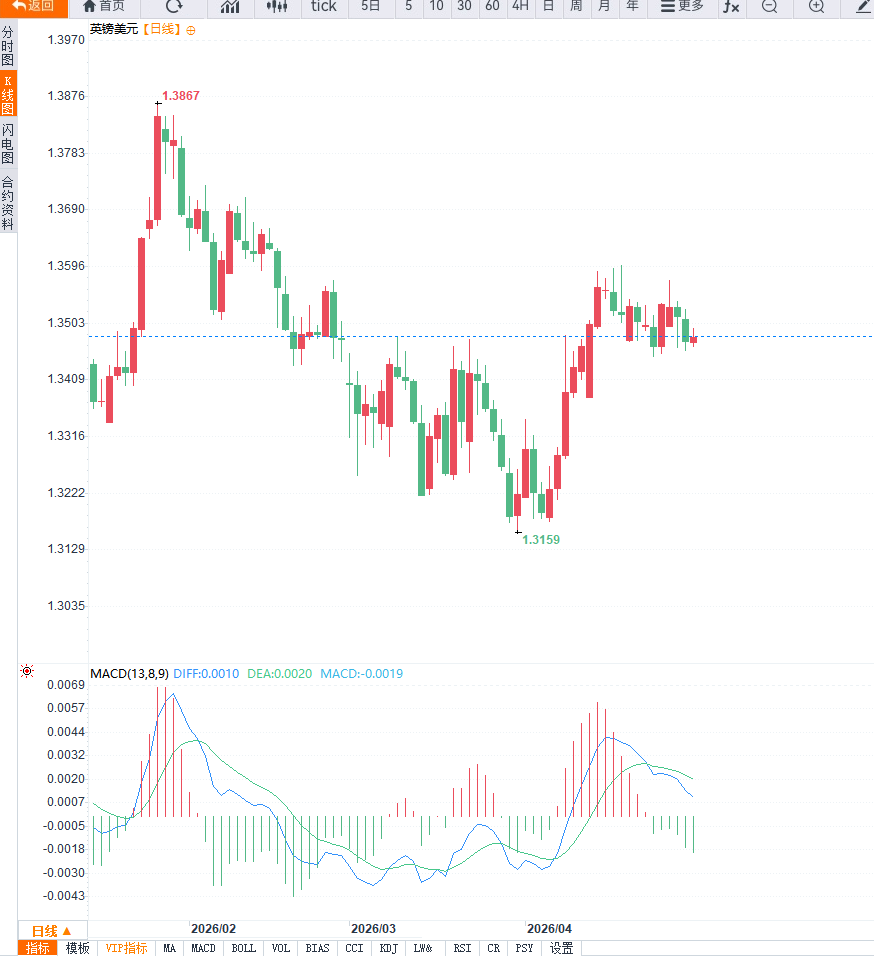
From a technical perspective, the GBP/USD daily chart remains within a range-bound pattern, but has clearly weakened in the short term. The exchange rate previously formed a high near 1.3570 and has now retreated to the lower half of the range. Currently, the price is still trading above the 50-day moving average at 1.3440 and the 200-day moving average at 1.3380 , indicating that the medium-term trend has not completely turned bearish, but short-term downward pressure is significant. A break below 1.3440 would open further downside potential to the 1.3380 and even the 1.3300 area.
From the 4-hour chart, the exchange rate has formed a clear downward channel, with the highs consistently moving lower, indicating that the bears are gradually gaining the upper hand. Short-term resistance is concentrated in the 1.3525-1.3560 range; if this level cannot be broken effectively, any rebound will be considered a correction. In terms of momentum indicators, the RSI is in a neutral to weak range and has not yet entered an extremely oversold state, suggesting further downside potential.
Editor's Summary:
The current GBP/USD exchange rate movement reflects a market dominated by the US dollar. With the Federal Reserve maintaining high interest rates and risk aversion rising, the pound is under significant short-term pressure. Although the Bank of England may release some hawkish signals, the market has already priced this in, limiting its upside potential. In the short term, the exchange rate may continue to fluctuate weakly within the 1.34-1.36 range, with its future direction depending on policy signals from the UK and the US, as well as inflation data.
This decline was primarily driven by three factors. First, market research showed that hawkish rhetoric from US President Donald Trump pushed international oil prices sharply higher, with Brent crude briefly surpassing $110 per barrel , reinforcing market risk aversion and thus boosting demand for the US dollar. Second, while the Federal Reserve maintained interest rates at the 3.50%-3.75% range, the vote was 8-4 , one of the most severe divisions in decades, signaling uncertainty about the policy path. Finally, hawkish comments from Federal Reserve Chairman Jerome Powell at his press conference pushed the yield on the 10-year US Treasury bond above 4.4% , further enhancing the attractiveness of the US dollar.
Market focus quickly shifted to the "super window" of key data from the Bank of England and the US. The Bank of England will announce its interest rate decision and meeting minutes, with the market widely expecting it to keep the rate unchanged at 3.75% , but the voting outcome is a key variable. If multiple members support a rate hike, it could provide short-term support for the pound. However, the market has already priced in about 60 basis points of rate hikes this year, meaning that even with hawkish signals, the pound's upside potential may be limited.
Meanwhile, concerns are growing about the risk of stagflation in the UK economy. Most economists believe that the current economic environment presents both inflationary pressures and slowing growth, a trend exacerbated by rising energy prices. If the Bank of England emphasizes downside risks to the economy rather than inflation in its policy statement, it could weaken market confidence in interest rate hikes, thus putting pressure on the pound.
In the US, the upcoming core PCE price index, GDP data, and employment cost index will be key determinants of exchange rate direction. The market expects core PCE to rise to 3.2% year-on-year, and GDP to grow at an annualized rate of approximately 2.3% . Strong data would reinforce expectations that the Federal Reserve will maintain high interest rates, pushing the US dollar further higher and thus suppressing GBP/USD to test lower levels.
From a technical perspective, the GBP/USD daily chart remains within a range-bound pattern, but has clearly weakened in the short term. The exchange rate previously formed a high near 1.3570 and has now retreated to the lower half of the range. Currently, the price is still trading above the 50-day moving average at 1.3440 and the 200-day moving average at 1.3380 , indicating that the medium-term trend has not completely turned bearish, but short-term downward pressure is significant. A break below 1.3440 would open further downside potential to the 1.3380 and even the 1.3300 area.
From the 4-hour chart, the exchange rate has formed a clear downward channel, with the highs consistently moving lower, indicating that the bears are gradually gaining the upper hand. Short-term resistance is concentrated in the 1.3525-1.3560 range; if this level cannot be broken effectively, any rebound will be considered a correction. In terms of momentum indicators, the RSI is in a neutral to weak range and has not yet entered an extremely oversold state, suggesting further downside potential.
Editor's Summary:
The current GBP/USD exchange rate movement reflects a market dominated by the US dollar. With the Federal Reserve maintaining high interest rates and risk aversion rising, the pound is under significant short-term pressure. Although the Bank of England may release some hawkish signals, the market has already priced this in, limiting its upside potential. In the short term, the exchange rate may continue to fluctuate weakly within the 1.34-1.36 range, with its future direction depending on policy signals from the UK and the US, as well as inflation data.
- Risk Warning and Disclaimer
- The market involves risk, and trading may not be suitable for all investors. This article is for reference only and does not constitute personal investment advice, nor does it take into account certain users’ specific investment objectives, financial situation, or other needs. Any investment decisions made based on this information are at your own risk.