With the average U.S. gasoline price nearing $4.20 per gallon, Venezuelan crude oil will ease pressure on oil prices.
2026-04-30 13:17:49
According to data released by the American Automobile Association (AAA) on April 28, the average gasoline price across the United States is currently $4.17 per gallon. This price is 15 cents higher than a week ago and $1.02 higher than the average price at the same time last year, representing a year-on-year increase of 32%. Amid the escalating conflict between the United States and Iran, pressure on oil prices has intensified significantly.
President Trump recently stated that he expects higher gasoline prices to persist at least until the midterm elections in November.
Gasoline retail prices are primarily determined by crude oil costs, which typically account for 40% to 70% of the final price at gas stations. Currently, the international Brent crude oil price is around $110 per barrel, while the day before the US and Israel launched military action against Iran, the Brent crude oil price was only $70.75 per barrel, representing a surge of 56%.
According to data from the U.S. Energy Information Administration, the United States is the world's largest oil producer, with a daily output of 21.91 million barrels, followed by Saudi Arabia with 11.13 million barrels per day, and Russia with 10.75 million barrels per day.
The United States imports a relatively small proportion of crude oil from the Middle East, accounting for only about 8% in 2025. Although a severe energy shortage is unlikely in the United States due to the ongoing conflict with Iran, the significant rise in international oil prices will continue to have a direct impact on domestic gasoline prices in the United States.
However, according to Chevron (NYSE:CVX) executives, U.S. gasoline prices might have been even higher if the U.S. hadn't recently begun importing large quantities of Venezuelan crude oil.
Chevron is currently the only U.S. oil company operating in Venezuela, and it continues to ship tankers fully loaded with crude oil to its Pascagoula refinery in Mississippi. The refinery has a maximum daily processing capacity of 330,000 barrels and can process heavy Venezuelan crude oil, converting it into various end products such as gasoline, diesel, jet fuel, liquefied petroleum gas, and petroleum coke.
Andy Walz, president of Chevron’s downstream, midstream and chemical businesses, said that there had been a period when Chevron was unable to obtain Venezuelan crude oil.
He said, "We are currently processing about 100,000 barrels a day, and this shipment will last us about four days. This tanker is helping to lower oil prices in the United States because we have gained a new source of supply that we didn't have before."
When asked what would happen to gasoline prices without these tankers from Venezuela, Andy Waltz said, "I don't want to say too much, but our costs would definitely be higher. Reduced supply means higher prices."
He further pointed out that although acquiring crude oil from Venezuela (which has the world's largest oil reserves) has not yet led to an immediate drop in gasoline prices, as the United States is also strongly affected by fluctuations in the global oil market, Chevron believes that this strategy will ultimately benefit American consumers.
Walz said, "Once the situation returns to normal, the increased oil supply from Venezuela will truly translate into lower oil prices for American consumers. So there will be a positive impact in the future, but that impact is not yet fully apparent."
He added that Chevron plans to increase Venezuelan oil production by about 50% in the coming years. Currently, the company imports the equivalent of 250,000 barrels of Venezuelan crude oil per day; with a 50% increase, daily imports will rise to 350,000 to 400,000 barrels.
Venezuelan oil production is gradually recovering after President Nicolas Maduro was arrested and taken to the United States for trial on charges related to drugs and terrorism.
Despite possessing approximately 17% of the world's oil reserves, Venezuela currently accounts for only about 1% of global oil production due to its long-standing aging infrastructure. However, in March of this year, Venezuela's oil exports reached 1 million barrels per day for the first time since September of last year.
Multiple institutions estimate that Venezuela will need to raise more than $100 billion over the next decade to effectively restore its oil production capacity. Maintaining a production level of 1.1 million barrels per day would require an investment of over $50 billion; increasing production to 3 million barrels per day would require approximately $183 billion.
Francisco Monaldi, director of the Latin American Energy Program at Rice University’s Baker Institute for Public Policy, believes that the most optimistic scenario for Venezuelan oil production is that it will gradually increase from nearly 1 million barrels per day at the end of last year to about 1.2 million barrels per day by the end of 2026.
Venezuela has now passed a new law opening its oil sector to foreign investment, and momentum is gradually building. Chevron has agreed to expand its largest project in the Orinoco Heavy Oil Belt; Shell (NYSE:SHEL) plans to develop gas-rich areas both onshore and offshore; and ExxonMobil (NYSE:XOM) also plans to send a small team to Venezuela for assessment.
At the same time, the oilfield services company has begun mobilizing drilling rigs and specialized equipment that have been stored in warehouses for a long time in preparation for potential new projects.
Currently, the average price of gasoline in the United States has risen to $4.17 per gallon, a significant increase of 32% compared to the same period last year. President Trump expects this high oil price trend to continue at least until the midterm elections in November. The 56% increase in international Brent crude oil prices is the main driver, while the United States' low dependence on Middle Eastern crude oil, although reducing the risk of supply disruptions, still cannot completely isolate it from the impact of global oil price fluctuations.
Against this backdrop, crude oil imported by Chevron from Venezuela is playing a buffering role. Executives like Andy Waltz believe that while the short-term easing effect on oil prices is limited, as Venezuelan production gradually recovers and attracts more international investment, this increased supply is expected to bring lower gasoline prices to American consumers in the future.
However, Venezuela's infrastructure reconstruction requires enormous funds, and production recovery still faces numerous challenges. The future trend of US gasoline prices will depend on the development of the Iranian conflict, changes in global crude oil supply and demand, and the actual progress of Venezuela's oil production increase.
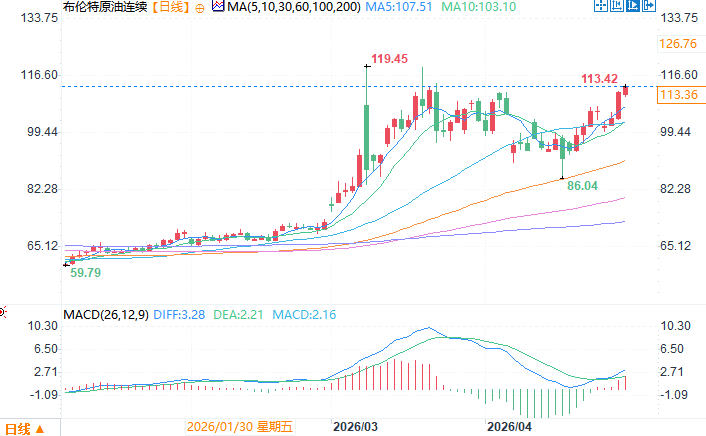
Brent crude oil daily chart source: EasyForex
At 12:08 Beijing time on April 30, Brent crude oil futures were trading at $113.42 per barrel.
President Trump recently stated that he expects higher gasoline prices to persist at least until the midterm elections in November.
The surge in crude oil prices directly pushed up terminal oil prices.
Gasoline retail prices are primarily determined by crude oil costs, which typically account for 40% to 70% of the final price at gas stations. Currently, the international Brent crude oil price is around $110 per barrel, while the day before the US and Israel launched military action against Iran, the Brent crude oil price was only $70.75 per barrel, representing a surge of 56%.
According to data from the U.S. Energy Information Administration, the United States is the world's largest oil producer, with a daily output of 21.91 million barrels, followed by Saudi Arabia with 11.13 million barrels per day, and Russia with 10.75 million barrels per day.
The United States imports a relatively small proportion of crude oil from the Middle East, accounting for only about 8% in 2025. Although a severe energy shortage is unlikely in the United States due to the ongoing conflict with Iran, the significant rise in international oil prices will continue to have a direct impact on domestic gasoline prices in the United States.
Chevron executive: Venezuelan crude oil is easing pressure on US oil prices.
However, according to Chevron (NYSE:CVX) executives, U.S. gasoline prices might have been even higher if the U.S. hadn't recently begun importing large quantities of Venezuelan crude oil.
Chevron is currently the only U.S. oil company operating in Venezuela, and it continues to ship tankers fully loaded with crude oil to its Pascagoula refinery in Mississippi. The refinery has a maximum daily processing capacity of 330,000 barrels and can process heavy Venezuelan crude oil, converting it into various end products such as gasoline, diesel, jet fuel, liquefied petroleum gas, and petroleum coke.
Andy Walz, president of Chevron’s downstream, midstream and chemical businesses, said that there had been a period when Chevron was unable to obtain Venezuelan crude oil.
He said, "We are currently processing about 100,000 barrels a day, and this shipment will last us about four days. This tanker is helping to lower oil prices in the United States because we have gained a new source of supply that we didn't have before."
When asked what would happen to gasoline prices without these tankers from Venezuela, Andy Waltz said, "I don't want to say too much, but our costs would definitely be higher. Reduced supply means higher prices."
He further pointed out that although acquiring crude oil from Venezuela (which has the world's largest oil reserves) has not yet led to an immediate drop in gasoline prices, as the United States is also strongly affected by fluctuations in the global oil market, Chevron believes that this strategy will ultimately benefit American consumers.
Walz said, "Once the situation returns to normal, the increased oil supply from Venezuela will truly translate into lower oil prices for American consumers. So there will be a positive impact in the future, but that impact is not yet fully apparent."
He added that Chevron plans to increase Venezuelan oil production by about 50% in the coming years. Currently, the company imports the equivalent of 250,000 barrels of Venezuelan crude oil per day; with a 50% increase, daily imports will rise to 350,000 to 400,000 barrels.
Venezuelan oil production is slowly recovering.
Venezuelan oil production is gradually recovering after President Nicolas Maduro was arrested and taken to the United States for trial on charges related to drugs and terrorism.
Despite possessing approximately 17% of the world's oil reserves, Venezuela currently accounts for only about 1% of global oil production due to its long-standing aging infrastructure. However, in March of this year, Venezuela's oil exports reached 1 million barrels per day for the first time since September of last year.
Multiple institutions estimate that Venezuela will need to raise more than $100 billion over the next decade to effectively restore its oil production capacity. Maintaining a production level of 1.1 million barrels per day would require an investment of over $50 billion; increasing production to 3 million barrels per day would require approximately $183 billion.
Francisco Monaldi, director of the Latin American Energy Program at Rice University’s Baker Institute for Public Policy, believes that the most optimistic scenario for Venezuelan oil production is that it will gradually increase from nearly 1 million barrels per day at the end of last year to about 1.2 million barrels per day by the end of 2026.
Venezuela has now passed a new law opening its oil sector to foreign investment, and momentum is gradually building. Chevron has agreed to expand its largest project in the Orinoco Heavy Oil Belt; Shell (NYSE:SHEL) plans to develop gas-rich areas both onshore and offshore; and ExxonMobil (NYSE:XOM) also plans to send a small team to Venezuela for assessment.
At the same time, the oilfield services company has begun mobilizing drilling rigs and specialized equipment that have been stored in warehouses for a long time in preparation for potential new projects.
High oil prices are unlikely to ease in the short term, with Venezuelan supply becoming a key variable.
Currently, the average price of gasoline in the United States has risen to $4.17 per gallon, a significant increase of 32% compared to the same period last year. President Trump expects this high oil price trend to continue at least until the midterm elections in November. The 56% increase in international Brent crude oil prices is the main driver, while the United States' low dependence on Middle Eastern crude oil, although reducing the risk of supply disruptions, still cannot completely isolate it from the impact of global oil price fluctuations.
Against this backdrop, crude oil imported by Chevron from Venezuela is playing a buffering role. Executives like Andy Waltz believe that while the short-term easing effect on oil prices is limited, as Venezuelan production gradually recovers and attracts more international investment, this increased supply is expected to bring lower gasoline prices to American consumers in the future.
However, Venezuela's infrastructure reconstruction requires enormous funds, and production recovery still faces numerous challenges. The future trend of US gasoline prices will depend on the development of the Iranian conflict, changes in global crude oil supply and demand, and the actual progress of Venezuela's oil production increase.
Brent crude oil daily chart source: EasyForex
At 12:08 Beijing time on April 30, Brent crude oil futures were trading at $113.42 per barrel.
- Risk Warning and Disclaimer
- The market involves risk, and trading may not be suitable for all investors. This article is for reference only and does not constitute personal investment advice, nor does it take into account certain users’ specific investment objectives, financial situation, or other needs. Any investment decisions made based on this information are at your own risk.