The yen surged 500 points! Behind the short-selling stampede: Was there any intervention or not?
2026-04-30 20:59:24
On Thursday, April 30th, the USD/JPY exchange rate experienced unusually sharp fluctuations during the Asian trading session. After reaching a high of 160.721, the rate quickly fell by more than 500 points, currently trading around 156.70, a single-day drop of over 2%. This unusual movement occurred after Japanese Finance Minister Katayama and currency diplomat Mimura issued their strongest warnings, instantly escalating market speculation about possible intervention. Simultaneously, liquidity shortages during the Asian session further amplified the price swings. The US dollar index also fell to 98.45, and oil prices retreated after a brief rise in the morning, indicating a clear correlation among multiple assets.
Japanese Finance Minister Katayama clearly stated before 4:00 PM Beijing time that the time for "decisive action" was approaching. Subsequently, currency diplomat Jun Mimura issued a "final warning" in Tokyo, emphasizing, "If you want to escape, listen carefully," and revealed that he was maintaining 24/7 contact with his US counterparts, hinting at trans-Pacific coordinated support. Following the warning, the exchange rate plummeted from 159.50 to 157.80 within minutes, triggering a large number of short-selling stop-loss orders and causing a significant spike in trading volume in a low-liquidity environment.
Several international institutional strategists offered their professional interpretations of the causes of this volatility. Kamal Sharma, Senior FX Strategist for the Americas at Bank of England, noted, "We cannot be certain whether it was actual intervention, but the market's sense of urgency regarding intervention significantly increased this morning." Francesco Pesole, Currency Strategist at ING, believes this is more of an exaggerated reaction to warnings than direct market intervention, adding, "Some European and British traders may have closed their short yen positions ahead of the holidays." Kenneth Brooks, Strategist at Société Générale, judged, "This certainly looks like intervention, and it has triggered short covering." Hirofumi Suzuki, Chief FX Strategist at Sumitomo Mitsui Banking Corporation, emphasized, "Whether there was actual intervention is unclear, but the key fact is that the exchange rate fluctuated sharply after the authorities' tough stance."
Given the thin trading volume during Asian sessions and the upcoming Golden Week holiday, such verbal warnings often have unexpected positive effects. Historical experience shows that when exchange rates approach the key psychological level of 160, verbal intervention in a low-liquidity window can easily trigger a chain reaction, leading to short-term overshooting. Currently, the market remains uncertain, and the USD/JPY exchange rate is expected to show a more pronounced correction in the short term.
The key data comparison for the day is as follows:
Federal Reserve Chairman Jerome Powell kept interest rates unchanged at his final policy meeting in office, with a split vote of 8-4, the most divided since 1992, as three officials opposed continuing to convey an accommodative bias. This decision comes amid rising inflation concerns, highlighting a clear internal division on the future path of the Federal Reserve. His successor, Kevin Warsh, will officially take over on May 15th. The market had previously expected him to push for rate cuts, but Warsh has not made any explicit commitments.
While the Japan-US interest rate differential remains at a certain level, it has been offset in the short term by warnings from Japanese officials. Oil prices rose in early trading but then fell back, easing some of the imported pressure on the yen, while the dollar is currently under overall pressure. Although geopolitical tensions and oil price volatility had previously supported safe-haven demand for the dollar, the current decline has provided relative support for the yen. Analysts point out that if the Federal Reserve's signals become clearer in the future, interest rate differentials may regain dominance, but the current hawkish stance of the Japanese authorities has altered the short-term pricing logic.
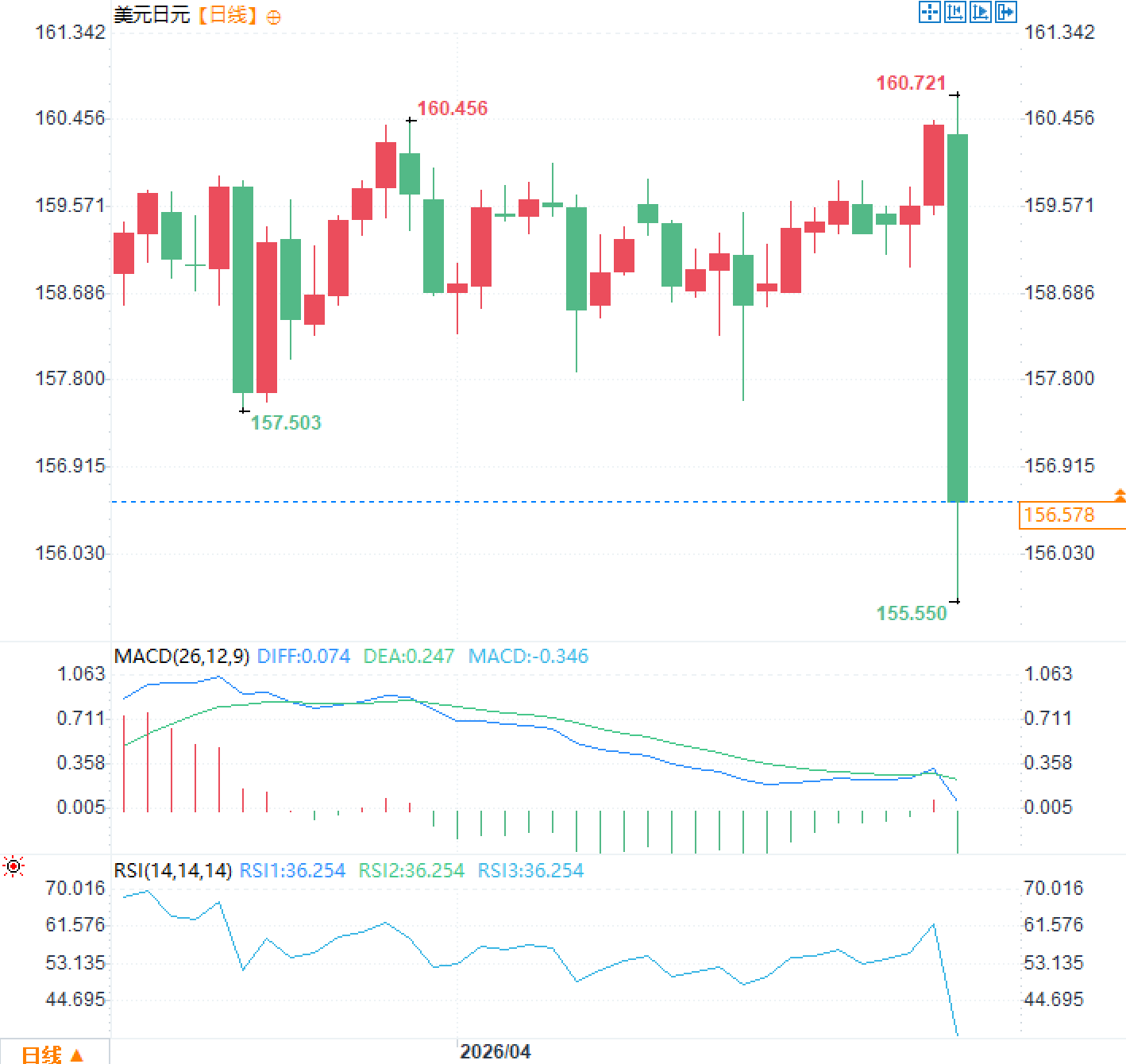
From a technical chart perspective, the USD/JPY pair formed a long bearish candlestick during the day, briefly dipping to around 155.550. The RSI (14) indicator fell to 36.254, indicating that it is approaching oversold territory in the short term, but selling momentum remains strong. The MACD indicator shows DIFF at 0.074, DEA at 0.247, and MACD at -0.346, with the histogram turning negative, confirming a trend reversal signal. Key support levels are concentrated in the 156.50-157.00 range, and once it returns above 160, the probability of actual intervention will increase significantly.
In terms of market sentiment, option pricing indicates that short-term bullish sentiment towards the yen has reached its strongest level since early March. Driven by both profit-taking and short covering, current volatility is likely to remain high. Japanese authorities have made it clear that they will continue to monitor the market during Golden Week, and will not let their guard down even if trading is thin during the holiday. Without further concrete action, the exchange rate may enter a consolidation phase; conversely, any attempt to break through 160 could trigger a new round of warnings or stronger measures.
Background and Market Reaction to Japan's Official Warning
Japanese Finance Minister Katayama clearly stated before 4:00 PM Beijing time that the time for "decisive action" was approaching. Subsequently, currency diplomat Jun Mimura issued a "final warning" in Tokyo, emphasizing, "If you want to escape, listen carefully," and revealed that he was maintaining 24/7 contact with his US counterparts, hinting at trans-Pacific coordinated support. Following the warning, the exchange rate plummeted from 159.50 to 157.80 within minutes, triggering a large number of short-selling stop-loss orders and causing a significant spike in trading volume in a low-liquidity environment.
Several international institutional strategists offered their professional interpretations of the causes of this volatility. Kamal Sharma, Senior FX Strategist for the Americas at Bank of England, noted, "We cannot be certain whether it was actual intervention, but the market's sense of urgency regarding intervention significantly increased this morning." Francesco Pesole, Currency Strategist at ING, believes this is more of an exaggerated reaction to warnings than direct market intervention, adding, "Some European and British traders may have closed their short yen positions ahead of the holidays." Kenneth Brooks, Strategist at Société Générale, judged, "This certainly looks like intervention, and it has triggered short covering." Hirofumi Suzuki, Chief FX Strategist at Sumitomo Mitsui Banking Corporation, emphasized, "Whether there was actual intervention is unclear, but the key fact is that the exchange rate fluctuated sharply after the authorities' tough stance."
Given the thin trading volume during Asian sessions and the upcoming Golden Week holiday, such verbal warnings often have unexpected positive effects. Historical experience shows that when exchange rates approach the key psychological level of 160, verbal intervention in a low-liquidity window can easily trigger a chain reaction, leading to short-term overshooting. Currently, the market remains uncertain, and the USD/JPY exchange rate is expected to show a more pronounced correction in the short term.
The key data comparison for the day is as follows:
| index | numerical values | change |
|---|---|---|
| USD/JPY intraday high | 160.721 | - |
| Latest exchange rate of USD to JPY | 156.72 | It fell by about 2.2%. |
| US Dollar Index | 98.45 | Down 0.5% |
| Euro against the US dollar | 1.17 | Up 0.16% |
Federal Reserve policy divergence and macroeconomic factors
Federal Reserve Chairman Jerome Powell kept interest rates unchanged at his final policy meeting in office, with a split vote of 8-4, the most divided since 1992, as three officials opposed continuing to convey an accommodative bias. This decision comes amid rising inflation concerns, highlighting a clear internal division on the future path of the Federal Reserve. His successor, Kevin Warsh, will officially take over on May 15th. The market had previously expected him to push for rate cuts, but Warsh has not made any explicit commitments.
While the Japan-US interest rate differential remains at a certain level, it has been offset in the short term by warnings from Japanese officials. Oil prices rose in early trading but then fell back, easing some of the imported pressure on the yen, while the dollar is currently under overall pressure. Although geopolitical tensions and oil price volatility had previously supported safe-haven demand for the dollar, the current decline has provided relative support for the yen. Analysts point out that if the Federal Reserve's signals become clearer in the future, interest rate differentials may regain dominance, but the current hawkish stance of the Japanese authorities has altered the short-term pricing logic.
Technical Signals and Short-Term Risk Outlook
From a technical chart perspective, the USD/JPY pair formed a long bearish candlestick during the day, briefly dipping to around 155.550. The RSI (14) indicator fell to 36.254, indicating that it is approaching oversold territory in the short term, but selling momentum remains strong. The MACD indicator shows DIFF at 0.074, DEA at 0.247, and MACD at -0.346, with the histogram turning negative, confirming a trend reversal signal. Key support levels are concentrated in the 156.50-157.00 range, and once it returns above 160, the probability of actual intervention will increase significantly.
In terms of market sentiment, option pricing indicates that short-term bullish sentiment towards the yen has reached its strongest level since early March. Driven by both profit-taking and short covering, current volatility is likely to remain high. Japanese authorities have made it clear that they will continue to monitor the market during Golden Week, and will not let their guard down even if trading is thin during the holiday. Without further concrete action, the exchange rate may enter a consolidation phase; conversely, any attempt to break through 160 could trigger a new round of warnings or stronger measures.
Frequently Asked Questions
Question 1: Why did the USD/JPY exchange rate experience a single-day drop of over 500 points today?
A: The core driver was the strong warnings from Japanese Finance Minister Katayama and currency diplomat Mimura, who clearly stated that "the time for decisive action is approaching" and issued "final advice," hinting at coordination with the US. With extremely low liquidity during the Asian session and the eve of the Golden Week holiday, traders panicked and closed out their short yen positions, triggering a chain reaction of stop-loss orders. Multiple strategists confirmed that while no actual intervention was confirmed, verbal intervention was significantly amplified in the thin trading environment, leading to an overshooting pullback.
Question 2: Has the Bank of Japan or the Ministry of Finance actually intervened in the market?
A: There has been no official confirmation yet, and the market is highly skeptical but lacks sufficient evidence. Sharma, Americas strategist at Bank of England, stated, "It's impossible to determine whether there has been intervention, but the urgency to intervene is evident." ING's Pessolai believes it's more like an exaggerated reaction triggered by a warning than direct action. Societe Generale's Brooks judged that "it certainly looks like intervention and has triggered a pullback." The key point is that if the exchange rate approaches 160 again, the risk of actual intervention will rise sharply; historical cases show that such warnings often precede concrete action.
Question 3: What impact will the divergence in Federal Reserve policies have on the future trend of the Japanese yen?
A: Powell's final meeting saw an 8-4 vote to keep interest rates unchanged, indicating significant internal disagreement on the path of easing. While his successor, Warsh, who took over on May 15th, was expected by the market to push for rate cuts, he did not commit to any such cuts. Interest rate differentials are currently overshadowed by warnings from Japan, and falling oil prices further support the yen. The USD/JPY pair is expected to maintain a corrective trend in the short term. If the Fed's signals become clearer, interest rate differentials may regain dominance, but continued monitoring by Japanese authorities will limit upside potential.
- Risk Warning and Disclaimer
- The market involves risk, and trading may not be suitable for all investors. This article is for reference only and does not constitute personal investment advice, nor does it take into account certain users’ specific investment objectives, financial situation, or other needs. Any investment decisions made based on this information are at your own risk.